Quick Summary
New York City’s subscription-cancellation rule takes effect on October 1, 2026. It covers automatic-renewal and continuous-service offers and requires businesses to provide a simple cancellation method that is as easy to use—and uses the same medium—as the method the consumer used to sign up.
This is a New York City rule, not a new nationwide federal requirement. It also does not mean every cancellation must literally finish with one click. The legal test focuses on comparable ease, the same signup medium, access through every medium a business accepts for consent, and the absence of unreasonable obstacles or delays.
The rule also adds disclosure and notice duties. It requires advance notice for certain long-term renewals, material changes such as price increases, and free trials lasting more than a month. Some financial, banking, alarm, franchised, and service-contract businesses are exempt.
Reader Decision
If you cancel a covered subscription on or after October 1, begin with the medium you used to enroll. Save the cancellation page, confirmation, date, and any later charge. If the company forces you into a harder channel, delays the request, or keeps billing after your first attempt, preserve the evidence and consider filing a complaint with NYC’s Department of Consumer and Worker Protection.
What Changes on October 1
The NYC Department of Consumer and Worker Protection adopted rules covering paid subscriptions and purchasing agreements that either renew automatically after a definite term or continue until the consumer cancels.
Before asking for consent or billing information, a covered business must clearly present material terms. These include what is being renewed, the amount and frequency of charges, the deadline for stopping future charges, and the available cancellation mechanisms. A free gift, free trial, or temporary price must also explain when the price changes and what will later be charged.
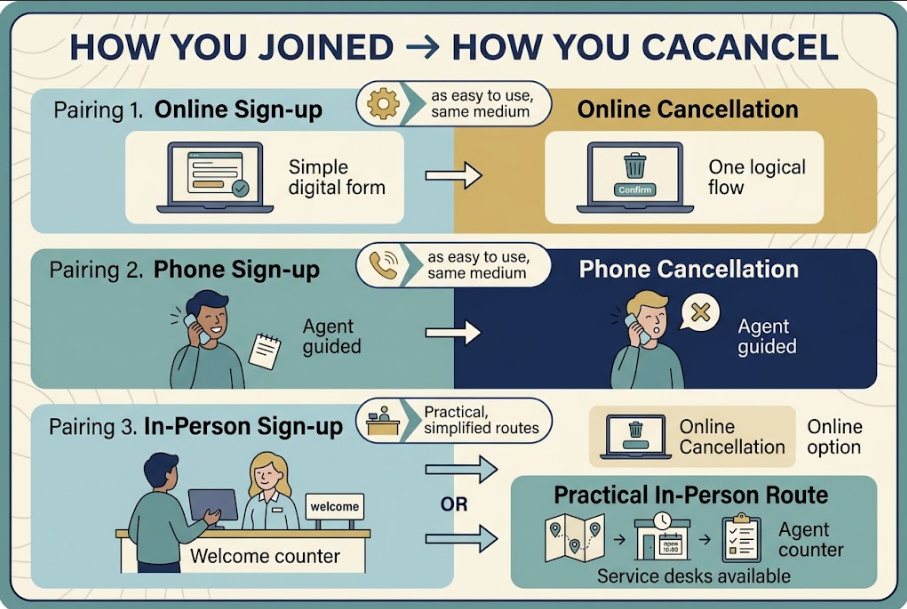
The rule then connects enrollment to cancellation. A consumer must be able to cancel at any time through a simple mechanism that is as easy as the mechanism used to consent and is available through the same medium. A business must also offer cancellation through every medium it allows consumers to use to accept the subscription or a price increase.
For example, a company that accepts online consent cannot make the only exit a telephone call or store visit. If consent was obtained in person, the company must offer online cancellation, such as a website or email, as well as a similar in-person method where practical.
“Click to Cancel” Does Not Always Mean One Literal Click
The public name captures the purpose, but the adopted text does not promise that every subscription ends after exactly one mouse click.
The operative standards are “simple,” “as easy to use,” and “through the same medium.” A business may need enough information to identify the account or explain a legitimate consequence, such as the date paid access ends. What it may not do is impose unreasonable or unlawful conditions, refuse to acknowledge the request, obstruct it, or unreasonably delay it.
Examples include hanging up on a caller, hiding or falsifying instructions, and misrepresenting cancellation costs, consequences, or delays. A retention offer is permitted only if it does not obstruct or unreasonably delay cancellation.
Which Renewal Notices Are Required?
The rule does more than regulate the cancellation screen.
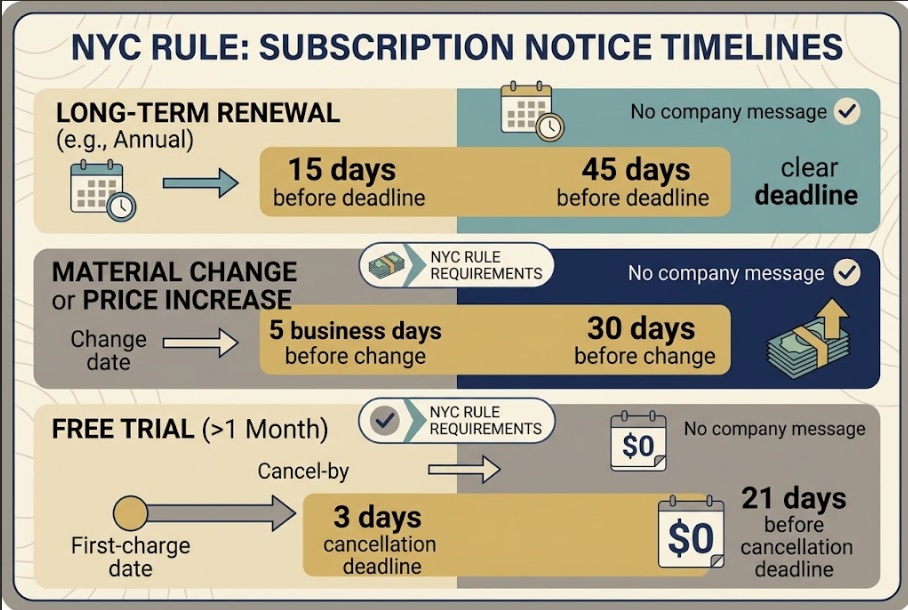
For an initial paid term of at least one year that renews for a paid term of at least six months, the business must send a renewal-charge notice 15 to 45 days before the cancellation deadline. It must use a notification method selected by the consumer—such as text, email, or an app notification—and include cancellation instructions.
For a material change to an accepted subscription, including a price increase, the business must provide clear notice at least five business days and no more than 30 days before the change.
When a free gift or trial lasts more than one month and will be followed by the first charge, the business must notify the consumer three to 21 days before the cancellation deadline and explain how to cancel.
These windows are not interchangeable. A one-year renewal, a price change, and the end of a long free trial trigger different timelines.
Which Subscriptions Are Covered—and Which Are Exempt?
The rule is broad by product type: it applies to goods or services that meet its definitions of automatic renewal or continuous service. That can include recurring digital services, memberships, product shipments, and other ongoing purchasing arrangements.
But it contains express exemptions. They include certain services provided under a franchise issued by a New York political subdivision; entities regulated by the New York State Department of Financial Services and their subsidiaries or affiliates; licensed security-system alarm operators; banks, credit unions, and other state- or federally licensed financial institutions; and sellers or administrators of qualifying service contracts under New York insurance law.
The final rule did not create a blanket telecommunications exemption. Coverage still depends on the business, product, transaction, and other law; not every recurring charge is necessarily covered.
The adopted text also does not state that only subscriptions first purchased after October 1 qualify. The effective date clearly controls when the new city requirements begin, but the published materials reviewed for this article do not answer every transition question about older contracts. For an existing subscription, document any cancellation attempt made on or after October 1 and ask DCWP if the company disputes coverage.
What If Unrequested Products Arrive?
If a business sends goods under an automatic-renewal or continuous-service arrangement without first obtaining the consumer’s affirmative consent, the rule treats those goods as an unconditional gift. The consumer may use or dispose of them without an obligation to pay or bear return-shipping responsibility.
That is narrower than a rule allowing someone to keep any disputed delivery. It applies when the required affirmative consent was not obtained. Keep the original offer, order history, package label, and communication before disputing the shipment or charge.
How to Build a Useful Cancellation Record
Before starting, save the offer terms and identify how you originally enrolled. Then:
- Use the cancellation method connected to the signup medium.
- Capture each screen or record the call date, time, number, and representative.
- Save the final confirmation, confirmation number, and stated end date.
- Check the next card or bank statement for another charge.
- If billing continues, preserve the first cancellation attempt and later correspondence.
The first-attempt date matters. The rule makes a violator potentially liable for restitution equal to amounts charged after the consumer’s first cancellation attempt. DCWP can also seek civil penalties, beginning at $525 for a first violation and increasing for repeat violations.
Blocking a payment method may not cancel the agreement. Use the official cancellation path where possible, then address unauthorized later billing with the payment provider.
How to File a NYC Complaint
DCWP says consumers can file subscription complaints beginning October 1. Complaints may be submitted online, through 311, by phone, or by mail or fax. The city asks consumers to include supporting documents and provides a complaint number. DCWP may review the materials, send the complaint to the business, or use a mediator.
The process does not guarantee an immediate refund or a finding that the rule applies. It gives the agency evidence to evaluate an undisclosed renewal, forced channel change, delay, or later billing.
The Practical Takeaway
NYC’s new rule makes the route out of a covered subscription part of the original bargain. The business must disclose recurring terms before consent, preserve an equally easy cancellation path in the same medium, and avoid turning retention efforts into obstruction.
For consumers, the most important habit is evidentiary: know how you joined, cancel through that channel, and preserve the first attempt. October 1 is the enforcement starting point—not a reason to assume every subscription everywhere follows the same rule or every exit must take exactly one click.
This newsletter provides general consumer information, not legal advice. Coverage and remedies can depend on the business, subscription, transaction location, contract, and other law. Confirm current guidance with NYC DCWP or a qualified adviser.
FAQ
Does the NYC rule take effect before October 1, 2026?
No. The adopted rule takes effect October 1, 2026, and DCWP says subscription complaints under the new rule can be filed beginning that day.
Must every covered subscription cancel in exactly one click?
Not necessarily. The rule requires a simple method that is as easy to use and uses the same medium as the consumer’s consent. It prohibits unreasonable obstacles and delays.
Can an online subscription require a phone call to cancel?
A business that accepts online consent must provide cancellation through that online medium. A phone-only exit would not satisfy the same-medium requirement for that enrollment.
Does the rule apply nationwide because the company sells nationwide?
No. This is a New York City rule. Whether it governs a particular consumer transaction requires a city-jurisdiction and coverage analysis.
Are subscriptions purchased before October 1 covered?
The adopted materials do not clearly resolve every transition scenario. Document cancellation attempts made on or after October 1 and ask DCWP if a business disputes applicability.
What proof should I keep after cancelling?
Keep the signup method, cancellation screens or call details, confirmation number, stated end date, correspondence, and statements showing any later charge.
Sources
- NYC Department of Consumer and Worker Protection — Click to Cancel
- NYC DCWP — New Laws and Rules
- NYC Rules — Cancellation of Subscriptions
- NYC DCWP — Notice of Adoption: Cancellation of Subscriptions