Quick Answer
Choose a vacuum for the floors you actually have, not for the largest wattage, the longest feature list, or one impressive demonstration. First inventory the home: bare floors, low- or high-pile carpet, delicate rugs, stairs, edges, upholstery, hair, large debris, and any flooring warranty requirements. Then look for the controls and tools that let one machine clean those surfaces without damaging them.
For a mixed-floor home, useful capabilities often include a brush roll that can be switched off, a bare-floor tool with non-scratching wheels or glides, adjustable height or suction for carpet and rugs, and attachments you can comfortably use on stairs and edges. If dust containment matters, evaluate the entire collection and exhaust system—not merely a “HEPA” filter label. Finally, handle the machine, change its settings and attachments, check filter and bag costs, and confirm the return policy. The best vacuum is the compatible one you can use and maintain consistently.
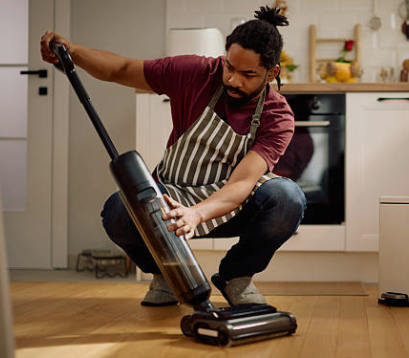
Begin With a Floor-and-Task Inventory
A vacuum purchase is really a matching problem. Write down each surface before comparing machines:
- sealed hardwood, laminate, vinyl plank, tile, or stone;
- wall-to-wall carpet by approximate pile height and construction;
- area rugs, including fringed, looped, hand-made, wool, or otherwise delicate pieces;
- stairs, baseboards, corners, upholstery, mattresses, vents, and vehicles; and
- recurring debris such as fine dust, crumbs, long hair, pet hair, litter, or tracked grit.
Now find the care and warranty documents for the installed floors and rugs. They control. A vacuum head permitted on one carpet can be too aggressive for another; a hard-floor head with a dirty or damaged wheel can mark a finish; loose fringe can wrap around a powered roll. If the manufacturer names a vacuum type, certification, brush setting, or prohibited tool, treat that as a purchase requirement rather than a suggestion.
Also identify practical constraints. How many levels will the machine travel? Where will it be stored and charged? Who will lift it? Is there an outlet near the stairs? How often will a bin, bag, filter, brush roll, or battery need attention? These questions are not secondary. A technically capable vacuum that is painful to carry, awkward to steer, or difficult to empty may remain in the closet.
Match the Cleaning Head Before Comparing Motor Numbers
The floor head is where suction, airflow, agitation, surface contact, and debris size meet. Its design can matter more than a large motor number.
An ENERGY STAR technical scoping report found minimal correlation between motor input power and cleaning performance. It noted that head design, brush mechanisms, filtration, sealing, and the complete system can be more influential than input watts or amperage. Air watts can describe suction power under specified conditions, but even that number does not reproduce airflow through the hose, filters, nozzle, and floor contact during ordinary use.
That means watts, amps, pascals, air watts, and marketing terms should not be compared as if they were a universal cleaning score. Test evidence that reflects the surface and complete machine is more useful. For carpet, the Carpet and Rug Institute’s Seal of Approval (SOA) program evaluates soil removal, dust containment, and surface appearance change. Its product database also identifies features such as vacuum type, brush-roll shutoff, height levels, collection type, and HEPA filtration. Certification is evidence for the tested carpet performance; it is not proof that the machine suits every hard floor, rug, stair, user, or budget.
Bare Floors Need Debris Pickup Without Abrasion
On sealed hardwood, laminate, vinyl, tile, and stone, the first goal is to remove grit without scattering it or dragging it across the surface. Look for either a dedicated bare-floor head or a powered head whose brush roll can be fully switched off when the flooring instructions require it.
Inspect what touches the floor: wheels, glides, bristles, metal edges, and the underside of the nozzle. They should be cleanable, smooth, intact, and compatible with the floor. A soft-looking attachment can still trap grit. A heavy head is not automatically harmful, but a jammed wheel, exposed fastener, damaged strip, or debris caught underneath can scratch or scuff.
Large crumbs and litter also reveal a design trade-off. A very low nozzle may push debris instead of admitting it, while an open front may pick up larger pieces but reduce contact or control elsewhere. If this debris is common in your home, test it rather than assuming the strongest advertised suction will solve the geometry.
Do not treat vacuum compatibility as permission to ignore the material’s care guide. The earlier articles in this cluster address moisture, cleaners, seams, finishes, and repairs. This purchase decision is narrower: choose a head and controls that can remove dry soil without creating a new surface problem.
Carpet Needs the Right Amount of Agitation
Many ordinary carpets benefit from powered agitation because it helps release embedded dry soil. But “more brush” is not always better. The head must contact the pile without digging in, stalling, becoming hard to push, or changing the texture.
Height adjustment raises or lowers the head for different carpet thicknesses. Suction control reduces the force holding a nozzle against a dense carpet or lightweight rug. Brush-roll speed control changes agitation. Brush-roll shutoff removes powered agitation entirely. These controls solve different problems, so one should not be treated as a substitute for all the others.
High-pile and specialty carpets deserve extra caution. CRI warns that the brush rolls used by many upright vacuums can accelerate severe, typically irreparable texture change in some high-pile carpets. Its technical bulletin identifies straight-air machines without a brush-roll agitator—often canister or central systems with a suitable floor tool—as a preferred approach for that situation. This is not a rule that all carpet needs suction-only cleaning. It is a reason to check the specific carpet and to reject a machine that cannot reduce or disable unsuitable agitation.
For looped carpet, hand-made rugs, fringe, loose yarns, or a specialty fibre, follow the maker’s instructions. Do not run a powered roll over fringe. Stop immediately if yarn pulls, the brush stalls, the rug lifts, or the machine becomes unusually difficult to move.
Treat Filtration as a Whole-System Question
HEPA describes filter performance under a defined test, not automatically the performance of the entire vacuum in your home. EPA explains that a HEPA filter is capable of capturing at least 99.97% of particles at 0.3 micrometres under the definition it cites. In separate HEPA-vacuum guidance, EPA stresses that all intake air must pass through the final HEPA stage without leaking around it; adding a HEPA filter to a machine not designed and tested as a sealed HEPA vacuum is not equivalent.
For an ordinary household purchase, ask:
- Is the claim for the filter media or for the complete machine?
- Does the manufacturer describe a sealed path or whole-machine test?
- Are replacement filters and seals available, and how often must they be serviced?
- Does the collection system release a visible dust cloud during emptying?
- Can the user change the bag or empty the bin without direct contact with debris?
A bagged design can contain debris neatly when the bag closes well, but it creates a recurring purchase and availability dependency. A bagless bin avoids bags and makes fill level visible, but emptying and filter washing may expose the user to dust and require more hands-on maintenance. Neither category is universally cleaner; construction, seals, filters, emptying design, condition, and maintenance matter.
Do not promise that a vacuum will prevent or treat asthma, allergies, infection, or another health condition. Filtration can reduce some particles passing through a functioning system, but health outcomes depend on pollutants, exposure, source control, ventilation, cleaning practice, and individual factors. People with a medical concern should use appropriate professional guidance rather than a product label as a treatment plan.
Choose a Form Factor You Can Use Throughout the Home
Upright, canister, stick, handheld, central, and robotic vacuums distribute weight and work differently. The useful question is not which category wins; it is where each design places the motor, dust, battery, hose, cord, and floor head during your actual tasks.
An upright can combine carpet head and collection in one unit, but its full body usually moves with every pass. A canister lets a smaller head reach under furniture and may offer several floor tools, while the user manages a hose and trailing body. A cordless stick can make quick pickups easier, but advertised runtime may use a low-power setting or a non-powered tool; verify runtime in the configuration you expect to use. Batteries age and may be difficult or expensive to replace. A corded machine trades charging limits for outlet changes and cord management.
For stairs, do not judge only the machine’s total weight. Check whether it can rest securely, whether the hose reaches without pulling the body, and whether a powered stair tool is controllable. For mobility, grip, balance, hearing, or fatigue concerns, test handle comfort, steering force, trigger or button placement, noise, emptying force, and the heaviest lift required. Avoid carrying a running machine, stretching a hose across a landing, or balancing an unsecured vacuum above you.
Robot-vacuum suitability and cordless-versus-upright comparisons belong to a separate planned cluster. Here, those formats are simply options that still must pass the same flooring, containment, maintenance, and usability tests.
Calculate Ownership, Not Just Purchase Price
The shelf price does not show the full cost. Before buying, price the expected bags, prefilters, exhaust filters, belts, brush rolls, floor tools, and—where applicable—the replacement battery and charger. Confirm which parts the owner may wash and which must be replaced. A washable filter still has a cleaning and drying requirement; reinstalling it damp can damage a machine or create odour.
Check how hair is removed from the brush roll and whether the roll can be accessed without a complex teardown. Find the blockage path. Read the warranty exclusions and determine whether parts and repair service exist in your region. A lower-priced machine with unavailable filters can become a disposable purchase; a premium machine with costly consumables can exceed the household budget even when it performs well.
Noise, storage footprint, wall mounts, dock clearance, cord length, hose reach, and attachment storage also affect whether the machine fits the home. Treat smart features and extra tools as valuable only when they solve a task on your inventory.
Use a Short In-Store or Return-Window Test
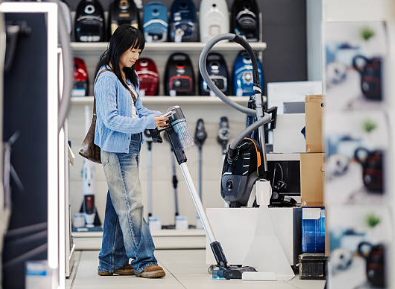
If possible, bring your floor and rug requirements to a retailer or confirm a return policy that permits a meaningful home test. Use the machine on representative surfaces with ordinary dry debris. You are not trying to conduct a laboratory comparison. You are checking compatibility and usability.
Verify that you can:
- switch the brush roll off and confirm that it actually stops;
- change height or suction without interrupting the whole routine;
- move from bare floor to carpet without scattering debris or locking to the pile;
- clean along an edge and under a low piece of furniture;
- use the stair and upholstery tools without unsafe pulling or awkward lifting;
- remove hair and find a blockage;
- change a bag or empty the bin and service the filter; and
- store the vacuum, cord, hose, charger, and attachments in the planned space.
After a small test, inspect the floor, carpet, and rug under good light. Look for scratches, scuffs, pulled yarn, fuzzing, excessive pile change, or debris left in rows. Listen for brush contact or a stalled roll. If the machine is hard to push, do not force it; adjust it according to the manual or stop.
Make the Decision in This Order
Use a simple hierarchy:
- Protect the flooring. Eliminate machines or heads that conflict with the floor, carpet, or rug instructions.
- Cover the tasks. Require the controls and attachments for every high-frequency surface.
- Check containment. Evaluate the complete air path, collection method, seals, filters, and emptying process.
- Check the user fit. Test steering, lifting, stairs, controls, noise, storage, and charging or cord reach.
- Check ownership cost. Price consumables, battery, wear parts, and realistic service.
- Use credible performance evidence. Prefer applicable whole-machine or carpet testing over isolated motor numbers.
- Buy only after a practical test or usable return option. A specification cannot reveal every floor interaction.
One home may reasonably need one adaptable primary vacuum plus a small task-specific tool. Another may be better served by two simpler machines than one complicated model. The goal is not to own every format. It is to remove dry soil consistently without damaging the surfaces, redistributing dust, or making routine cleaning so difficult that it is postponed.
FAQ
Is a higher-wattage vacuum always more powerful?
No. Motor input power is not a universal cleaning score. Nozzle design, airflow under load, agitation, seals, filters, surface contact, and maintenance all affect the complete machine’s performance.
Do I need a brush roll for carpet?
Many ordinary carpets benefit from powered agitation, but some high-pile, looped, fringed, or delicate surfaces can be damaged by it. Follow the carpet or rug instructions and choose a machine with the necessary height, suction, speed, or shutoff controls.
Should the brush roll be off on hardwood and other bare floors?
Follow the installed flooring and vacuum manuals. A shutoff is valuable because some floors call for a suction-only or dedicated bare-floor head, and a powered roll can scatter debris or create contact that the flooring maker does not permit.
Does a HEPA filter make any vacuum a HEPA vacuum?
No. EPA distinguishes a complete HEPA vacuum—designed so intake air passes through the final HEPA filter without bypass—from a machine merely fitted with HEPA filter media. Look for a whole-system claim and maintain seals and filters as directed.
Is bagged better than bagless?
Not universally. A self-closing bag may make disposal tidier, while a bagless bin avoids replacement bags. Compare complete filtration, seals, emptying exposure, filter work, consumable availability, and cost.
Is a cordless vacuum enough for a whole home?
It may be, depending on floor area, carpet load, battery performance with the powered head, charging time, debris capacity, and access to a replacement battery. Test the configuration and power mode you will actually use.
What should I test before the return window ends?
Test every floor type, rug, stair, edge, and common debris task. Operate all adjustments, empty the collection system, inspect surfaces for change, check runtime or cord reach, and confirm that storage and routine maintenance are realistic.
Sources
- Carpet and Rug Institute – Seal of Approval Certified Vacuums
- Carpet and Rug Institute – Seal of Approval Program
- Carpet and Rug Institute – Technical Bulletin: Vacuums for High Pile Carpet
- EPA – What Is a HEPA Filter?
- EPA – What to Look for in a HEPA Vacuum
- ENERGY STAR / EPA – Market and Industry Scoping Report: Vacuum Cleaners
More in This Cluster: Floor Care by Material
- Hardwood Floor Cleaning and Humidity
- Laminate Floor Care
- Vinyl Plank Floor Cleaning
- Tile and Grout Maintenance
- Carpet Spot Cleaning
- How to Choose a Vacuum for Your Flooring (you are here)
- Floor-Cleaning Products to Avoid by Surface