Quick Summary
As of September 4, 2026, some U.S. patients are having difficulty filling prescriptions for estradiol transdermal patches. The Food and Drug Administration told Reuters that it is working with all six manufacturers to increase supply, monitor availability, and expedite reviews related to supply increases when appropriate.
This does not mean FDA has designated estradiol patches as being in an official nationwide shortage. FDA says patches remain available, although the availability of a particular product or brand can vary by pharmacy and location. Separately, the American Society of Health-System Pharmacists lists specific strengths and packages from several manufacturers as back-ordered, allocated, or intermittently available.
The practical question is therefore not simply, “Are estradiol patches available?” It is, “Can this pharmacy obtain my exact strength, dosing schedule, manufacturer, and package—and if not, what change can my pharmacist and prescriber safely arrange?” Do not cut patches, stretch the replacement interval, reduce the dose, combine patches, change brands, or stop treatment without professional instructions.
Reader Decision
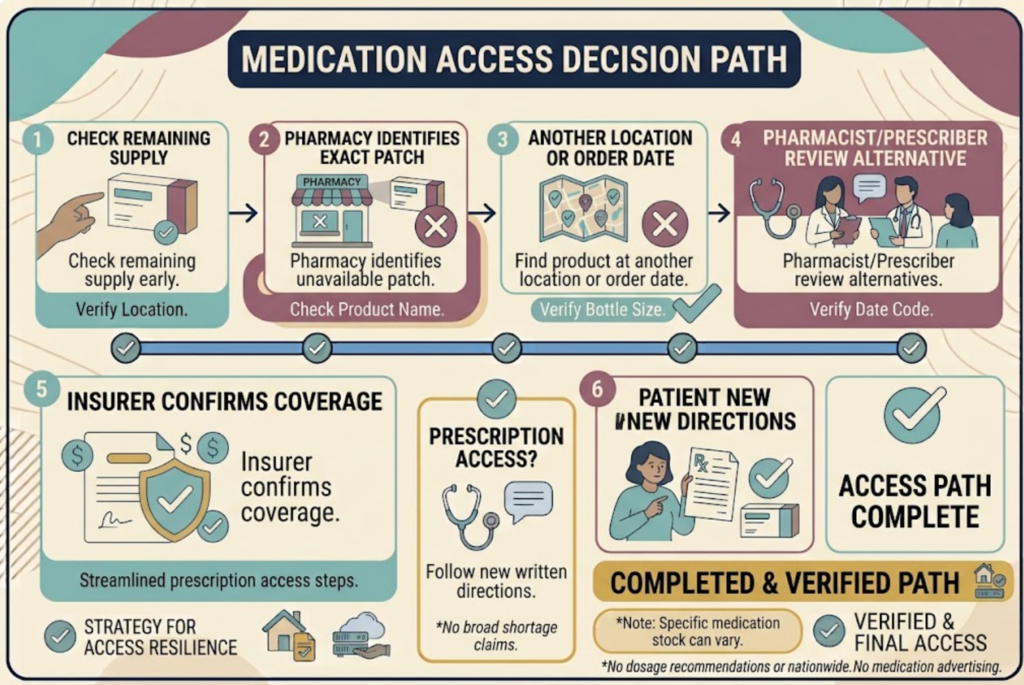
Check supply before the next refill becomes urgent. Have the pharmacy identify the exact product that is unavailable, then ask about other locations or order timing. If a different strength, brand, frequency, or form may be needed, involve the prescriber and confirm insurance coverage before changing treatment.
Two Shortage Systems Can Give Different Answers
The word “shortage” is being used in two different ways.
FDA determines national shortage status using nationwide supply and demand information, including manufacturer reports. Its general definition is a period when U.S. demand or projected demand exceeds supply. Reuters reported that FDA had not designated estradiol transdermal patches as being in shortage and said the products remained available.
ASHP maintains a separate drug-shortage service used by healthcare professionals. Its August 12 entry listed affected products from Sandoz, Amneal, Viatris, Noven, and Zydus. Some presentations were on back order or allocation, while other strengths and products were listed as available. Bayer’s Climara presentations were listed as available at that update, although Bayer later told Reuters that one Climara dose could face temporary constraints until early 2027.
These statements are not necessarily contradictory. A patient can face a real local or product-specific supply problem even when total nationwide supply has not crossed FDA’s threshold for an official shortage designation.
“Estradiol Patch” Is Not One Interchangeable Item
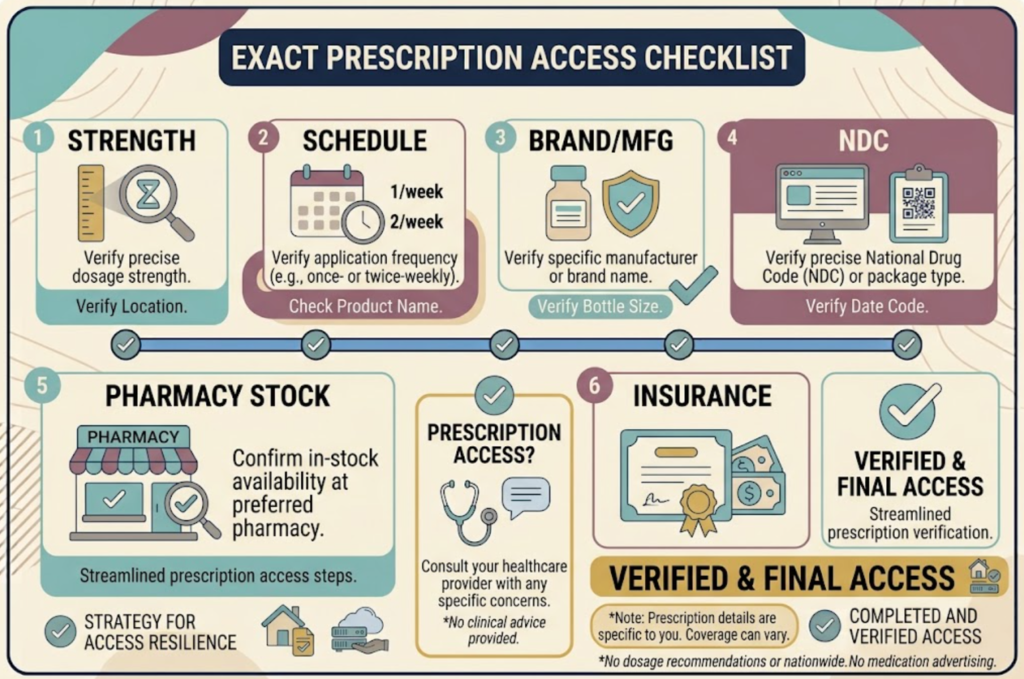
A prescription contains details that matter to treatment and dispensing. Patches come in different strengths, may be designed for once-weekly or twice-weekly replacement, and are sold under different brand or generic names and package identifiers.
ASHP’s list illustrates why a pharmacy’s answer can be specific. At its August update, two Dotti strengths were back-ordered without an estimated release date, while other Dotti strengths and Lyllana products were listed as available. Noven products were on intermittent back order with weekly releases. Zydus products were on allocation. Sandoz had two once-weekly strengths on back order and other presentations on allocation. One Viatris twice-weekly presentation was intermittently back-ordered while supplies were being released.
This does not guarantee that an “available” product will be on the shelf at a particular pharmacy. It also does not mean a product listed as constrained is unavailable everywhere. Wholesaler access, local inventory, prescription specifications, and insurer rules can all affect the answer.
Ask the Pharmacy These Questions First
Begin with the pharmacy holding the prescription. Ask:
- Which exact item is unavailable? Request the strength, once- or twice-weekly schedule, manufacturer or brand, package size, and NDC if available.
- Is it temporarily out of stock or unavailable from the wholesaler? A delayed shipment and a longer back order may require different plans.
- Can another branch fill the same prescription? Ask the pharmacy to check nearby locations if its system permits.
- Can it be ordered, and is there a realistic arrival date? “We can order it” is different from confirmed wholesaler inventory.
- Is a partial fill possible? Availability and dispensing rules vary, so ask rather than assume.
- Would another stocked product require a new prescription? The pharmacist can identify what is legally and clinically substitutable and when the prescriber must act.
Record the date, pharmacy, product details, and answer. This prevents a vague “patch unavailable” message from losing the information the prescriber needs.
When the Prescriber Needs to Join the Decision
Contact the prescriber if the pharmacy cannot fill the prescribed product in time or says that a different strength, schedule, brand, or dosage form requires authorization.
Send concrete information: how many patches remain, when the next change is due, the exact prescribed product, what the pharmacy cannot obtain, and any alternatives the pharmacist identified. Ask which option preserves the intended treatment plan and what instructions replace the old ones.
Do not perform your own dose conversion. Two lower-strength patches are not automatically an approved substitute for one higher-strength patch, and a once-weekly product is not automatically equivalent in use to a twice-weekly product. Adhesive, delivery design, replacement timing, and labeling can differ.
ASHP specifically warns against treating patch cutting as a routine shortage solution. Reservoir patches should never be cut, while cutting matrix patches can produce uneven drug release and variable therapy; stability may also vary. The safe conclusion for patients is simple: do not cut an estradiol patch unless the prescriber and pharmacist have provided product-specific instructions.
Check the Insurance Step Before Accepting a Change
A clinically acceptable alternative can still be delayed at the pharmacy counter if the insurer treats it differently.
Ask whether the alternative is on the formulary, whether prior authorization or a new prescription is required, and whether the copay changes. If the preferred product cannot be obtained, ask the pharmacy or prescriber whether the plan has a shortage, medical-necessity, or formulary-exception process. The existence and outcome of those processes depend on the plan.
Keep screenshots or notes showing unsuccessful fills, quoted prices, and communications. Do not pay an unexpectedly high cash price before asking whether the claim used the correct product and whether a covered option is available. Discount prices and insurance claims also follow different rules; compare the actual total cost without assuming they can be combined.
Do Not Wait Until the Last Patch
Supply searches take time. Check the refill date and remaining quantity while there is still room for the pharmacy, prescriber, and insurer to communicate. Do not apply patches early to build a reserve or request more than prescribed.
If treatment may be interrupted, ask the prescriber what to do rather than improvising. Extending wear time, skipping scheduled changes, reusing a patch, or stopping suddenly can change the delivered therapy and may allow symptoms to return. The appropriate response depends on the individual’s prescription and medical history.
FDA’s 2025 hormone-therapy labeling action does not make treatment decisions universal. The agency retained the endometrial-cancer boxed warning for systemic estrogen-alone products, and product-specific contraindications, warnings, and directions still matter. A supply problem is not a reason to bypass those safeguards.
The Practical Takeaway
Estradiol patch access is uneven, not uniformly absent. FDA is working with manufacturers, but it has not designated the entire category as being in an official nationwide shortage. ASHP’s more granular list shows why patients may still encounter genuine back orders for an exact product.
Act early and keep the decision specific. Identify the unavailable strength and schedule, check the same prescription across legitimate pharmacy channels, involve the prescriber before changing it, and verify insurance before accepting a substitute. The goal is continuity through a documented clinical plan—not continuity created by self-rationing.
This newsletter provides general medication-access information and is not medical advice. Availability, shortage status, product listings, insurance rules, and resupply estimates can change. Confirm current supply with a licensed pharmacy and obtain individualized treatment instructions from the prescribing healthcare professional.
FAQ
Has FDA declared a nationwide estradiol patch shortage?
No. As reported September 3, FDA said it had not designated the patches as being in shortage, although product and local availability may vary.
Why does ASHP list a shortage if FDA does not?
FDA determines national status, while ASHP reports product-level supply disruptions. Different thresholds and levels of detail can produce different listings.
Can a pharmacist switch me to another brand?
That depends on the prescription, product, state rules, clinical equivalence, and insurance requirements. Ask whether pharmacist substitution is permitted or a new prescription is needed.
Can I use two lower-dose patches instead of one higher-dose patch?
Do not make that change yourself. A prescriber and pharmacist must determine whether a particular alternative is appropriate and provide new directions.
Can I cut an estradiol patch to create the prescribed dose?
Do not cut it on your own. Patch designs differ, and ASHP warns that cutting can cause uneven delivery or variable stability.
What information should I send my prescriber?
Include the exact product and strength, replacement schedule, remaining patches, next dose date, pharmacy findings, and any alternatives the pharmacist identified.
Sources
- Reuters — U.S. FDA Is Working With Manufacturers to Boost Estrogen Patch Supply
- American Society of Health-System Pharmacists — Estradiol Transdermal System Shortage Detail
- FDA — Frequently Asked Questions About Drug Shortages
- FDA — How to Report a Shortage or Supply Issue
- FDA — Hormone Replacement Therapy Labeling Action