Quick Summary
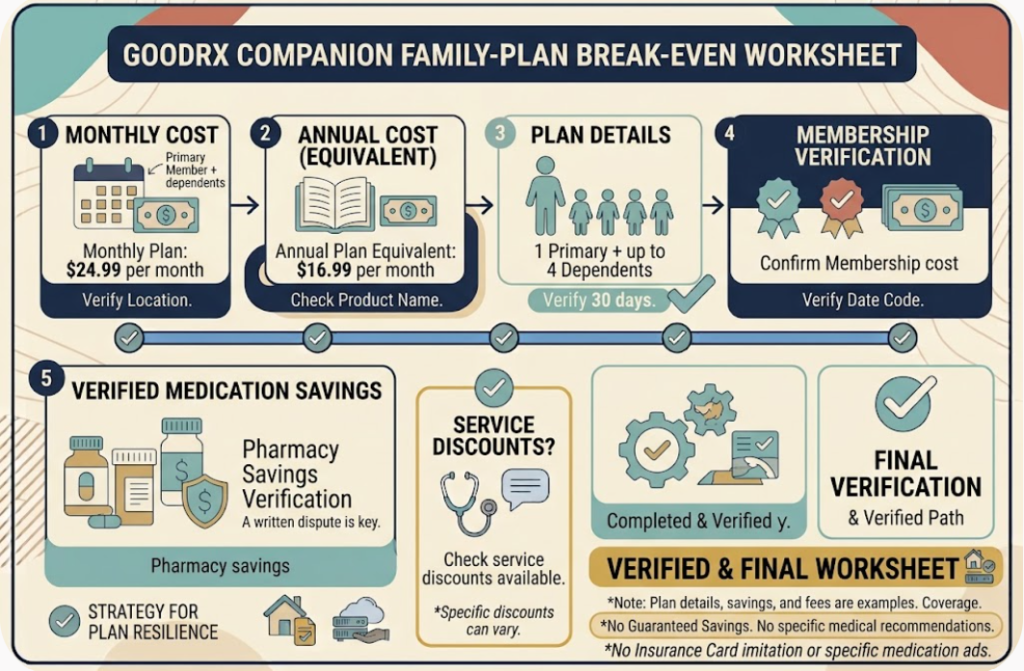
As of September 4, 2026, GoodRx has announced a Companion Family Plan costing $24.99 per month or $16.99 per month when paid annually. It covers one primary member and up to four dependents, who may be children, adult family members, or pets, with no stated age restriction.
GoodRx says members can access more than 250 eligible generic medications for free, hundreds more for under $10, and discounts on dental, vision, laboratory, and imaging services. The primary member also gets access to $19 online-care visits.
This is a discount membership, not health insurance. It does not pay medical claims, replace comprehensive coverage, or let a member combine the Companion price with insurance on the same prescription or procedure. The plan is worthwhile only if the household’s verified savings exceed the membership fee and any additional service charges.
One caution is especially important at launch: GoodRx’s September 3 family-plan announcement and some existing Companion webpages and terms were not yet fully aligned. Before enrolling, confirm the family price, billing period, included members, renewal date, cancellation rules, and actual prices in the final checkout terms.
Reader Decision
Price the household’s real prescriptions and likely services before subscribing. Compare the Companion total with insurance and free GoodRx prices at the pharmacies and providers you would actually use. Join only when conservative, repeatable savings exceed the fee—not because the headline says “250+ free medications.”
Start With the Real Annual Cost
The monthly option costs $24.99, or $299.88 over 12 months if the price remains unchanged. GoodRx advertises the annual option as $16.99 per month when paying annually, an implied annual cost of $203.88.
The annual member needs enough expected value to justify the larger prepaid commitment. Confirm the amount actually charged at checkout; the announcement does not explain every billing or refund condition for the new family tier.
Do not count the membership as savings. Use this calculation:
Verified prescription savings + verified service savings − membership fee − service charges − costs that no longer count through insurance = net value.
A quoted saving is worth less if it requires a distant pharmacy or does not apply every month.
“250+ Free Medications” Needs Four Checks
The word “free” applies to eligible generic medications under the program—not every strength, quantity, formulation, or pharmacy.
For every regular prescription, search the exact:
- drug and formulation;
- strength;
- prescribed quantity;
- participating pharmacy; and
- household member using it.
GoodRx’s current Companion information says more than 250 medications are free at at least one pharmacy and that eligible medication prices can change. The family-plan announcement says members can access those medications through a broad pharmacy network. Neither statement guarantees that a specific prescription will cost $0 at the family’s preferred location.
A prescription is still required. Membership does not authorize a medication, and a lower price is not a reason to change the drug, dose, or quantity without the prescriber.
Pets may be included as dependents, but pet prescriptions require the same exact-price check. Do not assume every veterinary medication or human medication prescribed for an animal appears on the eligible list.
Compare Companion With Insurance One Transaction at a Time
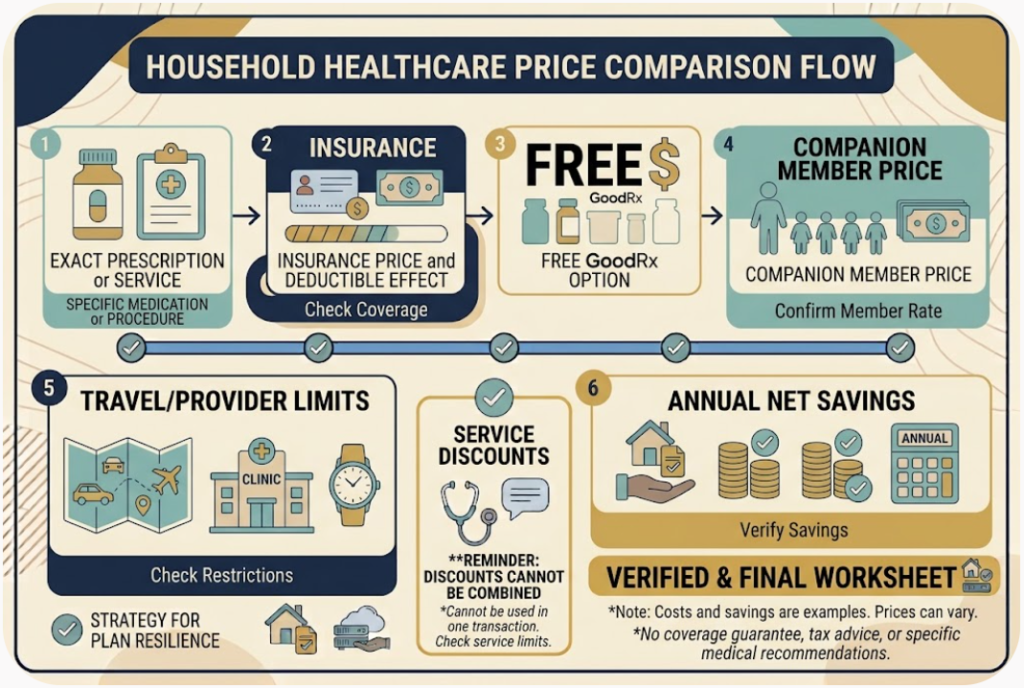
GoodRx says Companion can be used by people who have insurance, including Medicare, but the discount and insurance cannot both be applied to the same prescription or procedure. The member chooses which price to use for that transaction.
That choice can have a second effect. A purchase processed outside insurance may not automatically count toward the health plan’s deductible or out-of-pocket maximum. Ask the insurer whether receipts can be submitted and what, if anything, will be credited. Do not assume a lower counter price produces the lowest total annual healthcare cost.
GoodRx also states that HSA or FSA funds cannot be used to buy a Companion membership. Those funds may be usable for qualifying prescriptions, depending on the account rules. Confirm eligibility with the HSA or FSA administrator and keep receipts.
Service Discounts Are Not Prepaid Care
The family plan advertises savings on dental, vision, lab, and imaging services. GoodRx’s existing Companion page describes discounted provider networks and lists $19 online-care visits, but members remain responsible for service fees.
The launch announcement says the primary member receives access to the $19 online visits. It does not say that every dependent receives the same telehealth benefit. Families should verify who can use each service before assigning value to it.
For dental, vision, laboratory, or imaging savings, check:
- whether a participating provider is reasonably nearby;
- the member price for the exact service;
- whether the provider accepts the program for that appointment;
- whether insurance offers a better negotiated price or coverage; and
- whether professional interpretation, facility, follow-up, or other charges are separate.
An advertised percentage or average saving is not a quote. A household that rarely uses those services should not treat the maximum possible discount as annual value.
Build a Conservative Break-Even Test
Review the previous three to six months of pharmacy receipts and the next year’s predictable needs. Make one row for each household member and one for each recurring prescription or likely service.
Record the usual insurance or cash price, the free GoodRx price, the Companion price, the participating location, and how often the expense occurs. Count only savings that you can verify today. Exclude a future dental procedure, imaging test, or online visit unless it is reasonably likely.
Then test three scenarios:
- Low-use year: regular prescriptions only.
- Expected year: regular prescriptions plus likely routine services.
- High-use year: additional services, without assuming every advertised maximum discount.
The plan is easier to justify if it wins even in the low-use or expected case. If it wins only after adding uncertain services, the subscription may depend on spending that never occurs.
Also compare the free GoodRx coupon price. Paying for Companion is unnecessary when the free option, insurance, a manufacturer program, or another legitimate route already produces the same or lower usable cost.
Read the Renewal and Cancellation Terms at Checkout
GoodRx says Companion subscriptions renew automatically and can be canceled. Its existing individual-plan terms require cancellation at least one day before renewal to avoid the next charge and generally make membership fees nonrefundable, subject to specified state rules.
However, those terms still display individual-plan prices. Do not assume every individual-tier billing example applies unchanged to the family plan.
Before paying, save the checkout page or confirmation showing the charged amount, free-trial end date if offered, renewal date, cancellation method, and refund rule. Set a reminder before the first renewal. After cancellation, keep the confirmation rather than relying only on the disappearance of benefits from the app.
What Changes With the 2027 Employer Version
GoodRx says it expects Companion to become available through participating employers beginning January 1, 2027. Reuters reports employers may subsidize the membership, with employees paying any remaining share.
That is a future employer option, not a guarantee that every workplace will offer it or pay the full fee. During benefits enrollment, compare the employee price, covered family members, payroll treatment, start date, and whether leaving the employer ends or converts the membership.
Even an employer-paid Companion benefit remains a discount program rather than health insurance. Evaluate it alongside medical, prescription, dental, vision, HSA, and FSA benefits—not as a replacement for them.
The Practical Takeaway
GoodRx Companion Family Plan could be valuable for a household with several eligible recurring prescriptions or predictable services at participating locations. The shared membership may also be more efficient than separate individual subscriptions.
But the headline benefits are a menu, not guaranteed household savings. Verify exact products, people, pets, pharmacies, providers, and prices. Include the effect of paying outside insurance, then subtract the full membership cost. Finally, read the live family-plan terms because GoodRx’s existing pages were still catching up with the September 3 launch.
This newsletter provides general consumer, healthcare-cost, and subscription information. It is not medical, insurance, legal, or tax advice. Prices, eligible medications, participating providers, terms, and employer availability may change. Confirm current details with GoodRx, the pharmacy or provider, the insurer, and the HSA/FSA administrator as applicable.
FAQ
Is GoodRx Companion Family Plan health insurance?
No. GoodRx describes Companion as a discount plan, not insurance. Members remain responsible for healthcare and service charges.
How many people can be included?
The launch announcement says one primary member plus up to four dependents. Dependents may include children, adult family members, or pets.
Is the annual plan $16.99 total each month?
GoodRx describes it as $16.99 per month when paying annually. Confirm the full prepaid charge, renewal date, and refund terms at checkout.
Are all 250-plus medications free at every pharmacy?
No guarantee is stated. Eligibility depends on the exact prescription and participating pharmacy, and prices or included medications can change.
Can Companion be combined with insurance?
Not on the same prescription or procedure. Compare the Companion and insurance prices, including possible deductible consequences, before choosing.
Can I use HSA or FSA money for the membership?
GoodRx says HSA/FSA funds cannot purchase the membership. They may cover qualifying prescriptions depending on the account’s rules.
Sources
- GoodRx — Companion Family Plan Launch Announcement
- GoodRx — Companion Benefits and Current Consumer Information
- GoodRx — Companion Terms of Service
- GoodRx — GoodRx and Companion Restrictions
- Reuters — GoodRx Offers Health Subscription for Families