A refrigerator can look orderly and still handle food poorly. Clear bins may hide an expired leftover. Raw chicken may sit above washed fruit. A crowded back wall may freeze lettuce while a warm door holds food that needs steadier cold. Organization matters when it helps the refrigerator maintain temperature, prevents leaks and cross-contamination, and makes time-sensitive food visible.
Quick decision: Verify that the refrigerator stays at 4°C (40°F) or below with an appliance thermometer. Separate raw meat, poultry, fish, and seafood in leak-proof containers on a low shelf; keep ready-to-eat food protected above and away from raw juices; leave room for cold air to circulate; and date leftovers using the official storage guidance for your country and food type. Use one visible “eat first” area and one simple inventory note—without relying on appearance or smell to prove that food is safe.
Temperature Comes Before Containers
The first organizing tool is not a bin. It is a verified cold temperature.
Health Canada, FDA, USDA, and FoodSafety.gov advise keeping a refrigerator at 4°C (40°F) or below. A control dial does not necessarily display the actual food-storage temperature, and different areas may run warmer or colder. Use an appliance thermometer and follow the refrigerator manufacturer’s instructions for placement, adjustment, loading, and troubleshooting.
Check the temperature after the appliance has stabilized, especially after:
- a major grocery trip;
- moving shelves or blocking vents;
- a power interruption;
- a door that was left open;
- a change in room temperature;
- noticing frozen food in the refrigerator section; or
- suspecting that milk or other perishables spoil unusually quickly.
Do not turn the setting colder solely to compensate for overcrowding. First clear airflow, make sure the door seals and closes, and check the manual. If the appliance cannot maintain a safe temperature, move perishable food to reliable cold storage and seek appropriate service. Organization cannot repair a failing refrigerator.
The freezer should generally be maintained at -18°C (0°F) or below under U.S. and Canadian guidance. This article focuses on the refrigerator; Article”Bulk Food Storage Without Waste” will address portioning and freezing bulk purchases.
Build a Safety Order, Not a Decorative Map
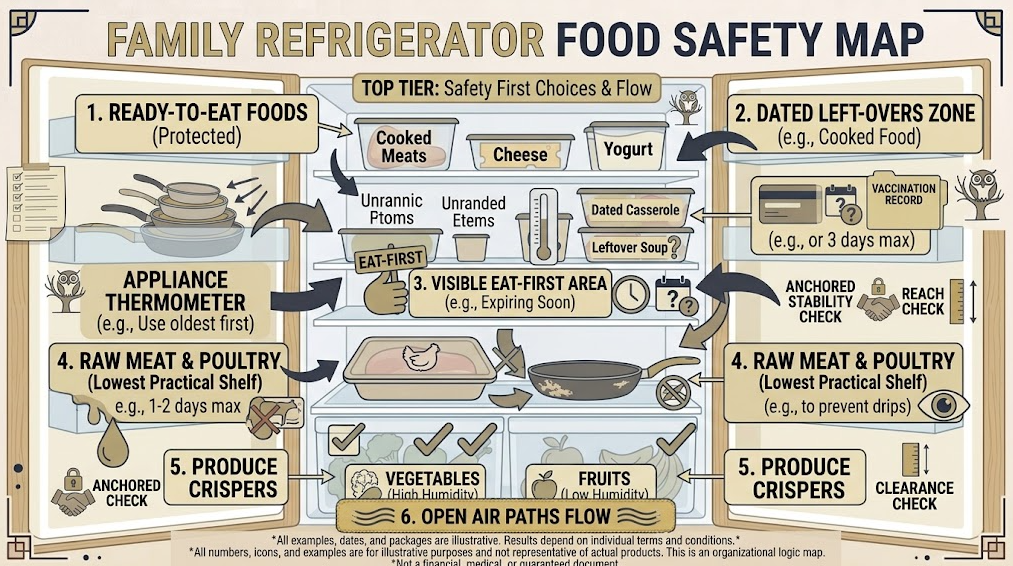
The safest location depends on what could happen if a package leaks, how soon the food must be used, and whether it will receive a cooking step before it is eaten.
Use this broad order as a household framework, adjusting for the refrigerator’s manual and physical design:
Protected ready-to-eat foods
Keep cooked foods, prepared meals, dairy products, washed ready-to-eat produce, and other items that will not be cooked again protected from raw animal-food juices. Covered containers also reduce spills and accidental contact.
Raw meat, poultry, fish, and seafood
Health Canada advises keeping these foods separate in containers. Its guidance for people at higher risk specifically recommends sealed containers or bags on the bottom shelf so raw juices cannot drip onto other foods.
Use a washable, leak-resistant tray or bin that fully contains the package. “Bottom shelf” is a contamination-control principle, not permission to block a vent, overload a drawer, or place meat where the refrigerator manual forbids it. If the lowest usable shelf sits above a produce drawer, the secondary container still matters.
Keep raw packages away from foods eaten without further cooking. Clean and sanitize a shelf or container appropriately after leakage, following food-safety and surface instructions. Do not rinse raw poultry to make storage safer; splashing can spread contamination around the sink and nearby surfaces.
Produce
Use produce drawers according to their controls and the appliance instructions. Store cut fruits and vegetables in the refrigerator. Keep ready-to-eat produce separated from raw meat, poultry, and seafood and from their juices.
Humidity controls affect quality more than they establish food safety. A crisp-looking vegetable is not evidence that every nearby food has remained safely cold.
Door storage
The door experiences frequent movement and temperature change. Use it for items whose labels and manufacturer guidance allow that location. Do not assume that every molded compartment is the best place for eggs, milk, infant feeding supplies, medication, or another temperature-sensitive item. Follow the food label and appliance instructions; egg storage practices and regulatory requirements differ by country.
Avoid creating universal shelf rules that ignore the appliance. Some models place cold-air outlets, drawers, or dedicated compartments differently. The safety goals remain stable: verified temperature, separation, leak containment, airflow, and visible time limits.
Leave Cold Air a Route
A full refrigerator is not automatically efficient. Health Canada advises avoiding overstocking so cool air can circulate effectively, and U.S. food-safety guidance gives the same warning.
Look for four airflow problems:
- Packages press against interior vents.
- Tall containers form a wall across a shelf.
- Food is packed so tightly that cold air cannot move around it.
- A bin fills the full depth and width without the clearance intended by the appliance.
Bins can improve containment and retrieval, but they also create solid barriers. Use the smallest bin that solves a defined problem. Open-sided or shallow organizers may preserve visibility and airflow better than a refrigerator filled with deep matching boxes.
Do not line shelves or drawers with materials unless the manufacturer permits them. A liner can interfere with airflow, drainage, temperature sensing, or cleaning. Keep vents, lights, sensors, drains, and door seals accessible.
After reorganizing, close the door fully and recheck the thermometer once the appliance stabilizes. If one area repeatedly freezes food or runs warm, consult the manual or a qualified technician rather than inventing a storage workaround for a mechanical problem.
Create an “Eat First” Area Without Mixing Risk Levels
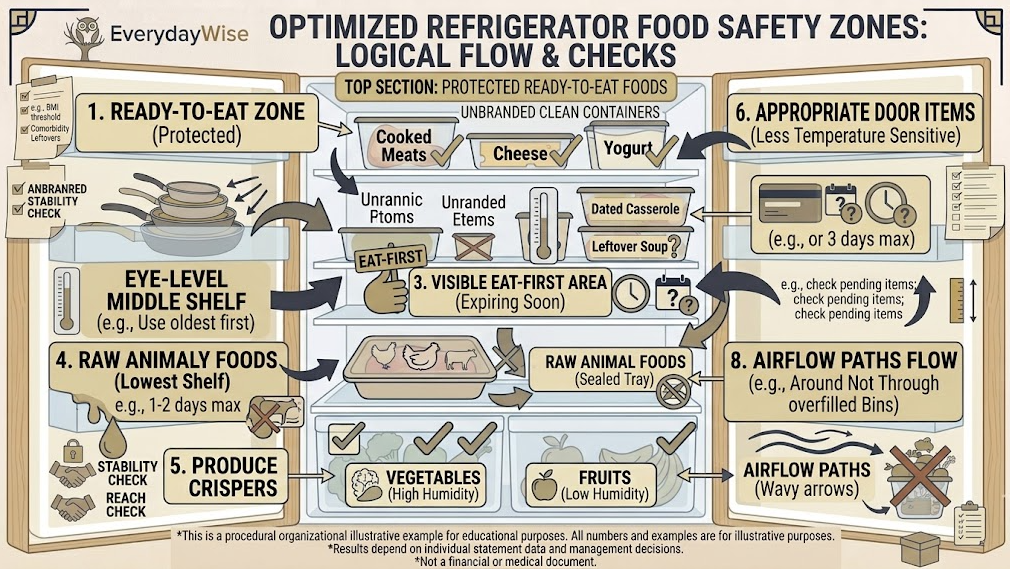
An “eat first” area makes short-dated food visible, but it should not become one mixed basket of raw meat, opened dairy, washed fruit, and leftovers.
Choose a small, clearly visible section for ready-to-eat or safely packaged foods that should be used soon. Raw animal foods should remain in their separate leak-contained area even when their planned cooking date is near. A note can identify them as priority without moving them beside ready-to-eat food.
An item may enter the eat-first area because:
- a leftover is approaching its official storage limit;
- a package has been opened;
- produce is ripe or beginning to lose quality;
- a meal-plan ingredient is scheduled for the next day; or
- a product label gives an earlier use instruction.
Do not use the zone to extend a safety limit. Moving an old leftover to the front does not make it safe for another day. When time or temperature history is uncertain, consult official guidance; never taste food to decide whether it is safe.
Date Leftovers and Cool Them Promptly
Food-safety organization must begin before the container reaches the shelf.
U.S. and Canadian guidance generally calls for refrigerating or freezing perishable foods and leftovers within two hours. FoodSafety.gov shortens the window to one hour when food is exposed to temperatures above 32°C (90°F). These limits include time spent serving, transporting, and sitting on a counter—not two new hours at each stage.
Use clean containers. Shallow containers help large quantities cool more quickly. Follow current local guidance for whether and when to cover hot food; official instructions can vary by food, quantity, and cooling method. Do not leave a large pot at room temperature for hours waiting for it to become completely cold.
Label leftovers with:
- the food name;
- the date prepared or opened; and
- when helpful, the planned use or freeze date.
Storage-time guidance is not perfectly identical across jurisdictions. FoodSafety.gov commonly lists many cooked leftovers at three to four days when held at 4°C (40°F) or below. Health Canada pages may advise two to three days for leftovers or, in broader guidance, using them within two to four days; its food-specific charts give particular times. Follow the current official chart for your location and food type, plus any more restrictive product instruction.
Freezing pauses the refrigerator timetable but does not repair food that was already mishandled. When a household will not use a leftover within the applicable window, freeze it early in a suitable labelled package.
Separate Food-Safety Dates From Quality Dates
A printed date can mean different things depending on the country, product, and wording. Do not create a refrigerator rule that treats every “best before,” “sell by,” “use by,” or expiration date as interchangeable.
Keep three information sources distinct:
- Manufacturer or regulated label instructions: storage conditions and any legally meaningful date language for that product.
- Official cold-storage charts: time limits after purchase, opening, preparation, or cooking.
- Household record: when the item actually entered, opened, thawed, or was cooked.
The household label fills a memory gap; it does not override the package or food-safety authority. If a product requires use within a certain time after opening, write the opening date rather than relying on the unopened-package date.
Appearance and smell can identify obvious spoilage, but the absence of spoilage signs does not establish safety. Harmful microorganisms may not produce a warning a person can see, smell, or taste.
Use Jerome’s Refrigerator Note as a Small Inventory System
From Jerome, EverydayWise Contributor
In our household, if I did not keep a note on the refrigerator, I would often return from grocery shopping and realize that I had forgotten something we needed. With four family members and more food moving through the kitchen, relying on memory was not enough.
The passage above comes from an EverydayWise contributor’s household experience. It shows that visibility has two sides: seeing what is already inside and recording what needs to come in next.
A refrigerator note can support both without becoming a full inventory database. Divide one small board, paper, or shared digital list into three sections:
- Use soon: dated leftovers, opened items, and ripe produce.
- Running low: recurring staples that someone has physically checked.
- Planned meal: the few ingredients reserved for upcoming meals.
Give the list a trigger. The person who empties a staple adds it. The person who stores a leftover writes the date. Before shopping, someone checks the refrigerator rather than copying the list blindly.
The note should not hold sensitive medical information, and it cannot determine whether a food is safe. Its job is to reduce duplicate purchases, forgotten ingredients, and invisible leftovers. Remove an entry when the item is used, frozen, discarded, or purchased.
Keep Cleaning Compatible With Food Safety
Clean spills promptly, especially raw animal-food leakage. Move food to safe cold storage if cleaning will keep the door open or the refrigerator warm for an extended period.
Use cleaning and sanitizing products only as directed for food-contact or refrigerator surfaces. Do not mix chemicals. Remove drawers and shelves only as the appliance instructions permit; cold glass or plastic parts can crack when exposed to sudden temperature changes or force.
During a routine reset:
- discard food according to official time, temperature, recall, and product guidance;
- inspect containers for leaks and damaged seals;
- wipe handles and high-touch areas;
- clean the raw-food containment tray;
- keep the thermometer visible; and
- make sure the door gasket is clean and the door closes fully.
If recalled food may be present, follow the recall notice’s product identifiers and disposal or return instructions. Do not assume that reorganizing, cooking, or freezing removes every recall hazard.
Plan for a Power Interruption
The organized refrigerator should make emergency decisions easier. Keep an appliance thermometer inside and know where to find official outage guidance.
FoodSafety.gov states that an unopened refrigerator keeps food safe for about four hours during a power outage. Keep the door closed as much as possible. After an outage, decisions depend on time and measured temperature; perishable food held above 4°C (40°F) for too long may need to be discarded. Do not taste it to test safety.
These are not permission to wait four hours before taking action when reliable backup cold storage is available, nor proof that every item is unsafe at the instant power returns. Use the current official outage chart item by item. People at higher risk from foodborne illness may need more conservative guidance from their public-health or healthcare professional.
A 15-Minute Refrigerator Reset
Work one shelf at a time so perishable food does not remain at room temperature unnecessarily.
- Confirm the appliance thermometer reads 4°C (40°F) or below.
- Check dated leftovers against the appropriate official storage chart.
- Put raw meat, poultry, fish, and seafood in leak-proof secondary containment low in the refrigerator.
- Protect ready-to-eat foods from raw juices.
- Clear blocked vents and reduce tightly packed rows.
- Place eligible short-dated foods in the visible eat-first area.
- Update the use-soon and running-low note.
- Clean any spill using appropriate instructions.
- Close the door and make sure it seals.
Success is not a refrigerator that looks empty or color coordinated. It is a refrigerator that stays cold, keeps raw hazards contained, shows which food needs attention, and helps the household use food before time or uncertainty takes the decision away.
FAQ
What temperature should a refrigerator be?
Keep it at 4°C (40°F) or below under U.S. and Canadian official guidance. Verify the actual temperature with an appliance thermometer and follow the refrigerator instructions for placement and adjustment.
Should raw meat always go on the bottom shelf?
Store raw meat, poultry, fish, and seafood separately in sealed, leak-proof containment low enough that juices cannot drip onto other food. Adapt the exact shelf to the appliance design without blocking vents or placing raw food above ready-to-eat items.
How long can leftovers stay in the refrigerator?
It depends on the food and jurisdiction. U.S. guidance commonly gives three to four days for many cooked leftovers; Canadian official materials may give two to three or two to four days and provide food-specific charts. Use the current official chart and any stricter product instruction.
Can I put hot leftovers directly in the refrigerator?
Perishable food should be refrigerated promptly, generally within two hours. Divide large amounts into shallow containers and follow current local guidance for cooling and covering; do not leave a large pot out for hours waiting for it to become completely cold.
Are refrigerator-door egg holders safe?
Follow the egg-carton instructions, local food-safety guidance, and refrigerator manual. Egg processing and storage rules vary by country, and the door may experience greater temperature fluctuation.
Do clear storage bins improve food safety?
They can improve visibility and contain leaks, but oversized or tightly packed bins can block airflow. A bin does not replace temperature control, separation, dating, cleaning, or official storage limits.
Can I tell whether food is safe by smelling it?
No. Smell and appearance can reveal some spoilage, but dangerous contamination may not produce an obvious warning. Follow time, temperature, recall, and product guidance, and never taste uncertain food to test it.
Sources
- Health Canada — Safe Food Storage
- Health Canada — Food Safety Tips for Leftovers
- Health Canada — Food Safety and You
- FDA — Are You Storing Food Safely?
- FDA — Refrigerator Thermometers: Cold Facts About Food Safety
- FoodSafety.gov — Cold Food Storage Charts
- FoodSafety.gov — Food Safety During Power Outage
More in This Cluster: Kitchen and Pantry Organization
- How to Organize a Pantry by Use
- Small-Kitchen Storage Ideas That Preserve Access
- How to Store Pots, Pans, and Lids
- Refrigerator Organization for Food Safety (you are here)
- How to Create a Snack Station
- Bulk Food Storage Without Waste
- Kitchen Zones: A Practical Setup Guide