A small kitchen rarely fails because every wall is empty. It fails when adding storage makes the room harder to use. A cart narrows the route to the refrigerator. A rack above the stove puts paper and utensils near heat. Deep bins hold more packages but require three other things to move before dinner can begin.
The best small-kitchen storage does not merely add capacity. It preserves access to food, tools, work surfaces, appliances, controls, ventilation, doors, and safe movement.
Quick decision: Protect the kitchen’s essential functions first: walking and turning, opening appliances and cabinets, preparing food, using heat and water safely, and reaching frequently used items. Then choose one reversible storage improvement for a verified category. Keep daily items accessible, occasional items farther away, heavy objects low, and combustible or unstable storage out of cooking and escape paths.
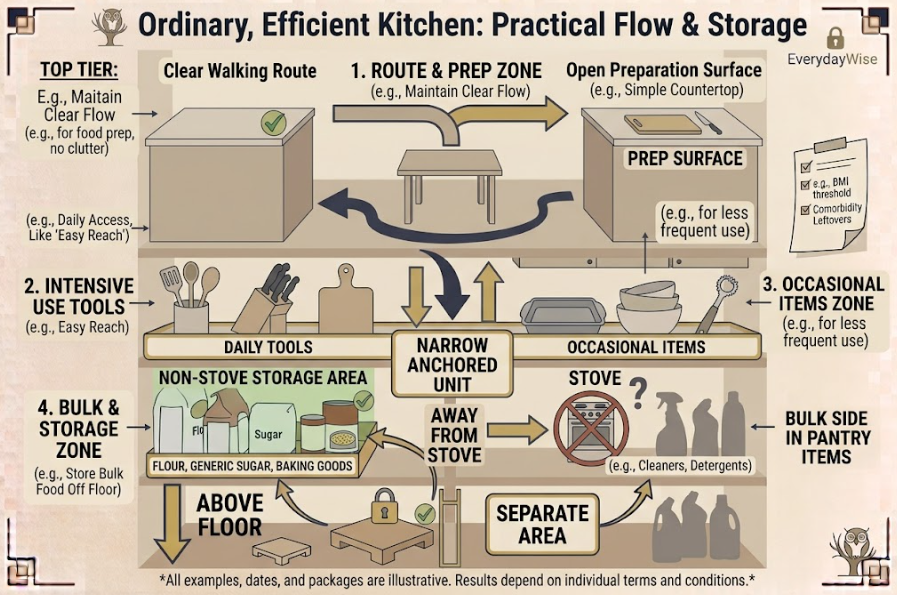
Measure the Working Kitchen, Not Just the Empty Wall
An empty strip of wall or floor is not automatically available storage. Doors swing into it. Drawers need room to open. A person may stand there while loading the dishwasher. A refrigerator door may need a wider arc so shelves and bins can be removed for cleaning.
Before buying anything, map the kitchen in use:
- Open the refrigerator, oven, dishwasher, and largest cabinet doors one at a time.
- Pull out the deepest drawer.
- Stand where food is normally prepared.
- Walk the route among refrigerator, sink, preparation area, stove, and table.
- Note electrical outlets, switches, shutoffs, vents, radiators, windows, and doorways.
- Identify where another household member passes while someone cooks.
- Mark the floor and wall areas that must remain clear.
Measure the proposed storage piece itself and its operating space. A cart needs room for handles, wheels, and items placed on top. A pull-out rack needs its full extension. A door organizer adds depth that may strike shelves or keep the door from closing.
Do not borrow a commercial accessibility measurement and present it as a universal residential rule. Bodies, mobility devices, assistance needs, housing codes, and kitchen layouts vary. The useful principle is an unobstructed approach: storage should not remove the clear floor or turning space a household member needs to reach and operate the kitchen.
Decide What Deserves Kitchen Space
When the room is small, location should reflect frequency and consequence.
Use three access levels:
- Primary: items used daily or several times a week, placed where they can be seen and reached without moving unrelated objects.
- Secondary: weekly or monthly items that can occupy higher, deeper, or less immediate space.
- Remote: seasonal, duplicate, entertaining, and specialty items that can reasonably live outside the kitchen in a clean and suitable location.
Remote storage is not failure. A dining-room cabinet may serve holiday dishes better than the only food-preparation drawer. A labelled container elsewhere may hold occasional baking decorations more effectively than a daily-use shelf.
Test each category before assigning space:
- Is it used in the kitchen?
- How often is it used?
- Where is it used?
- Is it heavy, sharp, breakable, hot, wet, or spill-prone?
- Does it need power, ventilation, or manufacturer-specified clearance?
- Who needs to reach it?
- What would become less accessible if it moved here?
The final question prevents an “extra” shelf from quietly consuming the only comfortable work surface.
Preserve One Real Preparation Surface
Counter storage often expands until food preparation moves to a cutting board balanced over the sink or to the dining table. Decide how much continuous surface the household needs for its ordinary meal and protect it.
Countertop items should earn their position through frequent use, difficult relocation, or a real physical need. A coffee maker used every morning may stay. A large appliance used twice a year usually should not occupy the same priority space.
Use trays only when they create a complete action group. A tea tray might hold the kettle’s pantry companions and lift away as one unit. A tray containing unrelated bottles, papers, medicines, and utensils merely gives clutter a border.
Do not store anything on an appliance unless the manufacturer explicitly permits it. Heat, vibration, ventilation, moisture, and maintenance access may make the surface unsuitable. Keep refrigerator tops, microwave tops, and range areas clear when instructions require clearance or when stored objects could fall, melt, or block airflow.
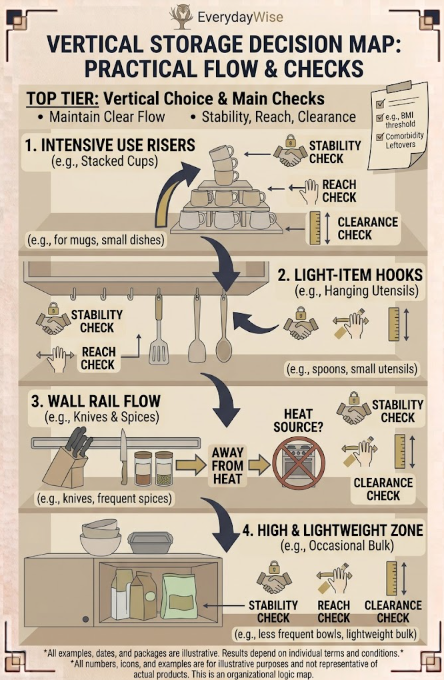
Use Vertical Space in Layers
Vertical storage is most useful when it improves visibility without creating a falling or reaching hazard.
Add a shelf within a shelf
A freestanding shelf riser can separate plates, bowls, cans, or mugs without permanent construction. Choose a stable size that sits fully on the supporting shelf and does not exceed its load capacity. Avoid stacking several risers into a tall, unstable structure.
Use hooks for light, predictable items
Hooks can hold measuring cups, lightweight utensils, or towels when the mounting surface and hardware suit the load. Keep hanging items away from burners, heating elements, open flames, and locations where they catch on clothing or strike someone opening a cabinet.
Add a rail only where retrieval is safe
A wall rail can free a drawer, but it places tools in the open. Sharp tools, heavy pans, and breakable items require stronger mounting and household-specific safety. A rail above the stove may expose items to heat, grease, and flame and can encourage reaching across hot cookware.
Use upper space for light, occasional categories
The highest cabinet space works best for lightweight items used infrequently. It is a poor location for a heavy appliance, large glass bowl, or anything that must be lifted down while standing on unstable furniture. If a household member cannot reach the space safely, treat it as unavailable or redesign access with an appropriate fixed solution.
Use Doors Without Preventing Them From Working
Cabinet and pantry doors can hold shallow items, but door storage changes weight, depth, and closing clearance.
Before installation:
- check hinges and manufacturer instructions;
- measure the space between the door and interior shelves;
- confirm the organizer does not strike handles, adjacent doors, or drawers;
- test whether bottles remain upright when the door moves;
- avoid heavy loads that pull the door out of alignment; and
- keep child safety and sharp objects in mind.
An over-door rack on a room door also changes the door’s operation. It should not prevent full closure, damage a fire-rated or required door, obstruct an exit, or create a head-level projection. Renters should check lease and building rules before drilling or changing doors.
Door storage works best for narrow, frequently used, low-risk items. It is less suitable for large glass bottles, heavy cans, knives, cleaners accessible to children, or packages that fall each time the door opens.
Make Deep Cabinets Shallower in Practice
Deep cabinets create theoretical capacity and practical invisibility. The solution is not always a larger bin.
Use one of four patterns:
- Shallow pull-forward trays: one use category moves together without concealing several layers.
- Turntables: bottles or jars remain in one visible row and rotate into reach.
- Tiered risers: back-row cans or spices become visible above the front row.
- Full-extension hardware: professionally suitable drawers or pull-outs bring the contents forward.
Choose the tool after measuring the cabinet opening, hinges, pipes, and actual product sizes. A bin that fits the shelf may not fit through the framed opening. A turntable may lose corner capacity but still improve use because nothing hides behind another row.
Do not pack a pull-out beyond what its slide or shelf supports. Heavy cookware and appliances need hardware rated for the load and installed according to instructions. Article”How to Store Pots, Pans, and Lids” will address pots, pans, and lids in detail.
Evaluate Rolling Carts as Moving Workstations
A narrow cart can hold breakfast supplies, baking ingredients, or a small appliance and move away when not needed. It can also block circulation, roll during use, or become an unstable climbing point.
A useful cart has:
- a measured parking location outside the cooking and escape route;
- a width and handle position that do not catch passing clothing;
- stable construction and appropriate load capacity;
- effective wheel locks when stationary work occurs;
- heavier items low and lighter items above;
- no hot appliance use unless the cart and appliance instructions support it; and
- cord management that never crosses a walkway or approaches water or heat.
Test the cart with appliance and cabinet doors open. If it must move every time someone reaches the refrigerator, it has not created dependable storage. A stationary narrow shelf may be better—but a freestanding unit can introduce tip-over risk and may need anchoring under its instructions and household conditions.
CPSC advises anchoring furniture with drawers, doors, and shelves to prevent tip-over injuries. Use the hardware and wall attachment appropriate to the product and wall. Do not treat a generic adhesive strap as equivalent to a verified installation.
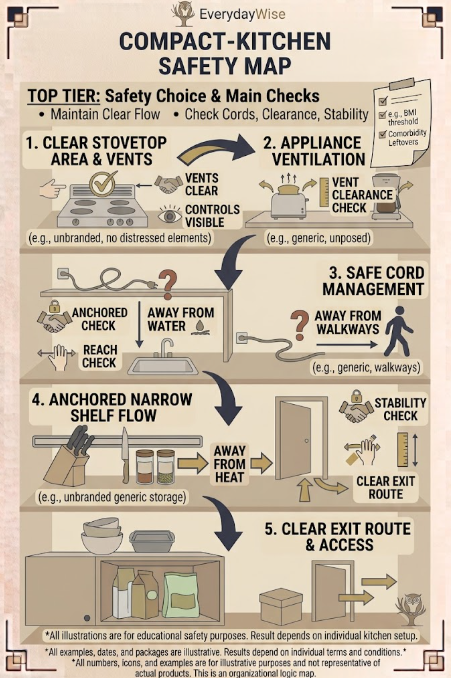
Keep Cooking and Electrical Clearances Non-Negotiable
Small kitchens tempt households to use every surface close to the stove. This is where capacity must yield to safety.
NFPA advises keeping anything that can catch fire—such as oven mitts, wooden utensils, food packaging, towels, and curtains—away from the stovetop. A decorative basket, hanging rail, paper organizer, spice shelf, or snack bin should not enter the heat and flame area merely because the wall is convenient.
Keep appliance vents and manufacturer-required clearances open. Do not run cords across sinks, burners, walking routes, or sharp edges. The U.S. Fire Administration advises plugging major appliances directly into wall outlets rather than using extension cords and recommends unplugging small appliances when not in use.
Storage should also preserve access to:
- appliance controls and plugs;
- gas or water shutoffs when present;
- electrical panels and breakers;
- fire extinguishing equipment when provided;
- smoke and carbon-monoxide alarms;
- windows and doors used for escape; and
- the range’s anti-tip bracket and maintenance access.
CPSC notes that freestanding ranges should use anti-tip brackets to reduce crushing and scalding hazards. A narrow storage gap beside a range is not a reason to interfere with that installation or store combustible material beside heat.
Create a Landing Place Without Creating a Paper Pile
Small kitchens often receive keys, mail, school papers, chargers, medicines, shopping lists, and reusable bags because the room sits near the entrance and household activity. These items consume food-preparation space and may create contamination, privacy, or safety problems.
If the kitchen must serve as a landing zone, make it narrow and complete:
- one wall-mounted holder for active papers;
- one hook for the reusable bag currently in rotation;
- one small tray for keys away from food preparation;
- one shopping-list location; and
- a removal route for everything else.
Medicines require storage according to their labels and household safety needs, not an open catch-all tray. Chargers and electronics need distance from water, heat, and spills. Cleaning chemicals belong in a suitable separate location, not above or beside food because a small shelf is available.
Design for the Person Who Has the Hardest Reach
A small kitchen can be efficient for one person and inaccessible to another. Height, grip, vision, balance, pain, fatigue, pregnancy, age, mobility aids, and temporary injury change what “easy reach” means.
Ask each household member:
- Which necessary item requires help?
- Which door, bin, or lid takes too much force?
- Where is bending or reaching painful or unstable?
- Does an open drawer or cart remove needed floor space?
- Can labels be read under the available lighting?
- Can the kitchen be used without carrying items across the room repeatedly?
Move a limited set of daily items into the easiest range for the person who uses them. Duplicating one low-cost tool at two work areas may be more useful than forcing repeated travel. Handles, pull-out shelves, lighting, and contrasting labels can improve access, but any modification should suit the user and preserve safety.
ADA design standards provide important requirements for covered facilities; they are not a substitute for assessing a private household’s actual resident and applicable local housing rules. A renter or owner planning structural changes may need the landlord, building authority, occupational therapist, accessibility specialist, or qualified contractor.
Add Storage One Category at a Time
Storage products can become a second clutter category. Use a test sequence before buying:
- Name the exact category that lacks a home.
- Remove items that do not belong in the kitchen.
- Measure the category and proposed location.
- Protect doors, controls, vents, heat clearance, and circulation.
- Test the idea with a temporary tray or cardboard footprint.
- Choose the smallest structure that solves the access problem.
- Install it according to instructions.
- Use the kitchen for two ordinary shopping and cooking cycles.
- Keep, adjust, or remove the structure based on retrieval and reset effort.
Do not add the next organizer until the first one has proved useful. This prevents a coordinated set of products from locking the kitchen into an untested design.
A Practical 30-Minute Improvement
Choose one repeated obstruction: a counter appliance that is rarely used, a deep cabinet with invisible staples, or a drawer that contains several unrelated tasks.
- Define the function that must become easier.
- Remove only that category.
- Assign primary, secondary, and remote items.
- Measure the available space with doors and drawers open.
- create a temporary shallow zone using something already owned;
- return only the items that fit the function; and
- cook one ordinary meal before purchasing permanent storage.
Success is not measured by how many objects entered the kitchen. It is measured by whether a person can prepare food, open appliances, retrieve daily items, and move safely with fewer interruptions.
FAQ
What is the best first storage improvement for a small kitchen?
Identify the most repeated obstruction first. A shallow tray in a deep cabinet, one shelf riser, or relocating an occasional appliance may help more than a large new storage unit.
Should I use the space above the refrigerator?
Only if the appliance instructions allow it and stored items do not block ventilation, fall, encounter damaging heat, or require unsafe reaching. Lightweight occasional items in an appropriate secured cabinet may be safer than loose objects on top.
Are magnetic racks safe on a refrigerator or appliance?
Check the appliance manufacturer’s guidance, rack rating, magnet strength, ventilation, heat, door movement, and falling risk. Do not cover vents or place heavy, sharp, or breakable objects where they can detach.
Is a rolling cart better than fixed shelving?
It depends on the parking location and task. A cart helps when it can lock, remain stable, and move without blocking doors or routes. Fixed shelving may be better when the cart requires constant relocation.
What should stay off the countertop?
Items unrelated to frequent food preparation, objects that create fire or electrical risk, and occasional appliances that can be stored accessibly elsewhere should be reviewed first. Protect enough continuous surface for an ordinary meal.
Can I hang utensils above the stove?
Avoid placing combustible objects or storage where heat, flame, steam, grease, or reaching across hot cookware creates risk. NFPA advises keeping items that can catch fire away from the stovetop.
How do I add storage in a rental kitchen?
Use reversible, measured solutions that do not damage surfaces, interfere with required doors or safety devices, or violate the lease. Obtain permission before drilling, altering cabinetry, or attaching structural hardware.
Sources
- Safety With Cooking Equipment — National Fire Protection Association
- Appliance and Electrical Fire Safety — U.S. Fire Administration
- Anchor It: Tip-Over Information Center — U.S. Consumer Product Safety Commission
- Childproofing Your Home — U.S. Consumer Product Safety Commission
- 2010 ADA Standards for Accessible Design — U.S. Department of Justice
More in This Cluster: Kitchen and Pantry Organization
- How to Organize a Pantry by Use
- Small-Kitchen Storage Ideas That Preserve Access (you are here)
- How to Store Pots, Pans, and Lids
- Refrigerator Organization for Food Safety
- How to Create a Snack Station
- Bulk Food Storage Without Waste
- Kitchen Zones: A Practical Setup Guide