A notification arrives saying your child’s Trump Accounts is ready to activate. The $1,000 federal deposit sounds straightforward enough. What’s less obvious is the next question sitting right behind it: now that the account exists, should you actually put your own money into it — or would that money grow faster somewhere else?

Quick Action Summary
Trump Account contributions became possible on July 4, 2026. The $1,000 federal deposit is separate from — and doesn’t require — any additional money from you. Whether adding your own contributions makes sense depends on what you’re saving for: a 529 plan usually wins for education costs, a custodial account wins for flexibility, and a Trump Account fills a narrower gap in between.
What a Trump Account Actually Is
A Trump Account is a new type of retirement account for children, created under the Working Families Tax Cuts law and officially opened for contributions starting July 4, 2026. The account functions much like a traditional IRA, but for a minor, with its own eligibility rules and contribution limits attached.
Two separate things are happening inside these accounts, and it helps to keep them apart:
- The federal pilot deposit — a one-time $1,000 contribution from the U.S. Treasury.
- Ongoing contributions — money that parents, other family members, or employers choose to add on top.
The $1,000 deposit and the decision to add more money are not the same choice. A family can accept the $1,000 and stop there. The question this article focuses on is the second one: whether contributing beyond that $1,000 is worth doing for your household.
Who Qualifies for the $1,000 Deposit
The federal pilot contribution is narrower than “every child born in the United States.” To receive it, a child must:
- be a U.S. citizen with a valid Social Security number (an ITIN does not qualify);
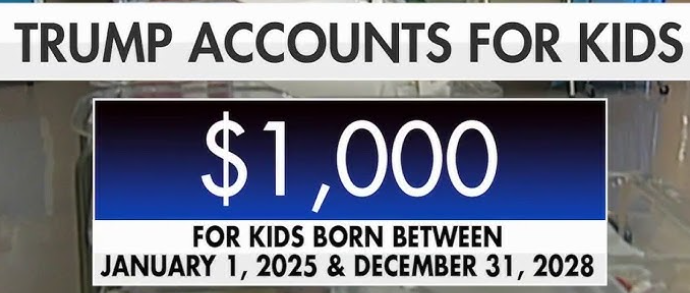
- have been born after December 31, 2024, and before January 1, 2029; and
- not already have a prior pilot program election processed for them.
The $1,000 isn’t deposited automatically just because a child meets those conditions — an eligible individual has to actually elect to receive it, using IRS Form 4547 or the trumpaccounts.gov tool. Two different election roles are involved here, and it’s worth keeping them separate:
- Electing to open the account (with no pilot contribution) generally follows a priority order: legal guardian first, then parent, then adult sibling, then grandparent.
- Electing to receive the $1,000 pilot contribution is more specific — it must be made by someone who anticipates claiming the child as their “qualifying child” for tax purposes that year (per IRC §152(c)), typically the custodial parent. A grandparent or adult sibling can generally open the account itself, but claiming the $1,000 pilot deposit specifically requires meeting that qualifying-child relationship test.
Children born outside the 2025–2028 window can still have a Trump Account opened for them — the general requirement is simply that they’re under 18 with a valid Social Security number. Citizenship is required specifically for the $1,000 pilot deposit, not for opening a Trump Account itself. These children can still receive family or employer contributions; they simply don’t receive the $1,000 federal pilot deposit.
Some children who don’t qualify for the $1,000 deposit may separately be eligible for a one-time $250 charitable deposit from the Michael & Susan Dell Foundation — reported eligibility criteria include being age 10 or younger and living in a ZIP code with a median income below $150,000, with enrollment reportedly capped at a set number of accounts. This is a private philanthropic program, not a federal entitlement, so its exact rules, funding limits, and enrollment status should be confirmed directly through the program rather than assumed from this summary.
There is no income limit on the $1,000 federal deposit itself. A household earning $40,000 and a household earning $400,000 both qualify equally, as long as the child meets the birth-year, citizenship, and election requirements above for the pilot deposit specifically.
What “Adding Your Own Money” Actually Looks Like
Once an account is open, contributions can come from more than one source, all counting toward a combined annual limit:
- Parents, family members, or the account owner: contributions are allowed, subject to the overall annual cap, and these contributions create “basis” in the account — money that was already taxed once and generally isn’t taxed again on withdrawal.
- Employers: up to $2,500 per year, excluded from the employee’s taxable income. This limit is per employee, not per child — if an employee has two or more children with Trump Accounts, the employer’s tax-free contributions across all of those accounts still can’t exceed $2,500 total in a year. A cafeteria-plan salary-reduction contribution is only allowed when it’s made to a dependent’s Trump Account, not the employee’s own.
- Combined annual limit: total contributions from parents, employees, and employer sources are capped at $5,000 per year. The $1,000 federal pilot deposit does not count against this limit and doesn’t create basis, since it’s treated differently from a personal contribution.
Funds inside a Trump Account must be invested in specific low-cost mutual funds or ETFs that track a broad U.S. stock market index, such as the S&P 500. This is a meaningfully narrower investment menu than what’s available in most 529 plans or custodial brokerage accounts — there’s no option to pick individual stocks, bonds, or international funds inside a Trump Account.
The Withdrawal Rules Change the Math
This is the detail that most affects whether contributing extra money makes sense: money in a Trump Account cannot be withdrawn at all during what’s officially called the “growth period,” which runs through December 31 of the year the child turns 17 — meaning the post-growth-period rules technically begin on January 1 of the year the child turns 18, which can be several months before their actual birthday. There’s no hardship withdrawal option and no way to close the account early to access the funds.
Once the growth period ends, the account converts to being governed by ordinary traditional IRA rules — and this is the part worth understanding carefully rather than treating as a clean “unlocked at 18” moment:
- Withdrawals are split proportionally between basis and taxable amounts. The account doesn’t let you choose to withdraw the “already-taxed” parent-contributed portion first — each withdrawal is divided based on the ratio of total basis to total account value, with the taxable portion included in ordinary income.
- A 10% additional tax generally applies to withdrawals made before age 59½, unless a specific exception applies — such as qualified higher education expenses or a first home purchase. The end of the growth period removes the no-withdrawals-at-all restriction, but it does not by itself remove the early-withdrawal penalty that applies to traditional IRAs generally.
- Not all contributions create basis. Contributions from parents or other individual contributors create basis — money that was already taxed and isn’t taxed again when withdrawn. But the $1,000 federal pilot deposit and employer contributions do not create basis, so a larger share of pilot-and-employer-funded growth ends up taxable when it’s eventually withdrawn, pro-rated across the whole account rather than tracked separately by source.
In practice, this means a Trump Account is better understood as a long-term, IRA-style account that happens to allow non-education uses — not a flexible savings account that simply “opens up” once a child turns 18. The end of the growth period changes which set of rules applies; it doesn’t remove the tax structure of a retirement account.
That structure matters when you compare it to the two accounts most families already consider for a child’s future.

Trump Account vs. 529 Plan: The Comparison Most Parents Actually Need
If the money is meant for education — K-12 tuition, college, trade school, or even a portion of student loan repayment — a 529 plan generally offers a stronger tax outcome than a Trump Account.
| Trump Account | 529 Plan | |
|---|---|---|
| Growth | Tax-deferred | Tax-deferred |
| Withdrawals for education | Education can qualify as an exception to the 10% early-withdrawal penalty, but earnings are still taxed as ordinary income | Tax-free (both penalty and income tax) when used for qualified education expenses |
| Non-qualified or general-purpose withdrawals | Taxable portion (pro-rated against basis) is subject to ordinary income tax; a 10% additional tax generally applies before age 59½, unless an exception applies | Earnings portion is subject to income tax plus a 10% additional tax when not used for qualified expenses, unless an exception applies |
| Contribution limit | $5,000/year combined (non-federal sources) | Much higher limits; varies by state, often six figures lifetime |
| Investment choice | Narrow — specific U.S. stock index funds only | Broad — age-based portfolios, multiple fund choices |
| Access before 18 | No access at all — no exceptions during the growth period | Can be used any time for qualifying expenses, at any age |
| State tax benefit | No federal deduction for individual contributions; state-level treatment isn’t yet fully established | Many states offer a state income tax deduction or credit for contributions |
| Best suited for | A long-term, IRA-style account with a federal head start | Money specifically earmarked for education |
The core difference isn’t “restricted vs. unrestricted” — it’s which tax break applies to which use. A 529 plan’s biggest advantage is that qualified education withdrawals are entirely tax-free, both the penalty and the income tax. A Trump Account can treat education as an exception to the early-withdrawal penalty, but the earnings portion is still taxed as ordinary income either way. For money you already know is going toward education, that makes a 529 plan the more direct tax win in nearly every case.
Trump Account vs. Custodial Account (UGMA/UTMA)
A custodial account is often the other option families weigh, especially if they want more flexibility than either a Trump Account or a 529 plan provides.
| Trump Account | Custodial Account (UGMA/UTMA) | |
|---|---|---|
| Purpose restriction | No restriction on what the money is used for, but it’s still taxed and penalized like a retirement account before 59½ (with limited exceptions) | No restriction — funds can be used for anything, at the custodian’s discretion until transfer |
| Investment choice | Narrow (specific index funds) | Broad — stocks, bonds, funds, and other assets |
| Ownership | Child’s, subject to Trump Account/IRA rules | Irrevocably the child’s once contributed |
| Age of transfer | No set “transfer” — the child becomes the account owner outright, but IRA distribution rules still apply | 18 or 21, depending on state, with no further tax restrictions after transfer |
| Effect on financial aid | Not yet clearly addressed in current FAFSA guidance — no explicit Trump Account category exists in the form as of this writing | Counted as the student’s asset, assessed at a higher rate than parent-owned assets |
| Best suited for | Families who want the federal deposit plus modest additional saving, and are comfortable with IRA-style tax rules | Families who want maximum flexibility and don’t mind full ownership transferring to the child |
The financial aid impact is worth flagging separately. Assets counted directly in a student’s name — as custodial accounts are — are typically assessed more heavily in federal financial aid formulas than assets held in a parent’s name. Current FAFSA guidance doesn’t yet spell out a specific category for Trump Account balances during the growth period, so how they’ll ultimately be treated in aid calculations remains an open question rather than a settled answer.
Three Questions That Actually Decide This
Instead of treating this as “should I max it out,” it’s more useful to work through three questions in order.
1. Is the money for education, or is it undesignated savings for the child’s future? If the answer is clearly education, a 529 plan’s tax-free qualified withdrawals are difficult for a Trump Account to beat. If the answer is “I’m not sure yet,” the Trump Account’s broader range of permitted uses becomes more appealing — though it’s worth remembering that flexibility applies to what the money can eventually be used for, not to how easily or tax-efficiently it can be accessed.
2. Do you want the investment decision made for you, or do you want more control? The Trump Account’s limited menu of U.S. stock index funds is a feature for some families and a limitation for others. If you’d rather not think about fund selection at all, that simplicity has value. If you want to diversify into bonds, international markets, or adjust risk as the child ages, a 529 plan or custodial account offers more room to do that.
3. Does your employer offer a Trump Account contribution benefit? Employer contributions of up to $2,500 per year are excluded from taxable income. If your workplace offers this, it’s effectively free money layered on top of the $1,000 federal deposit — worth checking with HR before deciding how much to contribute personally elsewhere.
A Reasonable Way to Think About the $5,000 Ceiling
Because the combined contribution limit is $5,000 per year across all non-federal sources, a family that wants to contribute significantly more than that for a child’s future will hit the Trump Account’s ceiling quickly. In that case, the Trump Account tends to work best as one piece of a broader plan — accepting the $1,000 federal deposit, contributing a modest amount annually if it fits the budget, and directing the bulk of dedicated education savings toward a 529 plan, while any fully flexible extra savings go into a custodial account or a regular investment account in the parent’s name.
Putting the Three Questions Together
Working through an example makes the framework easier to apply to your own situation.
Consider a family with a child born in March 2026, who meets the child-level eligibility requirements for the $1,000 federal deposit — meaning a parent still needs to file the election to actually receive it. The parents also already have a 529 plan open for the child, funded through modest monthly contributions since birth. Their employer doesn’t currently offer a Trump Account contribution benefit.
Running through the three questions:
- Is the money for education, or undesignated savings? They’re already covering education through the 529 plan, so the Trump Account isn’t competing with that goal — it’s filling a different one: a long-term, IRA-style account the child will eventually control, understanding that early withdrawals before 59½ still face the standard IRA rules unless an exception applies.
- Do they want control over investments, or simplicity? They’re comfortable with the Trump Account’s fixed index-fund menu, since they’re not trying to actively manage this particular account.
- Is there an employer benefit to factor in? Not currently, so any contribution beyond the $1,000 deposit comes directly from the household budget rather than being offset by free employer money.
Their reasonable conclusion: claim the $1,000 deposit, keep the 529 plan as the primary education vehicle, and contribute a small, optional amount to the Trump Account only if there’s room in the budget after other savings goals are met — treating it as a bonus account rather than a competing priority.
A different family, without an existing 529 plan and with an employer that matches Trump Account contributions, might reach the opposite conclusion: prioritize the Trump Account more heavily in the early years to capture the employer match, then open a 529 plan once the child’s education timeline becomes clearer. Neither approach is universally correct — the right order depends on what else is already in place.
What NOT to Do
- Don’t assume the $1,000 deposit requires any action beyond enrollment. It’s a one-time contribution tied to eligibility, not something that needs ongoing contributions to “activate” or “keep.”
- Don’t redirect money earmarked for education savings into a Trump Account without comparing the tax treatment first — a 529 plan’s tax-free qualified withdrawal is usually the stronger choice for that specific goal.
- Don’t assume all children in the household qualify for the $1,000 deposit equally. Birth year matters — a child born in 2024 does not qualify for the federal pilot deposit even though a sibling born in 2025 does.
- Don’t assume the account “opens up” freely once your child turns 18. Traditional IRA rules take effect starting January 1 of the year the child turns 18 — which can be months before their actual birthday — and those rules include a 10% additional tax on withdrawals before age 59½ unless a specific exception applies.
- Don’t wait to check with an employer. Employer contributions are optional on the company’s part, and confirming availability early avoids missing a year of tax-free employer contributions.
- Don’t treat this as a decision that needs to be made all at once. Accepting the $1,000 deposit, deciding on personal contributions, and choosing how to split future savings across accounts can happen in stages as the rules and your family’s plans become clearer.
The Practical Bottom Line
The $1,000 federal deposit is close to a “why not” decision for any eligible family — it costs nothing to claim through Form 4547, once the right person makes the election. The harder decision is what happens after that: whether to treat the Trump Account as a primary savings vehicle or as a small, federally seeded addition to a plan built mainly around a 529 account and, if flexibility matters most, a custodial account. For most families, the strongest approach isn’t choosing one account over the others — it’s understanding which type of saving belongs in which account, and letting the Trump Account do the specific job it’s actually built for: a modest, IRA-style account, governed by traditional IRA tax rules after the growth period, that starts with $1,000 already inside it.
This article is for general informational and educational purposes only and does not constitute tax, legal, or financial advice. Trump Account rules, contribution limits, and financial aid treatment are new and may be clarified or changed through future IRS guidance. Consult a qualified tax professional or financial advisor before making contribution decisions for your specific situation.
FAQ Section
Q1. Do I have to contribute my own money for my child to get the $1,000 Trump Account deposit? No. The $1,000 federal pilot deposit is separate from personal contributions. It isn’t automatic, though — someone who anticipates claiming the child as their “qualifying child” for tax purposes that year (under IRC §152(c), often the custodial parent) has to actively elect to receive it, using Form 4547 or the trumpaccounts.gov tool. No additional family money is required to receive it.
Q2. Can I open a Trump Account for a child born before 2025? Yes, provided the child hasn’t reached age 18 by the end of the election year and has a valid Social Security number — there’s no citizenship requirement for opening the account itself. That child won’t receive the $1,000 federal pilot deposit, since eligibility for that specific deposit is limited to children born between January 1, 2025, and December 31, 2028, but the account can still be opened and can still receive family or employer contributions.
Q3. Is a Trump Account better than a 529 plan? It depends on the goal. For education-specific savings, a 529 plan’s tax-free qualified withdrawals generally make it the stronger choice. A Trump Account works better as a long-term, IRA-style account whose eventual uses aren’t limited to education — but whose distributions still follow traditional IRA tax rules rather than offering a tax-free exit.
Q4. Can grandparents contribute to a Trump Account? Yes. Contributions can come from parents, other family members, or the account owner, as long as the combined total from all non-federal sources stays within the $5,000 annual limit.
Q5. What happens to the money once the growth period ends? The growth period — during which no withdrawals are allowed at all — ends December 31 of the year the child turns 17, so the shift to standard rules technically begins January 1 of the year they turn 18, possibly months before their actual birthday. From that point, the account is governed by standard traditional IRA rules: withdrawals are split proportionally between basis and taxable amounts, and a 10% additional tax generally applies to withdrawals made before age 59½ unless an exception applies, such as qualified education expenses or a first home purchase. It’s not a clean “unlocked, no restrictions” moment — it’s a shift from one set of restrictions (no access at all) to another (IRA tax rules).
Q6. Does contributing to a Trump Account affect financial aid eligibility? This isn’t fully settled yet, since the contribution window only opened in mid-2026 and current FAFSA guidance doesn’t yet spell out a specific category for Trump Account balances. Custodial accounts are typically assessed more heavily than parent-owned accounts in federal financial aid formulas; how Trump Account balances will be treated is still becoming clear as guidance develops.
Q7. Is contributing to a Trump Account the same as putting money in a regular IRA for my child? Similar, but not identical. A Trump Account uses the same underlying IRA tax framework, but with its own contribution limit ($5,000/year combined, separate from regular IRA limits), a restricted investment menu, and no requirement that the child have earned income to receive contributions — a real difference from a standard custodial IRA, which does require the child to have compensation.