Quick Summary
Federal Student Aid opened the second phase of 2027–28 FAFSA beta testing on August 25, 2026. Students and contributors can now request access before the form becomes publicly available to everyone, which the Department of Education says will happen by October 1.
This is not a practice form. A student admitted to the beta can submit an official 2027–28 Free Application for Federal Student Aid, list up to 20 colleges or career schools, and have an official Institutional Student Information Record sent to those institutions and the relevant state agency.
But requesting access is not the same as being selected, and submitting through the beta does not give a student an advantage over other applicants. Federal Student Aid says it will admit groups of users during the beta period. Colleges may also wait until their normal cycle to download or process early records.
Reader Decision
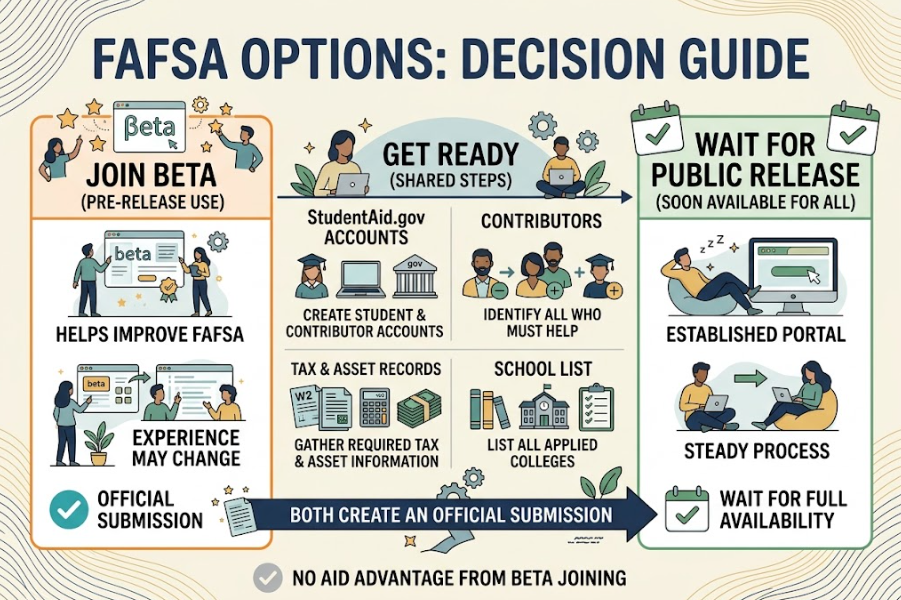
Consider the beta if the student and all required contributors are ready, the family is comfortable using a form that is still being tested, and early completion would reduce a real scheduling burden. Waiting for public access by October 1 is also reasonable. Either way, check state and college deadlines separately and do not treat beta participation as a guarantee of earlier or larger aid.
What Opened on August 25
The 2027–28 FAFSA beta has two rounds. Beta 1 began in early August through selected schools and community organizations. Federal Student Aid says nearly 2,000 students completed forms during that phase.
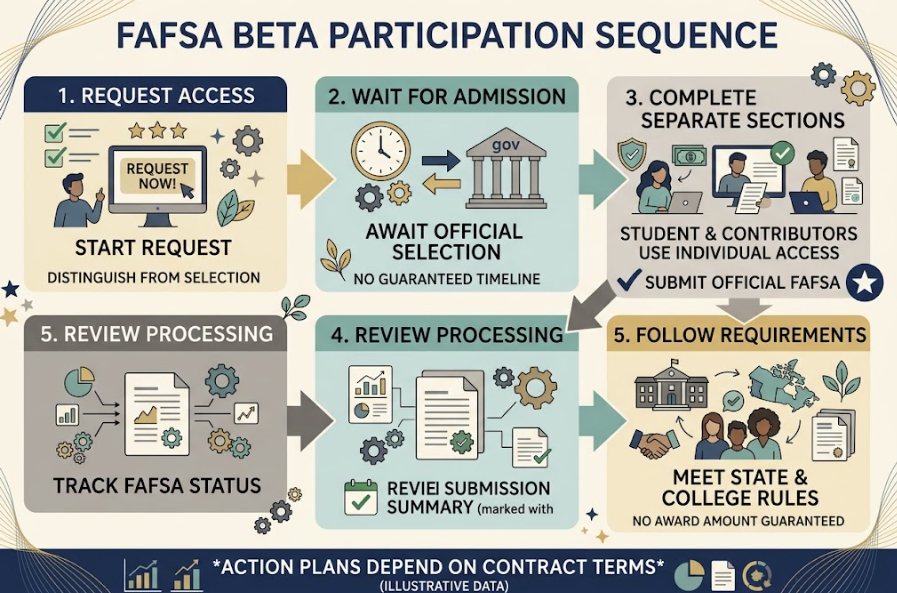
Beta 2 broadens access. Any student or contributor can request participation through StudentAid.gov, and Federal Student Aid will admit groups of users rather than opening the form to everyone at once. The request therefore creates an opportunity to participate; it does not promise immediate access.
The department uses the beta to identify technical problems, verify that data reaches institutions, and make fixes before public access. Beta 1 identified federal tax-information transfer, traffic-management, and question-wording issues.
Families who join are not merely testing buttons with fictional information. Their submission is part of the real financial-aid process.
Is a Beta FAFSA an Official FAFSA?
Yes. Federal Student Aid says beta participants complete a real 2027–28 FAFSA. The resulting ISIR is official, and institutions should use it as the basis for packaging aid when the appropriate point in their awarding cycle arrives.
A successfully processed beta FAFSA should not be recreated merely because it was filed early. Monitor its status, review the FAFSA Submission Summary, and correct missing or inaccurate information.
Early submission does not mean the college will immediately calculate an award. Federal Student Aid says many institutions and state agencies may wait until their normal awarding cycle because their software is not ready, they have not begun admissions or aid packaging, or they prefer their established schedule. Beta records are not supposed to be removed from institutional mailboxes while schools wait.
The practical distinction is simple: the application can be official before the college is ready to act on it.
Does Joining Give You Priority for Aid?
Federal Student Aid directly says that submitting during beta does not give a student an advantage over other students. It provides an early start, not a federal aid preference or promise of a larger award.
That statement should not be stretched into a claim that timing never matters anywhere. State agencies, colleges, and individual programs can have their own priority dates, limited funding, additional applications, or document requirements. A FAFSA alone may not complete every state or institutional aid process.
Check deadlines with the student’s state agency and every school under serious consideration. If a program says to apply as soon as possible or while funds remain, ask whether an official beta FAFSA satisfies that step and whether another application is required. Do not assume a beta request date counts as a submission date; what matters is whether the FAFSA itself was completed and processed.
Who May Benefit From Joining?
Beta participation can help when the student will file for 2027–28, contributors are available, and September is easier than October because of travel, work, caregiving, or admissions demands.
It can also reveal account or contributor problems while there is time to resolve them. Each person required to contribute needs their own StudentAid.gov account. Accounts should not be shared, even within a household, because each person uses an account to provide legally significant information and a signature.
Joining may be less useful when major information is not ready, a contributor cannot participate, or the family would be uncomfortable encountering a technical issue in a live test. Waiting is not falling behind the federal public-release schedule. The department says the form will be available to everyone by October 1.
The official invitation does not support joining from fear that waiting will forfeit aid.
What to Prepare Before Requesting Access
Preparation matters more than being among the first people to click the request button. The student and required contributors should identify who must participate and confirm that each person can access their own StudentAid.gov account and email.
Gather the records normally needed for FAFSA completion:
- the student’s and contributors’ identifying and contact information;
- the applicable federal tax information and tax returns;
- records of child support received, when applicable;
- current cash, checking, savings, investment, business, and farm information when requested; and
- a list of colleges, career schools, or trade schools under consideration.
The online FAFSA can include up to 20 school codes. A student does not need to have been admitted before listing a school. Include realistic possibilities rather than waiting for an admissions decision, and check whether the student’s state requires schools to be listed in a particular order.
Financial information must be entered according to the form’s instructions. If the tax year shown on the FAFSA no longer reflects the family’s circumstances because of job loss, reduced income, or another major change, complete the form as directed and then contact each school’s financial-aid office about a possible professional-judgment review. Do not substitute a different tax year on your own.
If You Request Access but Are Not Admitted
A participation request is not a submitted FAFSA. Watch the email and StudentAid.gov account connected to the request, but avoid creating duplicate accounts or submitting information through unofficial links.
If access does not arrive, confirm accounts, contributors, school codes, and records for public release. Recheck FAFSA Central because beta capacity and timing can change.
Do not let the beta distract from other application work. College admissions, CSS Profile requirements at participating institutions, state aid forms, scholarships, verification documents, and institutional deadlines are separate processes.
After a Beta Submission
Save the confirmation and review the FAFSA status in the student’s account. When the FAFSA Submission Summary becomes available, check names, contributor completion, school codes, reported information, processing status, Student Aid Index, and any requested corrections or follow-up.
Confirm that priority schools are listed, but remember that sending FAFSA data does not equal applying for admission. Monitor messages from schools and state agencies for additional forms or documentation. If a school has not begun processing 2027–28 records, an early FAFSA may simply wait in its system until the normal cycle.
The Practical Takeaway
The beta is a real application pathway, not a race for better aid. Its value is practical: some prepared families can finish earlier and help Federal Student Aid identify problems before public release.
Join because early completion fits the household’s calendar and everyone required is ready. Wait because the family prefers the fully public release or needs more preparation. Neither choice replaces the more important work of submitting accurate information, meeting each applicable deadline, and following every school or state process after the FAFSA.
This newsletter provides general educational and financial-aid information. It is not legal, financial, or individualized aid advice. Beta access, public-release timing, deadlines, and application procedures may change. Verify current information with Federal Student Aid, state aid agencies, and the financial-aid offices of relevant institutions.
FAQ
Is the beta FAFSA only a test form?
No. Admitted participants complete an official 2027–28 FAFSA, and institutions receive official ISIRs that can be used for aid packaging at the appropriate time.
Will I need to submit another FAFSA on October 1?
Not merely because the first submission occurred during beta. Monitor processing, review the FAFSA Submission Summary, and complete corrections or follow-up if requested.
Does requesting beta access guarantee participation?
No. Federal Student Aid says students and contributors may request access and that groups of users will be admitted during the beta period.
Does a beta submission improve my aid priority?
Federal Student Aid says beta submission gives no advantage over other students. State, college, and program deadlines still require separate checking.
Can parents request access without the student?
Students and contributors may request participation, but the FAFSA remains the student’s application. Each required contributor must use their own StudentAid.gov account to complete their assigned section.
How many schools can be listed?
The online 2027–28 FAFSA can include up to 20 school codes. Check state rules about listing order and remember that listing a school is not an admissions application.
Sources
- Federal Student Aid — 2027–28 FAFSA Beta Testing Plan
- Federal Student Aid — FAFSA Central Updates
- Federal Student Aid — Early Access to the 2027–28 FAFSA Form
- Federal Student Aid — FAFSA Checklist: What Students Need