A full mailbox can make every envelope look equally important. Advertising, routine statements, government notices, insurance changes, and documents carrying deadlines may arrive in the same stack. The useful question is not whether a paper looks official. It is what the household may need that record to prove, claim, replace, or complete.
Jerome’s mailbox in Canada often fills between his roughly monthly checks, mostly with flyers. After separating those from the real mail, he may find utility notices, bank records, insurance correspondence, or letters from a city or government agency. He did not initially keep much of it. Over time, however, requests for proof of address and the practical value of certain contracts and notices changed his approach.
The answer is not to save every envelope. Keep a document when it remains the best evidence of an identity, right, obligation, transaction, ownership interest, claim, or unresolved action. Give it a category and review trigger when it enters the home.
Quick decision: Keep permanent identity and civil records, current documents that establish an active right or obligation, records supporting taxes or claims for the required period, and papers tied to unresolved matters. Keep a recent proof-of-address document only when it is likely to be accepted for a foreseeable need. Discard duplicates, advertisements, expired routine notices, and replaceable information after checking for deadlines, retention rules, and personal data.
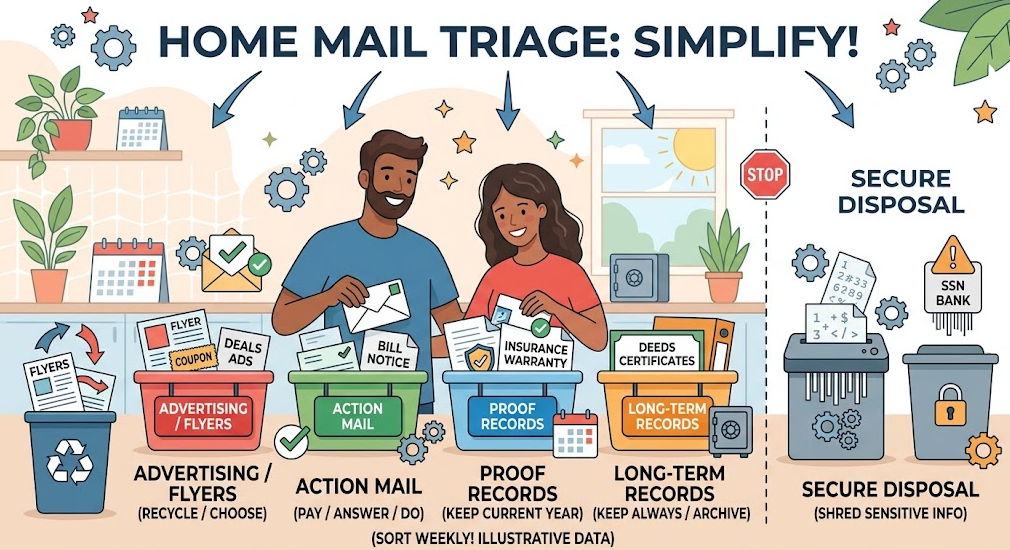
Decide by Purpose, Not by Appearance
Official letterhead does not automatically make a record permanent. A one-time notice may be safe to discard after the requested action is complete, while an ordinary-looking receipt may remain important because it supports a warranty or tax claim.
Ask what the document can still do:
- Prove identity or family status: birth, marriage, adoption, citizenship, immigration, or name-change records.
- Prove ownership or a continuing right: property, vehicle, loan, lease, account, pension, benefit, or insurance records.
- Define an obligation: a contract, court order, repayment agreement, assessment, renewal, cancellation, or notice with a deadline.
- Support money already reported or claimed: tax slips, receipts, invoices, statements, donation records, or proof of payment.
- Support a future claim: purchase records, warranties, repairs, insurance inventories, medical expense records, or correspondence about a dispute.
- Help replace or access something important: policy numbers, account contacts, document numbers, and secure copies of critical records.
- Show where a matter stands: applications, approvals, denials, complaint records, and unresolved correspondence.
If none of these purposes remains, the document may not need long-term storage. Before discarding it, confirm that no response date, payment issue, appeal window, return period, or current verification need remains.
Keep Core Identity and Civil Records
Some documents represent a fact that remains important for decades. These normally deserve permanent or very long-term protection:
- birth, adoption, marriage, divorce, and death certificates;
- citizenship, immigration, and legal-status records;
- passports and national identity documents while current, plus any older document specifically needed to prove travel or status history;
- legal name-change documents;
- wills, powers of attorney, trusts, guardianship, and custody records;
- military, pension, or benefit records that establish long-term eligibility; and
- final court orders and other legal records whose effect continues.
Not every photocopy has the same legal value as an original or certified copy. Record where the authoritative original is stored, who can access it, and how a replacement can be requested. A scan improves access but does not automatically replace an original that an authority may require.
Emergency-preparedness guidance from Ready.gov includes household identification, vital records, insurance, financial information, and other critical documents in financial preparedness. That does not mean all originals belong in a grab-and-go bag near the door. Security, fire and water protection, evacuation access, and the consequences of theft must be balanced. The cluster’s emergency-file article will address that trade-off directly.
Keep Records That Establish Ownership and Long-Term Rights
A home, vehicle, investment, loan, or pension can produce documents long after the original transaction. Keep records that establish the transaction and the terms still governing it.
For a home, this may include the deed or title-related records available in the jurisdiction, purchase and closing documents, mortgage or secured-loan agreements, surveys, permits, major improvement records, and documents affecting boundaries or use. In the United States, the Consumer Financial Protection Bureau identifies the promissory note, mortgage or security instrument, and deed among key closing documents. Names and legal systems differ elsewhere, so households should use the final records issued for their own transaction.
For vehicles and other titled property, retain the current ownership or registration record, financing or lien-release documents, and significant repair or warranty records while they remain relevant. For investments, pensions, or insurance, keep the documents needed to identify the institution, owner or beneficiary, contractual terms, and current claim route.
Do not assume an online account will preserve every historical version indefinitely. Download the final signed agreement and any amendment that changes rights, costs, beneficiaries, coverage, or repayment terms. A dashboard showing today’s balance is not necessarily a substitute for the contract that explains how the account works.
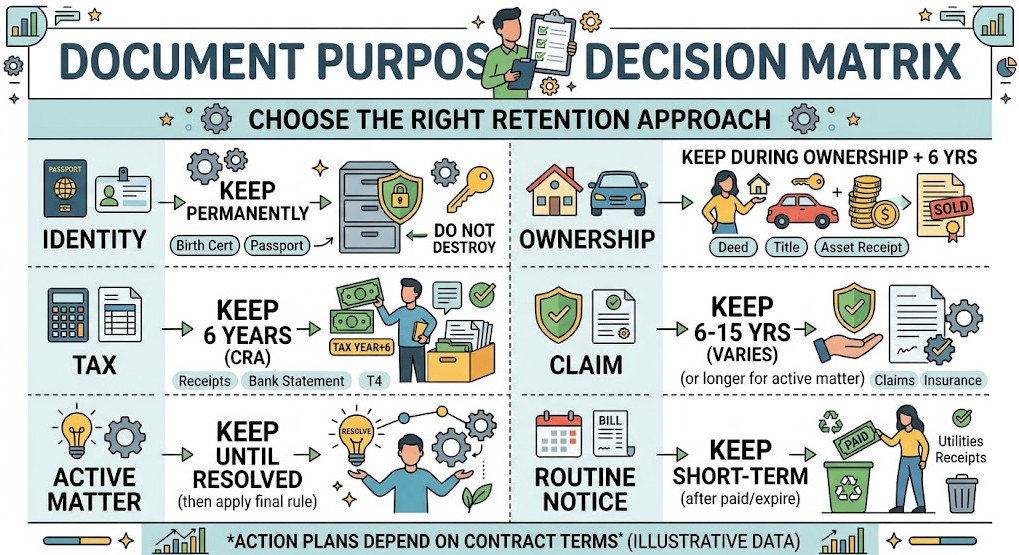
Keep Current Contracts and Coverage Records
Active agreements should remain available while they govern the household and, when needed, through a later claim or dispute period. Examples include:
- current home, tenant, auto, life, disability, and other insurance policies;
- leases and tenancy condition records;
- loan, credit, and repayment agreements;
- employment, benefit, pension, and severance records;
- service contracts with cancellation or renewal terms;
- child care, education, medical, or care agreements that create continuing responsibilities; and
- warranties and protection plans for items still covered.
Keep the signed version, not merely an unsigned quote or marketing summary. Add amendments, renewal notices, beneficiary confirmations, cancellation records, and proof of important communications. When one version replaces another, mark the current version clearly before archiving or disposing of the old one.
Expired documents may still matter if a claim arose during the covered period, a bill remains disputed, or a legal limitation period has not passed. Because those periods vary by contract and jurisdiction, a universal “discard on expiry” rule is unsafe.
Keep Tax and Claim Support for the Applicable Period
Tax records require a country-specific rule. The retention clock may depend on the year involved, the filing date, an amendment, an audit, an appeal, property ownership, or business use.
For example, the Canada Revenue Agency tells individuals to keep tax documents and records for at least six years, including supporting items such as bank statements or other proof for deductions and credits claimed. Different or longer rules can apply in particular circumstances. A reader outside Canada should check the current instruction from the relevant tax authority rather than adopting the Canadian period.
Keep the filed return, assessment or confirmation, tax slips, and the evidence supporting reported income, deductions, credits, cost basis, and property transactions. If a matter is amended, reviewed, audited, objected to, or appealed, keep the related records until both the special process and the applicable retention period are complete.
The same evidence principle applies outside tax. If a document may support an insurance claim, reimbursement, consumer complaint, charge dispute, lawsuit, or benefit application, keep it until the matter is conclusively resolved and any relevant review or appeal period has ended.
Keep Proof of Address Deliberately
Jerome found that some applications asked for a document showing both his name and home address. A utility bill, bank statement, government letter, lease, insurance record, or similar item may serve that purpose—but acceptance rules differ by organization and can specify the document type, issuer, date, and whether a digital copy is acceptable.
A practical household approach is to retain one or two recent documents that:
- show the correct legal name and current residential address;
- come from an issuer commonly accepted for the expected purpose;
- fall within the receiving organization’s required date window; and
- do not disclose more financial or personal information than necessary.
Do not build a permanent archive of every monthly bill solely for address proof. Replace the retained copy as it becomes stale, unless another rule requires keeping it. When submitting proof, ask which documents are accepted and whether irrelevant balances or account numbers may be redacted. Never alter the identity, address, date, issuer, or other information the recipient needs to verify.
Treat Action Mail as a Temporary High-Priority Category
Some papers are important not because they belong in a permanent archive, but because they demand action. Government notices, traffic or parking matters, insurance changes, bank fraud alerts, tax correspondence, benefit reviews, and legal documents may carry response or payment dates.
When opening mail:
- identify the sender and confirm the notice is genuine through independently obtained contact information if anything seems unusual;
- find the action, amount, effective date, and deadline;
- record the task in the household’s normal calendar or task system;
- keep the notice with proof of the response, payment, submission, or appeal; and
- move the completed matter to its proper category or dispose of it when no further evidence is needed.
This category should be visible without exposing private information. A sealed action folder or secure digital task list is safer than leaving government, banking, or insurance mail on an entry table.
Jerome’s reluctance to open the mailbox reflects a real feature of paper mail: the consequential envelope is mixed with the routine stack. A predictable collection and opening schedule reduces the chance that concern turns into a missed deadline. Monthly collection may be too infrequent where mail volume is high or time-sensitive notices are common. The interval should be short enough to preserve response windows and prevent the mailbox from overfilling.
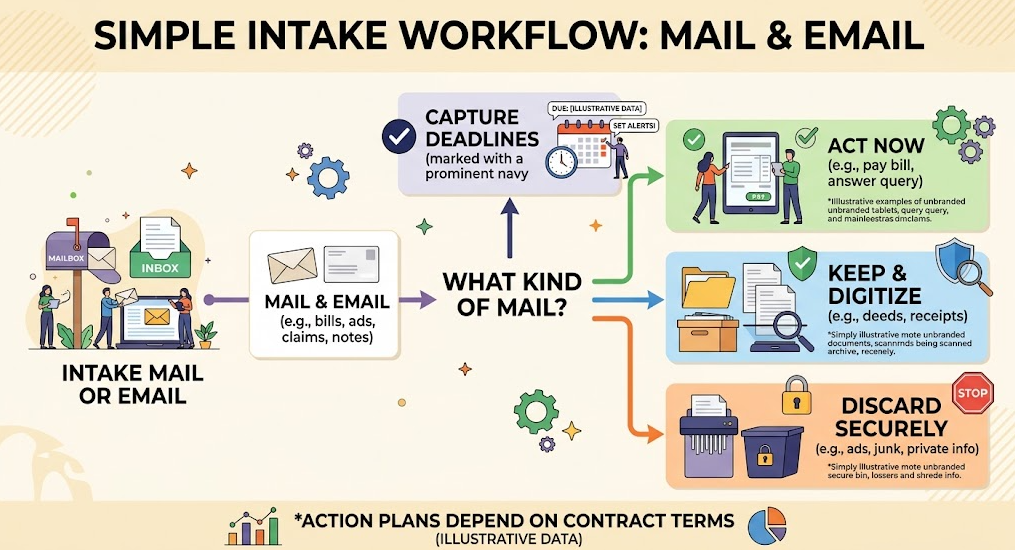
Do Not Keep Every Statement and Receipt by Default
Statements and receipts need a reason and a review trigger.
Keep a statement when it supports a tax position, loan or benefit application, dispute, balance history, proof of address, or transaction that cannot be reconstructed elsewhere. Keep a receipt when it supports a return, warranty, reimbursement, tax claim, insurance claim, ownership record, or high-value purchase history. The next cluster articles will address retention periods and warranty organization in detail.
Routine duplicate notices can often leave after verification. Examples may include an advertisement, an envelope with no relevant postmark, a monthly statement securely downloaded elsewhere, or a paid routine bill with no tax, claim, property, or dispute purpose. But first confirm that the digital version is complete, accessible for the needed period, and downloadable in a durable format.
Jerome continues receiving bank statements by mail because paper prompts him to look and can preserve history that an online interface may not display for long. That is a valid personal workflow, not a universal rule. Another household may choose digital delivery, automatic downloads, or both. The useful test is whether the chosen system reliably prompts review and preserves the records the household may later need.
Protect Personal Information When Records Leave
Documents being discarded can contain names, addresses, signatures, account numbers, policy numbers, barcodes, medical information, or identity details. Separate ordinary recyclable paper from records that require secure destruction.
Shred or use a reputable secure-destruction service for papers containing information that could enable identity theft, account access, or targeted fraud. Follow local recycling requirements for shredded paper. Remove labels from packaging when they expose unnecessary personal information, and do not place intact financial or identity documents in an open recycling bin.
Also reduce duplicate exposure. Keeping unnecessary copies in multiple drawers, bags, inboxes, and devices creates more places to search, update, protect, and eventually destroy.
Build a Household Records Map
The first useful system can be small. Create a one-page map with categories rather than listing sensitive numbers:
| Category | Examples | Primary location | Review trigger |
|---|---|---|---|
| Identity and civil | certificates, status records | protected originals file | life event or document renewal |
| Property and ownership | home, vehicle, major asset records | long-term property file | sale, refinance, major change |
| Current contracts | insurance, loans, leases | active agreements file | renewal, amendment, cancellation |
| Tax and claims | returns and supporting proof | folder by tax year or matter | retention date and final resolution |
| Proof of address | one or two accepted recent records | current verification file | replace when stale |
| Action required | notices with deadlines | secure action folder | scheduled review until closed |
The map tells another authorized household member what exists without turning the index itself into a collection of passwords and account numbers. Note which records exist only on paper, only digitally, or as protected copies. Do not store passwords, recovery codes, and full identity data in an unprotected household index.
Start With the Next Mail Stack
Use the next batch of mail to create the system:
- remove obvious advertising;
- isolate anything with a deadline or unexpected charge;
- identify permanent identity or ownership records;
- file current contracts and claim-supporting evidence;
- retain only purposeful statements, bills, and receipts;
- mark each temporary record with a review date or event; and
- securely destroy personal information that no longer has a purpose.
The goal is not a home archive large enough to answer every imaginable question. It is a small, dependable body of evidence that allows the household to prove what matters and act before an important window closes.
FAQ
Should I keep original documents or are scans enough?
Keep the original when a government agency, court, financial institution, insurer, or contract may require an original or certified copy. A scan improves access and recovery but does not automatically carry the same legal effect. Check the issuer’s and recipient’s current requirements.
Do I need to keep every utility bill as proof of address?
Usually not solely for that purpose. Keep a recent document that an expected recipient accepts, then replace it as it becomes too old. Retain older bills only when another purpose—such as tax, a dispute, tenancy, reimbursement, or usage history—requires them.
What should I do with a government letter after responding?
Keep the letter with proof of your response until the matter is closed and any review, appeal, payment, or record-retention period has passed. Then move it to a permanent category if it establishes an ongoing right, or securely dispose of it.
Should I keep paper bank statements?
Keep them when they support a claim, tax filing, application, address verification, dispute, or history you cannot reliably retrieve online. Paper is optional when complete digital records are securely preserved and accepted for the intended purpose.
Where should I keep passports and immigration documents?
Use a secure, access-controlled location protected as reasonably possible from theft, fire, and water. Keep recovery information or protected copies separately. Whether an original belongs in an emergency file depends on evacuation access and theft risk; do not leave high-value identity documents in an easy-to-remove bag merely for convenience.
Sources
- Canada Revenue Agency — How long should you keep your income tax records?
- Consumer Financial Protection Bureau — Review documents before closing
- Ready.gov — Financial Preparedness
- Ready.gov — Emergency Financial First Aid Kit