A receipt can become useless next week or remain important for years. The paper itself does not reveal which. A grocery receipt, a tire invoice, a home-improvement bill, and proof of a tax-deductible expense may all enter the same drawer, even though each has a different reason to stay and a different ending point.
Jerome feels more comfortable taking a product back to Costco, Canadian Tire, or Home Depot when he can bring the receipt. Costco may sometimes locate a purchase without the paper copy, but he still prefers keeping receipts for tires and electronics. They help establish the purchase date, warranty period, and service history before a problem occurs.
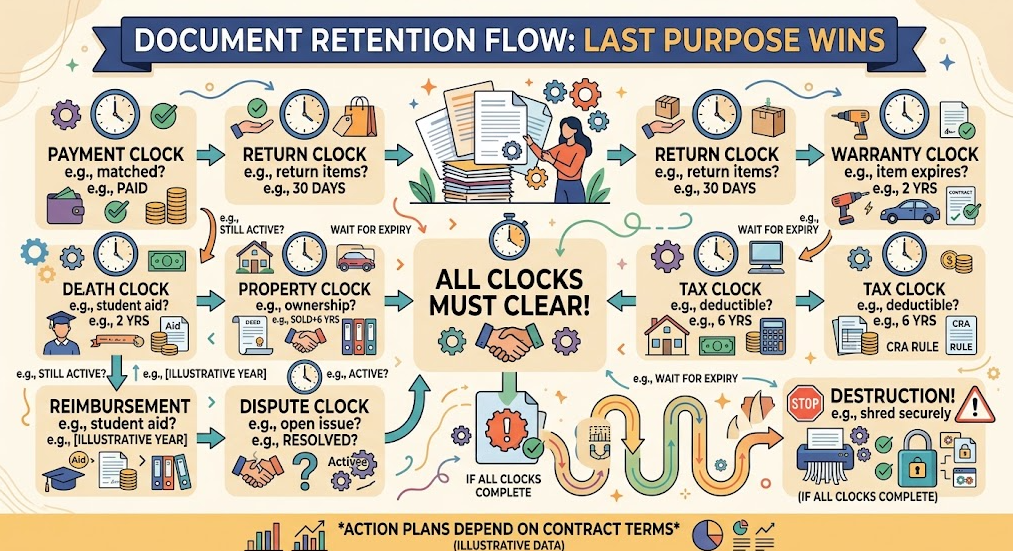
The safest practical rule is not “keep all receipts for seven years.” Keep each bill or receipt until the last purpose it supports has expired. That may be reconciliation, return, warranty, tax, insurance, property ownership, maintenance evidence, reimbursement, or an unresolved dispute.
Quick decision: First match the bill or receipt to every purpose it may serve. Then keep it until the latest applicable endpoint—not the earliest one. A routine purchase can leave after reconciliation and the return window. A warranted product stays through coverage and any open claim. Tax evidence follows the relevant authority’s rule. Property and improvement records may stay for as long as ownership and later tax or insurance consequences remain.
Start the Retention Clock With the Purpose
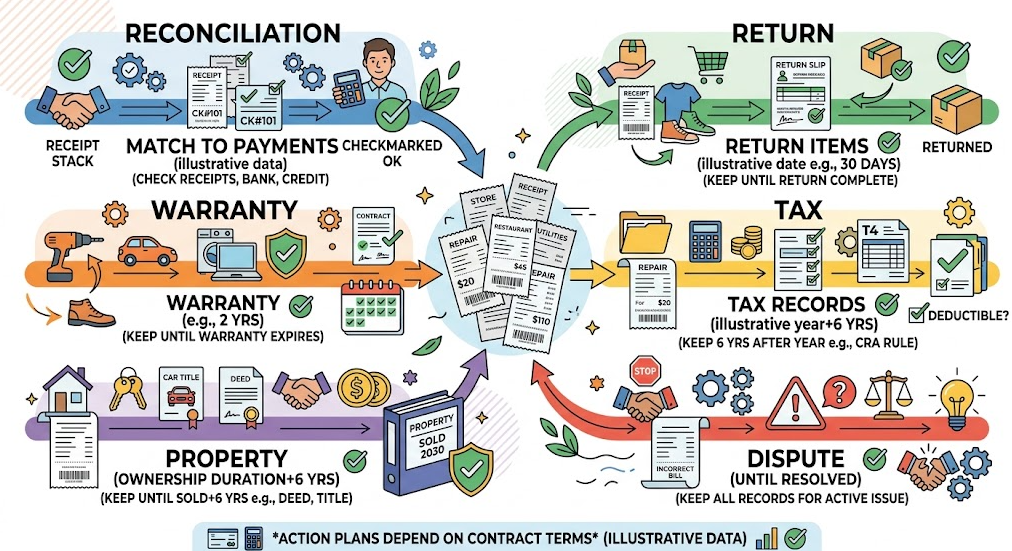
A single transaction may create several clocks. Imagine buying an appliance:
- the card statement may need to be checked for the correct amount;
- the store may allow a return within a stated period;
- the manufacturer may provide a longer warranty;
- an extended service contract may run longer still;
- the purchase may support an insurance inventory; and
- if used for an eligible business or rental purpose, tax rules may apply.
The receipt should not be destroyed merely because the return period ended if the warranty or tax purpose remains. Write or digitally tag the latest review date and the reason: Warranty ends May 2029—review after any open claim closes.
Use events where a calendar date is not enough. Examples include:
- until the statement is reconciled;
- until reimbursement is received and verified;
- until the return or price-adjustment window closes;
- until warranty or service coverage ends;
- until a dispute, appeal, chargeback, repair, or claim is fully resolved;
- until the applicable tax-retention period ends;
- until an asset is sold plus any later reporting or challenge period; or
- until a lease, loan, service, or ownership relationship is closed and the final balance is confirmed.
This produces a real destruction rule. “Keep important receipts” produces a pile.
Short-Term Receipts: Reconcile, Return, Then Review
Many ordinary receipts need only a short life. Keep them long enough to:
- confirm the item and price;
- match the payment to the card or bank account;
- inspect or test the purchase;
- complete any expected return, exchange, or price adjustment; and
- confirm that no reimbursement, shared-expense, or dispute purpose remains.
Return rules vary by seller and item. The US Federal Trade Commission notes that store policies and deadlines differ and may appear on the receipt. A familiar store’s usual practice is not a substitute for the policy governing that transaction. Clearance items, opened electronics, seasonal goods, online purchases, and third-party marketplace sales may have different conditions.
Once the payment is correct, the product is accepted, and every short-term window has ended, an ordinary low-consequence receipt may leave. Securely destroy it if it contains payment or identifying information.
Keep Purchase Proof Through Warranty and Service Coverage
For a warranted product, pair the receipt with the warranty terms. The FTC’s warranty guidance advises keeping the receipt because it can prove the purchase date and original ownership. Canada’s Office of Consumer Affairs similarly tells consumers to keep sales receipts and product information for warranty service.
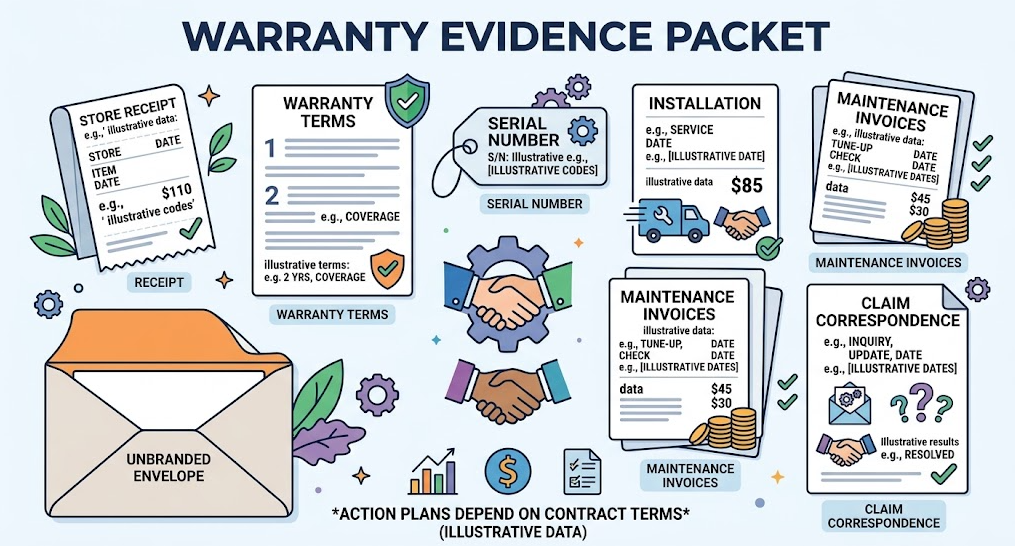
Keep:
- the dated itemized receipt or invoice;
- the warranty or service-contract terms that applied at purchase;
- model and serial numbers;
- registration confirmation if registration was completed;
- delivery and installation records when coverage depends on them;
- maintenance and repair invoices; and
- all claim correspondence and resolution records.
Do not keep only a credit-card statement if it identifies the merchant but not the product. It may help prove payment, yet fail to show the model, item, purchase condition, or coverage start date. Conversely, a warranty booklet without purchase evidence may not establish when coverage began.
Vehicle and tire records may require longer continuity than an ordinary consumer product. Maintenance evidence can affect a warranty or service-contract claim. The FTC’s auto warranty guidance advises keeping service records and receipts to show maintenance. Retain the relevant schedule, invoices, mileage or date information, and covered-repair history through the applicable coverage and any open claim.
Tax Receipts Follow the Tax Authority’s Clock
Tax retention is jurisdiction-specific. Do not borrow another country’s familiar number.
In Canada, the Canada Revenue Agency tells individuals to keep tax documents and records for at least six years, even when filing electronically. It may require more than an official receipt, including bank statements or other proof supporting deductions or credits. Special situations, late filing, objections, appeals, and property-related records can change the endpoint.
In the United States, the Internal Revenue Service provides different periods for different circumstances. Its general periods include three years in many ordinary situations, but longer periods can apply—for example, certain loss claims or substantial omitted income. Records connected with property generally need to support basis and tax consequences while relevant.
For any country:
- identify the return, deduction, credit, income item, or transaction the receipt supports;
- confirm the current rule for that taxpayer and circumstance;
- calculate from the event the authority specifies, not automatically from the purchase date;
- extend the date for late filing, amendment, audit, objection, or appeal when required; and
- preserve the filed return and assessment or confirmation with its supporting records.
A receipt’s ink fading does not shorten the legal need. Capture a legible copy while keeping any original required by local rules.
Keep Property and Improvement Records Beyond the Monthly Bill Cycle
Routine household operating bills and capital or ownership records are different.
A paid electricity, water, phone, or internet bill may leave after payment, reconciliation, address-verification need, tax purpose, and dispute windows end. Keep it longer if it documents a contested charge, tenant responsibility, reimbursable expense, home-office claim, or unusual usage relevant to a claim.
Home purchase, sale, and major improvement invoices may have a much longer role. They can support:
- the acquisition cost or adjusted tax basis of property;
- eligible improvement costs;
- insurance claims and replacement values;
- permits, inspections, and code-related history;
- transferable warranties;
- disclosure of work performed; and
- later disputes with a contractor or buyer.
Keep contracts, paid invoices, proof of payment, permits, inspection results, plans when relevant, and before-and-after evidence for significant work. Do not discard these simply because a contractor’s workmanship warranty ended. The property, tax, insurance, and future-sale reasons may last much longer.
Repairs that merely maintain a home and improvements that affect tax treatment may be classified differently. Save the evidence first; obtain jurisdiction-specific tax or legal guidance before deciding what qualifies.
Keep Bills Until Payment and Closure Are Proven
A “paid” stamp or bank withdrawal is useful, but some obligations need a final closure record.
For utilities, medical bills, tuition, child care, subscriptions, contractors, and other services, keep the bill and proof of payment until:
- the payment posts to the correct account;
- no remaining balance, adjustment, or reimbursement is expected;
- the service or cancellation is confirmed;
- any tax, benefit, or insurance purpose ends; and
- no active dispute remains.
For a loan, lease, collection matter, or large contractual obligation, retain the agreement, statements needed to reconstruct the balance, payment evidence, and the final release, discharge, zero-balance, or closure confirmation. A last payment alone may not prove that every fee, lien, or obligation ended.
Open Disputes Stop the Destruction Clock
If a transaction is disputed, preserve the complete evidence set regardless of the normal schedule:
- receipt, order confirmation, and advertised description;
- contract, warranty, return, or cancellation terms;
- payment and delivery records;
- photographs, inspection, repair, and service evidence;
- names, dates, case numbers, and communication copies; and
- the final resolution and proof it was carried out.
The FTC’s consumer complaint guidance recommends including copies of receipts, repair orders, and warranties while keeping originals. Canada’s Complaint Roadmap likewise tells consumers to send copies rather than originals when documenting a complaint.
Keep the file until the refund, repair, replacement, correction, appeal, or settlement is complete and any relevant challenge period has passed. If litigation, regulatory action, insolvency, fraud, injury, or a significant amount is involved, obtain qualified advice before destroying evidence.
Use a Review Date Instead of Guessing at Disposal Time
Create four practical receipt groups:
Reconcile and return
Ordinary purchases awaiting statement matching, testing, return, exchange, or price adjustment. Review frequently.
Warranty and ownership
Durable goods, electronics, appliances, tires, tools, furniture, and other items whose purchase proof supports coverage or ownership. Review when coverage ends, the item leaves, and all claims close.
Tax, reimbursement, and benefits
Receipts tied to a filed return, employer expense, insurance reimbursement, grant, subsidy, or benefit. Review only after the governing retention period and every related process end.
Property and long-tail matters
Home purchase and improvement records, vehicle history, major contracts, unresolved disputes, and evidence that may remain relevant beyond an ordinary warranty. Review at the asset’s sale or matter’s closure, then calculate any remaining retention need.
Label a digital or paper folder with both year and purpose: 2026 Home Roof—keep through ownership and later tax review, not merely Receipts 2026.
Preserve the Evidence Before the Paper Fades
Thermal receipts can become unreadable. Photograph or scan important receipts soon after purchase. Capture the entire receipt, including retailer, date, product, amount, taxes, payment reference, and policy text when relevant. Link it to the warranty, serial number, or property record.
Use a durable file name such as:
2026-08-29_Retailer_Product_Amount_Receipt.pdf
Do not rely only on a retailer account. Accounts can change, purchases may not link correctly, and retention periods are not guaranteed. Keep the household’s own copy when the consequence of loss would be meaningful.
Digital copies require privacy protection and backup, which Article”How to Back Up Household Records” will cover. For this article, the key is simpler: a saved image is useful only if it is legible, identifiable, retrievable, and accepted for the intended purpose.
Run a Controlled Annual Review
Once a year—tax season can be a useful trigger—review receipts by purpose:
- destroy reconciled routine receipts after all short-term needs end;
- remove warranty records only after coverage, ownership, and claims end;
- calculate tax dates using the correct jurisdiction and filing facts;
- keep property records that still affect ownership, basis, insurance, or sale;
- extend every file connected to an open dispute, audit, reimbursement, or appeal; and
- document the destruction date or rule for the remaining groups.
The result should not be the smallest possible archive. It should be an archive in which every retained bill or receipt has a live purpose—and every purpose has a clear ending condition.
FAQ
How long should I keep ordinary shopping receipts?
Keep them until the payment is reconciled, the product is accepted and working, and every return, exchange, price-adjustment, reimbursement, or dispute need has ended. Keep them longer when warranty, tax, insurance, ownership, or claim purposes apply.
Should I keep receipts for electronics and appliances?
Yes, through the warranty or service-contract period and any open claim. Pair the receipt with warranty terms, model and serial numbers, delivery or installation records, and repair history. Retain longer if tax, insurance, or ownership evidence remains relevant.
How long should I keep utility bills?
After payment and reconciliation, routine bills may leave when no address-proof, tax, reimbursement, tenancy, usage-history, or dispute purpose remains. Keep final bills and closure confirmations when ending or transferring service.
Is a bank or credit-card statement enough without the receipt?
Sometimes it helps prove payment, but it may not identify the exact product, model, tax treatment, warranty start, or purchase conditions. Keep the itemized receipt when those details matter.
Can I scan a receipt and discard the original?
Only after confirming that a digital copy is accepted for the intended tax, warranty, reimbursement, insurance, or legal purpose. Verify that the scan is complete and legible. Keep the original whenever a governing rule or foreseeable dispute may require it.
How long should I keep tax receipts?
Follow the tax authority for the country and circumstance involved. Canada generally tells individuals to keep records for at least six years; US federal periods vary and are often three years but can be longer. Filing dates, property, amendments, audits, and appeals can change the endpoint.
What receipts should I keep for a house?
Keep purchase, closing, major improvement, permit, inspection, contractor, and significant repair evidence while it can affect ownership, tax basis, insurance, warranty, disclosure, or a future sale. These records often outlive ordinary monthly bills.
When can I discard records from a dispute?
Wait until the matter is fully resolved, the promised refund or correction is completed, and every relevant review, appeal, chargeback, limitation, or enforcement period has passed. Seek qualified advice before destroying evidence in a significant legal, injury, fraud, or insolvency matter.
Sources
- Canada Revenue Agency — How long should you keep your income tax records?
- Internal Revenue Service — How long should I keep records?
- Federal Trade Commission — Warranties
- Federal Trade Commission — Auto Warranties and Auto Service Contracts
- Innovation, Science and Economic Development Canada — Warranties
- Innovation, Science and Economic Development Canada — The Complaint Roadmap