Warranty papers often remain untouched until the product stops working. At that point, the household does not merely need “the manual.” It needs the correct model, purchase date, coverage terms, receipt, service history, and claim route—before a deadline closes or an unsafe product is used again.
Jerome places warranty documents and manuals that arrive by mail on top of the entry closet. He rarely needs them, but keeping them in one known place feels safer than discarding them. That collection already solves the first problem: the papers are not scattered. The next step is to connect each document to the exact product and the decision it may support.
A useful warranty system is a product record, not a stack of booklets.
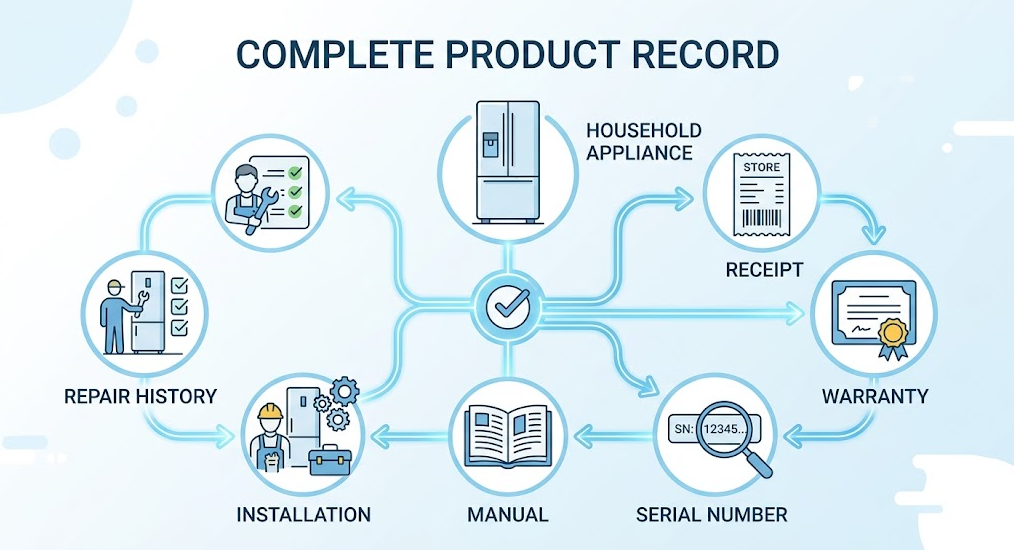
Quick decision: Create one record for each durable product worth tracking. Link the receipt, warranty terms, model and serial number, purchase and installation dates, seller and manufacturer contacts, maintenance requirements, repair history, and coverage end date. Keep only manual sections that are product-specific or difficult to replace, and review the record when coverage ends, the product leaves the home, or a claim remains open.
Decide Which Products Need a Record
Not every inexpensive household item needs a file. Prioritize products where missing information could create meaningful cost, delay, safety risk, or lost coverage:
- appliances and major electronics;
- heating, cooling, plumbing, electrical, security, and smart-home equipment;
- tools, outdoor equipment, generators, and seasonal machinery;
- tires, vehicle accessories, and separately warranted components;
- furniture or fixtures with meaningful coverage;
- child, mobility, medical-support, or safety equipment;
- products with scheduled maintenance requirements;
- items installed by a contractor; and
- purchases protected by an extended service contract or credit-card benefit.
Use a simpler record for lower-consequence items: receipt image, product name, purchase date, and coverage end. The system should reduce claim friction, not turn every small purchase into administration.
Capture the Product Identity First
“Kitchen appliance manual” is not enough when several models look alike. Record:
- manufacturer and exact product name;
- model number;
- serial number;
- manufacturing or date code when relevant;
- purchase date and seller;
- delivery, installation, or first-service date if coverage begins there;
- household location;
- installer or contractor; and
- a clear photograph of the product label.
Photograph the label before the product is installed against a wall, mounted overhead, placed behind cabinetry, or exposed to wear. Do not remove a safety or certification label from the product merely to file it.
Use the same identifier in the paper folder, digital folder, and household inventory. A filename such as 2026-08_Brand_Model123_Refrigerator is more useful than new fridge papers.
Build a Warranty Evidence Packet
The US Federal Trade Commission advises saving a copy of the warranty and the product receipt; the receipt can prove purchase date and original ownership. Canada’s Office of Consumer Affairs likewise recommends keeping sales receipts and product information.
For each tracked product, keep:
- Itemized receipt or paid invoice — not merely a card statement naming the merchant.
- Warranty terms in force at purchase — downloaded or printed before a website replaces them.
- Model and serial evidence — written record plus label photo.
- Delivery and installation records — including installer details and acceptance documents.
- Registration confirmation — when registration is completed.
- Maintenance schedule and evidence — invoices, dated logs, parts, and service records.
- Repair and claim history — problem description, case number, communications, shipment, decision, and result.
- Coverage dates — manufacturer warranty, parts/labour differences, and any separate service contract.
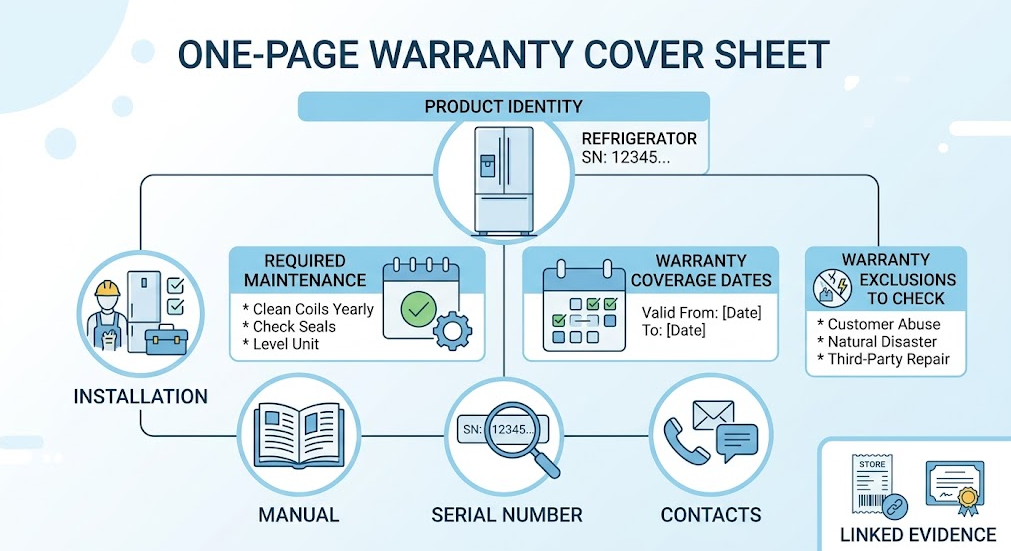
Read the actual terms. Coverage may begin on purchase, delivery, installation, manufacture, or another defined event. Parts and labour may end on different dates. Consumables, cosmetic damage, commercial use, improper installation, unauthorized repair, transport, or routine maintenance may be excluded.
Do not summarize away conditions that could determine a claim. Keep the complete governing terms with a short household cover sheet for quick reference.
Separate Manufacturer Warranty From Other Protection
One purchase may carry several different protections:
- seller return or exchange policy;
- manufacturer’s written warranty;
- retailer protection plan;
- third-party service contract;
- installer or contractor workmanship warranty;
- credit-card extended warranty or purchase protection;
- statutory consumer rights; and
- recall remedy.
These are not interchangeable. A seller’s return window can close while the manufacturer’s warranty remains active. A service contract may begin at purchase or after another warranty, depending on its terms. Legal rights may exist independently of a written warranty, but they vary by jurisdiction and require authoritative advice.
Create a small coverage timeline showing provider, start, end, claim contact, and required evidence. Do not label every protection simply “warranty.”
Keep the Manual Only for a Reason
Many manuals can be downloaded, but not every online copy will remain available or match the exact revision. Keep or download sections that support:
- safe operation and warnings;
- installation and required clearances;
- maintenance intervals and approved procedures;
- troubleshooting and error codes;
- parts identification;
- seasonal shutdown or storage;
- warranty requirements; and
- transfer, sale, or service of installed equipment.
Discard duplicate multilingual sections or generic marketing only when the needed information remains complete and retrievable. If the manual is easily available online, download the exact model’s version rather than saving only a bookmark. A link can change; a household-held file remains under household control.
Keep critical operating and emergency instructions near the equipment when immediate use matters, provided the location is safe and dry. The master warranty evidence can remain in the household record system.
Register Selectively and Understand the Purpose
Product registration can help a manufacturer connect an owner with safety notices, warranty administration, or service information. Canada’s Office of Consumer Affairs recommends registering newly purchased products and warranties online.
Before submitting:
- confirm the registration site belongs to the manufacturer or authorized administrator;
- provide only required information;
- distinguish warranty or safety registration from optional marketing consent;
- save confirmation and the policy or terms that applied; and
- update ownership or contact information when the program allows and the product changes hands.
Registration does not replace the receipt, warranty terms, serial number, or recall monitoring. Nor should a household assume that failure to register automatically eliminates every legal right; the governing terms and local law control.
For some durable infant or toddler products in the United States, CPSC registration-card rules are specifically designed to improve direct recall notification. That category-specific rule should not be generalized to every consumer product worldwide.
Track Maintenance That Could Affect Coverage
Some warranties and service contracts require scheduled maintenance or specify acceptable parts, fluids, installers, or procedures. Create a product maintenance log with:
- date and usage, mileage, or operating-hours reading where relevant;
- service performed;
- provider or person who performed it;
- part or material used;
- invoice or receipt link; and
- next due date.
The FTC’s auto warranty and service-contract guidance advises keeping service records and receipts to show vehicle maintenance. The principle can also help with other products when their written terms make maintenance relevant, but do not assume every missed maintenance item automatically voids all coverage. Read the terms and applicable law.
For tires, Jerome’s preference for retaining receipts is practical because purchase date, product identity, installation, rotation or service history, and coverage terms may all matter. The record should follow the actual tire set, not disappear into a general receipt drawer.
Prepare the Claim Before Contacting the Company
When a product fails:
- stop using it if continued operation could be unsafe;
- check current safety recalls through the appropriate official regulator or manufacturer;
- read the warranty’s claim instructions and exclusions;
- record the symptoms, date, conditions, photos, and error codes;
- gather receipt, model, serial number, maintenance evidence, and prior repairs;
- contact the correct provider and record the case number;
- send copies rather than irreplaceable originals unless the process specifically requires otherwise; and
- preserve the complete file until the remedy and any dispute are finished.
Canada’s Complaint Roadmap includes receipts, contracts, correspondence, repair orders, warranties, and other supporting records in a consumer complaint file. The FTC similarly advises consumers to include copies of relevant records and keep originals when trying to resolve a business problem.
Do not perform repairs, discard the product, remove labels, or ship it before checking claim and safety instructions. An insurer, manufacturer, retailer, regulator, or service administrator may need specific evidence or direct a particular remedy.
Review Records at Product Transitions
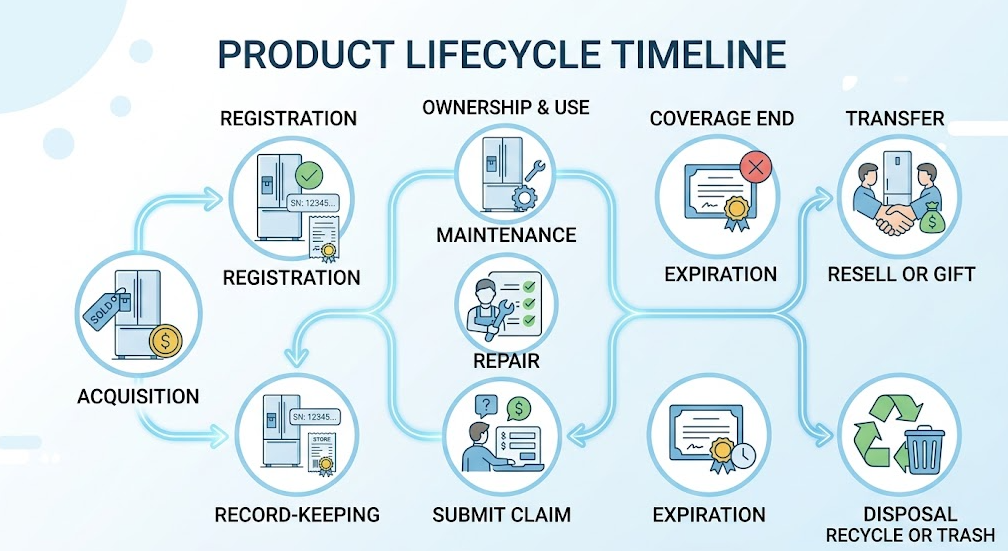
Review the product file when:
- a return window closes;
- a warranty or service contract changes or nears expiry;
- scheduled maintenance is completed;
- a repair, recall, or claim occurs;
- the product moves to another home;
- ownership transfers;
- the product is replaced or disposed of; or
- the household changes insurer or payment account relevant to protection.
At disposal, remove the record only after all claim, tax, insurance, recall, reimbursement, and dispute reasons end. Keep home-installed equipment records with the property file if they may help a future owner, service technician, insurer, or transaction.
For a sold or gifted product, provide the safe-use manual and transferable warranty information where appropriate, while removing receipts or registrations that expose unnecessary personal or payment data.
A Simple Product Index
Use a spreadsheet or paper index with no more information than needed for retrieval:
| Product | Model/serial location | Purchase date | Coverage end | Record location | Next action |
|---|---|---|---|---|---|
| Refrigerator | label photo in file | 2026-08-15 | terms vary by component | Home/Purchases/Kitchen | filter due February |
| Tire set | invoice and tire photo | 2026-05-10 | check written terms | Vehicles/Tires | rotation due by schedule |
Avoid full payment-card details in the index. Review it twice a year or when a major product enters or leaves the home.
The objective is not to keep every booklet forever. It is to make the correct evidence available at the moment the household must decide whether to maintain, stop using, repair, claim, transfer, or replace a product.
FAQ
Should I keep every product manual?
No. Prioritize exact-model instructions for safety, installation, maintenance, troubleshooting, parts, and warranty requirements. Download the correct version when relying on digital storage; do not keep only a bookmark.
What should be stored with a warranty?
Keep the itemized receipt, governing terms, model and serial number, purchase and installation dates, registration confirmation, maintenance evidence, repair history, claim contacts, and coverage end dates.
Is a credit-card statement enough as proof of purchase?
It may prove payment to a merchant but may not identify the exact product, model, purchase condition, or warranty start date. Keep the itemized receipt or invoice when those facts matter.
Do I have to register a product for the warranty to apply?
It depends on the product, terms, jurisdiction, and type of protection. Registration can aid administration and safety notices, but do not assume it creates or removes every right. Check the written terms and applicable consumer law.
How long should I keep warranty records?
Keep them through the latest applicable coverage period and until every repair, claim, reimbursement, recall, tax, insurance, or dispute matter closes. Installed-property records may remain useful beyond warranty expiry.
Should manuals stay beside the product or in the filing system?
Keep immediate safety or operating instructions near the equipment when useful and safe. Store the master evidence packet in the household records system. The index should connect both locations.
What if the receipt has faded?
Scan or photograph important thermal receipts soon after purchase, verify legibility, and link the copy to the product record. Keep the original when the provider or applicable rule may require it.
What should I do before making a warranty claim?
Check safety recalls, read the claim process, document the failure, gather purchase and maintenance evidence, contact the correct provider, keep a case record, and avoid disposal or unauthorized repair until instructions are clear.
Sources
- Federal Trade Commission — Warranties
- Federal Trade Commission — Auto Warranties and Auto Service Contracts
- Federal Trade Commission — Solving Problems With a Business
- Innovation, Science and Economic Development Canada — Warranties
- Innovation, Science and Economic Development Canada — The Complaint Roadmap
- US Consumer Product Safety Commission — Durable Infant or Toddler Product Registration Cards