An important paper does not become organized merely because it has a place. A letter placed in a familiar drawer can still disappear under newer mail. A contract stored safely can still be hard to find if no one remembers its category. A file can be tidy yet fail when a payment deadline, insurance claim, or household emergency arrives.
Jerome uses the top of the entry closet as a gathering place for warranty papers and manuals. He also keeps passports, immigration documents, Korean banking information, home contracts, and vehicle and home insurance records together in a bag nearby. The advantage is clear: important papers are not scattered through the house. The limitation is that records with different urgency, sensitivity, and emergency roles can become one collection.
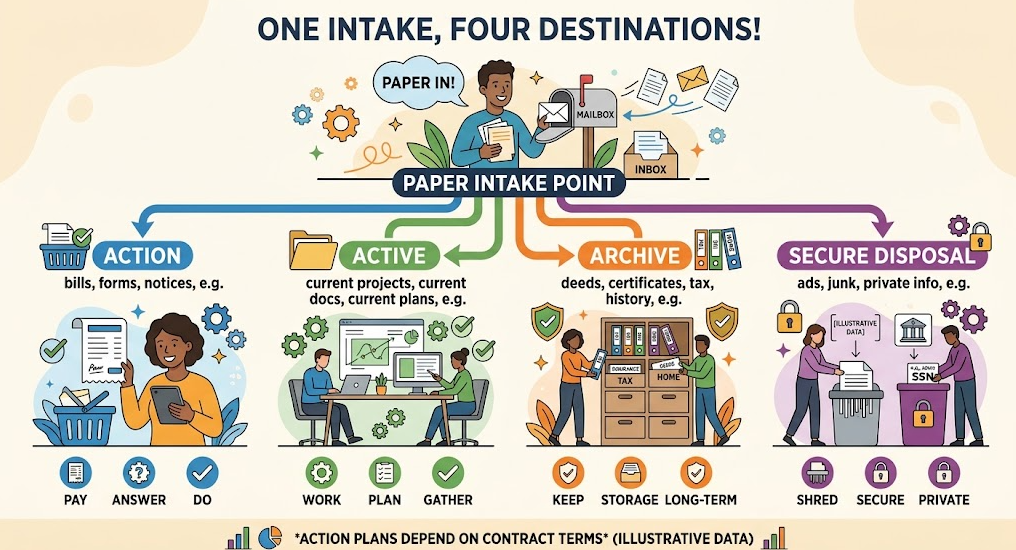
A dependable home filing system needs more than folders. It needs a controlled route from arrival to action, active use, long-term archive, and secure disposal.
Quick decision: Give new papers one intake point, but do not let that point become permanent storage. Separate deadline-bearing action papers from active household files and long-term originals. Label folders by the decision they support, record review triggers, restrict access to sensitive records, and schedule a short weekly intake plus a deeper annual archive review.
Build the System Around Four States
Most household papers can move through four operational states:
Action
The paper requires a response: pay, call, sign, submit, dispute, renew, cancel, compare, or add to a calendar. It remains here only until the task is completed and evidence of completion is attached.
Active
The record supports a current relationship or near-term household need. Examples include current insurance policies, a lease or mortgage, open medical or school matters, current-year tax papers, active warranties, and recent proof of address.
Archive
The record is no longer handled regularly but still proves identity, ownership, tax history, legal status, a past transaction, or another continuing right. Examples include civil records, closed-year tax files still within retention, home purchase documents, and completed contracts that remain relevant.
Secure disposal
These states matter more than the cabinet style. A small box can work if papers move reliably. A wall of filing drawers can fail if every document becomes “keep forever.”
Choose One Intake Point, Not One Storage Pile
Mail, school papers, receipts, printed forms, and documents brought home from appointments need one temporary landing place. Choose a tray, folder, or closed container near where papers naturally enter the household.
The intake point should:
- hold no more than one review cycle’s paper;
- protect names and account information from visitors or casual viewing;
- remain away from cooking splashes, entryway moisture, pets, and young children;
- be easy for authorized household members to use; and
- have a fixed processing day.
Do not file unopened mail. Open it, confirm the sender, identify the deadline, and decide the next state. Advertising leaves. Action papers enter the action file and calendar. Active or archival records go to their named folders. Anything uncertain enters a limited “Verify” folder with a review date—not an unlimited miscellaneous pile.
Jerome’s entry-closet location already solves part of the problem: it creates a predictable place. The improvement is to divide that collection by function before adding more paper. A warranty manual awaiting no action should not cover a government notice due next week, and a passport should not sit in the same easy-access layer as a replaceable manual.
Make the Action File Impossible to Confuse With the Archive
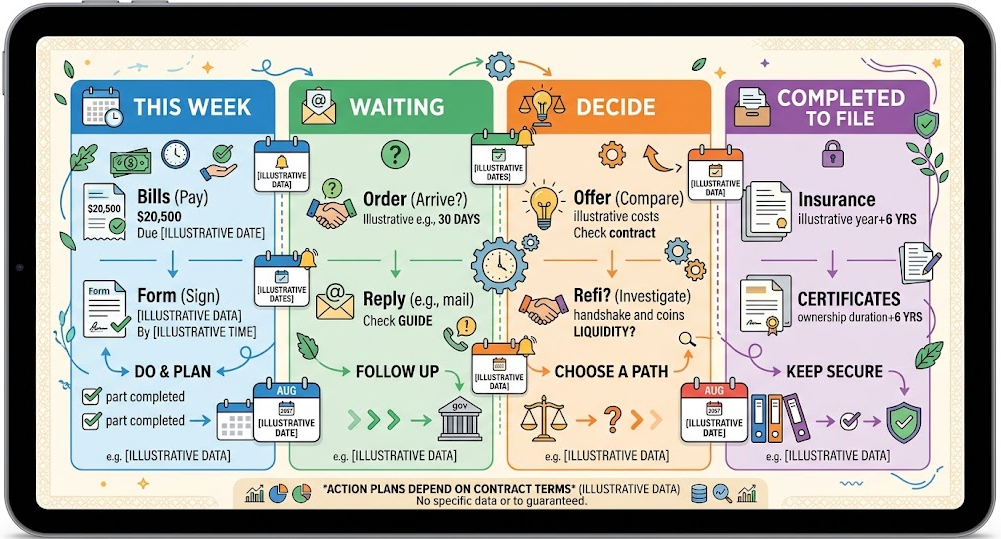
The action file is a task-management tool, not a storage category. Use a small container or folder with sections such as:
- This week
- Waiting for response
- To discuss or decide
- Completed—file proof
Every action paper should also have its deadline or follow-up date in the household’s actual calendar or task system. A folder does not create a reminder by itself.
Write a non-sensitive action note on the front or use a removable cover sheet: Submit by September 15, Call insurer—case number in file, or Confirm final balance. Avoid marking on original legal documents. After completing the task, attach or save proof: confirmation, receipt, sent copy, tracking number, or the name and date of a conversation. Then move the record to Active, Archive, or Secure Disposal.
Review the action file at least weekly and more often when urgent mail is expected. If the household checks a mailbox infrequently, the collection schedule must still leave enough time to meet foreseeable response windows.
Use Categories That Match Retrieval Questions
Folder labels should answer the questions a household will later ask:
- Where is the current home insurance policy?
- What proves this repair or purchase?
- Which papers support this year’s tax return?
- What records belong to this vehicle?
- Where is the final version of this agreement?
- Which document proves this person’s status or relationship?
A practical top-level structure might be:
- Identity and family — civil records, status documents, legal name records.
- Home and property — purchase, mortgage, title-related, permit, improvement, and property insurance records.
- Vehicles — ownership, financing, insurance, maintenance, and warranty records.
- Money and tax — one folder per tax year plus active financial agreements.
- Insurance and benefits — current policy and claim files by type.
- Work, education, and care — contracts, benefit records, credentials, school or care matters that warrant household retention.
- Purchases and warranties — durable goods and service evidence, later developed fully in Articel”How to Organize Warranties and Manuals“.
- Legal and estate — wills, powers, court records, and professional contact information, with storage appropriate to the governing requirements.
Do not create dozens of empty categories in advance. Begin with the records that actually exist. Split a folder only when it becomes hard to retrieve from. Combine categories only when their security, retention, and retrieval needs remain compatible.
Label the folder with subject and status: Home Insurance—Current, 2026 Income Tax—Open, or Vehicle A—Ownership and Service. Avoid vague labels such as Important, Miscellaneous, or Keep.
Separate Current Versions From Replaced Versions
Policies, contracts, account terms, and household details change. A filing system must show which version governs now.
Use one of these methods:
- a clearly marked Current section at the front and Prior behind it;
- separate active and archive folders;
- a cover sheet listing the effective date and superseded version; or
- colour or tab differences that do not depend on colour alone.
When a renewal arrives, compare it with the prior version before filing. Record changes to coverage, deductibles, beneficiaries, rates, contact details, and duties. Do not destroy the old version if a past-period claim, tax issue, dispute, or proof of prior coverage may still arise.
Keep the final signed document, not every draft and advertisement. If an amendment changes only part of an agreement, store it with the base agreement so the full terms can be reconstructed.
Give Sensitive Records More Protection Than Routine Files
Convenience and security do not always point to the same shelf. Passports, immigration records, tax files, banking documents, benefit records, medical information, and papers containing national identifiers should not be casually accessible.
Government of Canada guidance on protecting a Social Insurance Number advises keeping documents containing it in a locked cabinet or safe and not carrying the confirmation letter or card in a wallet or bag. The Competition Bureau Canada recommends shredding documents containing personal information before disposal. The FTC likewise recommends shredding personal or financial records when their retention period ends.
Choose access based on consequence:
- routine manuals may need no lock;
- current bills awaiting action need privacy but rapid access;
- identity and financial originals need stronger access control;
- emergency copies need a separate balance between portability and theft exposure.
Do not put all high-value originals in an easy-to-remove bag solely because it is convenient during an evacuation. Article”How to Build an Emergency Document Grab File“ will address originals, copies, grab files, and off-site access in detail.
Choose a Physically Safer Location
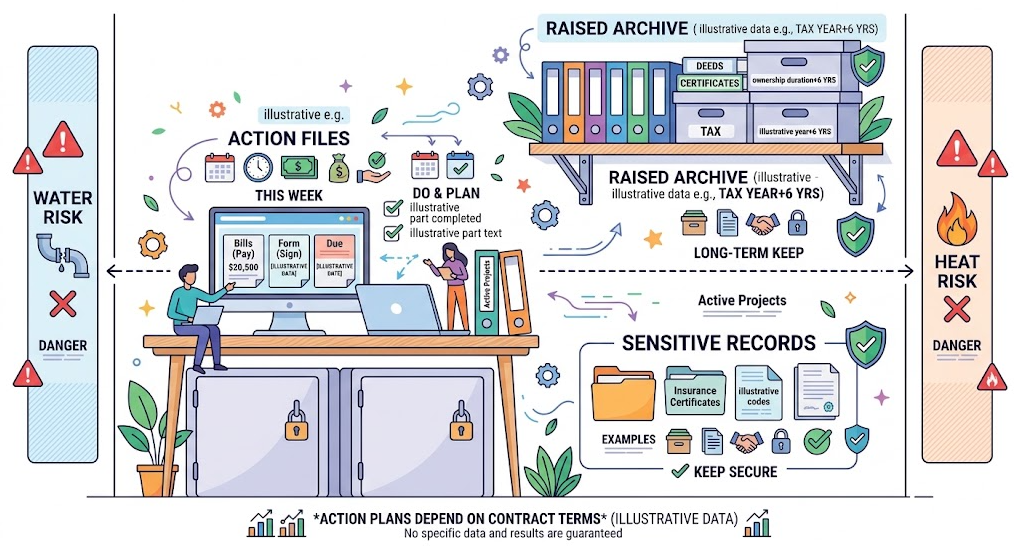
No ordinary cabinet makes paper disaster-proof. Reduce avoidable risks:
- avoid basements or floors with known water exposure;
- keep papers away from plumbing, exterior leaks, cooking areas, fireplaces, heaters, and direct sunlight;
- do not use an attic or garage with severe temperature or humidity swings for important long-term paper;
- raise files above floor level where practical;
- use containers that close and support papers without crushing them; and
- understand the tested limitations of any fire- or water-resistant container rather than assuming “fireproof” means invulnerable.
The US National Archives explains that cooler conditions slow paper decay and that excessive humidity encourages mold and insect activity. Household legal and financial records are not museum collections, but a cool, dry, stable interior location is still a sound boundary.
For irreplaceable, fragile, historic, or damaged documents, ordinary office supplies may be inappropriate. Avoid tape, lamination, glue, or repairs that could permanently alter the record. Seek archival or professional advice when preservation value is high.
Create a Records Map Without Creating a Security List
Another authorized household member should be able to locate necessary records if the person who built the system is unavailable.
Create a simple map:
| Category | Status | Primary location | Authorized access | Review trigger |
|---|---|---|---|---|
| Tax 2026 | Active | locked file drawer | both adults | after filing and retention calculation |
| Home insurance | Current | active home folder | both adults | renewal |
| Identity originals | Archive/current | protected location | named adults | renewal or life event |
| Warranty records | Active | purchases file | household purchaser | item disposal or coverage end |
Do not place complete account numbers, passwords, safe combinations, recovery codes, or full national identifiers on an exposed index. The map should locate the protected information, not reproduce it.
Tell authorized household members how to use the action file, where the records map is kept, and who should be contacted for legal, financial, or insurance records. Access should be deliberate; children, roommates, visitors, household employees, and contractors should not gain incidental access to unrelated private files.
Use a Weekly and Annual Rhythm
The filing system needs two different maintenance cycles.
Weekly intake
- collect and open mail;
- remove advertising;
- capture deadlines;
- pay, respond, or schedule action;
- file records that are immediately classifiable; and
- limit the Verify folder.
Annual archive review
- close the prior tax-year file when appropriate;
- replace current policies and mark prior versions;
- remove records whose latest retention purpose ended;
- check whether named contacts and authorized household access remain correct;
- inspect the storage area for moisture, pests, heat, or damage;
- confirm critical digital copies and backups where used; and
- update the records map.
Moving, marriage, separation, a new child, home purchase, death, retirement, immigration change, major illness, business closure, and evacuation planning should trigger an additional review.
Build the First Version in One Hour
Do not empty every existing box. Start with the papers most likely to create consequences.
- Choose a private intake container.
- Create Action, Active, Archive, Verify, and Secure Disposal sections.
- Pull out all deadline-bearing mail and calendar it.
- Separate high-risk identity and financial originals into protected storage.
- Create only the top-level folders needed today.
- Label current versions clearly.
- Write a one-page records map.
- Schedule the next weekly intake and annual review.
The system can expand later. Its first test is simpler: can the household find the right paper, know whether action remains, and protect it at the level its consequences require?
FAQ
What are the essential sections in a home filing system?
Use at least Action, Active, Archive, Verify, and Secure Disposal. Action papers require a task; Active records support current household matters; Archive records remain evidence; Verify is limited and dated; Secure Disposal holds expired sensitive paper until destruction.
How often should I process household mail and papers?
Use a fixed weekly review as a baseline, with faster processing when urgent documents are expected. The interval must leave enough time for payment, appeal, renewal, cancellation, or response deadlines.
Should I file documents by person or by subject?
Use the structure that matches retrieval. Identity and personal legal records often work by person; home, vehicle, insurance, tax, and purchase records often work by subject or year. Apply one rule consistently within each category.
Where should original passports and identity documents be stored?
Use a secure, access-controlled interior location with reasonable protection from theft, water, and fire. Do not keep national-identifier documents casually in a wallet or easily removed bag. Emergency copies and portable access require a separate risk decision.
Is a fire-resistant file box enough protection?
It can reduce some risks, but protection depends on the product’s tested rating, exposure duration, closure, installation, and water conditions. Keep critical copies or recovery information separately rather than treating one container as complete protection.
What should I do with papers I cannot classify?
Place them in one capacity-limited Verify folder with the exact question and review date. Contact the issuer or a qualified adviser when necessary. Do not let Verify become permanent miscellaneous storage.
How should multiple household members access the files?
Give authorized people a records map and clear responsibilities while restricting sensitive files. The map should identify categories and locations without displaying passwords, full account numbers, safe combinations, or national identifiers.
When should I shred old papers?
Shred personal, financial, medical, identity, or account information only after every action, retention, claim, tax, ownership, and dispute purpose has ended. Follow local recycling or secure-destruction options.
Sources
- Government of Canada — Protect your SIN
- Competition Bureau Canada — Identity theft
- Federal Trade Commission — Which documents to keep and which to shred
- Ready.gov — Financial Preparedness
- US National Archives — How to Preserve Family Archives