Button batteries at home are easy to overlook because it is usually hidden inside an ordinary household object. The danger often becomes visible only after a battery cover loosens, a product breaks, or a used battery is left on a counter during replacement.
For parents and caregivers, the practical question is not simply whether button batteries exist in the home. It is which products should be checked first, what makes a battery compartment reasonably secure, and what to do when a battery cannot be accounted for.
Button and coin batteries can cause severe internal injury if swallowed, particularly when they become lodged in a child’s esophagus. Serious injury can begin within two hours, and a child may initially show few or no obvious symptoms.
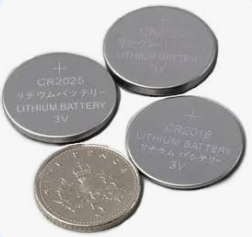
Quick Action Summary
Start with products that are:
- small enough for a child to carry;
- attractive, illuminated, musical, or frequently handled;
- stored on low tables, shelves, floors, bags, or key hooks;
- old, damaged, or missing a battery-cover screw;
- designed with a battery compartment that slides or pops open easily.
Check decorative LED products, remote controls, key finders, digital scales, watches, calculators, thermometers, hearing aids, greeting cards, small flashlights, toys, and spare-battery packaging.
A battery compartment should not open through one simple movement. A screw-secured cover or a design requiring two separate simultaneous actions provides better protection than a loose sliding tray.
If a battery may have been swallowed or inserted into the nose or ear, treat it as an emergency. Do not wait for symptoms.
Where Should You Begin the Home Check?
Walking through every room and inspecting every electronic item can feel excessive. A more useful approach is to begin with the products most likely to combine three risks:
- A button battery is present.
- A child can reach or handle the product.
- The battery can become accessible without much effort.
A wall-mounted clock with a tightly secured battery compartment near the ceiling does not usually require the same immediate attention as a loose key finder on the floor. The battery may be similar, but the child’s access is very different.
Use the following order for a first inspection.
| Check first | Why it deserves priority |
|---|---|
| Small handheld products | Children can carry, drop, open, or mouth them |
| Decorative lights and novelty items | They may look like toys and often use small battery compartments |
| Frequently dropped products | Impact can loosen or break the compartment |
| Products with missing screws or cracked covers | The battery may already be accessible |
| Spare and used batteries | They are no longer protected by a device compartment |
| Older or unlabelled products | They may predate newer warning and compartment standards |
This is not a list of products that must automatically be discarded. It is a way to direct attention to the places where a hidden battery is most likely to become a reachable one.
Decorative Items: The Risk Parents May Not Expect
Many parents naturally inspect toys first. That is sensible, but it can leave an important gap.
Button batteries also appear in products that were never intended for children:
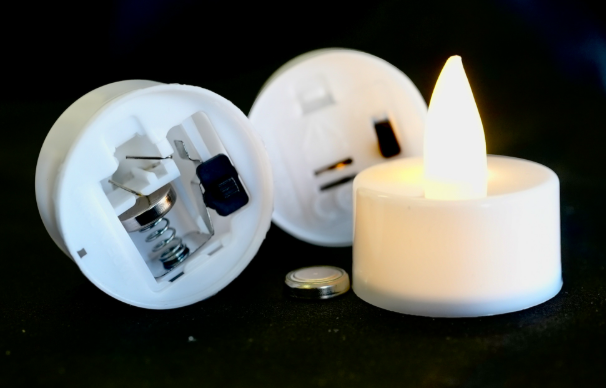
- flameless candles;
- illuminated decorations;
- seasonal ornaments;
- LED tealights;
- light-up signs;
- snow globes;
- decorative diffusers;
- musical cards;
- novelty accessories.
In July 2026, the Australian Competition and Consumer Commission began Federal Court proceedings concerning more than 66,000 homeware products across 29 product lines that allegedly did not meet mandatory button-battery safety or information requirements when supplied. The products included candles, diffusers, tealights, snow globes, and seasonal LED decorations.
The legal allegations concern one retailer and one regulatory system, but the household lesson is broader: a product does not need to look electronic—or look like a toy—to contain a button battery.
When checking decorative products, turn them over and locate the battery compartment. Confirm that the cover is intact, fully closed, and not held in place by tape alone. If the product has fallen, cracked, or become loose, check it again even if it appeared secure when purchased.
The object that deserves attention is often not the most expensive or sophisticated device. It may be the small glowing ornament a child notices because it is colourful, bright, and within reach.
Remote Controls, Key Fobs, and Finders
Remote controls are among the most familiar battery-powered objects in a home, which can make them easy to ignore.
Some use larger cylindrical batteries, but others—particularly slim remotes, garage-door controls, key fobs, and small media-device remotes—use coin batteries. Key finders and tracking tags may also use replaceable coin cells.
These products deserve an early check because they are often:
- left on coffee tables;
- dropped between sofa cushions;
- carried in handbags;
- attached to keys near an entryway;
- handled by children who imitate adults;
- damaged through repeated falls.
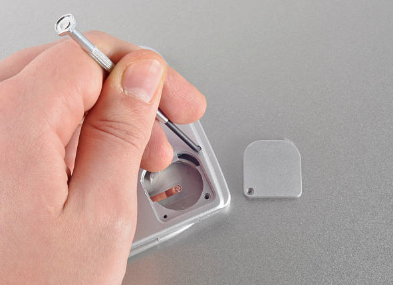
A cover that originally required pressure and a sliding motion may become easier to open after months of use. A missing screw should not be treated as a cosmetic defect. It changes the safety of the battery compartment.
In the United States, current federal requirements generally call for replaceable button-battery compartments to require a tool or at least two independent and simultaneous hand movements to open. The product, packaging, and instructions are also subject to warning requirements under the rules implementing Reese’s Law.
Parents do not need to conduct a formal compliance test at home. A simpler practical question is enough:
Could a young child open this compartment through one obvious movement, especially after dropping or twisting the product?
If the answer may be yes, move the item out of reach and replace or repair it rather than relying on reminders alone.
Bathroom, Bedroom, and Personal-Care Products
The living room is not the only place to inspect.
Button batteries may be found in:
- digital bathroom scales;
- thermometers;
- watches;
- hearing aids;
- small reading lights;
- calculators;
- electronic jewellery;
- personal alarms;
- light-up mirrors;
- medical or wellness accessories.
These objects may be kept on nightstands, bathroom counters, dresser tops, or inside bags that children can open.
A scale presents a different situation from a small remote. It may be too large to lift, but a battery cover on the underside can loosen when the product is moved or dragged. A hearing-aid battery is tiny and may be handled during frequent replacement. A watch may sit on a low bedside table.
The important point is not that every device creates equal danger. It is that access can arise through different routes. One product is portable. Another is dropped. Another requires frequent battery changes. Another is stored beside medication, where a battery might be mistaken for a pill.
Health Canada advises families to know which household products contain button batteries, check compartments regularly, supervise children using those products, and avoid storing batteries near food or medicine.
That last point matters particularly in homes where an older adult uses hearing aids. Canadian poison-centre data found that button-battery ingestion also occurs among older adults, with hearing-aid batteries involved in nearly all of the identified British Columbia cases involving adults over 59.
A household inspection should therefore consider both young children and adults who may have vision, memory, or medication-management difficulties.
Toys Are Important—but “Child Product” Is Not the Only Test
A toy with a secure, screw-fastened compartment may be safer than a non-toy household product with an easy sliding cover.
That may feel counterintuitive. Parents often assume that anything sold for children presents the greatest battery risk. In reality, regulated toys may be subject to specific battery-accessibility requirements, while older novelty products, imported goods, promotional items, or general household products may receive less attention from the buyer.
Inspect toys for:
- missing battery-cover screws;
- cracked plastic around the compartment;
- covers that no longer sit flush;
- corrosion or battery leakage;
- damage after being dropped;
- batteries that can be accessed when the toy is bent or twisted.
Do not assume that a screw once present is still doing its job. A screw that turns without tightening, or a cover that lifts while the screw remains installed, should be treated as a failed compartment.
The decision here is usually not whether to remove every battery-powered toy. It is whether the compartment continues to provide the protection the product was supposed to provide.
What Does a Safer Battery Compartment Look Like?
Parents are unlikely to know whether a product has passed a formal laboratory standard. They can still identify several practical signs of a better design.
More reassuring features
- A screw is required to open the compartment.
- The screw remains attached to the cover when loosened.
- Two distinct movements are required at the same time.
- The cover remains firmly seated after the product is dropped.
- The compartment has no cracks, gaps, or visible warping.
- The product and packaging include a clear battery warning.
Warning signs
- The cover slides open with one thumb.
- A fingernail can lift the compartment door.
- The screw is absent, stripped, or decorative rather than functional.
- Tape is being used as the primary closure.
- The product releases its battery when dropped.
- The battery tray protrudes or does not lock fully.
- A child has previously opened the compartment.
- The item has no warning and its battery type is unclear.
A warning label is useful, but it does not make an accessible battery safe. Conversely, a compartment that appears secure should still be checked periodically because wear and impact can change it.
Health Canada’s assessment of button- and coin-battery hazards specifically identifies foreseeable situations in which a compartment opens easily, a cover becomes dislodged after impact, loose batteries remain accessible, or battery packaging is not child-resistant.
In other words, the inspection should consider not only how the product looks today, but what could reasonably happen after ordinary household use.
Spare Batteries Require Their Own Safety System
A secure product does not solve the risk created by replacement batteries.
New batteries may be left:
- in an open drawer;
- in a handbag;
- beside a device waiting for repair;
- in partially opened packaging;
- near vitamins or medication;
- on a counter during replacement.
Used batteries may appear “dead,” but they can retain enough electrical charge to cause severe injury if swallowed. Health Canada specifically warns that used and expired batteries remain dangerous.
Keep unused batteries in their original child-resistant packaging whenever possible and store them in a locked or genuinely inaccessible location. A high shelf may not be enough if children can climb or if an older sibling can reach it.
During replacement, create a simple closed-loop routine:
- Bring out the new battery.
- Remove the old battery.
- Install and secure the new battery.
- Account for the old battery immediately.
- Tape both sides of the removed battery with non-conductive tape.
- Place it in the appropriate battery-recycling or disposal container, out of reach.
The purpose of the routine is to prevent the few minutes when a loose battery sits unnoticed on a table. That brief gap is one of the easiest risks to eliminate.
Do Not Forget Bags, Drawers, and Visiting Relatives
A home may be carefully childproofed while risk arrives in a visitor’s handbag.
Grandparents or other relatives may carry:
- hearing-aid batteries;
- key fobs;
- small flashlights;
- medical devices;
- watches;
- pill organizers stored beside batteries.
Children often explore bags because they contain unfamiliar objects. A zippered compartment is not necessarily child-resistant.
The same applies when visiting another home, a vacation rental, or a hotel. Parents cannot perform a full safety audit everywhere, but they can quickly move low-level remotes, loose electronics, and visible spare batteries out of reach.
This is where recognition matters more than perfection. The goal is not to create a battery-free environment. It is to notice the situations in which an ordinary item becomes unusually accessible.
What If a Button Battery Is Missing?
A missing battery should not be treated as a housekeeping mystery when a young child has been nearby.
Consider the battery unaccounted for if:
- a compartment is open and the expected battery is gone;
- a loose battery was seen but can no longer be found;
- a child was holding a battery-powered item with a damaged cover;
- the number of spare batteries does not match what should remain;
- a child may have placed something in the mouth, nose, or ear.
Do not wait for coughing, pain, vomiting, refusal to eat, or breathing difficulty. Serious injury can begin before clear symptoms appear. Canadian surveillance data reported 1,021 single-substance button-battery ingestion cases from 2020 through 2023, and most cases involving children occurred among those younger than six.
If ingestion or insertion is possible:
- seek emergency medical assessment immediately;
- call your regional poison centre for case-specific instructions;
- do not induce vomiting;
- do not delay care while searching the entire home;
- take the product, packaging, or a matching battery if it is immediately available.
In Canada, the Ontario Poison Centre advises that anyone who has swallowed a battery requires emergency-department assessment and an X-ray to locate it. Other Canadian regions have their own poison centres.
For a child at least 12 months old who can swallow, poison specialists may advise giving honey while travelling to the hospital. Guidance commonly specifies two teaspoons every ten minutes for up to six doses when the suspected ingestion occurred within the previous 12 hours. Honey must not be given to a child under one year, and it must never delay emergency care. Follow the instructions of your poison centre or emergency professional for the individual situation.
If the child has difficulty breathing, is bleeding, collapses, or appears critically unwell, call emergency services immediately.
A Ten-Minute Button-Battery Check
A full home review can be completed gradually. For today, a focused ten-minute check is more useful than postponing a perfect inspection.
Minute 1–2: Living room
Check remotes, tracking tags, key finders, scales, and items under sofa cushions.
Minute 3–4: Decorative products
Inspect flameless candles, LED lights, seasonal decorations, musical ornaments, and illuminated signs.
Minute 5–6: Bedrooms and bathrooms
Check watches, thermometers, hearing-aid supplies, calculators, mirrors, and small lights.
Minute 7–8: Toys and children’s products
Look for missing screws, broken covers, cracks, or compartments that no longer close tightly.
Minute 9: Spare and used batteries
Confirm that all batteries are packaged, contained, taped when removed, and inaccessible.
Minute 10: Bags and key storage
Move key fobs, visitors’ bags, hearing-aid batteries, and small electronics away from children’s reach.
You may find no immediate danger. That is still a useful result. The inspection establishes where the batteries are and which products deserve periodic rechecking.
The Most Important Product Is the One a Child Can Reach
Lists of button-battery products will never be complete. New household gadgets, decorations, trackers, and accessories continue to appear, while older devices remain in drawers for years.
That is why the strongest household rule is not “memorize every product.”
It is:
Identify anything small, powered, illuminated, musical, or remotely controlled—and then check how its battery is contained.
A well-secured device stored appropriately may present relatively little day-to-day risk. A single loose battery, damaged compartment, or forgotten decorative item may deserve immediate action.
Button-battery safety is not about making parents afraid of every electronic object. It is about recognizing a severe but preventable hazard before a small battery becomes separated from the product meant to contain it.
Start with the objects children already notice, carry, drop, and explore. Then make sure the battery remains where it belongs.
FAQ
How fast can a swallowed button battery cause injury?
Serious injury can begin within two hours if a battery becomes lodged in the esophagus. A child may show few or no obvious symptoms at first, so treat any suspected ingestion as an emergency rather than waiting to see if symptoms develop.
What should I do if I think my child swallowed a button battery?
Seek emergency medical assessment immediately and call your regional poison centre for case-specific instructions. Do not induce vomiting and do not delay care while searching the home. If the child is at least 12 months old and the suspected ingestion happened within the last 12 hours, poison specialists may advise giving 2 teaspoons of honey every 10 minutes for up to six doses on the way to the hospital. Honey must never be given to a child under one year old or delay emergency care.
Which household products are most likely to be overlooked?
Decorative and non-toy items are commonly missed, including flameless candles, LED tealights, seasonal decorations, snow globes, and musical greeting cards. These products were never marketed as children’s items, so parents often don’t think to check their battery compartments as carefully as they check toys.
Are regulated toys safer than other household products?
Not automatically. Regulated toys are often subject to specific battery-accessibility requirements, but older novelty items, imported goods, promotional products, and general household products may not receive the same scrutiny. A toy with a secure, screw-fastened compartment can be safer than a non-toy item with a simple sliding cover.
How should spare or used batteries be stored?
Keep unused batteries in their original child-resistant packaging and store them in a genuinely inaccessible location. Used batteries can still carry enough charge to cause injury even when they appear “dead,” so tape both terminals with non-conductive tape and dispose of them immediately in an out-of-reach container rather than leaving them on a counter.
Can button batteries at home be a risk for adults, not just children?
Yes. Canadian poison-centre data shows that button-battery ingestion also occurs among older adults, with hearing-aid batteries involved in nearly all identified cases among adults over 59. Homes with hearing-aid users should apply the same storage and handling caution used for young children.
What makes a battery compartment reasonably secure?
Look for a compartment that requires a screw or two separate simultaneous movements to open, stays seated firmly after the product is dropped, and shows no cracks, gaps, or warping. A cover that opens with one thumb, a stripped or missing screw, or tape used as the primary closure are all warning signs that the compartment is not providing adequate protection.