A message says your bank account is compromised. A caller claims you owe the government. An online seller offers an unusually good price. A new romantic partner suddenly needs emergency help.
The stories are different, but the payment instructions often lead to the same place: buy gift cards, send cryptocurrency, wire money, transfer funds through a payment app, or move money to a supposedly “safe” account.
That choice is not incidental. Scammers usually do not select a payment method because it is convenient for you. They select it because the money can move quickly, the transaction may be difficult to reverse, and the normal dispute process may offer little help after you voluntarily approve the payment.
This gives you a powerful way to evaluate an unfamiliar request. Instead of asking only, “Does the story sound believable?” ask a second question:
Why does this person need me to pay in this particular way?
A convincing story can be fabricated. The economics of the payment method are harder to disguise.
Verification date: The government guidance, reporting procedures, and fraud statistics in this article were checked against official U.S. and Canadian sources available on July 23, 2026.
Important information notice: This article is for general informational purposes only and does not constitute legal, financial, banking, cybersecurity, or consumer-protection advice. Rights, reimbursement rules, and recovery options depend on the payment method, financial institution, jurisdiction, timing, and facts of the transaction. Contact the relevant provider, bank, law-enforcement agency, or qualified professional promptly for advice about a specific incident.

The payment method can reveal the scam’s objective
Most scam stories are designed to control your emotions. They may create fear, urgency, sympathy, greed, embarrassment, or a sense of duty. The payment method reveals what the scammer wants operationally.
They generally want some combination of four things:
- Speed — the money reaches them before you reconsider.
- Finality — the transaction is difficult or impossible to reverse.
- Distance — the recipient can be located far from the victim.
- Weak recovery options — the victim may have no simple chargeback or dispute path.
The U.S. Federal Trade Commission repeatedly warns that scammers favor wire transfers, gift cards, payment apps, and cryptocurrency because recovering the money is often extremely difficult. Canadian authorities similarly identify requests for cryptocurrency, gift cards, money-service transfers, and unusual account movements as recurring scam indicators.
This does not mean every transaction using one of these methods is fraudulent. People legitimately use wire transfers, Interac e-Transfer, payment apps, and cryptocurrency. The risk appears when the story, pressure, recipient, and payment method do not fit together.
A family member may reasonably send an Interac e-Transfer to another family member. A lawyer may legitimately arrange a verified wire transfer for a property closing. A customer may buy a gift card as a present. Those are normal uses.
A government employee demanding Apple gift cards, a bank investigator ordering you to move money to a “secure account,” or a stranger insisting that cryptocurrency is the only acceptable payment method is different. The method does not fit the claimed purpose.
A practical comparison of common payment methods
The table below is a decision aid, not a guarantee. Protection depends on whether a transaction was unauthorized, whether you approved it after being deceived, how quickly you reported it, and the rules of the provider or financial institution.
| Payment method | Why scammers may prefer it | Typical recovery outlook after an authorized scam payment | Main warning sign |
|---|---|---|---|
| Credit card | Less attractive because disputes and fraud controls may exist | Better than many alternatives, but not guaranteed | Seller refuses normal card payment or pressures you off-platform |
| Debit card | Direct access to bank funds; protections vary | Possible in some cases, highly fact-dependent | You are told to reveal a PIN, one-time code, or card details |
| Payment app / P2P transfer | Fast and designed for person-to-person transfers | Often difficult once sent voluntarily | Stranger treats the app like protected retail checkout |
| Interac e-Transfer | Fast, familiar to Canadians, and easy to send | Often difficult after deposit, especially if voluntarily sent | Unknown recipient, changed email, urgent request, or “safe account” |
| Bank transfer | Large sums can move quickly | Often difficult, but immediate bank action may help | You are instructed to move savings to protect them |
| Wire transfer | Fast, cross-border, and difficult to recall | Very difficult; contact the provider immediately | Only acceptable payment is a wire or money-transfer service |
| Cryptocurrency | Transactions are generally irreversible and lack card-style dispute rights | Usually very poor | Guaranteed return, crypto ATM instructions, QR code, or wallet address |
| Gift card | Easy to buy, easy to resell, and card codes can be sent instantly | Usually very poor, though issuers should still be contacted | Anyone asks for the card number, PIN, or photo of the back |
| Cash | No built-in dispute system | Very poor once delivered | Courier pickup, cash in a box, or instructions to mail currency |
The most important distinction is not simply “card versus no card.” It is whether the payment system provides a meaningful way to challenge the transaction and whether the transaction was unauthorized or voluntarily authorized under deception.
If a criminal steals your card number and uses it without permission, statutory or network protections may apply. If a scammer persuades you to approve a transfer yourself, recovery can be much harder because the payment record may show that you authenticated it.
That is why prevention matters so much.
Gift cards: the payment that stops being a gift
Gift cards are designed to let someone spend a limited amount with a particular retailer or service. Scammers turn them into a substitute for cash.
The usual pattern is simple:
- The scammer creates an urgent problem.
- You are instructed to visit a store.
- You are told which gift cards to buy and how much to load.
- The scammer asks for the card numbers, PINs, or photographs.
- The value is redeemed or resold quickly.
FTC guidance explains why gift cards are attractive to scammers: they are widely available, have fewer buyer protections than many conventional payment options, can be converted quickly, and allow the recipient to remain relatively anonymous.
Canadian Anti-Fraud Centre guidance also documents extortion schemes that request prepaid or gift cards, including cards associated with services such as Apple, Google Play, or Steam.
The brand can change. The principle does not.
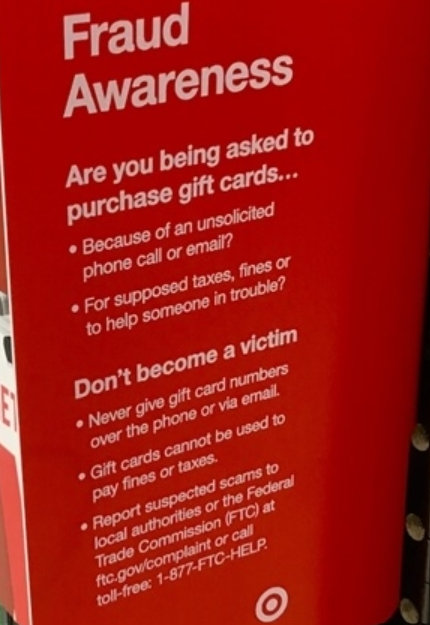
The decision rule for gift cards
A gift card is for giving to someone you know or for your own purchases. It is not a legitimate way to:
- pay taxes, fines, bail, utility bills, or government debts;
- secure a bank account;
- correct an accidental refund;
- pay a technology-support company;
- unlock a prize;
- satisfy a police officer or court;
- help an online romantic partner transfer funds.
If anyone instructs you to read the card number or PIN over the phone, send a photo, or type the code into a message, stop. The code is effectively the money.
Cryptocurrency: legitimate technology, dangerous payment pressure
Cryptocurrency is not automatically a scam. The danger comes from the combination of irreversible transfers, limited recovery mechanisms, and a recipient you cannot independently verify.
The FTC states that cryptocurrency payments generally do not carry the legal protections associated with credit and debit cards. Once a crypto transfer is confirmed, there is usually no card issuer that can process a conventional chargeback.
Scammers exploit that finality in several ways:
- fake investment platforms;
- romance or relationship-based investment fraud;
- government or bank impersonation;
- cryptocurrency ATM instructions;
- QR codes that direct funds to the scammer’s wallet;
- fake recovery services promising to retrieve earlier losses;
- demands to convert savings into crypto to “protect” the money.
The Canadian Anti-Fraud Centre describes investment scams in which victims are told to buy cryptocurrency through a legitimate exchange and then send it to a wallet controlled by the fraudster. A fake account dashboard may show profits even though the money is already gone.
Why the crypto platform can look real
The exchange where you purchase the cryptocurrency may be legitimate. That does not make the recipient or investment legitimate.
This distinction is essential. A bank transfer to a real cryptocurrency exchange can still be the first step in a scam. The criminal may stay on the phone while you:
- open an account;
- complete identity verification;
- buy cryptocurrency;
- scan a QR code;
- send funds to an external wallet.
The legitimate company processes the transaction you requested. The fraud occurs because the destination and story were false.
The decision rule for cryptocurrency
Treat a request as highly dangerous when someone you did not independently approach:
- insists that crypto is the only payment method;
- promises guaranteed returns;
- tells you exactly which exchange or ATM to use;
- supplies a wallet address or QR code;
- stays on the phone while you complete the transaction;
- tells you to hide the purpose from your bank or family;
- claims a government agency or bank requires cryptocurrency.
Legitimate institutions do not need you to transfer assets to an unknown wallet to keep your money safe.
Wire transfers and bank transfers: speed can work against you
Wire transfers are useful for legitimate, verified high-value transactions. They are also attractive to criminals because funds may move quickly and across borders.
FTC guidance advises anyone who sent a fraudulent wire to contact the bank or wire-transfer company immediately and ask whether the transfer can be reversed. The word immediately matters. Recovery may become less likely as funds are withdrawn, transferred onward, or moved through multiple accounts.
Common wire and bank-transfer scams include:
- business email compromise;
- fake property-closing instructions;
- supplier-account changes;
- romance scams;
- investment scams;
- emergency-family impersonation;
- bank-investigator scams;
- government impersonation;
- fake invoices.
The “safe account” lie
One of the most dangerous instructions is: “Your account is compromised, so transfer your money to a safe account.”
A real financial institution may freeze an account, replace a card, reset credentials, or guide you through its official fraud process. It does not need you to protect your money by sending it to an account controlled by a stranger.
The FTC specifically warns that the agency will never tell people to move money to protect it. Canadian authorities describe bank-investigator scams in which criminals impersonate financial institutions, law enforcement, Amazon, or credit-reporting agencies and manipulate victims into moving funds.
The decision rule for bank and wire transfers
Before sending a large or unusual transfer:
- Stop communicating through the channel that delivered the instructions.
- Contact the organization using a number or website you already know is genuine.
- Confirm the recipient’s legal name and account details.
- For business or property transactions, confirm changed banking instructions verbally with a known contact.
- Do not use the phone number contained in the suspicious email or message.
A changed account number should be treated as a security event, not a routine administrative update.
Payment apps and Interac e-Transfer: convenient does not mean protected retail checkout
Payment apps are convenient because they reduce friction. That same convenience can reduce the time available to detect a mistake.
In the United States, peer-to-peer services such as Zelle, Venmo, and Cash App are commonly used to send money between people. In Canada, Interac e-Transfer performs a similar practical role for many users.
These services can be appropriate for people and recipients you know and trust. Problems arise when a stranger presents a person-to-person transfer as though it were equivalent to a protected credit-card purchase.
Examples include:
- marketplace sellers demanding advance payment;
- fake rental deposits;
- puppy or pet scams;
- ticket scams;
- fake job equipment purchases;
- overpayment and refund schemes;
- account-verification requests;
- impersonated friends or family members.
An e-transfer or app transfer can display a familiar name, email, or phone number, but those details do not prove that the request is genuine. Accounts can be compromised, contact details can be spoofed, and criminals can imitate people you know.
The decision rule for person-to-person transfers
Use a payment app or e-transfer as though you were handing cash directly to the recipient.
Before sending:
- verify the recipient through a separate channel;
- confirm the amount and purpose;
- use a security question that is not easy to guess when applicable;
- be cautious with auto-deposit recipients you have not paid before;
- do not send a deposit merely because someone claims other buyers are waiting;
- avoid leaving the protections of a legitimate marketplace checkout system.
For an unknown seller, a credit card through a reputable platform may provide a stronger dispute path than a direct person-to-person transfer. Even then, verify the merchant and understand that no payment method can make a fraudulent seller safe.
Credit cards: stronger dispute tools, not immunity from scams
Credit cards are often less attractive to scammers because issuers and card networks may provide fraud monitoring, dispute procedures, and chargeback mechanisms.
In Canada, federally regulated financial institutions must provide protections for unauthorized credit-card transactions. The Financial Consumer Agency of Canada states that a cardholder’s liability for an unauthorized transaction on a bank-issued credit card is generally limited to a maximum of $50 unless the cardholder demonstrated gross negligence in safeguarding the card or authentication information.
But that rule should not be misunderstood.
A transaction you knowingly approved after being deceived may be treated differently from a transaction made without your authorization. A chargeback may also depend on the reason for the dispute, the evidence available, deadlines, merchant response, card-network rules, and the issuer’s investigation.
Credit cards are therefore relatively safer, not absolutely safe.
Why refusal of credit cards can be revealing
A seller who refuses ordinary card payment and insists on a gift card, wire, cryptocurrency, or direct transfer may be trying to avoid:
- identity checks;
- merchant-account scrutiny;
- transaction monitoring;
- chargebacks;
- a documented commercial relationship.
That refusal should increase your caution, especially if the seller is unknown and the transaction is remote.
Evidence: what recent fraud reports show
The payment method is not a minor detail in reported losses.
The FTC reported that U.S. consumers lost about $16 billion to fraud in 2025, an increase of roughly 25% from 2024. In its 2024 fraud data, the agency found that consumers reported losing more through bank transfers and cryptocurrency than through all other payment methods combined.
Earlier FTC analysis of 2023 reports showed the same pattern at a more detailed level:
- reported losses were highest through bank transfers at $1.7 billion;
- cryptocurrency followed at $1.2 billion;
- median reported individual losses were $5,000 for cryptocurrency and $4,581 for bank transfers;
- payment apps, credit cards, and debit cards were reported more frequently, but median losses were lower: $380, $136, and $110, respectively.
These numbers do not prove that one method causes fraud. They show that payment finality and transaction size can strongly influence the damage after a scam succeeds.
Canada faces the same broader problem. The Canadian Anti-Fraud Centre received more than 112,000 fraud reports involving over $704 million in reported losses in 2025. Reported losses represent only incidents that were reported to the centre, not every loss that occurred.
Interpretation: risk comes from the whole transaction
It would be too simple to rank every payment method from “safe” to “unsafe” without context.
A better assessment uses five questions:
1. Who initiated the contact?
An unexpected caller or message deserves more scrutiny than a transaction you initiated through a verified business.
2. Does the payment method fit the purpose?
Gift cards do not fit tax payments. Cryptocurrency does not fit account security. A personal e-transfer may not fit a purchase from an unknown commercial seller.
3. Are you being denied a normal alternative?
The insistence that there is only one acceptable payment method is a major warning sign.
4. Are you being rushed or isolated?
Scammers may tell you not to speak to your bank, spouse, children, accountant, police, or store employee. Isolation protects the scam.
5. What happens if the recipient is dishonest?
Before paying, imagine that the product never arrives or the story is false. Is there a realistic dispute or recovery process? Can the recipient be identified? Is the platform responsible for the transaction?
This last question turns payment choice into a risk-management decision.
The 30-second payment test
Before sending money in response to an unexpected or emotionally charged request, ask:
- Did I independently verify who is asking?
- Does this payment method make sense for the stated purpose?
- Am I being told this is the only way to pay?
- Is someone pressuring me to act before I can think or verify?
- Am I being told to keep the transaction secret?
- Would I still send the money if I knew it could not be recovered?
If any answer creates doubt, pause. Do not let the caller remain on the line while you verify. Use an official number, app, or website that you locate independently.
A legitimate organization can tolerate verification. A scammer needs to prevent it.
What to do if you already paid
Speed is more useful than embarrassment. Contact the payment provider first, even when recovery seems unlikely.
If you paid by credit or debit card
Contact the issuer immediately. Report the transaction and ask about fraud, dispute, replacement-card, and account-security procedures.
If you used a bank transfer or wire transfer
Call the bank, Western Union, MoneyGram, or other transfer provider immediately. Ask whether the transfer can be stopped, recalled, or reversed.
If you used a payment app or Interac e-Transfer
Contact the app provider and your financial institution immediately. Report the recipient and transaction. Change compromised passwords and review account security.
If you paid with cryptocurrency
Contact the exchange, ATM operator, or service used to send the funds. Provide the transaction ID and destination wallet address. A blockchain transaction may not be reversible, but prompt reporting can help identify accounts, preserve evidence, or support law-enforcement action.
If you paid with gift cards
Contact the card issuer immediately. Keep the physical card and receipt. Provide the card number only through an official issuer channel—not to the person who requested payment.
Preserve evidence
Save:
- messages and emails;
- phone numbers;
- account names;
- usernames and profile links;
- receipts;
- transfer confirmations;
- wallet addresses;
- transaction IDs;
- QR codes;
- screenshots;
- dates and times;
- the story the person used.
Do not pay a second person who promises guaranteed recovery. Recovery scams commonly target people who have already lost money.
Where to report in the United States and Canada
United States
Report fraud to the Federal Trade Commission at ReportFraud.ftc.gov. For internet-enabled crime, a report to the FBI Internet Crime Complaint Center at IC3.gov may also be appropriate. Contact local law enforcement when there is an immediate threat, theft, or substantial loss.
Canada
Report fraud or cybercrime to the Canadian Anti-Fraud Centre through its online reporting system or by phone at 1-888-495-8501. The CAFC also advises victims to contact their financial institution and local police. Misleading or deceptive marketing practices can also be reported to the Competition Bureau.
Reporting matters even when money is recovered or no money was lost. Reports help authorities identify patterns, accounts, phone numbers, websites, and coordinated campaigns.
The bottom line
A scam is not defined by one payment method. But the requested payment can reveal what the criminal is trying to achieve.
Gift cards turn retail value into transferable codes. Cryptocurrency can move beyond conventional dispute systems. Wire and bank transfers can move large sums quickly. Payment apps and e-transfers can make a stranger-to-stranger transaction feel as casual as paying a friend. Cash leaves almost no built-in recovery mechanism.
Credit cards generally provide stronger dispute and unauthorized-transaction protections, but they do not eliminate the need to verify the merchant, recipient, and transaction.
The most useful principle is simple:
Scammers do not choose payment methods because they are convenient for you. They choose them because they are difficult for you to reverse.
When the payment method does not fit the story, stop and verify before the money moves.
FAQ
Why do scammers ask for gift cards?
Gift cards are easy to buy, their codes can be sent instantly, and the value can often be redeemed or resold quickly. They also provide fewer recovery options than many conventional payment methods. No legitimate government agency, bank, court, or police department requires payment through retail gift cards.
Is cryptocurrency always a sign of a scam?
No. Cryptocurrency has legitimate uses. It becomes a major warning sign when an unexpected caller, online contact, supposed government official, bank representative, romantic partner, or investment promoter insists that you transfer crypto to a wallet they provide.
Can a wire transfer be reversed after a scam?
Sometimes, but recovery is difficult and depends heavily on speed. Contact the bank or wire-transfer provider immediately and ask whether the transfer can be stopped, recalled, or reversed. Do not wait for the scammer to respond.
Is a credit card the safest way to pay an unknown seller?
A credit card generally offers a stronger dispute path than gift cards, cryptocurrency, direct transfers, or cash. It does not make an unknown seller trustworthy, and a voluntarily authorized transaction may not receive the same protection as an unauthorized charge.
Can an Interac e-Transfer be recovered after fraud?
Recovery may be difficult after a transfer is deposited, particularly when the sender voluntarily authorized it. Contact the financial institution immediately, report the transaction, secure the account, preserve evidence, and report the incident to the Canadian Anti-Fraud Centre and local police.
What is the biggest warning sign in a payment request?
A strong warning sign is insistence that only one unusual or difficult-to-reverse method is acceptable, especially when combined with urgency, secrecy, threats, guaranteed returns, or instructions to ignore your bank or family.
What should I do first after paying a scammer?
Immediately contact the bank, card issuer, payment service, wire company, gift-card issuer, crypto exchange, or other provider involved. Ask what can be stopped or recovered, secure your accounts, preserve evidence, and report the incident.
Where should Americans report a payment scam?
Report it to the Federal Trade Commission at ReportFraud.ftc.gov. Internet-related crimes may also be reported to the FBI Internet Crime Complaint Center at IC3.gov. Contact local law enforcement when appropriate.
Where should Canadians report a payment scam?
Report it to the Canadian Anti-Fraud Centre online or by phone at 1-888-495-8501. Contact the financial institution and local police promptly. Misleading marketing practices may also be reported to the Competition Bureau.
Story Recommendation
Should AI-Generated Content Be Labeled? What Different Disclosure Rules Could Mean for You