The headline sounds simple: the Canada Child Benefit increased for 2026–2027. Yet some parents who checked their July deposit may have seen only a small increase—or even a lower payment than they received in June.
That does not necessarily mean the increase was cancelled or that the Canada Revenue Agency made an error. Two separate calculations changed at the same time:
- The maximum CCB amounts and income thresholds were increased for the new benefit year.
- The CRA switched from using your family’s 2024 income to using its 2025 income.
The first change can raise your benefit. The second can raise or lower it, depending on what happened to your adjusted family net income, family composition, custody arrangement, and children’s ages.
This guide explains the numbers behind the July 2026 recalculation, why different families can move in opposite directions, and what to check before deciding that your payment is wrong.
Key takeaway: For July 2026 through June 2027, the CCB provides up to $8,157 per child under age 6 and $6,883 per child aged 6 to 17. But those are maximums. Your actual payment is calculated using your 2025 adjusted family net income and other family information.
Verification date: Benefit amounts, income thresholds, reduction rates, and payment dates in this article were checked against Canada Revenue Agency guidance available on July 23, 2026.
What changed for the 2026–2027 benefit year?
The new CCB benefit year runs from July 2026 through June 2027.
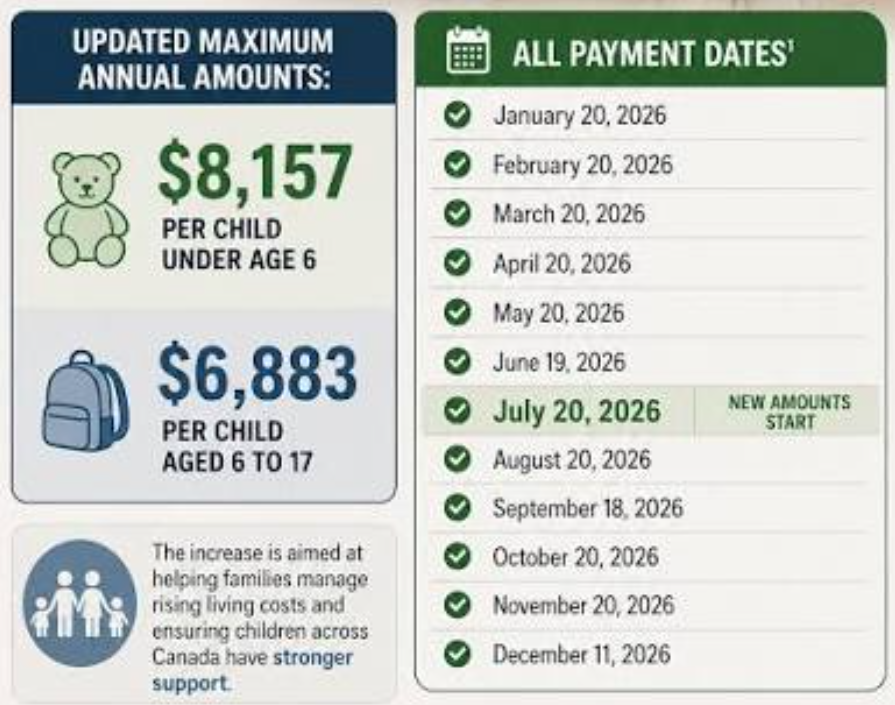
For this period, the maximum annual amounts are:
| Child’s age | Maximum annual CCB | Maximum monthly equivalent |
|---|---|---|
| Under 6 | $8,157 | $679.75 |
| Age 6 to 17 | $6,883 | $573.58 |
Compared with 2025–2026, the annual maximum increased by:
- Up to $160 for each child under 6
- Up to $135 for each child aged 6 to 17
The previous maximums were $7,997 for a child under 6 and $6,748 for a child aged 6 to 17.
The federal government indexes the CCB to inflation. Indexation raises not only the maximum benefit amounts but also the income thresholds used in the calculation. For 2026–2027, the first income threshold is $38,237, and the second is $82,847.
Those numbers matter because families with adjusted family net income below $38,237 can receive the maximum amount, while benefits are gradually reduced above that level.
Why July is different from June
The CCB does not use your current month’s paycheque to calculate the current month’s benefit.
Instead, each benefit year uses tax information from the previous calendar year:
| Payment period | Income year used |
| July 2025 to June 2026 | 2024 tax information |
| July 2026 to June 2027 | 2025 tax information |
That switch happens every July.
For example, your June 19, 2026 payment was still calculated using your 2024 adjusted family net income. Your July 20, 2026 payment was calculated using your 2025 adjusted family net income.
This creates the central tension in the new benefit year:
- Inflation indexation pushes the potential benefit upward.
- A rise in family income can push the actual benefit downward.
The direction and size of your July change depend on which effect is larger.
The numbers that determine your payment
The CRA calculates your CCB using several factors:
- The number of eligible children in your care
- Each child’s age
- Your adjusted family net income, or AFNI
- Your marital status
- Your custody arrangement
- Whether a child became or stopped being eligible during the year
- Whether the CRA is recovering an overpayment
- Whether your tax returns and family information are current
What is adjusted family net income?
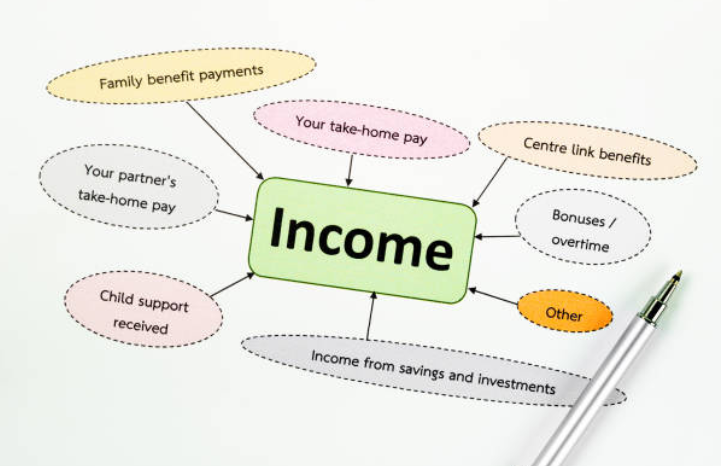
Adjusted family net income generally starts with:
- Your net income on line 23600 of your tax return
- Plus your spouse’s or common-law partner’s line 23600 amount, where applicable
The CRA then makes specific adjustments for certain Universal Child Care Benefit and Registered Disability Savings Plan amounts received or repaid.
This means AFNI is not simply your salary, household gross income, or taxable income from one T4. It is a family-based figure drawn from assessed tax returns.
The 2026–2027 CCB reduction rates
The maximum benefit is reduced once AFNI exceeds $38,237. The reduction rate depends on the number of eligible children.
Families with one child
| 2025 AFNI | Reduction |
| $38,237 or less | No reduction |
| More than $38,237 up to $82,847 | 7% of AFNI above $38,237 |
| More than $82,847 | $3,123 plus 3.2% of AFNI above $82,847 |
Families with two children
| 2025 AFNI | Reduction |
| $38,237 or less | No reduction |
| More than $38,237 up to $82,847 | 13.5% of AFNI above $38,237 |
| More than $82,847 | $6,022 plus 5.7% of AFNI above $82,847 |
Families with three children
| 2025 AFNI | Reduction |
| $38,237 or less | No reduction |
| More than $38,237 up to $82,847 | 19% of AFNI above $38,237 |
| More than $82,847 | $8,476 plus 8% of AFNI above $82,847 |
Families with four or more children
| 2025 AFNI | Reduction |
| $38,237 or less | No reduction |
| More than $38,237 up to $82,847 | 23% of AFNI above $38,237 |
| More than $82,847 | $10,260 plus 9.5% of AFNI above $82,847 |
These reductions apply to the family’s combined maximum CCB, not separately to each child.
Example 1: Your income stayed roughly the same
Suppose a family has one child under 6 and its AFNI remained at $45,000.
The calculation is:
- Maximum benefit: $8,157
- AFNI above the first threshold: $45,000 − $38,237 = $6,763
- Reduction: $6,763 × 7% = $473.41
- Annual CCB: $8,157 − $473.41 = $7,683.59
- Monthly equivalent: about $640.29
Because the maximum amount and thresholds increased, a family whose income stayed similar will generally receive a higher amount than under the previous benefit year, assuming no other family details changed.
Example 2: The published maximum rose, but your payment fell
Consider a family with one child under 6 whose AFNI rose substantially in 2025.
The family may benefit from the higher $8,157 maximum and higher income thresholds, but the increase in AFNI can create a larger reduction than the amount gained through indexation.
For a one-child family with AFNI of $100,000, the CRA’s 2026–2027 calculation is:
- AFNI above second threshold: $100,000 − $82,847 = $17,153
- Additional reduction: $17,153 × 3.2% = $548.89
- Fixed reduction: $3,123
- Total reduction: $3,671.89
- Maximum for one child under 6: $8,157
- Annual CCB: $8,157 − $3,671.89 = $4,485.11
- Monthly equivalent: about $373.75
If that family’s 2024 AFNI was considerably lower, its June payment could have been higher than its July payment despite the nationwide increase.
The correct conclusion is not “the CCB went down for everyone.” The maximum increased, but this family’s income-based reduction increased by more.
Example 3: A two-child family
Suppose a family has two children under 6 and 2025 AFNI of $60,000.
- Combined maximum: $8,157 × 2 = $16,314
- AFNI above first threshold: $60,000 − $38,237 = $21,763
- Reduction: $21,763 × 13.5% = approximately $2,938
- Annual CCB: approximately $13,376
- Monthly equivalent: approximately $1,114.66
This example also shows why looking only at a per-child maximum can be misleading. The CRA first adds the applicable maximum amounts and then applies the family-level reduction.
Seven common reasons your July payment changed
1. Your 2025 family income was different from 2024
This is the most common explanation.
A promotion, overtime, business income, investment income, return to work, job loss, parental leave, or other change reflected on a 2025 tax return may affect the July 2026 calculation.
A rise in income does not automatically eliminate the benefit. It changes the income-tested reduction.
Likewise, if family income fell in 2025, the July payment may rise by more than the published indexation increase.
2. A child moved into a different age band
The CCB rate changes after a child turns 6.
For 2026–2027:
- Under-6 maximum: $679.75 per month
- Age-6-to-17 maximum: $573.58 per month
The difference between those maximum monthly rates is $106.17.
The CRA states that a child who turns 6 during a month is paid at the under-6 rate for that month, with the older-child rate beginning the following month.
A child who turns 18 receives the final CCB payment for the month in which the child turns 18, assuming all other eligibility requirements are met.
3. Your marital status changed
Marriage, common-law status, separation, divorce, or reconciliation can change AFNI and therefore the amount.
The CRA needs the effective date of a marital-status change. Waiting until tax season can result in an incorrect entitlement, an overpayment, or a delayed adjustment.
4. Your custody arrangement changed
For shared custody, each parent generally receives 50% of the amount they would have received if the child lived with them full time, calculated using that parent’s own AFNI.
The CRA does not split shared-custody CCB using custom percentages.
A custody change can therefore alter both who receives the benefit and how much each parent receives.
5. The number of eligible children changed
A birth, adoption, change in care, a child turning 18, or a child no longer residing with you can affect the total maximum and the applicable reduction rate.
Because the reduction percentages vary according to the number of eligible children, the effect is not always a simple one-child subtraction.
6. A provincial or territorial benefit changed
Some provincial and territorial child benefits are delivered with the CCB as one payment.
As a result, the amount deposited into your bank account may not represent the federal CCB alone. A change in a provincial program can make the total deposit rise or fall even when the federal component moves differently.
Review the detailed benefit notice rather than trying to reverse-engineer the deposit from the federal maximums alone.
7. The CRA is applying an adjustment or recovering an overpayment
If the CRA determines that too much CCB was previously paid, it may apply all or part of future benefit payments against the balance.
Changes can also occur after the CRA receives updated tax returns, custody information, marital-status information, or responses to a review letter.
Child Disability Benefit: another number that may be included
A child who qualifies for the Disability Tax Credit may also qualify for the Child Disability Benefit.
For July 2026 through June 2027, the maximum CDB is:
- $3,480 per eligible child per year
- $290 per month
The CDB begins to be reduced when AFNI exceeds $82,847.
The reduction is:
- 3.2% of AFNI above $82,847 for a family with one CDB-eligible child
- 5.7% of AFNI above $82,847 for a family with two or more CDB-eligible children
The CRA calculates the CDB automatically and adds it to the CCB payment when eligibility requirements are met.
What to check before contacting the CRA
A lower-than-expected deposit can be stressful, but begin with the calculation details.
Step 1: Compare the correct months
Compare June 19, 2026 with July 20, 2026.
June used 2024 tax information. July used 2025 tax information. Comparing two months within the same benefit year will not show the annual recalculation as clearly.
Step 2: Find your 2025 AFNI
Review the assessed 2025 tax returns for you and your spouse or common-law partner.
Do not use household gross salary as a substitute. The CRA calculation is based on AFNI.
Step 3: Confirm each child’s age and eligibility
Check whether a child turned 6, turned 18, entered or left your care, or became subject to a shared-custody arrangement.
Step 4: Review your CRA benefit notice
In your CRA account, you can view:
- Your next expected payment date and amount
- Payment amounts for the July-to-June benefit year
- Your CCB statement of account
- Benefit notices explaining calculation changes
The benefit notice is more useful than the bank deposit alone because it can show the figures and circumstances used.
Step 5: Separate the federal CCB from combined benefits
Check whether the deposit includes a provincial or territorial child benefit or the Child Disability Benefit.
Step 6: Check for an overpayment balance
A recovery can reduce the amount deposited even if your underlying entitlement increased.
Step 7: Use the official calculator for an estimate
The CRA’s Child and Family Benefits Calculator can provide an estimate based on the information you enter.
Treat it as an estimate, not a replacement for an official notice. Small differences can arise from incomplete information, effective dates, rounding, or changes not reflected in your inputs.
What if you or your spouse filed taxes late?
Both you and your spouse or common-law partner must file an annual tax return to keep receiving the CCB, even with no income or tax-exempt income.
The CRA says returns should be filed by April 30 to avoid disruption. If a return is late, payments may stop temporarily.
After the return is assessed, the CRA will determine entitlement. Missed amounts for which you remain eligible are generally paid retroactively on a scheduled payment date.
A stopped payment is therefore not always a permanent loss, but the interruption can create a serious cash-flow problem. Filing on time remains the safest approach.
2026 CCB payment dates
The remaining scheduled CCB payment dates for 2026 are:
- August 20
- September 18
- October 20
- November 20
- December 11
Earlier 2026 dates were January 20, February 20, March 20, April 20, May 20, June 19, and July 20.
The CRA advises waiting five working days before contacting it about a payment that has not arrived.
So, should your July payment have increased?
The answer depends on what changed.
Your payment was more likely to rise if:
- Your 2025 AFNI was similar to or lower than your 2024 AFNI
- Your number of eligible children increased
- No child moved from the under-6 rate to the age-6-to-17 rate
- You became eligible for an additional child or disability benefit
- No overpayment recovery was applied
Your payment could fall if:
- Your 2025 AFNI rose enough to outweigh indexation
- A child turned 6
- A child turned 18 or left your care
- Your marital status increased the family income used
- A custody arrangement changed
- A provincial or territorial component declined
- The CRA began recovering an overpayment
The national announcement and your individual deposit answer different questions.
The announcement tells you that the program’s maximums and thresholds increased. Your deposit tells you how the indexed rules applied to your family’s updated information.
Important Information Notice
This article is for general informational purposes only and does not constitute tax, legal, financial, or government-benefit advice. Benefit eligibility and payment amounts depend on individual circumstances and may change after publication. Confirm current information through the Canada Revenue Agency or consult an appropriate qualified professional before making decisions based on this article.
The bottom line
For July 2026 to June 2027, the Canada Child Benefit offers a maximum of $8,157 per child under 6 and $6,883 per child aged 6 to 17. Families with AFNI of $38,237 or less can receive the maximum, while payments are reduced above that threshold. A second threshold of $82,847 changes the reduction formula.
Those increases are real, but they do not guarantee that every family’s July deposit increased. July is also when the CRA began using 2025 income instead of 2024 income.
The most useful question is therefore not simply, “Did the CCB go up?”
It is:
“After the new maximums, new thresholds, and my family’s updated 2025 information were all applied, does the CRA’s calculation make sense?”
Start with your benefit notice, confirm the underlying numbers, and contact the CRA when the information used is incorrect or the calculation remains unexplained.
FAQ
How much is the Canada Child Benefit in 2026–2027?
For July 2026 through June 2027, the maximum is $8,157 per year for each child under age 6 and $6,883 per year for each child aged 6 to 17. Actual amounts depend on adjusted family net income and family circumstances.
Why did my Canada Child Benefit go down in July 2026?
July 2026 payments use 2025 tax information, while January through June 2026 payments used 2024 tax information. A rise in adjusted family net income, a child turning 6 or 18, a marital- or custody-status change, or an overpayment recovery can outweigh the indexed increase.
What income is used for the July 2026 CCB?
The July 2026 to June 2027 benefit year is based on adjusted family net income from 2025 tax returns.
What is the CCB income threshold for 2026–2027?
The maximum benefit is available when adjusted family net income is $38,237 or less. Benefits are reduced above $38,237, with a second reduction tier beginning above $82,847.
Is the Canada Child Benefit taxable?
No. The CCB is tax-free and does not have to be reported as taxable income on your tax return.
What is the maximum Child Disability Benefit for 2026–2027?
The maximum is $3,480 per eligible child per year, or $290 per month. It begins to be reduced when adjusted family net income exceeds $82,847.
Do both spouses need to file tax returns to keep receiving the CCB?
Yes. The recipient and their spouse or common-law partner must file annual tax returns, even if either person had no income or tax-exempt income.
How does shared custody affect the CCB?
Each eligible parent generally receives 50% of the amount they would have received if the child lived with them full time. Each parent’s amount is calculated using their own adjusted family net income.
Story Recommendation
Checking vs Savings Accounts: What Each Is For and Why You May Need Both
Canada Groceries and Essentials Benefit (CGEB) 2026: Who Gets More, and What Should You Check?