The air outside has turned hazy again, and the house smells faintly of smoke even with the windows shut. Buying a commercial air purifier feels like the obvious fix, except the good ones aren’t cheap — and you’ve seen people online taping a furnace filter to a box fan and calling it done. The real question isn’t which option is “better” in the abstract. It’s which one actually gets enough clean air moving through the room you’re in.
Quick Action Summary
Both options can work when properly sized, selected, and used. A commercial air cleaner is generally the easier choice to size correctly, since most publish a tested CADR that can be matched to your room. A DIY box-fan filter, built correctly with a MERV 13 filter and a shroud, has EPA-measured performance that can rival commercial units, often at substantially lower upfront cost — but only with a newer, safety-certified fan and a bit more attention to setup. The wrong choice for most households isn’t picking one over the other; it’s buying or building something too small for the room.
Start With the Number That Actually Matters: CADR
Every air-cleaning decision here comes back to one figure: Clean Air Delivery Rate (CADR), a measurement of how much filtered air a device delivers per minute. The EPA and ENERGY STAR both recommend matching CADR to room size using the “2/3 rule”: your air cleaner’s smoke CADR should be at least two-thirds of the room’s square footage.
To use it:
- Multiply the room’s length by width to get square footage.
- Multiply that number by 0.67.
- That result is the minimum smoke CADR you’re looking for.
Example: A 300-square-foot living room needs a smoke CADR of at least 200 (300 × 0.67 ≈ 200).
This calculation assumes a standard 8-foot ceiling. EPA notes that if you have higher ceilings or an open floor plan, you should size for the larger air volume — either by using an air cleaner rated for a bigger area than your square footage alone would suggest, or by using multiple units.
For households that experience heavy or frequent smoke, the Association of Home Appliance Manufacturers (AHAM) — the organization behind the CADR rating system — suggests choosing a CADR roughly equal to the room’s square footage, rather than just two-thirds of it, to account for how much more polluted the air is during an active smoke event compared to everyday conditions. Most commercial units publish a CADR that can be matched using this method. A DIY box-fan filter’s CADR isn’t printed anywhere, but EPA has independently lab-tested several common designs, so reasonably reliable numbers do exist — just not on the box.
Commercial Air Cleaners: What You’re Actually Paying For
A commercial portable air cleaner offers three things a DIY setup can’t fully replicate:
- A published CADR in most cases. Most commercial units publish a CADR based on the AHAM AC-1 test method, and this number, when present, is a reasonable guide for room-size matching. A manufacturer publishing a CADR isn’t the same as independent verification, though — a rating carrying the “AHAM Verifide” mark has been independently tested, which provides stronger assurance than an unverified manufacturer claim.
- Consistency between units. Two DIY box-fan filters built the same way, even by the same person, can perform differently depending on the fan’s power and how tightly the filter is sealed.
- Noise information you can check before buying. Some commercial units publish a noise rating (a reading around 50 decibels is roughly a modern refrigerator), and many offer multiple speed settings — useful for evaluating bedroom use in advance, something a DIY box fan doesn’t offer in the same way.
The trade-off is cost. A unit with enough CADR to comfortably cover a 300-square-foot room using the 2/3 rule often costs more than the parts needed to build an equivalent DIY filter, though how much more varies widely by model, local pricing, and the commercial unit’s own CADR — it isn’t reliably “a fraction of the price” across every product.
One safety detail applies regardless of which option you choose: avoid any air cleaner designed to intentionally produce ozone — a lung irritant. Some ionizers, electrostatic precipitators, and certain UV-light or plasma devices marketed as air cleaners may also emit ozone as a byproduct even when it isn’t the device’s intended function, so don’t assume a technology label alone tells you enough — check for an independent low- or no-ozone certification. The California Air Resources Board and AHAM both maintain lists of devices tested and verified to emit little or no ozone.
DIY Box-Fan Filters: What the Research Actually Shows
Despite the informal reputation, DIY air cleaners aren’t a fringe workaround — EPA researchers lab-tested a range of DIY designs against simulated wildfire smoke and published the actual results. Design matters more than most people expect: adding a shroud alone increased CADR by about 40% with no added cost, and multi-filter designs increased it further.
| Design | EPA Lab-Tested Wildfire-Smoke CADR | Filters Needed | Relative Cost | Ease of Building |
|---|---|---|---|---|
| Box fan + one 1″ MERV13 filter | ~111 | 1 | Lowest | Easiest |
| Box fan + one 1″ MERV13 filter + shroud | ~156 | 1 | Lowest | Easy |
| Box fan + one 4″ MERV13 filter + shroud | ~248 | 1 (thicker) | Low–Medium | Easy |
| Box fan + two 1″ MERV13 filters + shroud (wedge) | ~263 | 2 | Medium | Moderate |
| Corsi-Rosenthal box: four 1″ MERV13 filters + shroud | ~401 | 4–5 | Highest | Most involved |
These figures come from a single EPA laboratory study and represent typical results for that specific design and test setup — actual performance can vary with the fan model, filter brand, and how tightly everything is sealed, so treat them as a reliable guide rather than a guarantee for any individual build.
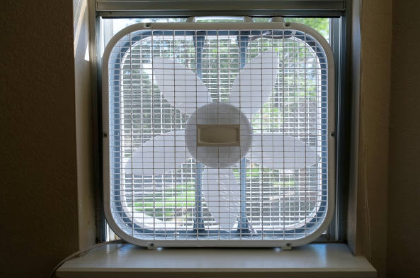
All of these designs use the same core components: a 20″×20″ box fan, one or more 20″×20″ furnace filters (MERV 13 or higher recommended), duct tape or clamps, and a cardboard shroud to concentrate airflow through the fan’s blade area rather than around the edges.
How to Build the Basic Version
What you need:
- One 20″×20″ furnace filter, 1″–4″ thick, MERV 13 or higher
- One 20″×20″ box fan — must be a certified model with a UL or ETL safety marking, built in 2012 or later
- Duct tape, clamps, or bungee cords
- A cardboard shroud (cut from the fan’s original box)
Steps:
- Check the filter’s airflow arrows and align them with the direction air moves through the fan — air should pass through the filter first, then into the fan.
- Secure the filter flat against the fan’s intake side using tape, clamps, or bungee cords, sealing the edges so air can’t bypass the filter through gaps.
- Attach a circular cardboard shroud over the front corners of the fan, leaving only the center blade area open — this pulls more air through the filter rather than around it and meaningfully improves performance.
- Run the fan at the highest setting occupants can comfortably tolerate, for as much of the smoke event as reasonably possible — higher speeds and longer run times both filter more air, but a lower speed run continuously is generally better than a high speed that gets turned off because of noise.
For higher performance, the wedge design (two filters) or cube design (four to five filters) follows the same core principles with more filter surface area, at the cost of being bulkier and slightly more involved to assemble.
The Safety Details That Actually Matter
This is where a DIY approach needs more attention than simply buying a plug-and-play commercial unit.
- Use a fan built in 2012 or later with a UL (Underwriters Laboratory) or ETL (Intertek) safety marking — this is a recommendation, not a flexible preference. EPA specifically advises against building a DIY air cleaner with a pre-2012 fan in the first place; replace the fan rather than working around its age.
- If a newer fan genuinely isn’t available and a pre-2012 fan is used anyway, treat this as a fallback risk-reduction step, not a green light: never leave it unattended, and never run it while people are sleeping.
- Never use an extension cord with the fan.
- Working smoke detectors matter more, not less, when running any air-moving device continuously during a smoke event.
- Check filters daily during a smoke event, and change based on condition, not a fixed schedule. Replace the filter when it looks dark brown or gray, or starts to smell like smoke — EPA testing found a heavily loaded filter can become almost completely ineffective, and exactly how long that takes varies with use and conditions. Handle removed filters gently to avoid releasing accumulated particles back into the air.
How Do You Know the Air Inside Actually Needs Filtering?
Smoke doesn’t need to be visibly hanging in the room for indoor air quality to be affected. Fine wildfire smoke particles are small enough to work their way indoors through door gaps, window seams, and ventilation, even in a closed-up house. None of the signals below tell you your exact indoor particle level — an indoor particle monitor is the only way to measure that directly — but together they’re a reasonable prompt to start running an air cleaner, or turn it up, rather than waiting for something more obvious:
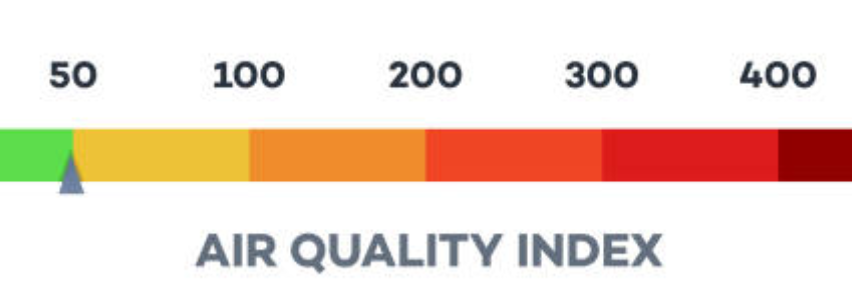
- Outdoor air quality readings for your area — Environment and Climate Change Canada’s Air Quality Health Index (AQHI) and the US AirNow system both report current outdoor smoke-related risk levels for your location. These describe conditions outside, not what’s actually inside your home, but a poor outdoor reading is still a reasonable reason to start filtration before smoke becomes obvious indoors.
- A faint smoky smell that lingers after windows and doors have been closed for a while, rather than fading — though keep in mind a smoky smell can persist even after particle filtration is working well, since most particle filters don’t remove the gases that cause the odor as effectively as they remove particles.
- Eye, throat, or respiratory irritation can be a reason to take protective action, but symptoms alone don’t identify your indoor particle level or confirm that wildfire smoke specifically is the cause — plenty of other things can cause similar irritation.
- Visible haze near light sources in a room, which usually means particle concentration is already fairly high.
None of these substitute for an actual indoor particle reading if you have one, but they’re a reasonable cue to act on rather than waiting for confirmation.
Cost and Upkeep Over a Full Smoke Season
The upfront price difference between the two options tends to get most of the attention, but ongoing cost matters just as much over a full wildfire season.
- DIY filters are cheaper to build initially, but the filters themselves need replacing regularly during heavy smoke periods, based on their condition rather than a fixed schedule. Buying filters in bulk ahead of smoke season keeps this cost down and avoids scrambling to find MERV 13 filters when local stores sell out during a smoke event.
- Commercial units typically use proprietary or brand-specific replacement filters. Whether they end up costing more or less than DIY filters over a season depends heavily on the specific model, its filter price, and how many hours it runs — worth checking a model’s estimated filter life before buying if cost matters to you.
- Electricity cost depends on the specific fan or unit’s wattage and how many hours it runs, rather than being reliably similar or different between the two options in general. EPA’s own cost-effectiveness testing of DIY designs included estimated electricity costs but did not include the cost of replacement filters, so a full season’s DIY cost is somewhat higher than the headline “cheap to build” comparison suggests once filters are factored in.
Thinking through a full season’s filter and electricity costs, not just the initial purchase or build cost, gives a more realistic comparison than looking at day-one price alone — though an exact side-by-side number requires comparing specific models, wattages, and filter prices rather than a general rule.
Which One Fits Your Situation?
| Your situation | Better fit | Why |
|---|---|---|
| Budget is tight, smoke events are occasional | DIY box-fan filter | EPA-tested performance can rival commercial units for meaningfully lower upfront cost |
| Multiple rooms need coverage | A mix — DIY units in secondary rooms, commercial unit in main living space | Balances cost against total coverage needed |
| You want to check noise level before buying | Commercial air cleaner | More likely to publish a noise rating and offer multiple speed settings |
| You only have an older, uncertified box fan available | Commercial air cleaner, or buy a new certified fan first | Fire-safety risk outweighs cost savings from an older fan |
| Smoke events are frequent or severe in your area | Whichever option lets you reach a higher CADR (AHAM suggests closer to a 1:1 ratio with room size for heavy smoke) | Extreme particle loads need more filtering capacity, not just meeting the minimum |
| Buying a commercial unit | Check that it isn’t an ozone-generating device (ionizer, electrostatic precipitator, some UV/plasma units) | Ozone is a lung irritant; CARB and AHAM both maintain lists of low/no-ozone certified devices |
What NOT to Do
- Don’t buy or build based on price alone without checking CADR against your room’s square footage. An undersized unit — commercial or DIY — will run constantly without meaningfully clearing the air.
- Don’t use a box fan without a UL or ETL safety marking, especially not one built before 2012, if a newer certified model is available instead.
- Don’t skip the shroud on a DIY build. It’s a small addition that meaningfully increases how much air actually passes through the filter rather than around it.
- Don’t assume a DIY filter needs no maintenance. A clogged filter loses effectiveness and should be replaced regularly during an extended smoke event, not left in place for the whole season.
- Don’t assume you automatically need one air cleaner per room. If your home isn’t divided by many closed doors, one unit sized for the entire connected square footage — not just the room it sits in — or one “clean air room” you spend smoke-heavy time in, may be enough. Separate closed-off rooms generally need their own unit, or the air simply won’t reach them.
The Bottom Line
Efficiency and operational safety are two different questions here, and it’s worth keeping them separate. On efficiency, neither option is inherently better — the deciding factor is whether the CADR, published or EPA-tested, actually matches your room. A well-built DIY box-fan filter with a certified fan, a MERV 13 filter, and a proper shroud can perform in the same range as a mid-tier commercial unit, often at meaningfully lower cost. On safety, EPA and UL testing found that newer certified fans were unlikely to pose a fire or burn hazard under the specific conditions tested — but that testing covered a limited set of fan models and setups, and EPA doesn’t extend it as a guarantee to every possible fan, filter, or assembly. A DIY build still depends more on the builder getting the details right (fan age, sealing, ventilation) than a commercial unit does, which arrives as a finished, tested product. For many households, the most practical approach during wildfire smoke season is a hybrid one: a commercial unit in the main living space, paired with one or two DIY filters in bedrooms or secondary rooms, so every occupied room actually gets covered rather than concentrating all the filtering capacity in one place. Whichever route you choose, check the CADR-to-room-size math before buying or building, since that single number determines whether the effort is worth it at all.
This article is for general informational purposes only and reflects publicly available guidance as of the verification date noted below. If you or a family member has a respiratory condition, heart condition, or other health concern affected by smoke exposure, consult a healthcare provider for guidance specific to your situation.
FAQ
Q1. Is a DIY box-fan air filter actually as effective as a commercial air purifier? EPA lab testing found that well-built DIY air cleaners achieved wildfire-smoke CADR values ranging from about 111 (basic single-filter design) up to about 401 (four-filter Corsi-Rosenthal box), which can rival or exceed many commercial units. Performance depends heavily on build quality — fan model, filter seal, and shroud use — so results vary more than with a commercial unit off the shelf.
Q2. What size box fan and filter do I need? The most common EPA-evaluated designs use a 20″×20″ box fan paired with one or more 20″×20″ furnace filters, 1″ to 4″ thick, rated MERV 13 or higher.
Q3. Is it safe to run a box-fan air filter overnight? Build it with a certified fan — 2012 or later with a UL or ETL safety marking — and this isn’t a major concern; EPA specifically advises against building one with an older fan in the first place. If an older, pre-2012 fan is genuinely the only one available, treat that as a fallback: never leave it unattended or run it while people are sleeping.
Q4. How do I know what size commercial air purifier to buy? Use the 2/3 rule as a baseline: multiply your room’s square footage by 0.67 to get the minimum smoke CADR to look for, assuming a standard 8-foot ceiling (size up for higher ceilings or open floor plans). For households with frequent or heavy smoke, AHAM — the organization behind the CADR rating — suggests sizing closer to a 1:1 CADR-to-square-footage ratio.
Q5. How often do I need to change the filter on a DIY air cleaner? Check it daily during a smoke event rather than following a fixed schedule. Change the filter when it looks dark brown or gray or starts to smell like smoke — EPA testing found that a heavily loaded filter can become almost completely ineffective, and exactly how fast that happens depends on conditions and use.
Q6. Can one air cleaner cover my whole house? Usually not, especially in a home with several closed-off rooms — air cleaners don’t clean air through closed doors. In a home without many interior doors, one unit sized for the full connected square footage (not just its immediate spot) can be enough, or you can designate one “clean air room” that people spend smoke-heavy time in. Separate closed rooms generally need their own unit.
Q7. Should I avoid any specific type of commercial air cleaner? Yes — avoid devices designed to intentionally generate ozone, a lung irritant not approved by any federal agency for use in occupied spaces. Some ionizers, electrostatic precipitators, and certain UV-light or plasma air cleaners may also emit ozone as an unintentional byproduct even when that’s not the device’s stated purpose, so don’t rely on the technology label alone. The California Air Resources Board and AHAM both maintain lists of devices independently verified to emit little or no ozone.
Story Recommendation
How to Clean an Air Fryer Basket with Baked-On Grease
How to Stay Cool When Your City Won’t Let You Install Air Conditioning