Emergency savings has two jobs that can pull in opposite directions. It should be close enough to reach when income stops or an urgent bill arrives, but separate enough that it does not quietly become everyday spending money.
Interest matters, but it is not the first test. A high advertised rate is of limited help if a withdrawal takes several business days, triggers a penalty, loses a bonus rate, or depends on an account you cannot access during the emergency. The strongest default is usually a separate, low-fee savings account at an appropriately protected institution, with withdrawals available promptly and without loss of principal.
That does not require every household to use the same product. Someone with reliable credit, two incomes, and several linked accounts may tolerate a short transfer delay. Someone with variable income, no available credit, or bills that must be paid in cash or by debit may need part of the reserve immediately accessible.
The practical question: If a real financial disruption began tonight, how much of this money could you use, by what method, and when?
Choose the storage structure by working backward from that question—not forward from the highest rate in a comparison table.
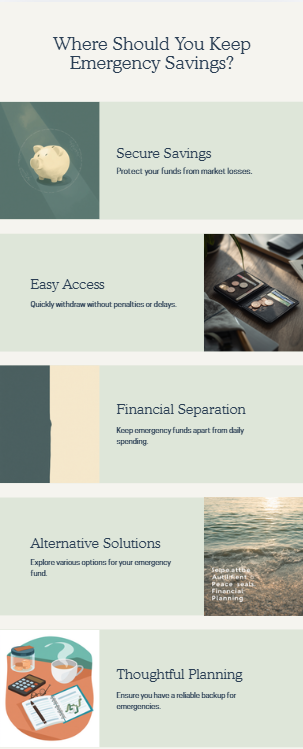
Start With Five Requirements
The U.S. Consumer Financial Protection Bureau says emergency savings should be safe, accessible, and held where it is not tempting to spend on non-emergencies.[1] Canada’s Financial Consumer Agency adds several useful product tests: a separate account, no or low transaction fees, withdrawals without penalty, and interest on the balance.[2]
Together, those principles create five requirements.
1. Principal stability
The balance should not be materially lower merely because you need it on a bad market day. Emergency savings is meant to transfer risk away from the household. A storage choice that introduces meaningful price fluctuation can undermine that job.
This article compares cash and deposit arrangements. EW-M-0020 will separately examine whether any part of an emergency fund should be invested and who can—or cannot—accept that additional risk.
2. Usable access
“Accessible” is more specific than “withdrawable.” Ask:
- Can you transfer the money outside banking hours?
- Is the transfer instant, same-day, or several business days?
- Can you pay a bill directly, or must the money first move to another account?
- Are there daily transfer, ATM, or debit limits?
- Would a new payee, lost phone, password reset, or fraud review delay access?
- Is there a branch, telephone option, or another route if online banking fails?
FCAC notes that some savings-account money must first be transferred to a chequing account and that this can add time.[3] Test the actual route before relying on it.
3. Low friction for emergencies, useful friction for ordinary spending
The ideal account is not necessarily the easiest account to spend from every day. Removing a debit card, keeping the balance off the main banking screen, or using a separate institution can interrupt impulse withdrawals.
But friction can go too far. A forgotten login, unfamiliar transfer process, mandatory notice period, or account known only to one household member can turn protection against casual spending into a barrier during a genuine crisis.
Aim for deliberate access, not difficult access.
4. Clear fees and conditions
Review monthly fees, transfer fees, withdrawal limits, minimum balances, inactivity rules, and early-withdrawal terms. A “free” savings account may still charge for particular transactions. A high rate may apply only if you make a monthly deposit, maintain a minimum balance, avoid withdrawals, or keep another paid account.
Emergency use can break those conditions at exactly the moment you need the money. That does not automatically make the product unsuitable, but the resulting cost or rate loss should be known in advance.
5. Verifiable deposit protection
Do not infer protection from a familiar app, brand, or the word cash. Confirm that the provider is an eligible institution, the product is a covered deposit, the account ownership is recorded correctly, and your combined deposits remain within the applicable limit.
Protection rules are country-specific and can change. They may apply across several brands that share one banking licence, and they do not necessarily cover investments or every product sold through a financial platform.
The Best Default for Most Households: A Separate Easy-Access Savings Account
For many households, a separate savings account with a protected bank, credit union, building society, or other locally authorized deposit-taking institution provides the best balance.
It can offer:
- stable principal;
- interest while the money waits;
- separation from day-to-day spending;
- transfers or withdrawals without a fixed maturity date; and
- formal deposit protection when the institution, product, ownership, and balance qualify.
MoneyHelper describes instant- or easy-access accounts as interest-paying accounts that permit withdrawals when needed, while noting that their rates may be lower than products that lock money away.[4] Australia’s Moneysmart similarly recommends a separate high-interest savings account for emergency funds because separation can reduce casual spending.[5]
“High-interest” or “high-yield” is a useful feature, not a product guarantee. The name may describe a promotional rate, a variable rate, or an account with conditions. Compare the rate you are likely to receive after any introductory period and after an emergency withdrawal—not only the number displayed in large type.
An account can be suitable even if it is not the market leader. A modest rate difference may be a reasonable price for faster transfers, simpler authentication, no fees, or a provider you can reliably reach. Conversely, convenience alone does not justify leaving a large reserve in an account that earns little when a comparably usable alternative is available.
Should You Keep It at Your Main Bank or Somewhere Else?
Both structures can work.
Keeping it at your main institution
This may provide faster internal transfers, one login, established identity verification, and easier branch or telephone support. If an emergency bill must be paid from your transaction account, an internal transfer may be simpler than waiting for money from another institution.
The trade-off is visibility and temptation. If the emergency balance appears beside the everyday account, it can begin to look like available spending. The household may also become dependent on one institution’s technology, fraud controls, and service availability.
Keeping it at a separate institution
This can create a meaningful boundary and may provide a better rate. It also gives the household another access route if the main account is temporarily frozen or unavailable.
The trade-off is transfer time and complexity. External links may require setup or verification. A transfer requested on a weekend or holiday may not arrive when expected. A dormant login or outdated phone number can create an avoidable delay.
The deciding question is operational: Does separation help you preserve the fund without making legitimate access unreliable? If you choose another institution, link the accounts, complete any test transfer, store support details safely, and keep authentication information current before an emergency occurs.
One Account or Several Layers?
One easy-access account is enough for many households. It is simple, visible, and easy to audit. Multiple accounts are useful only when they solve a real access or behaviour problem.
A layered structure might look like this:
| Layer | Purpose | Possible location |
|---|---|---|
| Immediate-access layer | First urgent payment, short outage, or transfer delay | Transaction account cushion or immediately linked savings |
| Main reserve | Most income-replacement and unexpected-expense protection | Separate easy-access interest-bearing savings account |
| Slower-access layer | Portion unlikely to be needed in the first days | Short, carefully staggered deposit terms only if early-access rules are acceptable |
This is not a rule that everyone needs three accounts. It is a way to match access time to likely need.
The immediate layer should not become an excuse to keep the entire reserve in a daily spending account. The slower layer should not be sized so aggressively that an ordinary emergency forces borrowing while cash remains locked.
For example, imagine a household with a $12,000 emergency target. It might keep $1,500 immediately linked to bill payments and $10,500 in a separate easy-access account. Another household may keep the full $12,000 in one account because transfers are immediate and spending boundaries are already strong. The correct design depends on payment methods, transfer speed, available backup resources, and household habits—not on making the system look sophisticated.
This article does not recalculate the target. EW-M-0015 owns that decision. Whatever structure you use, the layers together equal one emergency reserve; they are not additional targets to count twice.
Where Common Options Fit
Transaction or current account
A transaction account offers immediate bill payment, debit, cash withdrawal, and transfers. It can be appropriate for a small first-access cushion.
Keeping the entire fund there may reduce interest and increase the chance of everyday spending, overdrafts, subscriptions, or fraud affecting the balance. If you use this option, separate the emergency amount in your records and review the account’s protection and fee rules.
Easy-access or high-interest savings account
This is the usual default for the main reserve. Compare the effective rate, withdrawal process, transfer time, fees, deposit-protection eligibility, account-linking requirements, and whether the provider can change the rate.
Check bonus conditions carefully. Some accounts reduce interest for a month in which you withdraw. Emergency access should still work even when you lose a bonus; the question is whether the remaining terms are acceptable.
Money market deposit account or similarly named deposit product
In the United States, a money market deposit account at an FDIC-insured bank can be an insured deposit product.[6] That is not the same as a money market mutual fund, which is an investment and is not FDIC-insured.[6]
Names and legal structures differ across countries. Do not rely on “money market,” “cash,” or “savings” in the product name. Verify whether the specific product is a covered deposit and how withdrawals work.
Term deposit, certificate of deposit, or fixed-term savings
These products may provide a fixed or higher rate, but they exchange some access for that return. Early withdrawal may reduce interest, impose a fee, require notice, or be unavailable under the ordinary terms. Moneysmart notes that some Australian term deposits can require up to 31 days’ notice for early access.[7]
They are therefore a poor location for money that may be needed immediately. A short, staggered set of maturities may be considered for a later-access layer only when the household retains enough unrestricted cash and understands every early-access condition. Automatic renewal also needs attention: a matured deposit may roll into a new locked term if no action is taken.
Cash at home
A small amount of physical cash can help during a power, network, card, evacuation, or ATM disruption. It is not a strong home for the main reserve. Cash can be lost, stolen, destroyed, spent without a record, and does not earn interest. CFPB explicitly notes the risks of theft, loss, and destruction.[1]
If you keep emergency cash, choose a limited amount based on realistic short-term needs, store it securely, tell an appropriate trusted household member how it can be accessed, and include it in the total so it is not counted again elsewhere.
Prepaid cards, payment apps, and financial platforms
These may provide convenient spending access, but the protection structure can be less obvious than a direct deposit account. Funds may be held by a partner institution, subject to registration or pass-through conditions, or outside a deposit-insurance scheme entirely.
Before using one for emergency savings, identify the legal institution holding the money, verify the product’s protection from the relevant official insurer, understand what happens if either the platform or partner fails, and check transfer, card-replacement, account-freeze, and customer-support rules. Convenience is not a substitute for confirmed coverage.
Deposit Protection: Verify the Institution, Product, and Combined Balance
The table below is a current orientation, not a substitute for checking the official scheme.
| Country | Official protection framework | Standard protection cited as of August 1, 2026 | Important boundary |
| United States | FDIC for insured banks; NCUA for federally insured credit unions | Generally US$250,000 per depositor, per insured institution, per ownership category | Deposit accounts may be covered; mutual funds, stocks, bonds, and crypto assets are not FDIC deposits |
| Canada | CDIC for member institutions; separate provincial frameworks may apply to some credit unions | C$100,000 per insured category, per member institution, including principal and interest | Confirm membership, deposit eligibility, category, and whether multiple brands are the same member |
| United Kingdom | FSCS | £120,000 per eligible person, per authorised firm | Accounts under brands sharing one banking licence can be combined for the limit |
| Australia | Financial Claims Scheme | A$250,000 per account holder, per ADI | Applies to protected deposit accounts in Australian dollars with covered ADIs |
FDIC states that its standard amount is US$250,000 per depositor, per insured bank, for each account ownership category.[8] NCUA similarly states that individual accounts at federally insured credit unions are insured up to US$250,000, while ownership arrangements can affect total coverage.[12] CDIC protects eligible deposits up to C$100,000 in each insured category at each member institution, including principal and interest.[9] The UK limit rose to £120,000 on December 1, 2025.[10] Australia’s FCS protects eligible deposits up to A$250,000 per account holder per authorized deposit-taking institution and applies to covered accounts held in Australian dollars.[11]
Two accounts are not automatically two protection limits. Several brands can belong to one legal institution. Conversely, ownership categories can sometimes affect coverage. Use the official insurer’s checker or calculator rather than trying to infer the result from marketing names.
If your emergency savings is far below the local limit, this review is still worthwhile. It confirms that the product is actually a deposit and that the institution participates in the relevant scheme.
Access Is a Household System, Not Just an Account Feature
An account can look liquid on paper and fail in practice if only one person knows it exists or can pass the security checks.
Review:
- whose name the account is in;
- whether a spouse, partner, attorney, executor, or other appropriate person would need lawful access;
- whether the ownership choice affects tax, estate, creditor, benefit, or deposit-protection treatment;
- where account and support details are recorded;
- whether phone numbers, email addresses, identification, and beneficiaries are current;
- what happens if a device is lost or the account holder is hospitalized; and
- whether alerts are enabled for withdrawals, transfers, and profile changes.
Do not casually share passwords or bypass the institution’s security rules. Use lawful account ownership, authorized-user, power-of-attorney, trusted-contact, or estate-planning arrangements available in your jurisdiction, with professional advice when the consequences matter.
Accessibility also includes disability, language, location, and technology. An online-only account may work beautifully until the user cannot operate the authentication method. A branch account may be reassuring but impractical after relocation. Choose a route the actual household can use under stress.
Run a Small Access Test Before You Depend on the Account
After opening or reorganizing the account, test the system with a small amount rather than waiting for a crisis.
- Confirm the legal institution and deposit-protection status.
- Transfer a small amount into the account.
- Move part of it back to the account from which bills would be paid.
- Record how long each direction takes, including any hold.
- Check daily limits, fees, bonus-rate consequences, and weekend rules.
- Confirm that alerts arrived and support information is available.
- Restore the test amount to the emergency balance.
Repeat the check after changing phones, banks, account ownership, or contact information. Review the account at least annually for rate changes, new fees, expiring promotions, protection-limit changes, and access problems.
A Practical Selection Checklist
Before choosing a home for emergency savings, answer:
- Safety: Can the balance fall because of market pricing or product structure?
- Protection: Is the institution a member of the relevant scheme, and is this exact product eligible?
- Coverage: How are ownership, categories, shared licences, and other deposits counted?
- Speed: How much is available tonight, tomorrow, and after several business days?
- Payment route: Can you actually pay rent, utilities, repairs, travel, or essential purchases from it?
- Cost: What fees, penalties, rate reductions, or minimum-balance rules could an emergency withdrawal trigger?
- Behaviour: Is the money separate enough to resist ordinary spending?
- Resilience: Is there another access route if the institution, phone, card, or main account is unavailable?
- Household access: Can the appropriate person lawfully locate and use the money if you cannot?
- Maintenance: Will you review changing rates, terms, balances, and contact details?
No account will maximize every feature. The goal is a structure whose weaknesses you understand and can live with.
Decision Summary
For most households, the strongest default is a separate easy-access, interest-bearing savings account at an eligible protected institution, with low fees and withdrawals available without loss of principal.
Keep enough immediately accessible for the first urgent payments. If the main reserve sits at another institution, test the transfer route before relying on it. Use fixed-term deposits only for a genuinely later-access layer, and only after preserving enough unrestricted cash. Treat physical cash as limited outage backup rather than the main reserve.
Verify protection at the legal-institution and product level. A familiar brand, financial app, or product name does not prove coverage, and multiple brands may share one protection limit.
The best emergency account is not simply the one with the highest yield. It is the one that keeps the money intact, available on a realistic schedule, difficult to spend casually, and understandable to the household that may need it.
FAQ
Is a high-yield savings account good for an emergency fund?
Often, yes—if the product preserves principal, qualifies for applicable deposit protection, charges acceptable fees, and lets you withdraw promptly. Check promotional rates, withdrawal conditions, transfer time, and the rate after any bonus ends.
Should my emergency fund be at a different bank?
It can be. A separate institution may reduce temptation and provide another access route, but external transfers and account recovery can take longer. Test the link and keep contact information current.
Can I keep my emergency fund in a term deposit or CD?
Only cautiously. Fixed-term products can impose notice, penalties, lost interest, or access restrictions. They should not hold money needed immediately. A later-access portion may fit only when unrestricted savings already cover early needs.
How much emergency cash should I keep at home?
There is no universal amount. Consider a limited sum for short outages or card and ATM disruptions, based on essential local needs. Protect it from theft, fire, loss, and unrecorded spending, and count it as part of—not in addition to—the emergency fund.
Are money market accounts insured?
It depends on the product and country. In the United States, an eligible money market deposit account at an FDIC-insured bank can be insured; a money market mutual fund is an investment and is not FDIC-insured. Verify the exact product with the relevant official scheme.
Should I choose access or a higher interest rate?
Emergency access comes first. Compare the rate only among accounts that already meet your safety, timing, fee, and protection requirements. A small rate advantage is not worth a withdrawal delay that forces new debt.
Do multiple bank accounts always increase deposit protection?
No. Accounts at brands sharing one legal institution or banking licence may be combined. Protection can also depend on ownership category and product eligibility. Use the official insurer’s checker.
References
- An Essential Guide to Building an Emergency Fund, U.S. Consumer Financial Protection Bureau.
- Setting Up an Emergency Fund, Financial Consumer Agency of Canada.
- Savings Accounts, Financial Consumer Agency of Canada.
- Instant Access Savings Accounts, MoneyHelper, United Kingdom.
- Save for an Emergency Fund, Moneysmart, Australian Securities and Investments Commission.
- Are My Deposit Accounts Insured by the FDIC?, Federal Deposit Insurance Corporation.
- Term Deposits, Moneysmart, Australian Securities and Investments Commission.
- Deposit Accounts, Federal Deposit Insurance Corporation.
- What’s Covered, Canada Deposit Insurance Corporation.
- Deposit Protection Limit Increase, Financial Services Compensation Scheme, United Kingdom.
- Types of Accounts Covered Under the Financial Claims Scheme, Australian Prudential Regulation Authority.
- Share Insurance Coverage, National Credit Union Administration.
This article provides general educational information and does not constitute individualized financial, tax, legal, credit, debt, insurance, banking, or investment advice. Account access, fees, interest, taxes, ownership consequences, product eligibility, and deposit-protection rules vary by provider, country, and personal circumstances. Verify current terms and protection with the institution and the relevant official scheme before acting.
More in This Cluster: Emergency Funds
- How Much Should You Keep in an Emergency Fund?
- Emergency Fund vs. Sinking Fund: What Is the Difference?
- Where Should You Keep Emergency Savings? (you are here)
- How to Build an Emergency Fund on a Tight Budget
- What Counts as a Real Financial Emergency?
- Should You Invest Your Emergency Fund?
- How to Rebuild Savings After Using Your Emergency Fund