Quick Answer
A sinking fund is money you set aside gradually for a specific, expected expense. Instead of treating an annual insurance premium, family trip, school cost, or planned replacement as a surprise, you divide the estimated cost across the months or pay periods before it is due.
You may benefit from a sinking fund if a cost is predictable, does not fit comfortably into one month’s budget, and would otherwise force you to use a credit card, drain unrelated savings, or postpone something important. You do not need a separate fund for every possible expense. Start with one recurring or high-priority cost that regularly disrupts your cash flow.
The Problem Is Often Timing, Not the Expense Itself
Some expenses feel unexpected only because they do not arrive every month.
Your home-insurance renewal may be due once a year. A school activity fee may appear each fall. Holiday spending may be concentrated in a few weeks. A family trip may be optional, but you can often decide months in advance whether you want to take it. None of these costs belongs neatly beside rent, groceries, and utilities in a typical monthly budget.
That mismatch creates a cash-flow problem. A bill can be entirely predictable and still overwhelm the month in which it lands.
A sinking fund changes the timing. You begin treating part of the future expense as a current monthly responsibility. The bill does not become cheaper, but the payment becomes less concentrated.
For example, if you expect a $1,200 expense in 12 months and have nothing saved yet, a simple starting target is:
$1,200 divided by 12 months = $100 per month
If the same expense is due in six months, the target becomes $200 per month. This calculation does not prove that the target is affordable; it shows what the goal requires. If the number does not fit your budget, you can reduce the planned cost, extend the timeline when possible, contribute irregular amounts, or choose a more urgent goal first.
Jerome’s Turning Point: From Paying for a Trip to Planning the Next One
After immigrating, Jerome’s pay increased slowly over about ten years. Once his family had a little more room in the budget, he wanted to take the children on one trip each year. When his oldest child was around 12, the family flew together for the first time and went to Mexico. The warm air, blue water, comfortable resort, and a full week away became one of their favorite family memories. On the way home, Jerome was not thinking that the money had been wasted. He was thinking, “Where should we go next, and how much will I need to save?”
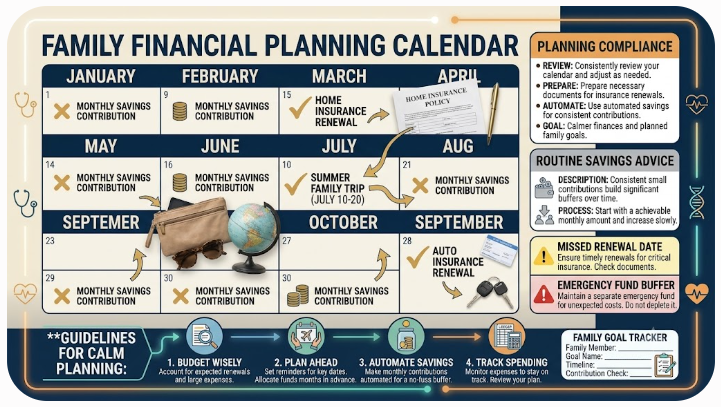
His insurance bills created the opposite feeling. Home insurance renewed in March and auto insurance in September – six months apart by coincidence. If he forgot about one, the account balance suddenly dropped. Even when he had managed to save a few hundred dollars each month, it could feel as though all that progress disappeared into the next large bill.
The lesson was not that travel was good and insurance was bad. Both were foreseeable. They simply needed names, dates, and separate plans before the money left the account.
What a Sinking Fund Actually Is
A sinking fund has four basic parts:
- A defined purpose: such as an insurance renewal, trip, appliance replacement, or school expense.
- A target amount: based on a known bill, a realistic estimate, or a spending limit you choose.
- A target date: when you expect to need the money.
- A contribution plan: the amount you intend to save each month, each payday, or whenever income arrives.
The term describes the purpose of the money, not a particular financial product. You might keep one sinking fund in a separate savings account, use several labeled savings buckets within one account, or track categories in a budgeting system while the cash remains in a single account. The best arrangement is the one that keeps the money identifiable, accessible when needed, and difficult to spend accidentally.
A sinking fund is also different from simply hoping that “extra money” will remain in checking. Unassigned cash is easy to treat as available. A named fund makes the trade-off visible: spending $200 from the travel fund today means having $200 less for the planned trip.
Which Expenses Belong in a Sinking Fund?
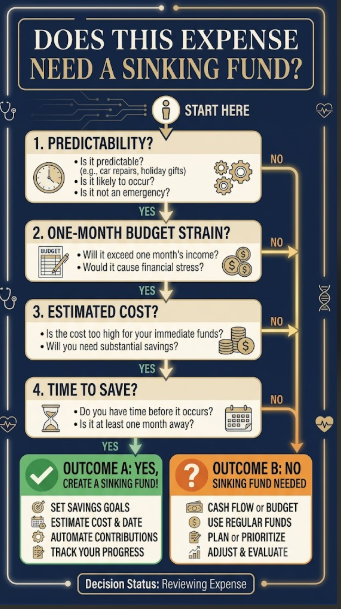
An expense is a strong candidate when it passes most of these tests:
- You can reasonably expect it. You know the bill will arrive, the event is planned, or the item will eventually need replacement.
- It is not comfortably covered by one normal month. Paying it all at once would squeeze essential spending or force you to move money from another goal.
- You can estimate the amount or set a limit. The final cost does not need to be exact, but you need a useful target.
- You have time to prepare. Even a few months can spread part of the burden.
- The money will be used within a practical planning horizon. The goal is closer than retirement and more specific than general wealth building.
Common examples include:
- annual or semiannual insurance premiums;
- holidays, gifts, and celebrations;
- planned travel;
- back-to-school costs and activity fees;
- routine vehicle maintenance and expected tire replacement;
- home maintenance or an appliance you expect to replace;
- professional fees, memberships, or annual subscriptions;
- predictable pet care;
- a known deductible or planned health-related cost, where permitted and appropriate in your country;
- moving costs or another planned life transition.
Not every item on this list will be right for every household. A monthly subscription already handled easily in your regular budget may not need a separate fund. A highly uncertain future wish may not deserve priority yet. The point is to identify the costs that create the greatest disruption when they arrive.
Sinking Fund, Regular Budget, or Emergency Savings?
The easiest distinction is based on predictability and timing.
| Money category | Best used for | Example |
|---|---|---|
| Regular monthly budget | Frequent expenses paid from current income | Rent, groceries, utilities |
| Sinking fund | Expected, nonmonthly, or chosen future expenses | Annual insurance, a planned trip, school costs |
| Emergency fund | Unplanned financial shocks or loss of income | An urgent repair after a breakdown, an unexpected medical bill, job loss |
The boundaries are not always perfect. Vehicle maintenance provides a useful example. A scheduled service or tires you know are wearing out can be planned through a sinking fund. A sudden transmission failure may be an emergency if you had no reasonable way to predict it.
This article uses that practical distinction, but households may label their accounts differently. What matters is that money intended for predictable costs does not quietly consume the reserve meant to protect you from genuine shocks. The U.S. Consumer Financial Protection Bureau similarly describes an emergency fund as cash reserved for unplanned expenses or financial emergencies. A later article in this cluster will examine the difference in more depth.
Who Is Most Likely to Need One?
You are likely to benefit from at least one sinking fund if:
- annual or seasonal bills repeatedly catch you short;
- you use credit cards for costs you knew were coming;
- you withdraw from emergency savings for holidays, renewals, or routine maintenance;
- one large payment makes your account balance fall sharply;
- you save regularly but cannot tell which future costs the savings must cover;
- you want to enjoy a planned purchase or trip without regretting the payment afterward;
- your income varies and you need to reserve money during stronger months for costs due in weaker ones.
Sinking funds can be especially useful for families juggling school calendars, travel, multiple vehicles, homeownership, or caregiving. They can also help renters, students, single adults, and people with irregular income. The need comes from the pattern of expenses, not from a particular life stage or income level.
However, a sinking fund cannot solve a budget that is consistently short of essential needs. If there is no money left after housing, food, utilities, transportation, minimum debt payments, and other necessities, creating many savings categories may only add pressure. In that situation, the first useful step may be to list annual obligations, identify the next unavoidable bill, and seek reputable budgeting or debt guidance where needed.
When a Sinking Fund May Not Be the Priority
A sinking fund is a tool, not a rule. It may not be your first priority when:
- you are behind on essential bills;
- high-cost debt is growing and requires an urgent repayment plan;
- you have no buffer at all for immediate financial shocks;
- the goal is optional and would compete with a more urgent need;
- the money is intended for a distant, long-term objective that requires a different savings or investment decision;
- saving the target amount would cause overdrafts or missed payments.
You can still record the future expense without funding it immediately. Knowing that a bill exists is better than allowing it to disappear from the plan. A calendar reminder and a rough target can become the starting point when your cash flow improves.
How to Decide What to Fund First
Do not begin by opening ten accounts. Begin by looking backward and forward.
Review the past year of statements, bills, emails, and calendar events. Look for payments that were predictable but did not occur monthly. Then look ahead 12 months for renewals, school dates, celebrations, travel plans, maintenance, and other known costs.
Rank candidates using three questions:
- What is unavoidable? Insurance, required fees, or necessary maintenance generally comes before optional spending.
- What is due soonest? A smaller bill due in two months may require attention before a larger bill due next year.
- What caused the most disruption last time? The expense that repeatedly leads to debt, overdraft risk, or raiding emergency savings may be the best first target.
Choose one. Write down the purpose, due date, expected amount, current balance, and number of contributions remaining.
If Jerome’s home-insurance premium were $1,200 and the next renewal were six months away, starting from zero would suggest $200 per month. If only $120 per month were available, that would not make the fund a failure. It would still produce $720 before renewal – reducing the amount that must come from that month’s income. The remaining gap would signal a need to adjust other spending, add a one-time contribution, or review the payment arrangement and coverage options before the deadline.
A Simple First Sinking Fund
Your first setup can be modest:
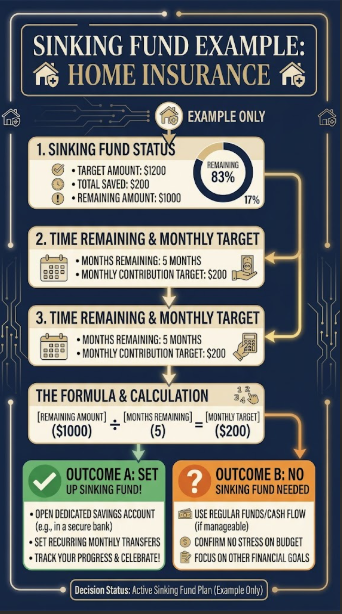
- Name: Home insurance
- Due date: March 1
- Expected cost: $1,200
- Already saved: $200
- Months remaining: 5
- Remaining amount: $1,000
- Monthly target: $200
The core formula is:
(Expected cost – amount already saved) divided by contributions remaining
If you are paid every two weeks, you may prefer to divide by the number of paydays before the deadline. If income fluctuates, use a minimum contribution during lean periods and add more during stronger ones. An annual planning tool can help reveal when irregular income and periodic expenses collide; the Consumer Financial Protection Bureau provides one example of this approach.
Keep the estimate realistic. For a known bill, begin with the latest renewal notice or previous payment and update it when the new amount arrives. For an optional goal such as travel, make the target a spending ceiling rather than a promise to spend every dollar.
What a Sinking Fund Changes – and What It Does Not
A sinking fund does not create income, guarantee that every goal is affordable, or prevent prices from changing. It does not eliminate the need to compare insurance, control travel costs, maintain emergency savings, or make difficult trade-offs.
What it can change is visibility.
The annual bill becomes a monthly planning decision. The family trip becomes a target with a limit. Savings stop looking like one undifferentiated pile that “disappears” whenever a large payment is due. You can see which goals are funded, which are falling behind, and which need to be reduced or postponed.
That clarity is the main benefit. A planned expense may still be large, but it no longer has to arrive without a plan.
Decision Summary
A sinking fund is probably worth trying if you can name an expense, estimate its cost, identify when it is due, and explain why paying it from one month’s income would be difficult.
Start with one fund, preferably for an unavoidable or repeatedly disruptive expense. Use a realistic target, contribute on a schedule that matches your income, and revise the plan when the cost or due date changes. Keep emergency savings for unplanned shocks, and do not fund optional goals at the expense of immediate essentials.
The goal is not to make every future cost perfectly predictable. It is to give predictable costs a place in today’s decisions.
FAQ
Is a sinking fund just another savings account?
Not necessarily. A sinking fund describes why money is being saved. You may hold it in a separate savings account, a labeled bucket within one account, or another appropriate cash-management arrangement. Check the fees, withdrawal rules, deposit protection, tax treatment, and access terms that apply where you live.
How many sinking funds should a beginner have?
One is enough to begin. Choose the expected expense that is unavoidable, due soon, or most disruptive. Add more only when the system remains easy to fund and track. A later article in this cluster will address when multiple funds become too complicated.
Can I have a sinking fund if my income changes each month?
Yes. Instead of relying on one fixed monthly amount, set a minimum contribution and add more when income is higher. Planning the full year can help you match stronger income periods with future expenses.
Should travel have a sinking fund?
It can, if the trip is a genuine priority and you can save for it without missing essential obligations. Set a budget and target date before booking. Detailed travel-funding strategies belong to the later cluster article on funding holidays without credit card debt.
What if I cannot save the full amount before the bill is due?
Partial preparation still reduces the burden. Save what is realistically available, identify the remaining gap early, and consider whether you can lower the cost, change the timing, add a one-time contribution, or discuss legitimate payment options with the provider.
Should I invest money in a sinking fund?
Money needed soon generally should not be exposed to a meaningful risk of loss. The appropriate place depends on your timeline, access needs, local account protections, fees, and tax rules. For a near-term bill, many people prioritize safety and liquidity over higher potential returns.
Is a planned car repair a sinking-fund expense or an emergency?
Routine service and a replacement you can reasonably anticipate fit a sinking fund. A sudden failure that could not reasonably be predicted may call for emergency savings. The distinction depends on what you knew and when you knew it.
General financial information only. This article does not provide individualized financial, tax, legal, insurance, or investment advice. Products, account protections, fees, and rules vary by country and provider.
Sources
- CFPB – Savings Plan
- CFPB – Annual Planner
- CFPB – An Essential Guide to Building an Emergency Fund
- Consumer.gov / FTC – Making a Budget
- FDIC – Saving for the Unexpected and Your Future
More in This Cluster: Sinking Funds and Planned Expenses
- What Is a Sinking Fund and Who Needs One? (you are here)
- How to Create Sinking Funds for Annual Bills
- Emergency Fund vs. Sinking Fund: Key Differences
- How Many Sinking Funds Are Too Many?
- Best Ways to Track Multiple Savings Goals
- How to Fund Holidays Without Credit Card Debt
- How to Plan for Car Repairs, School Costs, and Home Maintenance