Quick Answer
To create a sinking fund for an annual bill, record the expected amount and due date, subtract anything already saved, and divide the remainder by the number of contributions you can make before payment is due. Then schedule the transfer soon after each payday and keep the reserved money clearly separated from everyday spending.
Use this formula:
(Expected bill – amount already saved) ÷ contributions remaining = contribution target
If a $1,200 bill is due in six months and you have $300 saved, the target is $150 per month: ($1,200 – $300) ÷ 6. The calculation tells you what the deadline requires. If that amount is not affordable, save a smaller realistic amount and address the remaining gap early instead of letting an automatic transfer cause an overdraft or missed essential payment.
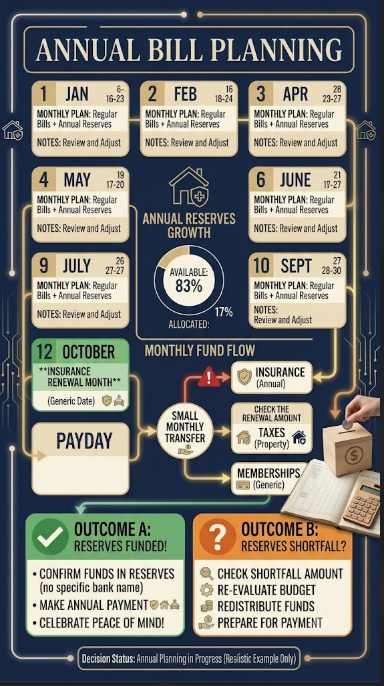
Why Annual Bills Need a Monthly Place in Your Budget
An annual bill is easy to overlook because it is absent from most monthly budgets. Yet the obligation is still forming in the background. A $1,200 renewal is effectively a $100 monthly cost when viewed across a full year, even if the provider collects it in one payment.
A sinking fund makes that hidden monthly cost visible. You reserve part of current income for a known future bill, so the payment month does not have to absorb the full amount.
This approach works for bills that are predictable but less frequent than monthly, including:
- annual insurance premiums or policy renewals;
- property taxes not already collected through a mortgage escrow arrangement;
- professional licences and membership renewals;
- annual subscriptions you intend to keep;
- school fees or recurring activity registrations;
- seasonal service contracts; and
- predictable quarterly or semiannual charges.
Confirm how a bill is actually collected before adding it. If a mortgage servicer already collects property taxes or insurance through escrow, for example, creating a second full fund for the same obligation could duplicate the expense. Likewise, distinguish a true annual charge from a monthly bill that merely offers an annual-payment discount.
The Consumer Financial Protection Bureau’s budgeting resources emphasize recording bills, due dates, savings, and the timing of income and expenses. EverydayWise uses “sinking fund” as the practical name for applying those planning ideas to a specific expected cost; it is not presented here as a regulated account type or a universal official definition.
Step 1: Build a 12-Month Bill Inventory
Start with evidence rather than memory. Review the previous 12 to 18 months of:
- bank and credit-card statements;
- insurance declarations and renewal notices;
- emailed receipts and subscription confirmations;
- tax or fee notices;
- school and professional calendars; and
- provider accounts that show the next renewal date.
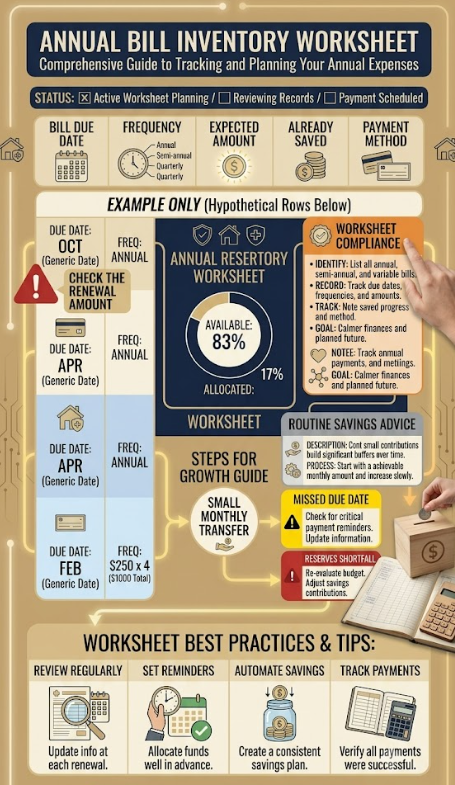
For each nonmonthly bill, record six details:
| Field | What to enter |
|---|---|
| Bill | A clear name, such as “renter’s insurance” |
| Due date | The payment deadline or expected renewal month |
| Frequency | Annual, semiannual, quarterly, or another schedule |
| Expected amount | Latest known bill or a reasonable estimate |
| Already saved | Money currently reserved for this bill |
| Payment method | Manual payment, autopay, payroll deduction, or escrow |
Do not count optional purchases merely because they happen every year. A streaming subscription you no longer value is a cancellation decision before it is a savings target. The inventory should reveal what you intend or are required to pay, not preserve every past expense automatically.
If you cannot find an exact due date, record the expected month and set a reminder to confirm it. A useful plan can begin with an estimate, but the estimate should not quietly turn into a false fact.
Step 2: Estimate the Target Amount Carefully
For a fixed bill, use the current renewal notice or contract amount. If the next amount is not available, begin with the most recent payment and consider a modest planning cushion based on the bill’s history. Label the cushion as an estimate, not a prediction.
For example, suppose last year’s professional fee was $480. You might temporarily plan for $500 if small increases have occurred before. Once the actual notice arrives, replace the estimate with the confirmed amount.
Avoid arbitrary percentage increases when you have better information. Check whether the provider has announced a new fee, whether taxes are included, and whether the billing frequency changed. Also note discounts that depend on paying annually, but do not assume the annual option is better without comparing the total price and the effect on your cash flow.
For variable annual costs, use one of three targets:
- Latest actual amount: simplest when changes have been small.
- Recent average: useful when several years of comparable bills vary.
- Chosen cap: appropriate when you control the spending limit.
The goal is a workable reserve, not false precision. If the actual bill is lower, leave the difference for the next cycle or deliberately reassign it. If it is higher, update the calculation as soon as you know.
Step 3: Count Contributions, Not Just Months
The standard formula is:
(Target amount – amount already saved) ÷ contributions remaining
“Contributions remaining” should match how you actually save. A monthly saver counts monthly transfers. Someone paid every two weeks may count paydays. A worker with irregular income may use a minimum transfer plus planned top-ups.
Consider three hypothetical examples:
| Bill | Target | Saved | Contributions left | Contribution target |
| Annual licence | $360 | $0 | 12 months | $30 per month |
| Insurance renewal | $1,200 | $300 | 6 months | $150 per month |
| Semiannual fee | $600 | $100 | 10 paydays | $50 per payday |
For recurring annual bills, the cleanest long-run calculation is often the annual amount divided by 12. But that works only after a full saving cycle. If the next bill is six months away, dividing by 12 would leave you underfunded.
This is the first-cycle problem: you are starting partway through the year. Calculate the amount needed by the actual deadline first. After paying the bill, reset the fund for a full cycle and divide the new estimate across all 12 months or the full number of paydays.
Step 4: Test the Plan Against Real Cash Flow
A mathematically correct transfer can still be financially unsafe. Before automating it, place the contribution in your monthly or payday budget alongside housing, food, utilities, transportation, minimum debt payments, and other essentials.
Ask:
- Will this transfer leave enough for bills due before the next income arrives?
- Does the account have a minimum-balance or overdraft risk?
- Are several annual-bill transfers scheduled on the same payday?
- Is the target based on dependable income or hoped-for extra money?
CFPB cash-flow tools focus on timing income and expenses week by week because a monthly total can hide a shortfall. Apply the same principle here. A household may be able to save $200 over a month but not safely move the entire amount on the first day.
If the calculated target does not fit, do not label the plan a failure. Choose among the real trade-offs:
- reduce or cancel a nonessential annual cost;
- start with the most urgent unavoidable bill;
- split the contribution across paydays;
- add part of a known one-time payment, such as a refund or bonus, only after it is received;
- ask the provider whether a legitimate instalment option exists and compare the total cost; or
- save a partial amount and make the remaining gap visible in the budget.
Never automate a savings transfer that predictably causes late essential bills, overdrafts, or new high-cost debt. Automation should support the plan, not conceal that the numbers do not work.
Step 5: Choose Where the Money Will Sit
You do not need a separate bank account for every bill. You need a reliable way to distinguish reserved money from spendable money.
Common arrangements include:
- one separate savings account for all annual bills, with a simple category record;
- one savings account with provider-supported labeled buckets;
- a small number of separate accounts for major obligations; or
- one account with an external budget record that allocates the balance by purpose.
Whichever arrangement you choose, verify fees, minimum balances, transfer limits, withdrawal timing, deposit protection, tax treatment, and access rules in your country. Near-term bill money should remain available when the payment is due and should not depend on selling an asset that may have lost value.
The balance in the account and the sum of your categories should reconcile. If the account holds $1,500 but your annual-bill list assigns $1,700, the system is promising $200 more than you actually have.
A later article in this cluster will compare tracking systems in detail. For now, use the simplest arrangement you can check in a few minutes.
Step 6: Automate the Contribution Safely
Once the target survives the cash-flow test, schedule the transfer.
A practical sequence is:
- Choose a transfer date shortly after dependable income arrives.
- Leave enough time between deposit and transfer for the income to clear.
- Use a descriptive label such as “annual bills” or the bill name.
- Turn on balance and transfer alerts if your provider offers them.
- Keep the bill’s own payment date separate from the savings-transfer date.
That final distinction matters. Moving money into savings is not the same as paying the bill. If the bill is on autopay, confirm which account will be charged and move the reserved amount back to that payment account early enough to clear. Review the account before the withdrawal rather than assuming that both automations will coordinate themselves.
For irregular income, a fixed automatic amount may be too rigid. Consider a small minimum that works in a lean period, followed by a manual percentage or top-up after stronger income arrives. Base transfers on money received, not on invoices sent or shifts you hope to work.
Step 7: Review the Fund Before and After the Bill
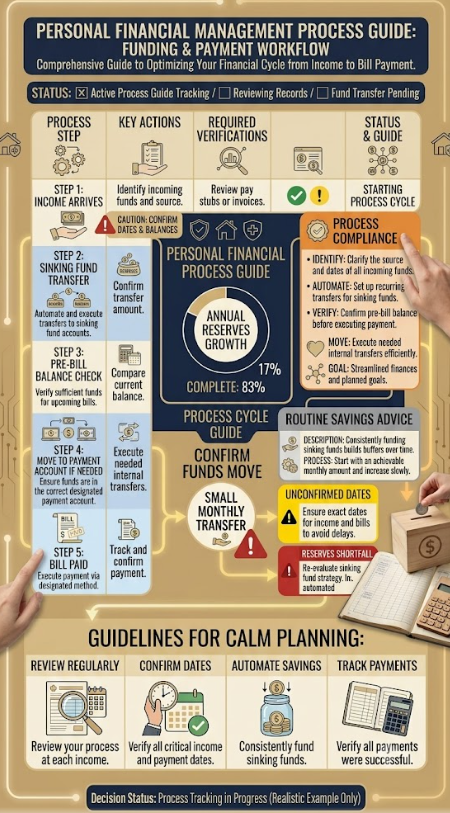
Set two reminders:
- Estimate review: 30 to 60 days before the expected notice or renewal, when practical.
- Payment review: shortly after the bill clears.
Before payment, confirm the amount, due date, payment source, and available fund balance. If the bill increased, recalculate the gap. If it decreased, decide explicitly whether the surplus stays for next year.
After payment, record the actual amount and reset the next target. If a $1,200 fund paid a $1,140 bill and $60 remains, and next year’s working estimate is $1,200, you need another $1,140 over 12 months: $95 per month. Alternatively, you may retain a separate cushion if that rule is documented and the total remains easy to understand.
Also review whether the bill still deserves a fund. Cancelled subscriptions, sold vehicles, changed insurance arrangements, and escrow changes can make an old target obsolete. Automation without review can keep moving money for a bill that no longer exists.
A 20-Minute Setup You Can Do Today
If a full annual inventory feels overwhelming, set up one bill:
- Choose the next unavoidable nonmonthly bill.
- Find its latest amount and next due date.
- Record any amount already reserved.
- Count realistic contributions before the deadline.
- Calculate the target and test it against your cash flow.
- Choose a clear holding place and label.
- Schedule a safe transfer and two review reminders.
One correctly funded bill is more useful than a complex system you abandon. Once the first bill has completed a full cycle, you will have actual evidence about whether the amount, timing, and automation fit your household.
Decision Summary
A workable annual-bill sinking fund connects four things: a verified bill, a realistic estimate, the real number of contributions before the deadline, and a transfer schedule that fits your income timing.
Start from records, not memory. Treat the first partial year differently from a full 12-month cycle. Keep reserved money visible, but do not create more account complexity than you can maintain. Automate only after checking cash flow, and review both the bill and the fund before each renewal.
The purpose is not perfect forecasting. It is to make a known future obligation part of today’s budget while there is still time to adjust.
FAQ
What if I am starting only three months before an annual bill is due?
Divide the remaining amount by the contributions available in those three months, then test the result against your budget. If it is unaffordable, save a realistic partial amount and address the gap now through cost reduction, changed timing, a legitimate payment plan, or another safe source of funds. After payment, begin a full-year cycle.
Should I divide a semiannual bill by six or by twelve?
If the same bill occurs twice each year, you can divide the total expected annual cost by 12 for a steady monthly target. When starting mid-cycle, calculate what is needed for the next due date first so the first payment is not underfunded.
How much extra should I add for a price increase?
Use confirmed information when available. Otherwise, a modest cushion informed by the bill’s recent history may be reasonable, but label it as an estimate. Avoid presenting an arbitrary percentage as a forecast, and update the target when the renewal notice arrives.
Can I automate a sinking fund with irregular income?
Yes, but a smaller minimum transfer plus manual top-ups may be safer than a fixed amount based on an average month. Schedule transfers only after income has arrived, and keep enough cash for essential payments before the next income date.
Should the annual bill itself also be on autopay?
That is a separate decision. If you use bill autopay, confirm the withdrawal date, amount, and payment account, and move the reserved money there in time. Savings automation does not guarantee that the bill-payment account is funded.
What should I do with money left after the bill is paid?
You can leave it as the starting balance for the next cycle, retain a documented cushion, or deliberately reassign it. Update your records so the same dollars are not counted for two goals.
Do I need a different savings account for every annual bill?
No. One account can hold several funds if your records clearly allocate the balance and the categories add up to the cash actually held. A later article in this cluster will examine tracking methods and tools in more detail.
General financial information only. This article does not provide individualized financial, tax, legal, insurance, or investment advice. Account protections, fees, payment rules, taxes, and product features vary by country and provider.
Sources
- CFPB – Your Money, Your Goals Toolkit
- CFPB – Creating a Cash Flow Budget
- Consumer.gov / FTC – Making a Budget
- Consumer.gov / FTC – Make a Budget Worksheet
- Consumer.gov / FTC – Opening a Bank Account
- FDIC – Saving for the Unexpected and Your Future
More in This Cluster: Sinking Funds and Planned Expenses
- What Is a Sinking Fund and Who Needs One?
- How to Create Sinking Funds for Annual Bills (you are here)
- Emergency Fund vs. Sinking Fund: Key Differences
- How Many Sinking Funds Are Too Many?
- Best Ways to Track Multiple Savings Goals
- How to Fund Holidays Without Credit Card Debt
- How to Plan for Car Repairs, School Costs, and Home Maintenance