Quick Answer
An emergency fund protects you from financial shocks you did not reasonably plan for, such as a sudden loss of income or an urgent, unexpected repair. A sinking fund holds money for a specific expense you expect, choose, or can reasonably foresee, such as an annual premium, holiday budget, scheduled maintenance, or planned trip.
The simplest test is not whether the expense feels unpleasant. Ask whether you knew it was likely, had a usable timeline, and could estimate a target. If so, it usually belongs in a sinking fund. If the event was genuinely unplanned, urgent, necessary, and difficult to cover from normal cash flow, emergency savings may be the better match.
You can need both. Sinking funds keep predictable costs from repeatedly draining the emergency reserve; the emergency fund remains available when life breaks the plan.
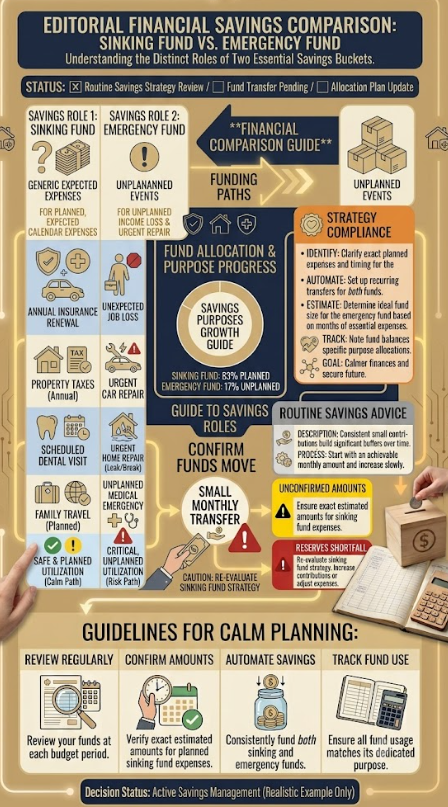
The Difference Is the Job Assigned to the Money
Both funds are savings. The difference is what each balance is supposed to do.
The U.S. Consumer Financial Protection Bureau defines an emergency fund as a cash reserve set aside for unplanned expenses or financial emergencies. EverydayWise uses sinking fund as a practical organizing term for money accumulated toward a specific expected expense. It is not presented here as a legal definition, regulated product, or term formally defined by the CFPB.
That distinction matters because a bank balance does not explain its own purpose. A person may have $4,000 in savings but still be financially exposed if all $4,000 is already needed for next month’s insurance renewal, tuition installment, and planned move. Conversely, a person may label all savings “emergency money” and repeatedly spend it on predictable bills, leaving no meaningful protection when income stops or an urgent repair appears.
Assigning jobs to savings makes the trade-off visible.
| Question | Sinking fund | Emergency fund |
|---|---|---|
| What is it for? | A named, expected expense | An unplanned financial shock |
| Is there usually a target date? | Yes | No exact date |
| Is there usually a target amount? | Yes, or at least an estimate or spending limit | Often a broader reserve target |
| Is spending expected? | Yes; using it for its purpose is success | No; it is held until a qualifying need occurs |
| What happens after use? | Reset or close the goal | Rebuild the protective reserve |
| Typical examples | Annual bills, planned travel, school costs, scheduled maintenance | Income loss, urgent unexpected repair, unforeseen necessary travel |
The labels are less important than consistent rules. If your household calls both balances “savings,” you can still track how much is committed to known costs and how much remains available for genuine shocks.
Four Questions That Usually Settle the Choice
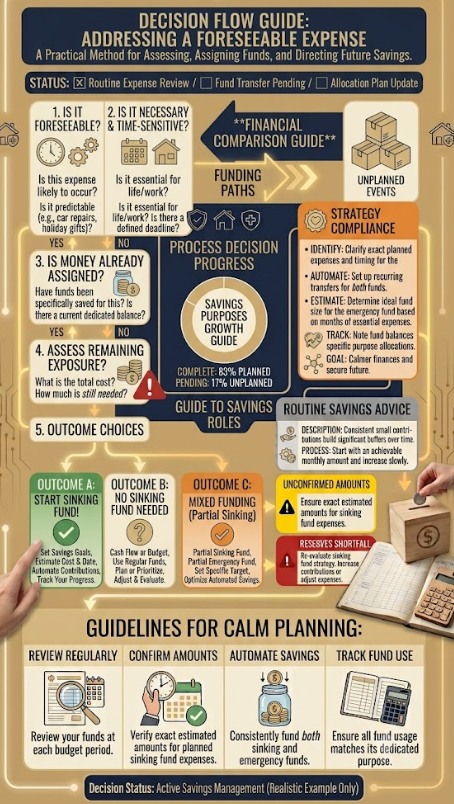
When an expense appears, work through these questions in order.
1. Was the expense reasonably foreseeable?
Foreseeable does not mean you knew the exact price. Tires wear out. Annual memberships renew. Children return to school. Homes and vehicles need routine maintenance. If the category and general timing were predictable, uncertainty about the final amount does not automatically make the expense an emergency.
By contrast, a sudden layoff or damage caused by an unexpected event may offer no useful planning window. That is the kind of shock an emergency reserve is meant to absorb.
2. Is it necessary and time-sensitive?
Urgency helps determine whether emergency money may be appropriate. A repair that must be completed now to keep a home safe is different from a cosmetic improvement that can wait. Necessary medical care is different from an elective purchase. Travel to support a critically ill family member is different from a vacation booked on short notice.
Urgent does not always mean unexpected, however. A tax payment known for months can become urgent near the deadline, but the deadline did not turn it into a surprise. That is usually a planning shortfall, not a new emergency.
3. Was money already assigned to this purpose?
If a suitable sinking fund exists, use it first. Spending a planned fund on its intended expense is not “losing savings.” It is completing the plan.
If the sinking fund is short, the remaining gap requires judgment. You may be able to reduce or postpone the expense, cover part from current cash flow, or use emergency savings if the unfunded portion is now essential and cannot safely wait. The original label does not have to trap you when circumstances change.
4. What will using this fund leave you exposed to?
Before moving money, look beyond the immediate bill. Using the emergency fund for a planned holiday may leave nothing for rent after a job interruption. Refusing to touch a travel fund for an urgent home-safety repair may force expensive borrowing even though flexible cash is available.
The goal is not perfect category purity. It is to protect essential needs while keeping future obligations visible.
Clear Examples—and Why Some Are Not Clear
Annual insurance renewal: usually a sinking fund
The date is known and a previous bill provides a starting estimate. A price increase may be unwelcome, but the renewal itself is not unexpected. If the new premium exceeds the fund, the increase creates a gap; it does not necessarily transform the entire bill into an emergency.
Sudden loss of income: usually an emergency fund
The reserve may need to cover essential expenses while income is reduced or absent. Unlike a sinking fund, there may be no known end date or exact target bill. This is why emergency savings needs a broader protective role.
Car costs: split the predictable from the sudden
Oil changes, scheduled servicing, registration, and tires already showing wear are sinking-fund candidates. A major breakdown that occurs without reasonable warning may justify emergency savings, especially when the vehicle is necessary for work, caregiving, or essential daily needs.
The same repair category can therefore belong to different funds. The useful question is not “Are car repairs emergencies?” It is “What did I know, when did I know it, and how urgently must this be fixed?”
Home costs: use condition and timing
Routine servicing, a planned appliance replacement, and maintenance identified well in advance can be funded gradually. An unexpected loss of heat during dangerous weather or sudden damage that threatens safety may be an emergency.
Deferred maintenance complicates the boundary. If a known leak was ignored for a year and then worsened, the resulting repair may be urgent, but part of the cost was foreseeable. Use the money needed to prevent harm, then add the recurring or replacement risk to future planning.
Medical and family needs: avoid rigid rules
A scheduled procedure with a known patient cost may be planned through a sinking fund where appropriate. An unexpected medical bill or urgent care need may require emergency savings. Local health coverage, benefits, billing rules, and tax-advantaged accounts vary, so the financial label should never be used to delay necessary care.
Similarly, planned family travel belongs in a sinking fund, while urgent travel after a serious illness or death may be an emergency. The destination may be identical; the reason, timing, and ability to plan are not.
When One Expense Uses Both Funds
Real life often produces mixed cases.
Suppose a household has saved $700 toward a vehicle repair expected later in the year. The vehicle fails sooner, and the necessary repair costs $1,100. The first $700 has an obvious job. The remaining $400 may reasonably come from emergency savings if the repair cannot wait and other safer options are not available.
This is not a failure of the sinking fund. It reduced the shock from $1,100 to $400.
Another household may have $1,500 reserved for a planned trip when a job loss occurs. Whether to redirect that money depends on cancellation terms, near-term essential needs, other reserves, and household priorities. A sinking fund is assigned money, but it is not untouchable. Plans can change. If the cash is redirected, record that the original goal is now delayed or unfunded rather than pretending both needs remain covered.
Mixed funding works best when you document three numbers:
- the total expense;
- the amount covered by the relevant sinking fund; and
- the amount taken from emergency savings.
That record helps you rebuild the right balance later instead of replacing money without knowing which goal lost it.
What If You Can Afford Only One Fund Right Now?
Limited cash flow makes this a priority decision, not a labeling exercise.
If you have no protection from even a small unexpected cost, a starter emergency cushion may deserve priority. CFPB research has linked having a saving habit and liquid savings with greater perceived financial security, although the research does not prove that one universal balance is right for everyone. The Federal Reserve’s 2025 household survey also shows why the problem is real: 63 percent of U.S. adults said they would cover a hypothetical $400 emergency expense with cash or its equivalent, while the rest would borrow, sell something, or be unable to pay it at that time.
At the same time, ignoring a known bill does not make it disappear. If an unavoidable renewal is due next month, directing every available dollar to a general emergency label may create a predictable shortfall. A practical compromise can be to protect a small emergency floor while putting the rest toward the nearest unavoidable expense.
For example, with $80 available this month, a household might keep $30 in a starter emergency reserve and assign $50 to an annual bill due soon. That split is hypothetical, not a recommended ratio. Someone facing unstable income, an imminent bill, high-cost debt, or essential arrears may reasonably prioritize differently.
Do not create multiple transfers that cause missed essentials, overdrafts, or new high-cost borrowing. A smaller honest plan is more useful than a technically perfect structure that cash flow cannot support.
Common Mistakes That Blur the Boundary
Calling every unpleasant bill an emergency
An expense can be large, frustrating, and mandatory without being unexpected. If the same bill appears every year, move it into forward planning after the first occurrence.
Treating every possible problem as a sinking fund
You do not need a named fund for every appliance, body part, or imaginable disaster. Excessive categories can become difficult to maintain. Later in this cluster, the article on how many sinking funds are too many will address that complexity directly.
Counting committed money twice
If $2,000 in a savings account is reserved for taxes and insurance, it is not also a $2,000 emergency fund. Track the committed portion and the uncommitted protective portion separately, even if the cash stays in one account.
Refusing to adapt when circumstances change
The categories serve the household—not the other way around. Redirecting planned savings toward a genuine emergency may be sensible. The important step is to acknowledge the trade-off and update the delayed goal.
Rebuilding the wrong balance
After a mixed expense, identify which fund paid what. Replenishing only the sinking fund while leaving the emergency reserve depleted may expose the household to the next shock; rebuilding only the emergency fund may leave the next known bill uncovered.
A Simple Rule for Your Next Expense
Use this sequence when deciding where the money should come from:
- Name the expense and deadline. Avoid vague labels such as “car stuff” or “family costs.”
- Write what was known before today. Include warning signs, renewal dates, and prior estimates.
- Separate the predictable portion. Use the relevant sinking fund for that amount.
- Test the remaining need. Is it unplanned, necessary, urgent, and beyond ordinary cash flow?
- Check what each withdrawal would endanger. Protect essential bills and a reasonable emergency floor where possible.
- Record the trade-off. Note which goal was delayed and which reserve needs rebuilding.
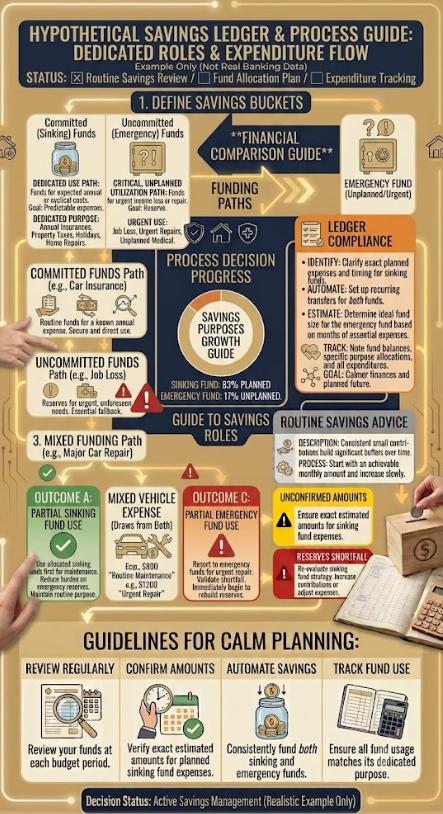
Decision Summary
Choose a sinking fund when the expense was reasonably foreseeable and has a purpose, estimate, or planning window. Choose an emergency fund when the event is genuinely unplanned, necessary, urgent, and too large for normal cash flow.
When the answer is mixed, use the sinking fund for the planned portion and evaluate emergency savings for the unexpected gap. Do not count the same money as available for both jobs. If you redirect a planned fund during a crisis, make the lost goal visible and decide later whether to rebuild, reduce, or postpone it.
The best system is not the one with the most categories. It is the one that keeps predictable costs from repeatedly consuming the money meant to protect you when life changes without warning.
FAQ
Is a sinking fund the same as an emergency fund?
No. A sinking fund is assigned to a specific expected expense, usually with a target or date. An emergency fund is a broader cash reserve for unplanned expenses or financial shocks.
Should car repairs come from a sinking fund or an emergency fund?
Scheduled maintenance and repairs you can reasonably anticipate usually fit a sinking fund. A sudden, necessary breakdown without useful warning may fit an emergency fund. A major repair can use both when planned savings cover only part of the cost.
Can I keep both funds in one savings account?
Yes, if you reliably track how much is committed to named goals and how much remains uncommitted for emergencies. Separate accounts or buckets may improve clarity, but this article does not recommend a particular product or tracking method.
What if my sinking fund is not enough?
Use the fund for the portion it can cover, then decide whether the gap can be reduced, delayed, paid from current cash flow, or treated as an emergency. An underfunded sinking fund still reduces the size of the shock.
Can I use a sinking fund during an emergency?
Yes. Assigned savings can be redirected when essential needs take priority. Record which goal lost funding so you do not assume it is still covered.
Which fund should I build first?
It depends on your immediate exposure. A person with no shock protection may prioritize a starter emergency cushion, while someone with an unavoidable bill due soon may need to split available savings. Do not fund either in a way that causes missed essentials or expensive borrowing.
Is a planned expense still an emergency if I forgot about it?
Usually, forgetting does not change a predictable bill into an emergency. Pay the necessary expense safely, then add its date and target to future planning so it does not repeatedly drain emergency savings.
This article provides general financial information, not individualized financial, tax, legal, insurance, medical, or investment advice. Account rules, consumer protections, taxes, benefits, and professional-help options vary by country and provider.
Sources
- CFPB – Financial Terms Glossary
- CFPB – Start Saving Today With Our New Savings Booklet and Email Boot Camp
- CFPB Office of Research – Perceived Financial Preparedness, Saving Habits, and Financial Security
- Federal Reserve – Economic Well-Being of U.S. Households in 2025
- MyMoney.gov – Save and Invest
More in This Cluster: Sinking Funds and Planned Expenses
- What Is a Sinking Fund and Who Needs One?
- How to Create Sinking Funds for Annual Bills
- Emergency Fund vs. Sinking Fund: Key Differences (you are here)
- How Many Sinking Funds Are Too Many?
- Best Ways to Track Multiple Savings Goals
- How to Fund Holidays Without Credit Card Debt
- How to Plan for Car Repairs, School Costs, and Home Maintenance