Quick Answer
There is no universal maximum number of sinking funds. You have too many when the categories create more confusion, missed transfers, double-counting, or cash-flow strain than clarity.
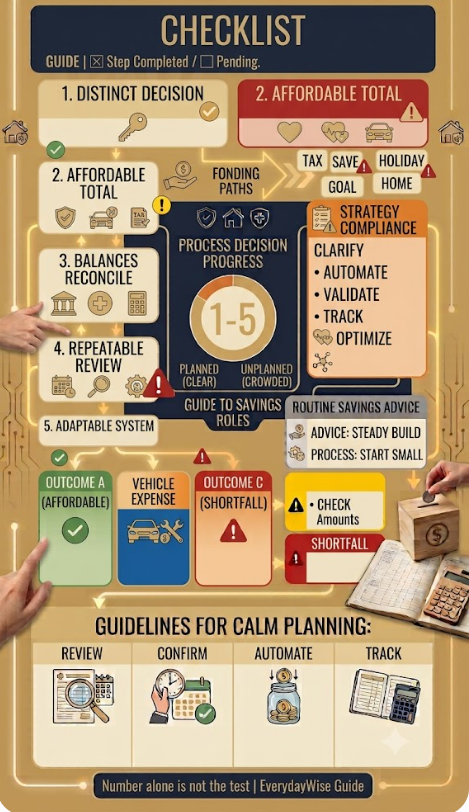
For one household, three broad funds may be enough. Another may comfortably manage eight or ten named goals because the dates, amounts, and balances are easy to see. The useful test is not the number alone. Ask whether every fund has a distinct job, whether the total monthly contribution is affordable, and whether you can review the whole system in a few minutes without reconstructing it from memory.
If the system feels crowded, do not automatically abandon planned saving. First close completed goals, merge categories that compete for the same money, pause low-priority goals, and keep separate only the expenses that need their own deadline, spending limit, or protection.
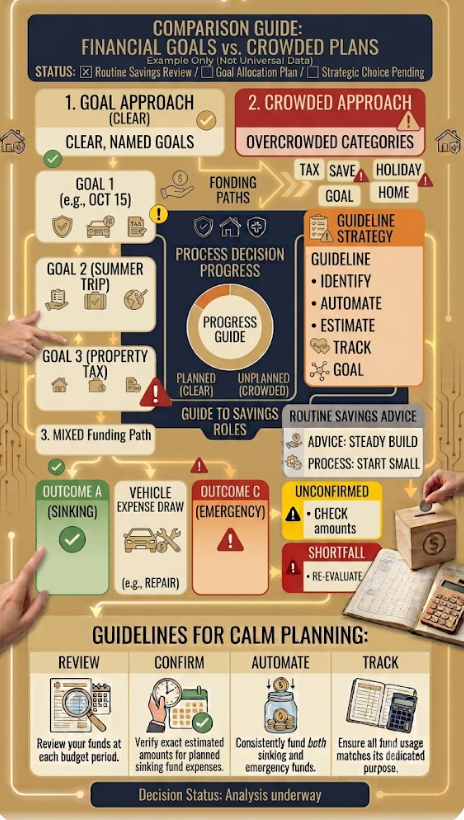
More Categories Are Not Automatically Better
A sinking fund gives a future expense a visible place in today’s plan. That can prevent annual bills, repairs, or chosen events from arriving as if they were surprises. But once every possible expense receives its own category, the system can stop helping.
The Consumer Financial Protection Bureau defines a savings goal as an amount set aside for a specific purpose. CFPB materials also encourage people to plan for short- and long-term goals and to save regularly. Those ideas support purposeful saving, but the agency does not prescribe a correct number of sinking funds. EverydayWise uses “sinking fund” as a practical organizing term, not as a regulated product or an official CFPB category.
The right level of detail depends on what the detail changes.
Separate funds can be valuable when they:
- protect money for a firm deadline;
- show whether a specific obligation is on track;
- prevent one attractive goal from consuming another;
- help two people coordinate responsibility; or
- make a spending limit easier to respect.
Separate funds are less useful when they:
- duplicate the same underlying expense;
- require frequent manual corrections;
- hide that total contributions exceed available cash;
- leave many tiny balances with no realistic plan; or
- make the household unsure how much is actually safe to spend.
The goal is not maximum categorization. It is enough structure to make planned costs visible without turning saving into a second bookkeeping job.
Five Tests for Whether Your System Is Too Complex
1. Every fund should change a decision
Ask what would be different if two categories were combined.
Suppose you maintain separate funds for oil changes, tires, registration, and routine vehicle repairs. If each has a different deadline and you want to protect the registration money from repair spending, separation may help. If you routinely move money among all four and think of them as one pool, a broader “Vehicle Costs” fund may show the same truth with less work.
A category earns its place when its separate balance affects how much you save, when you spend, or what you protect. A label that changes none of those decisions is probably optional.
2. The total contribution must fit real cash flow
An organized list can still be unaffordable.
Imagine that six funds call for monthly contributions of $90, $75, $60, $50, $40, and $35. The total is $350. If the household can consistently set aside only $220 after essential expenses and minimum obligations, the problem is not that six is inherently too many. The problem is that the plan promises $130 more than cash flow supports.
That gap should be resolved openly. Reduce a flexible target, extend a deadline where possible, pause a lower-priority goal, or plan a smaller version of a discretionary expense. Do not schedule transfers that are likely to cause an overdraft, missed essential bill, or new high-cost debt.
The total matters more than how neatly it is divided.
3. You should be able to explain every balance
Look at the full amount you call planned savings. Can you say how much is assigned, what each assignment is for, and what remains uncommitted?
If $3,000 sits in savings but your categories add up to $3,500, the same money has been counted twice. If the categories total only $2,300, the remaining $700 may be available, deliberately unassigned, or simply forgotten. Either answer can be valid, but it should be intentional.
This test does not require a separate bank account for every goal. It requires a reliable record. The detailed choice among accounts, bank buckets, spreadsheets, and apps belongs to the next article in this cluster. For now, the question is simpler: can your current record reconcile with the actual cash?
4. Routine review should be short and repeatable
A useful system should survive an ordinary busy month.
If reviewing the funds takes ten focused minutes and shows which goals are on track, the structure may be working. If it takes an hour to locate balances, repair formulas, classify transfers, and remember why categories exist, the maintenance cost is a warning.
There is no official ten-minute rule. The relevant standard is whether the process is short enough that you will realistically repeat it. A system that works only when you have unusual energy or uninterrupted time is fragile, even if it looks impressive when fully updated.
5. Small changes should not break the whole plan
Renewal prices change. Travel dates move. A household may add a school cost, sell a vehicle, or finish paying an annual bill. Your structure should absorb those changes without a complete rebuild.
If adding one goal forces you to rename several categories and redo every transfer, the system may be too tightly divided. Broader funds can provide flexibility. On the other hand, if one broad category repeatedly lets flexible spending consume a fixed obligation, more separation may be necessary.
Complexity is too high when the structure cannot adapt without losing accuracy.
When to Keep Funds Separate
Merging everything into one “future expenses” balance is not always simpler in practice. Keep a fund separate when its boundary protects an important decision.
The deadline is firm
A property-tax payment, insurance renewal, licensing fee, or tuition installment may need its own visible progress because the due date is not flexible. A general annual-bills fund can still work, but only if the record preserves how much of the total belongs to each deadline.
The spending limit matters
A vacation or holiday fund may deserve a separate cap because available cash can easily become permission to spend more. The balance provides a clear constraint: the plan is funded to this amount, not to whatever the trip or celebration could cost.
The money is easily redirected
Some goals compete emotionally. A home repair due next spring may lose to a nearer, more enjoyable purchase if both appear as one undifferentiated balance. Separation can protect the less visible obligation.
More than one person uses the plan
Partners or family members may need clear category ownership even when one person could manage a broader pool alone. A shared label can reduce repeated questions about whether money is available. The benefit is coordination, not merely tidiness.
The consequence of being short is significant
If underfunding one obligation could disrupt insurance coverage, essential transportation, housing, work, or education, visibility may justify a separate category. This does not mean every serious risk needs its own fund. It means the cost of losing track is part of the decision.
When to Merge Funds
Merge categories when separation no longer improves control.
The expenses share one practical purpose
Oil changes, routine service, and predictable minor vehicle costs might become one “Vehicle Maintenance” fund. School supplies, activity fees, and routine classroom requests might fit one “School Costs” fund when their timing and priority are similar.
Avoid categories so broad that they conceal conflicts. “Life” is not a useful fund. “Annual Home Costs” may be, if the underlying obligations are still listed.
You move money between them every month
Frequent transfers are evidence that the boundaries may not match how the household actually decides. Occasional reallocation is normal. Constant rebalancing among similar categories suggests one shared pool could be more honest.
The goal is complete or no longer relevant
Close a one-time fund after the expense is paid and any refund period has passed. Retire categories for a sold vehicle, canceled event, or discontinued service. Empty labels still take attention and make the system look more demanding than it is.
Several tiny goals have no priority or timeline
A list of “maybe someday” purchases can dilute contributions to obligations that are real and approaching. Combine them into a flexible future-purchases category, keep them on a wish list outside the funded system, or activate one only when it becomes a genuine priority.
The categories cannot be reconciled with cash
If category balances repeatedly disagree with the actual account balance, simplify until the record becomes trustworthy. A smaller accurate system is safer than a detailed one that overstates available money.
A Practical Three-Level Structure
If you are unsure where to begin, sort goals into three levels. This is an EverydayWise planning framework, not an official financial rule.
Level 1: Fixed and unavoidable
These are known expenses with firm or highly predictable deadlines and meaningful consequences if unpaid. Examples may include an annual premium, required registration, or a scheduled essential payment.
Give these goals first claim on available planned-savings contributions. They are usually the strongest candidates for separate tracking.
Level 2: Predictable but adjustable
These costs are likely, but the timing, amount, or version can change. Routine maintenance, clothing replacement, school costs, and household upkeep may fit here.
They can often be grouped by purpose, provided the household still sees upcoming needs within the broader balance.
Level 3: Chosen and flexible
Travel, celebrations, upgrades, and optional purchases may be important, but the date or amount can usually move. These goals can remain separate when a spending cap motivates the plan, or they can be paused when fixed obligations require more cash.
This ranking does not make flexible goals frivolous. It simply prevents the system from treating every target as equally urgent when money is limited.
Consider a household able to save $300 a month toward planned expenses. Its initial list contains nine goals totaling $475 in desired monthly contributions. After review, it keeps annual insurance and registration separate, combines three home categories into “Home Maintenance,” combines two vehicle categories, and pauses an optional electronics upgrade. The result is five active funds totaling $300.
Five is not the lesson. The lesson is that the active system now matches available money and protects the most consequential deadlines.
Use Active, Paused, and Closed Statuses
Not every legitimate goal must receive money at the same time.
An active fund receives contributions now. A paused goal remains visible but receives nothing until cash flow, timing, or priority changes. A closed goal is complete or no longer relevant.
This distinction solves a common problem: keeping fifteen future needs in view without pretending that all fifteen can be funded today.
For example, a renter planning to move next year may actively fund the move, an annual insurance bill, and a professional renewal. A hoped-for trip can remain paused until the nearest fixed obligation is on track. After the renewal is paid, its monthly contribution can be redirected without erasing the longer-term goal.
Pausing is not failure. It is an explicit allocation decision.
A 15-Minute Sinking-Fund Audit
Review your current system with one pass:
- List every active fund and its balance. Include categories tracked inside a shared account.
- Add the balances and compare the total with actual cash. Resolve any double-counting or unassigned difference.
- Add all planned monthly contributions. Compare the result with what cash flow can reliably support.
- Name the decision each category changes. Mark categories with no distinct deadline, limit, protection, or coordination benefit.
- Close finished goals. Remove categories that no longer represent a real expense.
- Merge overlapping goals. Preserve the underlying obligations in a note or list when dates still matter.
- Pause lower-priority goals. Keep them visible without promising current contributions.
- Set the next review date. Revisit after a major bill, household change, or meaningful price update.

If the review reveals that you need a better way to hold or display multiple goals, that is a tracking-system decision. The next article compares practical ways to track several savings goals without assuming that everyone needs multiple accounts or a particular app.
Decision Summary
You have too many sinking funds when categories no longer produce distinct, reliable decisions. Warning signs include unaffordable total contributions, overlapping purposes, frequent manual rebalancing, balances that do not reconcile with cash, abandoned tiny goals, and a review process you avoid because it is too demanding.
Keep a fund separate when its deadline, spending limit, consequence, or shared ownership needs protection. Merge funds that serve the same practical purpose. Close completed goals and pause valid goals that cannot receive money yet.
The best number is the smallest number that keeps important obligations visible, flexible goals honest, and the total plan affordable.
FAQ
Is there a recommended maximum number of sinking funds?
No universal maximum applies to every household. The system is too large when you cannot maintain it accurately, afford its total contributions, or explain what each separate category changes.
Is five sinking funds too many?
Not necessarily. Five may be simple if each has a distinct purpose and the balances are easy to review. Two can be too many if both claim the same cash or require contributions the household cannot afford.
Should every sinking fund have its own savings account?
No. Several goals can be tracked within one account if assigned balances reconcile with the cash. Separate accounts may help some people, but detailed tool and account comparisons are covered in the next cluster article.
Which sinking funds should I prioritize?
Start with fixed, unavoidable costs with the nearest or most consequential deadlines. Then consider predictable but adjustable needs and chosen flexible goals. Protect essential bills without creating transfers that endanger current necessities.
Can I combine several annual bills into one fund?
Yes, if you still track each bill’s expected amount and due date within the combined total. Combine the cash pool without losing the obligations that determine how much must be available and when.
What should I do with a sinking fund after I spend it?
Close it if the goal was one-time. If the expense recurs, update the next target and deadline before restarting contributions. Do not leave completed categories active without a defined next use.
Is it okay to pause a sinking fund?
Yes. Pausing can be a responsible choice when cash flow cannot support every goal. Keep the goal visible, record why it is paused, and decide when it should be reviewed again.
This article provides general financial information, not individualized financial, tax, legal, insurance, or investment advice. Account rules, consumer protections, taxes, and professional-help options vary by country and provider.
Sources
- CFPB – Financial Terms Glossary
- CFPB – Building Your Savings? Start With Small Goals
- CFPB – Looking for an Easy Way to Save Money? Make It Automatic
- CFPB Office of Research – Consumer Savings App Strategies and Savings Outcomes
- CFPB – Your Money, Your Goals Toolkit
More in This Cluster: Sinking Funds and Planned Expenses
- What Is a Sinking Fund and Who Needs One?
- How to Create Sinking Funds for Annual Bills
- Emergency Fund vs. Sinking Fund: Key Differences
- How Many Sinking Funds Are Too Many? (you are here)
- Best Ways to Track Multiple Savings Goals
- How to Fund Holidays Without Credit Card Debt
- How to Plan for Car Repairs, School Costs, and Home Maintenance