Quick Answer
Clean vinyl plank flooring by removing grit first, wiping spills promptly, and using the cleaner, moisture level, and equipment permitted by the exact installed product. A soft broom, clean microfiber dust mop, or hard-floor vacuum handles most loose debris. When damp cleaning is needed, use a clean pad and the product-approved solution, avoid leaving excess liquid at seams and room edges, and dry the floor as directed.
Do not treat “vinyl,” “luxury vinyl,” “rigid core,” and “waterproof” as universal care instructions. Manufacturers disagree about some cleaners, polishes, and even steam mops. The floor may also be floating, glued down, or recently installed, which changes what a leak, raised edge, or shifting plank means. If the product is unknown, use conservative dry care while you find the invoice, carton label, spare plank, care guide, or warranty.
Confirm That the Floor Is Vinyl Plank
Wood-look vinyl plank can resemble laminate or engineered hardwood. Those materials may share colour, bevels, texture, and plank size while requiring different cleaners and repair decisions. Visual appearance alone is not enough.
Look for the purchase invoice, installation record, leftover carton, spare plank, product code, warranty registration, or landlord records. The documents may identify the floor as luxury vinyl plank (LVP), luxury vinyl tile (LVT), rigid core, flexible glue-down plank, or another resilient product. They may also state whether the installation is floating, click-lock, loose lay, or adhered.
Do not scrape through the surface, pry up an installed plank, pour water into a joint, or use a solvent as an identification test. If records are unavailable, a retailer, installer, property manager, or flooring professional may be able to help. Until identification is reasonably secure, avoid steam, wax, polish, abrasive pads, strong chemicals, and broad wet cleaning.
This first step prevents an easy mistake: choosing a method because a bottle says “hard floors” when the flooring manufacturer limits it to specific resilient surfaces or excludes it entirely.
Remove Grit Before Adding Cleaner
Tracked sand, small stones, and hard crumbs can abrade a wear layer when shoes, chair legs, or a mop drag them across the floor. Shaw, COREtec, Karndean, and Armstrong all begin routine care with sweeping, dust mopping, or suitable vacuuming.
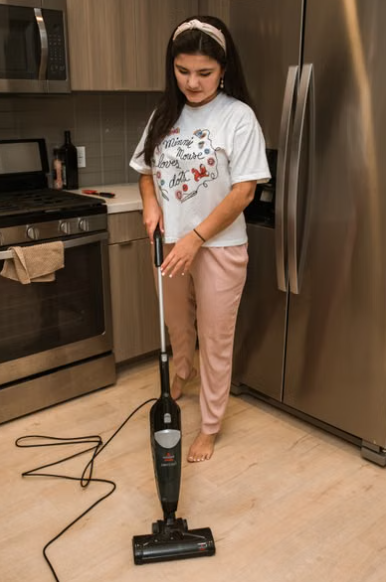
Use a soft broom, clean microfiber dust mop, or vacuum configured for hard flooring. Turn off a rotating beater bar unless the floor and vacuum instructions expressly permit it. Inspect wheels, brush housings, and pads for trapped grit. A dirty microfiber pad can redistribute soil or behave like fine sandpaper.
Focus on entrances, kitchens, dining areas, pet routes, and spaces beneath movable chairs. Clean entrance mats regularly and lift them to check for trapped moisture. The mat backing must be compatible with the product: several vinyl manufacturers warn that rubber or latex backing can discolour some floors.
There is no need to wet-clean the entire floor every time dust appears. Dry removal is often enough, and it prevents cleaner residue from accumulating faster than the soil it was intended to remove.
Damp-Clean According to the Installed Product
When dry care no longer removes visible soil, read both the floor instructions and the cleaner label. Check the approved cleaner type, dilution, application method, rinsing requirement, and any waiting period for a new installation.
A conservative sequence is:
- Remove loose soil completely.
- Test the documented method in an inconspicuous area if the care guide recommends a test.
- Apply the correctly diluted solution to a clean mop or use the specified spray method.
- Work in small sections, keeping liquid from pooling at joints, thresholds, cabinets, walls, and floor vents.
- Change or rinse the pad when it becomes dirty instead of spreading grey water.
- Remove visible residue or rinse only when the instructions call for it.
- Keep people and pets off the floor until it is dry enough to walk on safely.
Shaw and COREtec generally direct readers toward neutral-pH cleaners for resilient flooring. Karndean similarly permits its own cleaner or a pH-neutral cleaner approved for vinyl. Those examples support a sensible default when the product documents agree.
They do not create a universal chemical rule. Mannington’s current instructions for certain ADURA products specify a clear, non-sudsing ammonia-based solution, while Shaw tells owners of its luxury vinyl to avoid ammonia-based products. Both instructions can be correct for their respective products. Do not average them, and do not borrow one brand’s stain table for another floor.
“Waterproof” Does Not Make Every Wet-Cleaning Method Safe
Many vinyl plank products are marketed as waterproof because their flooring components resist water or do not swell in the way some wood-based cores can. That is useful, particularly for everyday spills. It does not mean that the whole room assembly is a waterproof basin.
Liquid can still travel through perimeter gaps, transitions, cut edges, vents, damaged joints, or installation openings. It may reach the subfloor, underlayment, adhesive, wall base, cabinets, or the level below. A floating plank may tolerate water differently from the materials beneath it. A glued floor can present a different concern if liquid, heat, or cleaner affects the bond.
Therefore, wipe spills promptly even when the floor has a waterproof claim. Do not flood the floor, let mop water sit, or assume a leak can remain until the stated warranty period expires. A waterproof product claim is not permission to ignore a dishwasher leak, overflowing fixture, exterior-water entry, or repeated pet accident.
For a large wetting event:
- stop the source if it is safe to do so;
- remove standing liquid without spreading it;
- photograph the affected area and note when it occurred;
- find the product, installation, and warranty documents; and
- arrange appropriate assessment when water may have gone below the planks or into adjacent building materials.
Routine cleaning advice is not a flood-remediation plan. Odour, recurring moisture, staining at walls, loose adhesive, or changes that continue after the visible surface dries require investigation rather than more cleaner.
Steam Is a Product-Specific Decision
Steam combines heat, moisture, and repeated pad pressure. COREtec and Karndean do not recommend steam mops for the vinyl products covered by their current guidance, and Shaw’s residential resilient maintenance document also advises against them. Mannington, however, currently approves residential steam-based cleaners designed for hard surfaces on specified ADURA flooring.
The safe conclusion is not that steam is always safe or always forbidden. It is this: use a steam mop only if the current written care or warranty document for the exact installed product explicitly permits it, and follow every condition. A steam-appliance label saying “sealed hard floors” does not override the flooring document.
If the floor is unidentified, do not steam it. If it is newly installed, wait for any adhesive or installation restriction to pass. If joints are damaged, edges are lifting, or moisture may already be below the surface, adding heat and vapour is not a diagnostic test.
Treat Cloudiness and Stickiness as Residue Until Proven Otherwise
A dull or sticky floor often leads people to add more soap, polish, vinegar, disinfectant, or scrubbing pressure. That can compound the problem.
First determine when the appearance changed. Was too much cleaner used? Was a no-rinse product diluted anyway, or a concentrate used full strength? Was a soap-based detergent, mop-and-shine product, disinfectant, or incompatible pad introduced? Is the film uniform, concentrated along mop paths, or limited to high-traffic areas?
Stop layering products. Dry-remove loose soil, then consult the flooring and cleaner instructions for residue correction. Some manufacturers direct readers to rinse with clean water; others formulate approved cleaners as no-rinse products. Use a clean white cloth or pad so transferred soil is visible, and change the water or pad rather than spreading residue.
Do not attempt to restore gloss with wax or polish unless the exact product guide calls for it. Some vinyl lines prohibit finish products, while other specific lines publish approved restoration systems. A low-gloss floor can look dull because that is its intended finish, not because it needs coating.
Detailed cross-surface chemical exclusions belong to the later article on floor-cleaning products to avoid. The practical decision here is simpler: identify what was applied, stop improvising, and use the correction method authorized for this floor.
Match the Spill Response to the Substance
For a fresh liquid spill, blot promptly with a clean, white, absorbent cloth. Work from the outside toward the centre to limit spreading. Pick up solids without grinding them into the texture, then use the product-approved spot method. Leave the surface dry.
For a dried spot, begin with gentle agitation using a tool permitted by the manufacturer. Avoid steel wool, scouring powder, abrasive scrubbers, metal blades, and aggressive rubbing. Texture can hold residue, but extra force can change the sheen or damage the wear surface.
Special stains require special caution. Manufacturer stain tables sometimes name isopropyl alcohol, bleach solutions, stronger cleaners, or solvents for particular products and controlled contact times. Those are narrow product instructions, not household recipes. Ventilation, flammability, skin and eye exposure, cleaner-label directions, and incompatibility with other chemicals all matter. Never mix cleaning products.
If the substance is unknown, the floor is unconfirmed, or the first approved step changes the colour or gloss, stop. Photograph the area and contact the manufacturer or a qualified flooring professional before escalating.
Distinguish Soil, a Scuff, a Scratch, and Installation Movement
Good side lighting can help classify what you see without digging at it.
- Soil or residue sits on the surface and transfers to a clean cloth with the approved method.
- A scuff is deposited material or a friction mark; some product guides provide a gentle removal method.
- A scratch or gouge disrupts the wear surface and may catch a fingernail or reveal a different colour.
- A raised edge, gap, bubble, or loose plank suggests movement, bond failure, damage, or a condition below the visible surface.
- Discolouration may come from sunlight, heat, an incompatible mat backing, rubber, chemicals, dyes, or a substance that has migrated into the flooring.
Cleaning can remove surface contamination. It cannot rebuild a cut wear layer, correct an installation gap, restore a failed adhesive bond, or diagnose moisture beneath the floor. Do not sand vinyl plank. Do not inject adhesive, heat a plank, coat a scratch, or cut out a section without product-specific repair guidance and a clear understanding of warranty consequences.
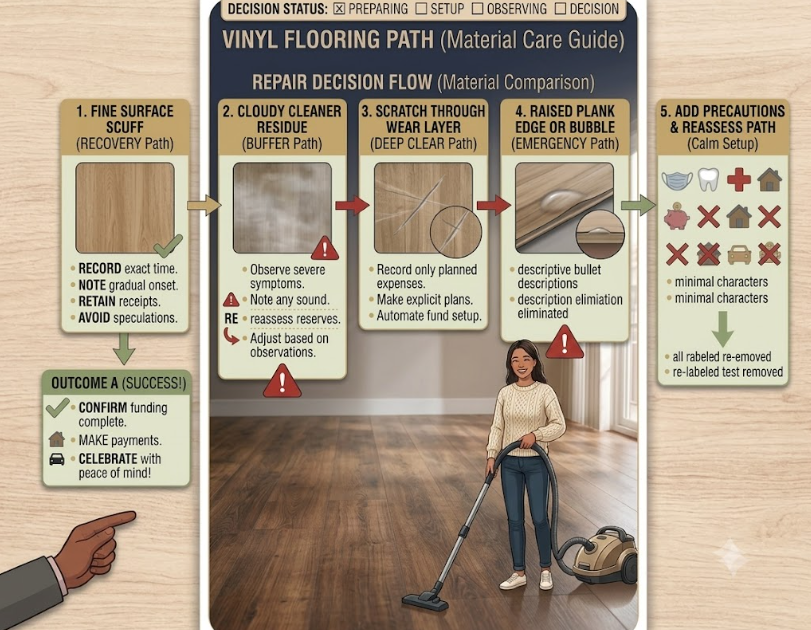
Arrange assessment when a plank lifts or shifts, a gap widens, a bubble develops, adhesive releases, discolouration spreads, odour persists, damage follows a leak, or the floor may contain trapped moisture. Save product records, photographs, dates, cleaner names, and the history of the event before repair changes the evidence.
Prevent Damage That Cleaning Cannot Undo
Use wide, non-staining furniture protectors sized for the load, and keep them free of grit. Lift heavy furniture or move it over protective runways rather than dragging it. Check manufacturer guidance for rolling chairs and casters; repeated point loads can indent or mark resilient flooring.
Use compatible mats at entrances and areas exposed to drips, but do not assume every rubber, latex, or coloured backing is safe. Keep plant saucers, pet bowls, appliance lines, and exterior doors from creating repeated hidden wetting. Manage pet nails and inspect toy wheels for embedded stones.
Window coverings can reduce prolonged direct sunlight and heat, both of which manufacturers identify as possible causes of colour change. Avoid placing hot appliances or heat-producing objects directly on the floor unless the product instructions allow the setup.
These measures are less dramatic than a deep-cleaning hack, but they address the damage a mop cannot reverse: scratches, indentations, migrated stains, heat changes, and movement caused by load or installation conditions.
A Practical Vinyl-Plank Decision
Before cleaning, buying a device, or attempting repair, answer five questions:
- What exact product and installation type is this? Find the current care and warranty documents.
- Is the problem loose grit, residue, a spill, physical damage, discolouration, or movement? Each requires a different response.
- What cleaner, dilution, tool, and moisture level does this product permit? Another brand’s instructions are not a substitute.
- Could liquid, heat, or cleaner have reached a joint, adhesive, perimeter, or layer below the flooring? If so, cleaning the top may not solve the problem.
- Will the next step remove soil or risk altering the floor? When risk exceeds the likely benefit, document and ask before escalating.
Vinyl plank is designed for practical everyday use, but easy care still depends on correct identification. Remove grit, clean spills promptly, control residue, and let the installed product—not a viral recipe—decide the exceptions.
FAQ
What is the safest everyday cleaner for vinyl plank flooring?
Use the cleaner or cleaner type named in the exact floor’s current care guide. Many manufacturers recommend a neutral-pH vinyl-floor cleaner, but some products publish different instructions. Follow the floor document and the cleaner’s dilution and application label.
Can I use vinegar or ammonia on vinyl plank flooring?
Do not assume either is universally safe. Shaw tells owners of its luxury vinyl to avoid vinegar- and ammonia-based products, while Mannington specifies a clear, non-sudsing ammonia-based solution for certain ADURA floors. The installed product’s instructions control.
Is a steam mop safe on luxury vinyl plank?
Only when the current written guidance for the exact product explicitly permits it. Several major manufacturers advise against steam, while a limited number of product lines allow residential steam equipment. If the floor is unknown, do not use steam.
Can waterproof vinyl plank flooring be wet-mopped?
Use only the amount and method permitted by the product guide. Waterproof flooring components do not make the entire room, seams, perimeter, adhesive, or subfloor waterproof. Never flood the surface, and clean spills promptly.
Why does my vinyl floor look cloudy or feel sticky after mopping?
Too much cleaner, soap, an incompatible product, dirty water, or repeated no-rinse applications may leave residue. Stop adding products, identify what was used, and follow the floor and cleaner instructions for correction. Do not automatically add wax or polish.
Can scratches in vinyl plank be sanded out?
No. Sanding can remove or alter the wear layer and printed design. Minor product-specific repair options may exist, but a deep scratch, gouge, or cut should be assessed under the manufacturer’s guidance.
When does a vinyl plank problem need professional assessment?
Seek help when planks lift, shift, gap, bubble, or release from adhesive; discolouration spreads; odour or moisture persists; damage follows a leak; or the correct product and repair method cannot be confirmed.
Sources
- Shaw Floors – Luxury Vinyl Care
- COREtec / Shaw Industries – COREtec Pro Residential Maintenance Guidelines
- Karndean Designflooring – Cleaning & Care
- Mannington – ADURA Max Care and Maintenance
- Armstrong Flooring / AHF – How to Clean Vinyl, Engineered Tile & Rigid Core Floors
- Resilient Floor Covering Institute – Vinyl Resilient Flooring Types