Quick Answer
Do not choose a floor cleaner from the word “floor” on the front label. Identify the installed surface and finish, read its care or warranty document, and then verify that the cleaner, concentration, tool, moisture level, and contact time are allowed. A product that is acceptable on ceramic tile may etch natural stone; a polish meant to add shine can leave a film on vinyl; steam permitted for one named resilient-floor product may damage another.
Three rules deserve priority. Never mix bleach with ammonia or another cleaner. Avoid unapproved steam, flooding, abrasive pads, waxes, polishes, oil soaps, strong acids, and strong alkalis until the exact floor instructions allow them. Finally, test an approved product in a hidden area, use the stated dilution, and stop if the finish changes, colour transfers, seams swell, the surface becomes tacky, or a new haze appears.
The safest default is not a universal homemade recipe. It is dry soil removal followed, when needed, by the least aggressive method authorized for that specific floor.
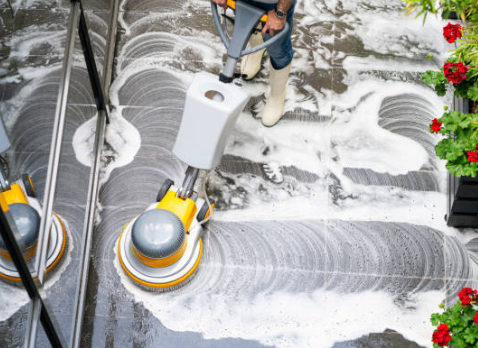
Start With the Installed Floor, Not the Cleaning Product
Many cleaning mistakes begin with a category that is too broad. “Wood-look floor” may be finished hardwood, laminate, or vinyl plank. “Tile” may be glazed ceramic, porcelain, quarry tile, or a calcium-based stone such as marble or limestone. “Carpet” may have fibre, dye, backing, stain treatment, and warranty requirements that are not visible from above.
Find the invoice, spare plank or tile, box label, manufacturer, product name, finish, and warranty. If those are unavailable, ask the installer, retailer, property manager, or a qualified flooring professional before using a high-risk method. Visual resemblance is not reliable enough to justify acid, solvent, bleach, wax, steam, a powered scrubber, or large amounts of water.
Then read both documents: the floor instructions and the cleaner label. The floor maker decides compatibility with the installed material and warranty; the cleaner maker defines dilution, ventilation, protective equipment, contact time, rinsing, storage, and prohibited mixtures. A cleaner is not approved merely because its label lists “hard surfaces.” It must include your surface without conflicting with the floor instructions.
Use Three Levels of Avoidance
“Avoid” can mean different things. Sorting a product into the right level prevents both careless use and unnecessary fear.
- Never combine: Do not mix bleach with ammonia or any other cleaner or disinfectant. CDC warns that dangerous vapours can be released. Do not use one cleaner over another while the first remains on the floor unless both labels explicitly describe that sequence.
- Default to no: If a method commonly damages that surface—such as acid on marble, a wet mop on many laminates, or wax on many modern vinyl floors—do not use it unless the exact product documentation authorizes it.
- Conditional: Some tools and ingredients vary by product. Steam is a good example: several manufacturers prohibit it broadly, while particular product lines expressly allow it. A general web tip cannot resolve that conflict; the installed product guide must.
This framework also separates hazard from compatibility. A cleaner can be safe to handle exactly as labelled yet still dull a floor finish. Conversely, an ingredient may be compatible with one surface but still require gloves, ventilation, careful storage, or other label precautions.
What to Avoid on Finished Hardwood
Finished hardwood is not bare timber and is not automatically compatible with a product labelled for “wood.” The finish is the first cleaning surface, while liquid that enters gaps can reach the wood below.
As a general default, avoid wet mops, standing water, and steam. Also avoid steel wool, scouring powder, aggressive pads, harsh chemicals, and unapproved ammonia because they can scratch, dull, or damage finishes. Oil soap, wax, polish, and “restorer” products deserve special caution: some finishes or maintenance systems may use a specific coating, but adding an incompatible film can make the floor slippery, attract soil, interfere with recoating, or create uneven shine.
Do not assume vinegar is a harmless universal choice. Its concentration, the finish, repeated exposure, and the floor maker’s instructions matter. If the care guide does not approve it, choose the maker’s recommended cleaner rather than experimenting. A scratch or dent is also not a cleaning problem; stronger rubbing or more chemical will not rebuild missing finish or compressed wood.
What to Avoid on Laminate
Laminate’s wear layer can tolerate ordinary use, but liquid at joints and edges may affect the layered core. Many laminate care guides therefore prohibit wet mopping and steam, even when the product is marketed with enhanced water resistance.
Avoid flooding, leaving spills in place, pouring cleaner directly onto the floor, and allowing a wet tool to pause over seams. Shaw’s laminate guidance also warns against oil soap, steel wool, abrasive cleaners, strong ammoniated or chlorinated cleaners, and buffing or polishing machines. Wax and polish do not restore a worn photographic layer; they can leave a film that changes appearance and traction.
“Water-resistant” or “waterproof” wording does not grant permission to ignore cleaning limits, perimeter details, damaged joints, or the warranty. If a seam has swollen or the surface has chipped, stop escalating the cleaner. That condition may require documentation and repair rather than another stain treatment.
What to Avoid on Vinyl Plank
Vinyl plank is often highly water resistant, but the wear layer, coatings, joints, adhesive, perimeter, and subfloor still impose limits. Avoid treating “waterproof plank” as “waterproof room.” Remove spills and do not flood the floor or direct liquid into transitions and edges.
Many manufacturers warn against abrasive cleaners and pads, wax, polish, oil soap, detergent residue, and acidic or strongly alkaline products. These can scratch, haze, discolour, soften, or coat the surface. Rubber- or latex-backed mats may also discolour some vinyl products, so check the flooring guide before using them.
Steam cannot be settled by material name alone. Shaw and many COREtec instructions advise against it, yet COREtec identifies a specific Scratchless collection as steam-approved, and other manufacturers may define their own conditions. Do not transfer that exception to another collection, older installation, or unknown vinyl floor. The precise product and current instructions control.
What to Avoid on Tile, Natural Stone, and Grout
Do not treat every tiled floor as ceramic. Glazed ceramic and porcelain may tolerate products that damage natural stone, metal trim, grout, sealer, or flexible joints.
For marble, limestone, travertine, onyx, and other calcareous stones, avoid vinegar, lemon, acidic bathroom cleaners, and other acids unless a stone professional has specified a controlled treatment. The Natural Stone Institute warns that acids may dull or etch these stones. Abrasive powders and creams can scratch some stones, while strong alkaline or solvent products may affect sealer or surrounding materials.
Avoid using a wire brush, steel wool, razor, pumice stone, or aggressive powered pad as a general grout solution. It can scratch tile, remove material, damage a glaze, cut sealant, or create uneven joints. Bleach is not a universal answer for dark grout: it may affect colour, surrounding materials, or sealers, and it must never be mixed with other cleaners. Persistent darkening, loose grout, cracked tile, soft joints, odour, or repeated moisture may indicate a water or assembly problem rather than insufficient chemical strength.
Sealer is not a waterproof membrane and does not make every cleaner compatible. Determine whether the surface is stone or tile, the grout type, whether a sealer is present, and what the manufacturer allows before selecting a descaler, disinfectant, solvent, or coating.
What to Avoid on Carpet and Rugs
Carpet cleaning chemistry depends on fibre, dye, backing, stain treatment, residue, and the spill. Avoid scrubbing, oversaturating, using coloured towels, or applying several spot products in succession. These actions can spread the spill, distort pile, transfer colour, leave residue, or carry liquid into the backing and cushion.
The Carpet and Rug Institute advises using solutions at the recommended concentration and avoiding spot products with optical brighteners that can bleach or discolour fibres. It also warns against automatic dishwasher detergent because bleaching agents may damage dyes and fibres, and against laundry detergent because optical brighteners can alter colour. This does not make a single alternative recipe appropriate for every carpet. Wool, natural fibres, specialty rugs, and warranty-covered carpet may require a named approved product or professional treatment.
Avoid steam or hot-water equipment based only on the word “carpet.” Temperature, extraction, solution, drying capacity, construction, and warranty all matter. A machine that adds more moisture than it removes can move contamination deeper or prolong drying. Stop home treatment when the spill is hazardous, widespread, unknown, has reached the cushion, returns after drying, or involves a valuable or specialty rug.
Avoid These Cross-Surface Mistakes
Several mistakes are risky across more than one flooring category:
- Mixing products: Never create an improvised chemical mixture or layer cleaners without a documented, compatible sequence.
- Using extra concentrate: Stronger than the label dilution can increase residue, fumes, colour change, and finish damage without improving the result.
- Assuming “natural” means compatible: Vinegar, citrus, essential oils, baking soda, and other household ingredients still have acidity, alkalinity, oils, particles, dyes, or fragrance that may affect a surface.
- Using an abrasive melamine foam, powder, pad, or brush without approval: Apparent stain removal may actually be finish removal.
- Adding shine: Wax, polish, oil, and restorer can create a coating the floor was not designed to receive.
- Applying disinfectant by default: Cleaning and disinfecting are different tasks. A disinfectant must be registered or authorized where required, used on a listed compatible surface, and kept wet for its labelled contact time without violating the floor instructions.
- Spraying the floor directly: Overspray can enter seams, reach walls and furniture, or create uneven concentration. Follow the authorized application method.
- Using one tool throughout the house: A pad can carry grit, cleaner residue, dye, or incompatible chemistry from one surface to another.
If You Already Used the Wrong Product
Stop. Do not neutralize it with another household chemical. Keep children and pets away, ventilate if the label directs, and follow the product’s first-aid and spill instructions. If cleaners were mixed or anyone develops breathing, eye, skin, or other symptoms, leave the affected area as appropriate and contact emergency services or the local poison centre. In Canada, provincial poison centres provide urgent advice; elsewhere, use the local equivalent.
For the floor, photograph the label, ingredients, concentration, amount, contact time, area, and visible change. Save the container and the flooring records. If the label and floor guide permit removal with water, use only the specified minimal method and dry promptly. Do not keep rubbing a dull, sticky, swollen, bleached, etched, or softened area.
Contact the flooring manufacturer, retailer, installer, or an appropriate restoration professional. A cleaner may leave removable residue, but it may also alter a coating, dye, stone surface, adhesive, seam, or finish. Testing additional remedies before the problem is identified can erase evidence and enlarge the damage.
Make the Decision in This Order
- Identify the exact flooring, finish, grout, sealer, carpet, or rug.
- Read the installed product’s care and warranty documents.
- Reject any cleaner or tool that conflicts with those documents.
- Read the full cleaner label, including dilution, ventilation, contact time, rinsing, protective equipment, and prohibited mixtures.
- Never mix cleaners; use one compatible method at a time.
- Test in a hidden area and allow it to dry before judging the result.
- Use the least product, moisture, heat, pressure, and abrasion needed.
- Stop when the surface changes or the problem appears structural rather than cosmetic.
The goal is not to memorize one blacklist. It is to recognize that a floor is a material system, not merely a dirty surface. Compatibility first is slower than grabbing a viral recipe, but far faster than repairing an etched stone, swollen seam, stripped finish, discoloured carpet, or coated vinyl floor.
FAQ
Is vinegar safe for every floor?
No. Acids can etch calcareous stone, and some hardwood, laminate, and vinyl manufacturers prohibit vinegar or do not approve it. Follow the exact flooring guide rather than treating dilution as universal permission.
Can I use a steam mop if the floor is labelled waterproof?
Only if the exact product instructions expressly allow it. Waterproof claims do not automatically cover heat, vapour at seams, adhesives, perimeter conditions, or every product line.
Is bleach safe on tile and grout?
Not universally. Tile, stone, grout colour, sealer, trim, ventilation, and the bleach label all matter. Never mix bleach with ammonia or any other cleaner.
Are homemade floor cleaners safer than commercial products?
Not necessarily. Household ingredients still have chemical and abrasive properties, and a homemade mixture may lack tested dilution, surface compatibility, and clear safety directions.
Why should I avoid wax or polish on modern floors?
Many factory-finished hardwood, laminate, and vinyl products are not designed for added coatings. Wax or polish may leave residue, change traction or gloss, attract soil, and interfere with later maintenance.
Can I use laundry detergent or dishwasher detergent on carpet?
Do not improvise with them. CRI warns that laundry detergents may contain optical brighteners and automatic dishwasher detergents may contain bleaching agents that can alter carpet colour or fibres.
What should I do if a cleaner makes the floor cloudy or sticky?
Stop adding products and document what was used. Check the label and floor instructions for an approved removal method, and contact the manufacturer or a flooring professional if the change remains. Do not attempt to neutralize it with another cleaner.
Sources
- CDC – Cleaning and Disinfecting with Bleach
- Shaw Floors – Hardwood Floor Care & Maintenance
- Shaw Floors – Laminate Floor Care & Maintenance
- Shaw Floors – Vinyl Floor Care & Maintenance
- COREtec – Scratchless Collection
- Health Canada – Canada Launches 1-844 POISON-X
More in This Cluster: Floor Care by Material
- Hardwood Floor Cleaning and Humidity
- Laminate Floor Care
- Vinyl Plank Floor Cleaning
- Tile and Grout Maintenance
- Carpet Spot Cleaning
- How to Choose a Vacuum for Your Flooring
- Floor-Cleaning Products to Avoid by Surface (you are here)