Decluttering often becomes hardest after the work has already begun. A closet has been emptied onto the bed, boxes are open across the floor, and every object now seems to require a separate decision. The room may contain less hidden clutter than it did an hour ago, yet it is temporarily less usable.
That disruption is not proof that the household is incapable of getting organized. It usually means the work area expanded faster than items could leave it.
Jerome sees a version of this during seasonal cleanouts in Canada. In late fall before winter, or in spring after it, his household brings out seasonal items and finds things that are worn out, in poor condition, or barely used for years. Even though this happens once or twice most years, unwanted items can still fill the back of his pickup truck. Clothes may go to younger children, a donation box, or a used shop. Other items go to the landfill. The difficult part is not merely deciding that something can leave. It is moving each item through the right exit without turning the house into a long-running sorting zone.
The practical answer is to control the size of the unfinished work. Declutter one bounded area, prepare real exit routes before sorting, and stop opening new areas until the current one is functional again.
Quick decision: Choose a space small enough to finish in one session. Prepare containers for items that will stay elsewhere, be donated, be recycled or specially handled, and become ordinary waste. Set a limit for undecided items. Sort only what fits the session, restore the space, and schedule the actual removal before beginning another area.
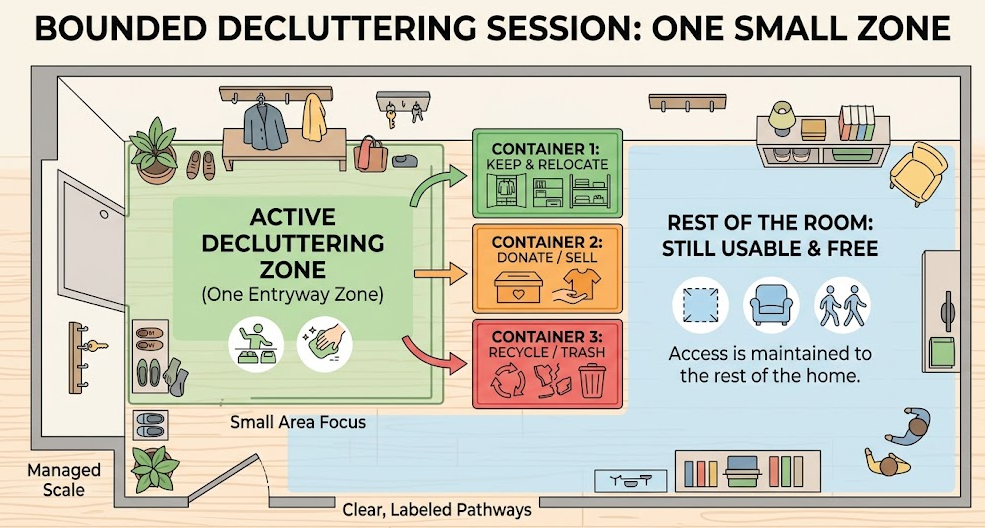
Define “Finished” Before Taking Anything Out
“Declutter the basement” is a destination, not a workable session. It does not say where to start, how much to open, or what condition will count as complete.
Use a physical boundary instead:
- one shelf;
- one drawer;
- one metre or yard of closet rail;
- the surface of one table;
- one category already stored together; or
- one box that can be opened, decided, and closed out today.
Then define the finish line. A session is finished when:
- the items being kept are returned to a usable place;
- items that belong elsewhere have been moved there;
- rubbish has entered the correct waste stream;
- donations, sales, and recycling have a named destination and removal date; and
- the floor, bed, table, doorway, or other working surface is usable again.
This definition prevents “I sorted everything” from masking a new collection of bags in the hallway. Decisions matter, but a decision that has not reached its destination remains part of the household workload.
Prepare the Exits Before You Sort
Many decluttering sessions create a bigger mess because every object is handled before the household knows what will happen to it. A donation pile grows without checking whether the intended organization accepts those items. Electronics are mixed with ordinary rubbish. Objects for other rooms are carried away one at a time, and each trip introduces a new distraction.
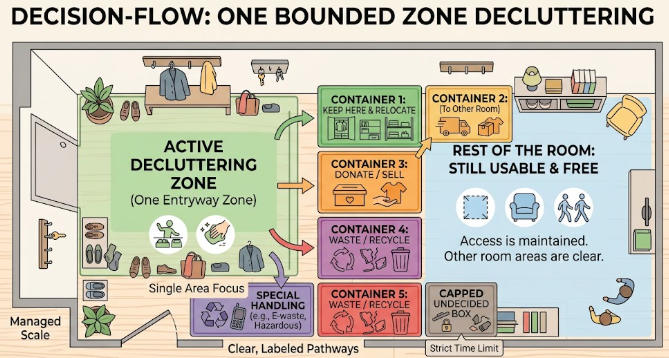
Prepare a small set of exit containers before opening the first drawer:
- Keep here: items that belong in the space being worked on.
- Move elsewhere: items with a known home in another room.
- Donate or give away: usable items with a realistic recipient or organization.
- Sell: only items worth the listing, communication, storage, and handoff effort.
- Recycle or special handling: electronics, batteries, paint, chemicals, and other locally regulated materials.
- Waste: items that are neither usable nor accepted through another route.
- Decide later: one limited container, not an expanding category.
Use labels that describe the next action. “Donate—Saturday drop-off” is more useful than “maybe donate.” “Ask Maya by Friday” is more useful than “family.” A destination and deadline convert a pile into a task.
EPA waste guidance places reduction and reuse before disposal and suggests selling or donating usable clothes, toys, appliances, and books rather than automatically discarding them. That does not mean every item is suitable for donation. Check the receiving organization’s current acceptance rules, condition standards, hours, and drop-off process before filling bags.
Make the Working Zone Smaller Than the Available Time
A clear afternoon does not guarantee the energy, attention, vehicle space, or disposal access needed for an entire room. Choose a zone that can be completed in less time than the session allows.
For a 60-minute session, one possible structure is:
- 5 minutes to label exits and protect the work surface;
- 25 minutes to make decisions;
- 15 minutes to return kept items and move room-to-room items;
- 10 minutes to bag, label, and stage outgoing items; and
- 5 minutes to restore the area and record the next action.
The exact numbers are not a universal productivity rule. They simply reserve time for closing the session. If all available time is assigned to sorting, cleanup becomes tomorrow’s problem.
Set a capacity limit as well as a time limit. Stop opening containers when the sorting surface is full. Do not empty a second shelf until the first shelf is functional. If the donation box is full, close it and arrange removal rather than building a second unplanned pile.
Separate Decisions From Walking
Carrying every object to another room as soon as it appears makes the session physically busy but difficult to control. It also creates opportunities to start organizing drawers, repairing toys, reading old papers, or looking for missing parts elsewhere.
Place room-to-room items in one container. At the end of the decision period, make one delivery round. If an item has no established home, do not invent a complicated storage solution during the walk. Return it to the decision zone and ask whether it is useful enough to earn a location.
Use the same separation for cleaning and repair. Dusting an empty shelf before replacing items is reasonable. Deep-cleaning the entire room, repairing every broken object, digitizing documents, testing old electronics, and listing items for sale are separate projects. Capture those tasks on a short follow-up list instead of allowing them to consume the decluttering session.
Use Questions That Lead to an Action
“Could this be useful someday?” is easy to answer yes. Almost any container, cable, old coat, spare board, or childhood toy could be useful under an imagined set of conditions. The question does not compare that possible use with the real cost of keeping the item visible, accessible, clean, and stored.
Ask narrower questions:
- Have we used this within a timeframe that makes sense for this type of item?
- Is there a specific, credible next use?
- Would we know we owned it and be able to find it when needed?
- Is it safe, complete, functional, and appropriate for its intended use?
- Does another item already perform the same job?
- Is the storage space worth assigning to this item rather than another need?
- If it left today, what would replacement actually cost in money, time, and inconvenience?
- Is this a memory item that deserves a deliberate sentimental decision rather than an ordinary utility test?
These questions do not require a strict “one-year rule.” Seasonal equipment, tax or legal records, emergency supplies, specialty tools, adaptive equipment, and items used for infrequent but important events may reasonably stay longer. The decision should reflect purpose, likelihood of use, replacement difficulty, safety, and available space.
Cap the Undecided Category
Some choices deserve more time. A child may be away, a document may need verification, an electronic device may need testing, or a sentimental item may need a quieter decision. The problem begins when “decide later” becomes the default destination.
Use one container with three controls:
- a fixed physical capacity;
- a review date; and
- the name of the missing decision or person.
For example: “Test by September 1,” “Ask both children this weekend,” or “Confirm record-retention requirement.” When the container is full, no new undecided item enters until another is resolved.
Jerome’s household still has several boxes brought during immigration about ten years ago that have never been opened. The boxes moved toward a corner, became harder to reach, and remained a deferred project. Their continued presence does not prove that everything inside is unnecessary. It shows how an undefined future decision can become less accessible with time.
An old unopened box can be a complete session by itself. Bring out one box, preserve the walking path, identify documents or hazards before discarding anything, decide its contents, and finish the exits. Opening every old box at once would recreate the original problem at a larger scale.
Do Not Let Outgoing Items Become a New Storage System
A donation bag is still in the home. A sale item is still being stored. A broken television waiting for a recycling event still occupies space. Count an item as removed only when it reaches the recipient, collection facility, recycler, or waste stream.
Give each outgoing route a service limit:
- Donation: next planned trip or a date within a short, realistic window.
- Give-away: one named recipient and response deadline.
- Sale: listing deadline, minimum acceptable price, and expiry date.
- Repair: cost or effort ceiling and appointment deadline.
- Special disposal: facility, accepted material, opening hours, fee, and transport plan.
If the deadline passes, make the next decision rather than resetting the same vague intention. A sale item might become a donation. An unaccepted donation might require another organization or responsible disposal. A repair may no longer justify the space it occupies.
Keep outgoing items near the actual exit only when they do not obstruct doors, stairs, heating equipment, electrical panels, vehicles, or safe movement. A garage or entryway is not a useful staging area if the household cannot use it safely.
Treat Hazardous and Electronic Items as a Pause Point
Do not place an unfamiliar chemical, battery, fluorescent lamp, paint container, pesticide, fuel, aerosol can, or electronic device into an ordinary rubbish or recycling container without checking local rules.
EPA guidance on common household waste notes that some household products can ignite, react, explode, or be corrosive and may require special collection rather than disposal in household rubbish, on the ground, or down a drain. Accepted materials and collection systems vary by community. Read the product label, keep substances in safe labelled containers, avoid mixing materials, and contact the local waste authority or an authorized program.
Electronics also require a verified route. Devices may contain batteries or components handled separately by local programs. Before donating or recycling a computer, phone, drive, or connected device, follow authoritative instructions for account removal and data protection. Topic 3 in this cluster will examine donation, sale, recycling, and disposal decisions in full; the rule for this first session is simply to isolate uncertain items safely rather than guessing.
Plan Heavy and Awkward Items Before Moving Them
Large furniture, old televisions, packed boxes, and appliances should not become spontaneous end-of-session jobs. Their weight, grip, balance, stairs, cords, sharp edges, and transport requirements change the task.
Jerome recently removed a television that had been used for about 20 years. It was heavy enough that he and his daughter struggled to move it together. The experience belongs here as a practical boundary: deciding that a large object should leave does not make it ready to lift.
Before moving a heavy or awkward item:
- clear the entire route and destination;
- measure doors, stairs, and vehicle space;
- disconnect power and other services correctly;
- remove detachable parts when the manufacturer permits;
- identify stable grip points;
- use appropriate equipment or qualified help; and
- keep children and pets away from the moving path.
NIOSH ergonomics guidance describes lifting risk as affected by task design and recommends fitting work to physical capabilities, including the use of assistive lifting devices where appropriate. Its lifting equation is an occupational assessment tool, not a universal safe-weight promise for household moves. If the object cannot be controlled comfortably, stop and arrange help rather than treating strain as the price of finishing.
Televisions and furniture also present tip-over risks. CPSC’s Anchor It guidance advises using sturdy supports and securing televisions and furniture according to manufacturer instructions. If an anchored item will remain in use after being moved, plan for safe reinstallation rather than leaving it temporarily unstable.
Close Every Session With a Reset
The final ten minutes protect the household from living inside an unfinished project.
Use this closing sequence:
- Return the kept items without overfilling the space.
- Deliver the “move elsewhere” container.
- Seal and label outgoing containers.
- Put special-handling items in a safe temporary location.
- Record appointments, drop-offs, listings, and questions.
- Remove ordinary rubbish.
- Clean only the newly accessible surface.
- Take one photo or note showing where the next session begins.
If the area is still unusable, stop making new item decisions and restore function. It is better to return a few unresolved items to one dated container than to leave a bed or walkway covered overnight.

Prevent the Next Round From Starting Immediately
Jerome’s conclusion after repeated seasonal cleanouts is that removal matters, but preventing unnecessary items from entering may matter even more. That is the bridge from a one-time project to a durable household system.
After each session, identify one inflow that contributed to the area:
- duplicates bought because existing items could not be found;
- free items accepted without a defined use;
- children’s items retained after the life stage changed;
- packaging kept without a specific return or storage need;
- aspirational hobby supplies without a scheduled activity;
- items awaiting repair without a deadline; or
- purchases entering faster than the category’s storage capacity.
Choose one matching rule. Check the house before rebuying. Give a category a fixed container. Decline a free item without a use. Place seasonal reviews on the calendar. Set a replacement rule for worn equipment. Create a short holding period for uncertain purchases.
The goal is not to prevent every possession from entering. It is to notice which decisions repeatedly create the same exit work.
A Practical First Session
For the first attempt, choose a visible but contained area such as one entryway shelf, one bathroom drawer, or one section of a child’s outgrown clothing.
Before starting:
- choose the boundary and finish time;
- protect one sorting surface;
- label the exit containers;
- check donation and disposal options that may be needed;
- decide the maximum undecided capacity; and
- avoid beginning with hazardous, private, highly sentimental, or very heavy items.
A successful session does not need to produce a dramatic empty room or a truckload of waste. It needs to leave one part of the home easier to use without transferring disorder to another part.
FAQ
Should I empty the whole room before decluttering?
Usually not. Emptying an entire room can remove access to the space before decisions and exits are complete. Start with one shelf, drawer, surface, or other boundary that can be restored in the same session.
How many sorting categories should I use?
Use only categories connected to real next actions: keep here, move elsewhere, donate or give away, sell, recycle or special handling, waste, and one limited undecided container. Combine categories if the number of bins becomes distracting.
What if I cannot decide whether to keep something?
Place it in a capacity-limited container with a review date and the exact missing decision. Sentimental items, legal records, untested electronics, and another person’s belongings may need separate review rather than a rushed choice.
How long should I try to sell an item?
Choose the deadline before storing it as a sale item. Consider likely price, listing effort, messages, pickup arrangements, and the space it occupies. If it does not sell by the deadline, decide whether to reduce the price, donate it, or use another responsible route.
Can everything usable be donated?
No. Organizations differ in what they accept, and condition, safety, hygiene, season, space, and local rules may affect acceptance. Check the recipient’s current guidance before packing or dropping off items.
What should I do with paint, batteries, chemicals, or electronics?
Keep them separate and check product labels and local government or authorized collection guidance. Do not assume they belong in household rubbish or curbside recycling, and do not mix unidentified products.
How do I declutter when I only have 15 minutes?
Choose a very small closed unit, such as one drawer or one bag of already-grouped clothing. Reserve several minutes to return kept items and remove rubbish. Do not open a new area when the timer ends.
Where should I start if the home feels unmanageable?
Start where a small completed change restores daily function: a safe walking path, one chair, a section of kitchen counter, or access to a necessary appliance. If clutter creates fire, sanitation, structural, fall, pest, or mental-health risks beyond ordinary household sorting, seek appropriate local professional support.
Sources
- What You Can Do — US Environmental Protection Agency
- How Do I Recycle Common Recyclables? — US Environmental Protection Agency
- About Ergonomics and Work-Related Musculoskeletal Disorders — NIOSH
- AnchorIt.gov — US Consumer Product Safety Commission
More in This Cluster: Decluttering
- How to Declutter Without Making a Bigger Mess (you are here)
- Room-by-Room Decluttering Plan
- What to Donate, Sell, Recycle, or Discard
- Decluttering When You Share a Home
- How to Avoid Rebuying What You Removed
- Sentimental Items: A Practical Decision Framework
- How to Maintain a Decluttered Home