An item can be unwanted without being ready to donate. A coat with years of wear, a recalled child product, a phone that still contains personal data, and an unopened household chemical may all be leaving the home, but they should not travel through the same exit.
Jerome sees this distinction during seasonal cleanouts. Some clothes his children have outgrown can be passed to families with younger children. Other usable items may go to a city donation box or a used shop he remembers visiting more often after immigrating to Canada. Items that are worn out or no longer suitable for reuse may go with the landfill load. The household is not making one decision called “get rid of it.” It is making a series of decisions about condition, safety, usefulness, responsibility, and what each receiving route will actually accept.
Good intentions do not settle those questions. Donating an unsafe, incomplete, contaminated, or unwanted item can transfer sorting and disposal work to someone else. Recycling an item into the wrong stream can contaminate a load or create a fire risk. Selling can preserve value, but it can also consume weeks of space and attention for a price that never materializes.
The responsible route is the one that matches the item’s real condition and risk, the next person’s ability to use it, and the verified rules where the item will go.
Quick decision: Before choosing donate, sell, recycle, or discard, confirm that the item is yours to release, identify any safety or recall issue, assess whether it is clean, complete, functional, and honestly useful, and check the receiving route’s current rules. Donate when a suitable organization or person wants it. Sell when the likely return justifies the work and storage. Recycle only through a program that accepts that material. Discard through the correct waste or special-handling route when reuse is unsafe or unrealistic.
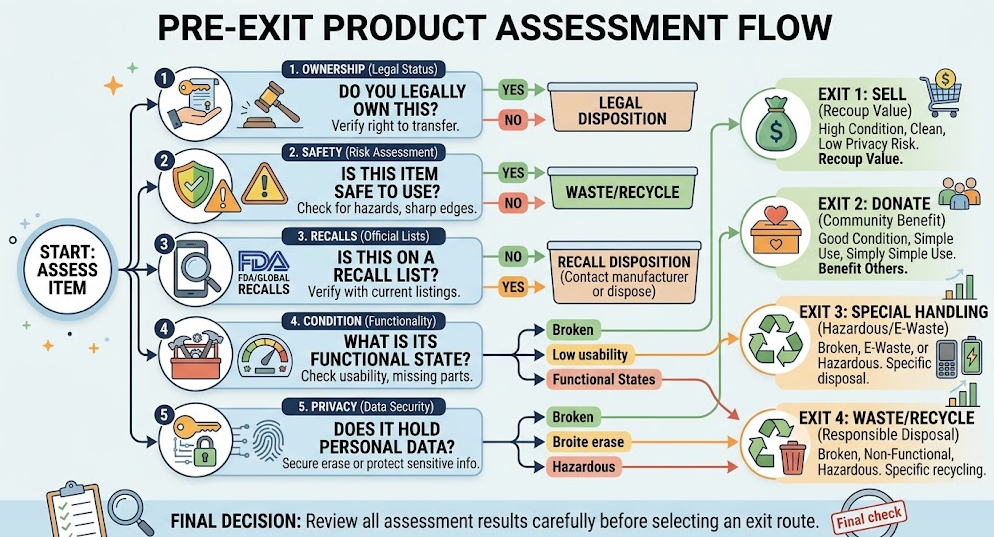
Start With the Decisions That Can Stop the Transfer
Is it yours to decide?
A shared object, a child’s possession, a partner’s box, a borrowed tool, an inherited item with unresolved ownership, or property supplied by a landlord or employer may not be yours to donate, sell, recycle, or discard. Set it aside with the owner’s name and a review date. Article “Decluttering-When-You-Share-a-Home” will address shared-home decisions in full.
Is it recalled, prohibited, or unsafe?
Search the model, product number, and manufacturer in the official recall database for the country where the transfer will occur. In Canada, Health Canada’s recall and safety alert database provides current notices, and its second-hand product guidance explains that used products remain subject to safety requirements. In the United States, the CPSC resale and thrift-store information centre directs resellers and consumers to recall and hazardous-product information.
Do not donate, give away, or sell a recalled product unless the official notice explicitly provides a completed remedy that makes transfer lawful and safe. Follow the recall instructions for return, repair, refund, destruction, or disposal. Rules differ by jurisdiction and product, so a general decluttering article cannot authorize a transfer.
Give additional scrutiny to items whose history or missing parts affect safety: child restraints, cribs, helmets, smoke and carbon-monoxide alarms, climbing equipment, protective gear, medical devices, gas appliances, electrical products, and furniture that relies on specific fasteners or anchoring hardware. “It worked the last time we used it” does not answer whether it meets current requirements or has hidden damage.
Does it contain private information or regulated material?
Computers, phones, tablets, drives, cameras, printers, connected-home devices, notebooks, labels, medication packaging, financial papers, and identification documents may reveal more than their appearance suggests. Chemicals, batteries, medicines, pressurized containers, fuel, paint, pesticides, sharps, and some electronics may require special handling. Pause the ordinary route until the information or material has been handled correctly.
Assess Condition From the Receiver’s Side
“Someone could use this” is too broad because it imagines a possible person without checking what that person would receive.
Assess the item as if you were considering bringing it into your own home:
- Is it clean enough for the proposed recipient and category?
- Does it work reliably for its intended purpose?
- Are essential parts, cords, fasteners, manuals, remotes, or chargers present?
- Is there damage, odour, mould, pest evidence, contamination, leakage, corrosion, or deterioration?
- Can it be transported and installed safely?
- Is it so obsolete or specialized that a realistic recipient is unlikely?
- Would disclosing every defect change the decision to accept or pay for it?
An item does not need to look new to be useful. A worn table may remain stable and functional; a nearly new appliance may be unsafe because of a recall. Cosmetic wear, repairable damage, missing safety components, and contamination are different conditions and should not be collapsed into one “used” label.
For clothing and household textiles, check for cleanliness, odour, persistent stains, tears, failed elastic or fasteners, and the receiving organization’s category rules. A family who has agreed to receive a child’s outgrown clothes is a different route from an unattended donation bin. In both cases, the condition should respect the next person rather than merely reduce the volume at home.
Donate When There Is a Real Recipient
Donation works when three things align: the item is safe and usable, the recipient or organization currently accepts it, and the household can complete the handoff.
Check before packing:
- accepted and excluded categories;
- required condition and cleanliness;
- seasonal restrictions;
- whether parts must be attached or bagged together;
- drop-off hours, pickup limits, and appointment requirements;
- whether large items need measurements or photographs; and
- whether a donation box is intended for that exact category.
An organization’s charitable purpose does not create unlimited storage, repair capacity, or waste service. If its website or staff say no, choose another verified route rather than leaving the item outside or placing it in a container with uncertain rules.
Direct giving can work well for known-use items. Jerome’s household sometimes passes children’s clothing to families with younger children. The strength of that route is not that every old garment becomes useful; it is that there is an identifiable recipient and an opportunity to ask what is wanted. Offer a clear description or photo, disclose condition, set a response deadline, and make “no” easy.
Donation may be a poor fit when the item is unsafe, recalled, incomplete in a way that prevents use, unhygienic, contaminated, broken beyond a realistic repair, or outside the recipient’s stated needs. In those cases, responsible recycling, special handling, or disposal is not a failure of generosity.
Sell When the Net Return Justifies the Project
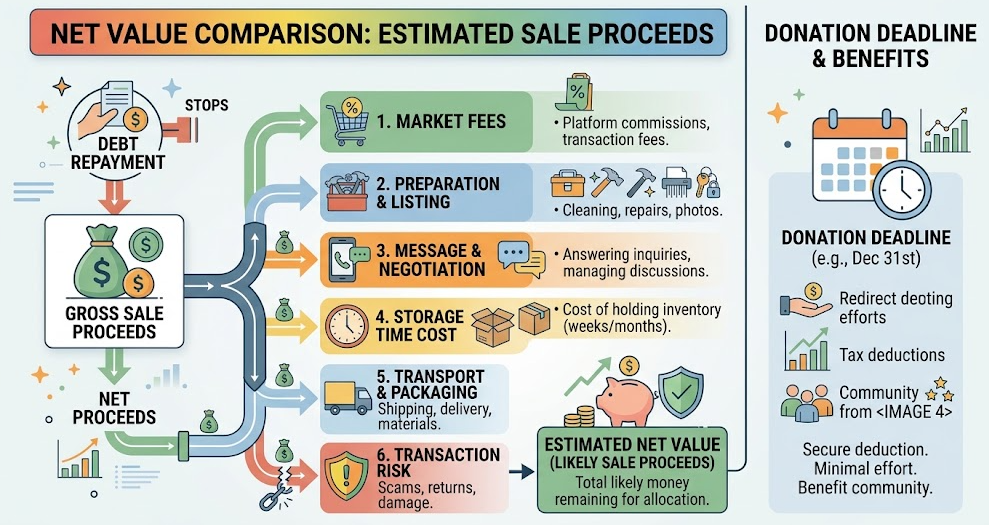
Selling is not automatically better than donating because an item once cost a great deal. The relevant comparison is the likely net return against the work and delay required now.
Estimate:
- a realistic sold price based on comparable completed sales, not optimistic listings;
- platform, payment, shipping, packaging, and transport costs;
- cleaning, testing, photography, measurement, and listing time;
- messages, negotiation, missed appointments, returns, and fraud risk;
- the space the item will occupy while listed; and
- the deadline after which the plan changes.
Choose a minimum price and an expiry date before listing. A high-value, in-demand item with verifiable condition may justify the effort. A bulky low-value item with expensive transport may not. Grouping inexpensive related items into one lot can reduce transaction work, but only if the bundle remains accurately described.
Disclose known defects, missing pieces, age, compatibility limits, and relevant history. Do not use vague language to move risk to the buyer. For safety-sensitive products, verify the laws and platform rules that apply where the sale occurs. Recalled or prohibited products do not become acceptable because the transaction is private or described “as is.”
Protect personal safety during handoff. Use the platform’s safety guidance, avoid unnecessary disclosure of home and schedule information, choose an appropriate meeting or pickup arrangement, and use payment methods you understand. Exact consumer and tax obligations vary by jurisdiction; a household decluttering plan should not assume that every occasional or repeated sale is treated the same.
Recycle Only Through a Verified Material Stream
The recycling symbol on an object or package does not guarantee that a local curbside program accepts it. Material combinations, size, contamination, colour, local equipment, and end markets can all affect the route.
Check the municipal or authorized program for the exact item. Separate ordinary curbside materials from store take-back, depot, scrap, textile, appliance, electronics, battery, and household hazardous-waste programs. Do not “wish-cycle” an uncertain object by placing it in a bin and leaving the facility to resolve it.
Electronics deserve a separate check. EPA electronics guidance advises removing personal information, considering whether batteries must be handled separately, and checking for an appropriate local recycler or take-back option. A working device may be suitable for reuse after data and account removal; a broken one may still contain recoverable materials, but only a verified program can say what it accepts.
Batteries should not be treated as an ordinary mixed category. Chemistry and local rules matter. EPA guidance for used household batteries notes that management differs by battery type and identifies specialized recyclers, retailer take-back, and household hazardous-waste programs as possible routes. Its lithium-ion guidance states that lithium-ion batteries and devices containing them should not go into household garbage or recycling bins and recommends separate collection routes.
Do not dismantle, crush, puncture, or improvise transport for a damaged or swollen battery. Keep it away from heat and combustible materials and contact the manufacturer, local fire authority, waste authority, or qualified program for instructions appropriate to its condition.
Remove Personal Information Before the Item Leaves
Deleting visible files or signing out of one app may not remove accounts, stored credentials, messages, photos, location history, connected-home access, or data on removable media.
For a computer, the US Federal Trade Commission recommends backing up information that should be kept, erasing the hard drive using the operating system’s process, and then using an appropriate disposal route. For a phone, FTC guidance includes backing up needed information, removing SIM and memory cards where applicable, and resetting the device.
Use current manufacturer instructions for the exact model and operating system. Also remove the device from accounts, activation locks, subscriptions, payment services, and device-management systems as applicable. Verify that the reset completed before handoff. If the device cannot be accessed or securely cleared, a qualified data-destruction or electronics program may be more appropriate than ordinary resale or donation.
Paper needs a similar decision. Keep documents for the period required by the relevant legal, tax, warranty, insurance, employment, medical, or personal purpose. When a document no longer needs to be retained, protect financial, identity, health, and account information before recycling or disposal. Local secure shredding options and rules vary.
Use Special Handling for Hazardous Household Materials
Paint, cleaners, oils, fuels, pesticides, pool chemicals, solvents, adhesives, fluorescent lamps, aerosols, propane cylinders, batteries, and other products may ignite, react, corrode, poison, or pressurize the waste stream.
EPA household hazardous-waste guidance identifies products such as paints, cleaners, oils, batteries, and pesticides as materials that can require special care. The exact definition and collection system vary by jurisdiction.
Keep uncertain products in their original labelled containers when possible. Do not mix leftovers, pour them down a drain, burn them, or place them in ordinary rubbish or recycling without authoritative local instructions. If a container is leaking, damaged, unlabelled, or unstable, avoid unnecessary handling and ask the local waste or emergency authority how to secure and transfer it.
Usable leftover material is not automatically suitable to give away. The product may be recalled, restricted, expired, poorly labelled, degraded, or unacceptable to the intended recipient. Verify the product and local rules before treating informal transfer as reuse.
Discard When Reuse and Recycling Are Not Responsible
Discard is the correct outcome when an item cannot be transferred safely, has no accepted recovery route, or would impose more harm and cost on a recipient than useful life.
Possible reasons include:
- contamination, infestation, mould, or persistent odour;
- structural failure or missing safety components;
- an official recall directing disposal;
- hygiene or product rules that prevent reuse;
- material that no local program accepts;
- damage that makes repair unrealistic; or
- a receiving organization declining the item.
“Discard” still requires a route. Ordinary household rubbish, bulky-item collection, construction waste, landfill, secure document destruction, hazardous-waste collection, and product return programs are not interchangeable. Check local requirements, fees, preparation rules, and transport limits.
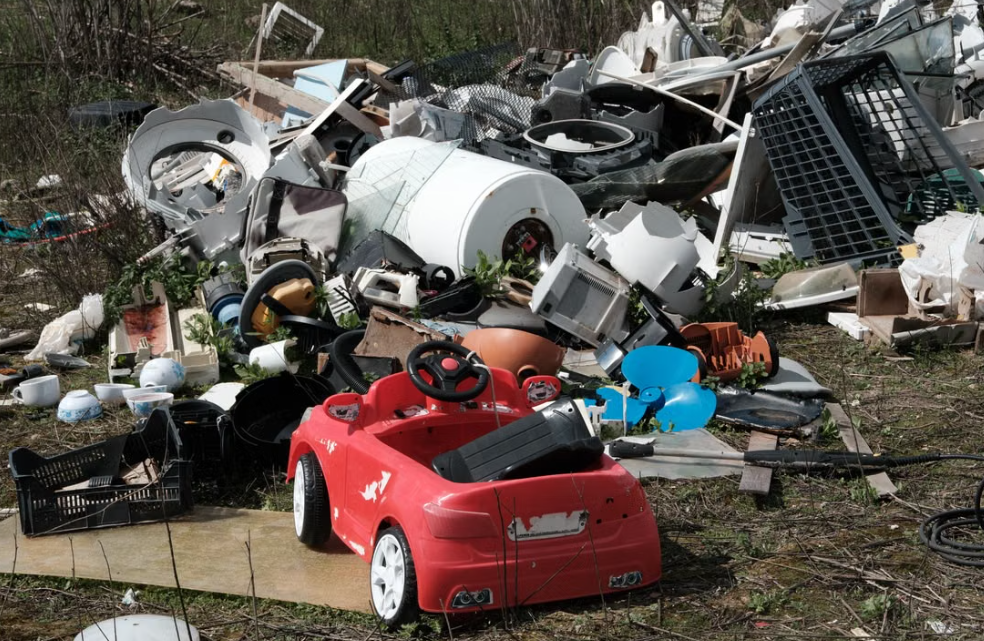
Jerome sometimes takes a pickup-truck load to a landfill after a cleanout. That experience reflects a real endpoint for some items, not a universal instruction about what belongs there. The decision must still follow the rules of the facility and the material involved.
Compare the Four Routes With One Decision Card
For an uncertain item, record:
- Owner: Who can authorize release?
- Identity: Brand, model, material, age, and contents.
- Safety: Recall, damage, missing parts, contamination, or unknown history.
- Privacy: Data, labels, accounts, documents, or removable media.
- Condition: Clean, complete, functional, repairable, or end-of-life.
- Recipient: Named person, organization, buyer market, or authorized program.
- Cost: Fees, effort, storage, transport, and risk.
- Deadline: The date the chosen route will be completed or reconsidered.
Then choose the most defensible route, not the most flattering label. A donation with no accepting organization is not yet a route. A sale without a deadline is storage. “Recyclable” without a program is an assumption. A discard bag that contains batteries or chemicals is an unresolved safety decision.
Finish the Exit
Label outgoing items with the destination and date: “Family pickup — Sunday,” “Used shop — confirmed clothing acceptance,” “Electronics recycler — Saturday,” or “Household hazardous waste — appointment required.” Keep receipts or recall confirmations when they may matter.
If a recipient declines, a listing expires, or a program will not accept the material, return to the decision card rather than leaving the item indefinitely. The next route may be another verified organization, a lower sale price, an authorized recycler, special disposal, or ordinary waste.
Decluttering is complete only when the item reaches a responsible destination. The aim is not to keep everything out of the rubbish at any cost. It is to preserve genuine usefulness where possible, recover materials where practical, protect people and information, and accept disposal when it is the honest final route.
FAQ
How do I know whether something is good enough to donate?
Confirm that it is safe, not recalled, clean, complete enough to use, and within the recipient’s current acceptance rules. Assess it from the receiver’s side and disclose defects. If the organization says no, choose another responsible route.
Is it better to sell or donate valuable items?
Compare the likely net sale return with fees, preparation, messages, transport, storage time, and risk. Sell when the return justifies that project. Donate when a suitable recipient values the item and the simpler handoff better fits the household’s priorities.
Can I donate broken appliances for repair?
Only when a named organization explicitly accepts that appliance and condition. Do not assume a charity can diagnose, repair, transport, or dispose of it. Disclose the defect and verify recall status first.
What should I do with a recalled product?
Stop using it as directed and follow the official recall notice. Do not donate, give away, or sell it unless the official remedy has been completed and transfer is lawful and safe in the relevant jurisdiction.
Can electronics go in household recycling?
Do not assume they can. Check an authorized local electronics, retailer take-back, or waste program. Remove personal information and handle batteries according to their chemistry and the program’s instructions.
What if I cannot erase a phone or computer?
Do not pass it to an ordinary buyer or recipient with data intact. Consult current manufacturer guidance or use a qualified data-destruction or electronics program that can explain how the device and storage media will be handled.
Should I throw an item away if no donation centre accepts it?
Reassess whether another verified recipient, sale, repair, recycling, take-back, or special-handling route is realistic. If none is safe and available, correct disposal may be the responsible conclusion rather than transferring the burden.
How long should outgoing items stay in the house?
Set the deadline when choosing the route. Use a specific pickup, listing-expiry, drop-off, or collection date. When the deadline passes, reconsider the route instead of resetting the same vague intention.
Sources
- Find Recalls, Advisories and Safety Alerts — Health Canada
- Buying Second-Hand Products — Health Canada
- Resale and Thrift Stores Information Center — US Consumer Product Safety Commission
- Electronics Donation and Recycling — US Environmental Protection Agency
- Used Household Batteries — US Environmental Protection Agency
- Household Hazardous Waste — US Environmental Protection Agency
- Removing Personal Information From a Computer — US Federal Trade Commission
- Removing Personal Information From a Phone — US Federal Trade Commission