“We might use it later” can sound like a simple statement about an object. In a shared home, it often contains several different decisions. Who expects to use it? How likely is that use? Where will it stay until then? What does keeping it prevent someone else from doing in the same space?
Jerome hears versions of this conversation when his household sorts accumulated belongings. He, his wife, and their children may look at the same item and assign different value to its possible future use. Often, an item kept for “someday” does not end up being used. That observation can inform the next discussion, but it does not give one family member permanent authority to decide for everyone else.
Shared-home decluttering becomes difficult when an item decision is treated as a verdict on the person who owns it. A request to clear a table can be heard as criticism of someone’s habits. A wish to keep an object can be treated as proof that the person will never let anything go. Neither conclusion is needed to solve the space problem.
The practical work is to separate ownership from shared-space impact. People retain meaningful control over their own belongings, while everyone who uses a common area needs a workable way to decide what the area must support and how much private storage can extend into it.
Quick decision: Before sorting, label items as personally owned, jointly owned, assigned to a child, supplied by a landlord or employer, borrowed, or ownership unclear. Let the owner decide personal items within agreed safety and space limits. Use a shared standard for common areas. Put disputed or absent-owner items in a bounded, dated holding area. Do not donate, sell, or discard another person’s property merely to complete the room.
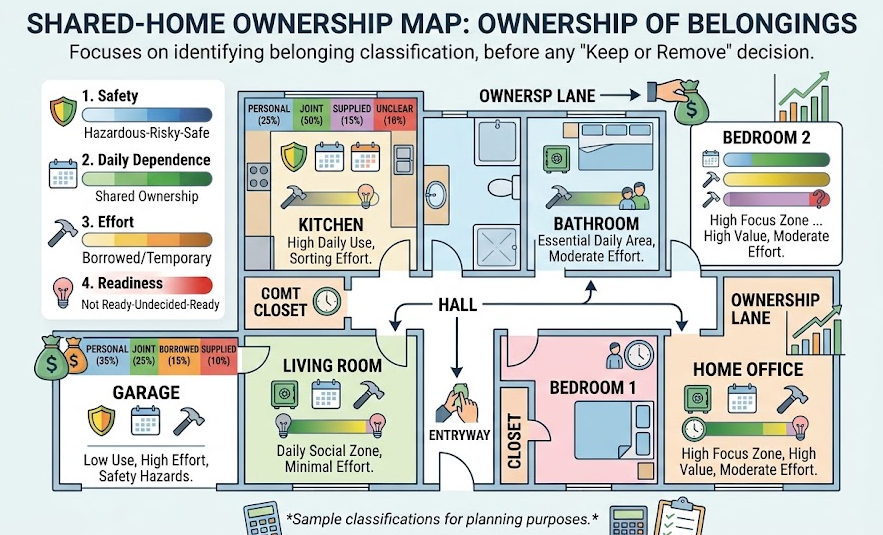
Classify Authority Before Classifying the Item
A “keep, donate, sell, recycle, discard” system begins too late when several people live together. The first category is decision authority.
Use these labels:
- Personally owned: acquired, received, or clearly assigned to one person.
- Jointly owned: purchased together, gifted to the household, or used as shared property.
- Child’s belongings: owned or meaningfully used by a child, with adult responsibility for safety and care.
- Borrowed or stored for someone else: belongs to a person outside the household.
- Supplied property: belongs to a landlord, employer, school, care provider, or other organization.
- Ownership unclear: history or agreement is uncertain.
The label may not settle every legal question. Property, marriage, tenancy, inheritance, separation, guardianship, and employment rules vary. If ownership affects money, legal rights, housing, an estate, or a dispute, preserve the item and seek appropriate local advice rather than making the decluttering session decide it.
For ordinary household work, the classification still prevents a common mistake: assuming that physical access creates authority. Finding an item in a shared basement does not make it available for disposal. Paying for the home does not automatically make every possession inside personally disposable. Being the person doing the cleaning does not transfer ownership.
Agree on What the Shared Space Must Do
Common areas need standards because one person’s storage changes another person’s use of the same room. The standard should describe function rather than personality.
Compare these two statements:
- “You leave too much stuff in the hallway.”
- “The hallway needs a clear route from the bedrooms to the exit, and the closet door needs to open fully.”
The second statement gives the household something observable to solve. It does not require agreement about whether anyone is messy.
Define each shared area’s minimum function:
- entry doors, stairs, windows, and essential routes remain safely accessible;
- kitchen surfaces needed for food preparation can be used and cleaned;
- the dining table supports the activities the household has assigned to it;
- seating remains available to the people who live there;
- bathroom and laundry fixtures can be reached;
- heating equipment, electrical panels, shutoffs, alarms, and mobility equipment remain unobstructed; and
- agreed storage boundaries are respected.
Safety requirements are not bargaining tokens. A blocked exit, unstable stack, inaccessible utility, spoiled food, pest condition, or hazardous material needs direct action. The household can still preserve ownership while moving an item temporarily to a safe, documented location.
Beyond safety, there may be several workable standards. One household may keep hobby materials in the dining room because the table is used mainly for projects. Another may need it clear for daily meals. The article cannot decide that purpose from outside the home; the people sharing the space need to name it.
Give Personal Storage a Visible Boundary
Shared-space conflict often persists because no one knows where personal discretion ends. A person may believe their objects occupy only a small part of the room, while others experience the entire surface as unavailable.
Use a physical boundary that everyone can see:
- one shelf in a shared bookcase;
- one basket near the entry;
- one section of a coat closet;
- one cabinet for hobby supplies;
- one drawer for each household member; or
- one labelled container for current projects.
Within that boundary, the owner can usually decide what stays, provided it does not create a safety, sanitation, legal, or property-damage issue. When the boundary is full, the next decision belongs to the owner: reduce the contents, move them into their own available storage, or ask the household to renegotiate the space.
Equal volume is not always equitable or practical. A person with medical supplies, adaptive equipment, work gear, school materials, religious items, or caregiving responsibilities may reasonably need different space. The agreement should reflect actual household needs rather than use identical containers as a substitute for discussion.
Replace “Keep or Go?” With a More Complete Future-Use Test
When Jerome’s family says an item may be used later, the useful next step is not to dismiss the claim. It is to make the proposed future more specific.
Ask:
- Who expects to use it?
- For what identifiable activity or event?
- Is anything else needed before that use can happen?
- Would the person know where to find it?
- How much space and care will it require until then?
- What review date fits the claimed use?
- What will happen if the expected use does not occur?
This turns “someday” into a testable plan without requiring the owner to prove affection or defend their character. Seasonal equipment may deserve a review after its next season. A project material may need a date tied to the project. A spare part may be reasonable if the household still owns the compatible equipment and can identify it.
Not every retained item needs a deadline. Important records, emergency supplies, heirlooms, specialized equipment, and durable items for infrequent events may have valid long horizons. The question is whether the household understands why the item stays and where it belongs.
Use a Holding Area Without Turning It Into Permanent Storage
Some decisions cannot be made during the session. The owner may be away. Two people may share ownership. A child may need time. The household may need to verify whether an item belongs to the rental property or another family member.
Use a temporary holding system with four fields:
- item or container description;
- person or people who must decide;
- the missing information or question; and
- review date.
Set a fixed capacity. The holding area should not expand every time a conversation is uncomfortable. When it is full, resolve earlier items before adding more.
Temporary relocation should also be traceable. Photograph the item in place if location matters, label the container, and tell the owner where it moved. Do not hide belongings to create the appearance of agreement. If an item must move immediately for safety, document that reason and preserve it unless authoritative instructions require another action.

Talk About One Decision Layer at a Time
Decluttering conversations become harder when several disputes merge:
- whether the item is useful;
- whether it belongs to one person or the household;
- whether the shared room can hold it;
- whether money could be recovered;
- whether it carries a memory; and
- whether one person feels they do more household work.
All of those concerns may matter, but they do not need to be resolved through one object.
Begin with the narrowest question: “Can this stay on the shared table after tonight?” If the answer is no, the next question is where the owner’s item can wait safely. Whether the item should ultimately be kept can remain the owner’s decision. A larger disagreement about labour, spending, or respect deserves its own conversation rather than being settled by a donation bag.
Use descriptions that another person could verify:
- “These boxes prevent the closet door from opening.”
- “The donation pickup is Saturday, and this bag is not labelled with an owner.”
- “We agreed that current school papers would fit in this tray.”
- “I need to know before Friday whether this is part of the landlord’s equipment.”
Avoid assigning motives such as “You do not care about the house,” “You keep everything,” or “You are just trying to control the space.” Motives are difficult to prove and often make the next physical decision less clear.
Set Decision Rules Before the High-Conflict Item Appears
A household agreement works better when it is written before someone is holding an object they value.
A short agreement can cover:
- who decides personal items;
- what counts as jointly owned;
- which spaces must remain clear;
- each person’s personal storage boundaries;
- how absent-owner items are handled;
- how long the holding area can wait;
- which decisions require unanimous agreement;
- what happens when an outgoing deadline passes; and
- which safety conditions allow temporary movement without prior discussion.
For jointly owned items, choose the approval threshold in advance. A conservative rule is that donation, sale, or disposal requires agreement from every owner, while temporary safe storage can proceed if the location is documented. Households may choose another lawful rule, but silence should not automatically become consent.
Money can change the discussion. If a shared item may be sold, agree on the price, listing effort, deadline, expenses, and use of proceeds before it leaves. Do not let the person who does the listing silently acquire full authority over the item or money unless that was the agreement.
Include Children Without Making Them Responsible for the Whole Project
Children’s participation should grow with their understanding and the decision involved. The UN Convention on the Rights of the Child establishes a broad principle that children capable of forming views should be able to express them in matters affecting them, with those views given weight according to age and maturity. This article applies that principle as a respectful household boundary, not as a legal ruling about ownership in a particular jurisdiction.
Offer choices a child can understand:
- select favourite toys within a defined storage space;
- identify clothes that fit and are comfortable;
- choose which outgrown items may be offered to a known younger child;
- separate active interests from projects no longer pursued; and
- help label a memory container without deciding every family keepsake.
Avoid using speed, surprise, shame, or a threatened mass disposal to force choices. Do not ask a child to manage adult storage or solve the household’s entire space shortage through their possessions. Adults still handle safety, hygiene, legal requirements, transport, and realistic space limits.
A very young child may make better choices between a few visible options than in front of every toy they have owned. An older child or teenager may need private time and a clear deadline. If an item is dangerous, recalled, contaminated, or unsuitable, the adult safety decision remains direct even while the reason is explained.
Handle Absent Household Members Deliberately
Travel, university, military service, hospitalization, elder care, separation, and changes in residence can leave possessions behind. The person who remains in the home still needs usable space, but absence does not automatically surrender ownership.
Inventory the items at a practical level, contact the owner through an appropriate channel, explain the space constraint, and offer realistic options with dates. Those options might include collection, shipping at an agreed cost, one bounded storage allocation, or another lawful arrangement.
If the owner cannot be reached or the situation involves tenancy, separation, death, incapacity, abandonment, or legal process, local rules may control notice, storage, access, and disposal. Preserve records and obtain qualified advice. A household article cannot supply a universal abandonment deadline.
Know When the Decluttering Session Should Stop
Stop the item decision when:
- ownership is disputed;
- someone withdraws consent to release a jointly owned item;
- the conversation becomes threatening or coercive;
- legal, estate, tenancy, separation, or capacity questions arise;
- the item may be evidence or an essential record;
- safety cannot be maintained during movement; or
- a child or adult is being pressured to make decisions they do not understand.
Restore the room as far as possible without disposing of disputed property. Use the documented holding area, preserve safe access, and arrange the next appropriate conversation or professional help.
If conflict about possessions is part of intimidation, financial control, destruction of property, threats, or fear in the home, the priority is personal safety rather than a better sorting method. Seek suitable local support through a safe channel.

A Shared-Home Decluttering Session
Before the session:
- Choose one shared zone and describe its required function.
- Mark personal, joint, borrowed, supplied, child, and unclear belongings.
- Confirm the personal storage boundaries and holding capacity.
- Agree on which decisions can happen today.
- Prepare labels for owners who are absent.
During the session, let owners decide their items within the agreed limits. Move room-to-room items in one delivery round. Route only authorized outgoing items. Record unresolved questions instead of treating delay as consent.
At the end, the shared area should support its agreed function, personal belongings should remain traceable, and every unresolved item should have an owner, question, location, and date.
The goal is not unanimous taste. People can prefer different levels of visible possession and still share a workable home. The durable result is a household that knows which choices are personal, which are shared, and how to proceed without using decluttering as permission to overrule one another.
FAQ
Can I throw away my partner’s belongings if they have not used them for years?
Not simply because they appear unused. Preserve the belongings, identify ownership, describe the shared-space impact, and request a decision within a reasonable process. Legal rights vary, especially during separation, tenancy disputes, or incapacity.
What if another person refuses to declutter anything?
Focus first on required safety and the function of shared areas. Negotiate visible personal-storage boundaries and a dated holding process. The other person may control their belongings, but that does not automatically grant unlimited use of common space.
How should we divide storage fairly?
Begin with the room’s function and each person’s actual needs. Equal containers may work, but medical, adaptive, work, school, caregiving, or other needs may justify different allocations. Make the boundaries visible and reviewable.
Should children decide what happens to their old toys?
Include them in a way that fits their age and understanding. Offer manageable choices and clear space limits. Adults retain responsibility for safety and should not pressure children to solve an adult household-storage problem.
What do I do with belongings left by someone who moved away?
Inventory them, contact the owner, explain the space constraint, and offer documented options and dates. Tenancy, separation, estate, incapacity, or abandonment rules may apply, so do not assume absence permits disposal.
How long should disputed items stay in a holding box?
Set a review date based on the missing decision and the person’s availability. The holding area needs a fixed capacity. A deadline should trigger another decision process, not automatic disposal when ownership or consent remains unresolved.
What if a shared item could be sold?
Agree in advance on ownership, minimum price, costs, listing effort, deadline, handoff, and use of proceeds. Do not list or sell jointly owned property based on one person’s assumption.
When should we get outside help?
Seek appropriate help when safety, coercion, severe conflict, legal ownership, tenancy, an estate, incapacity, hazardous conditions, or an unmanageable volume exceeds an ordinary household agreement. The right source may be legal, housing, safety, health, mediation, or community support.