A cleared shelf can show that a decluttering session worked. It cannot yet show whether the household changed the decisions that filled the shelf.
That leads to a more useful question than “How much did we remove?”: What would cause the same category to return?
Jerome reaches this conclusion after the seasonal cleanouts his household does in Canada. Once or twice most years, unwanted or worn items can still fill the back of his pickup truck. The house feels cleaner afterward, yet possessions accumulate again. For him, the larger lesson is that removing things matters, but preventing unnecessary things from entering may matter even more.
Prevention does not mean refusing every purchase, gift, replacement, or opportunity. Homes change. Children grow. Winter damages equipment. Work, health, hobbies, and family responsibilities create new needs. The goal is to distinguish those needs from a purchase that recreates the same storage and exit work without solving the earlier problem.
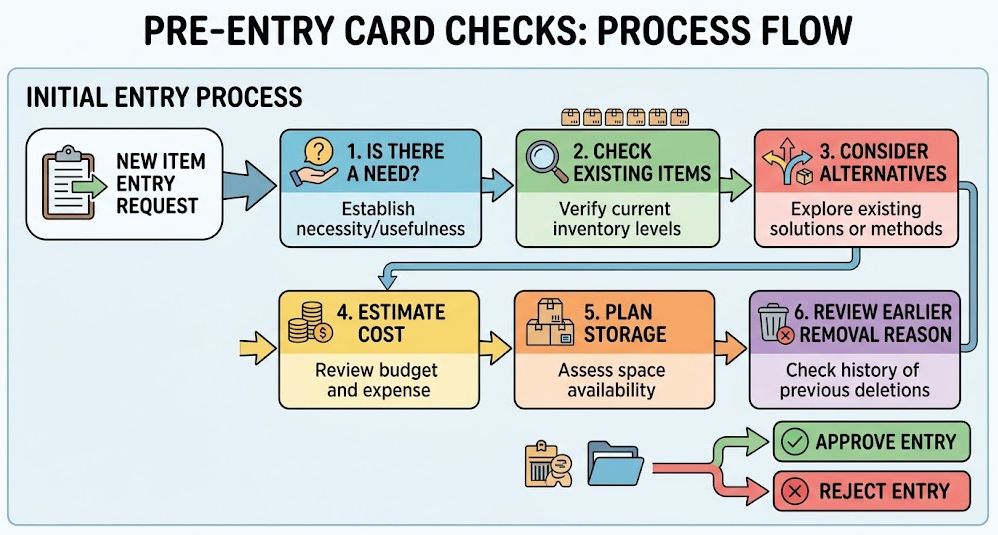
Quick decision: When a category is decluttered, record why its items left and how much space remains. Before another item enters, check what the household already owns, name the specific need, decide whether borrowing, repair, substitution, or waiting would meet it, and identify the item’s home. Use capacity and replacement rules for recurring categories. Allow intentional exceptions when the need has genuinely changed.

Record Why the Category Left
An item leaving the home contains information. If that information disappears with the item, the next buying decision starts from zero.
Use a short exit reason:
- duplicate;
- could not be found when needed;
- wrong size, fit, or compatibility;
- uncomfortable or difficult to use;
- poor quality or failed early;
- bought for an activity that did not continue;
- accepted free without a defined use;
- kept after the life stage changed;
- repair never completed;
- consumable expired before use;
- subscription or repeat order exceeded actual use; or
- no workable storage location.
The reason should guide the next decision. If three kitchen tools left because they performed the same task, a new version needs to replace a known function rather than join the group. If clothes left because their fit was wrong, a discount on the same cut does not address the problem. If supplies expired, a larger package may reduce the unit price while increasing waste.
Do not turn the record into a permanent inventory of every discarded object. Track patterns at the category level: “We removed four open cleaning products because we could not see what we had,” or “Most hobby supplies left because the activity had no scheduled time.” The useful record explains the failure mode.
Check the House Before Checking Out
Repeated purchases often begin with incomplete visibility. The item exists, but it is stored under another name, in another room, behind a full shelf, or inside a project box.
Before buying:
- Check the category’s assigned home.
- Search likely secondary locations.
- Ask the relevant household member.
- Confirm size, model, quantity, and condition.
- Put the existing item where it can be found next time.
A household list can help for categories that are expensive, easy to duplicate, or distributed across locations: tools, cables, travel adapters, seasonal gear, pantry reserves, children’s next-size clothing, spare parts, and event supplies. The list does not need to include every spoon. Use it where a short check is cheaper than another purchase.
If the existing item cannot be found within a reasonable search, buying a replacement may be necessary. Record that outcome. The prevention lesson may be better location and labelling, not a rule against replacement.
Define the Need Without Naming the Product
“I need a storage bin” already assumes the answer. A more useful statement describes the problem: “Current winter gloves need one visible location near the door.” That problem might be solved by reducing duplicates, repurposing an existing basket, changing the shelf, or buying a suitable container after measuring.
Describe:
- the task or result;
- who will use it;
- when and how often;
- required size, fit, compatibility, or performance;
- where it will live;
- what existing item it replaces or complements; and
- what would make the purchase unsuccessful.
This matters for aspirational purchases. A new exercise tool, craft kit, book series, kitchen appliance, or repair project can represent a desired future. The future may be realistic, but the product does not create the time, skill, space, or routine by itself. Connect the purchase to a scheduled activity or a small first step.
If the activity can begin with what is already available, begin there. The later purchase will be based on actual use rather than imagined identity.
Use Waiting Time to Improve the Decision
A waiting period creates room for inventory checks, measurements, comparison, and the possibility that the need passes. It should match the decision rather than become a universal number.
Examples:
- consumable refill: wait until the open supply reaches a defined level;
- clothing: check fit and existing combinations before removing tags;
- hobby equipment: complete a trial, lesson, rental, or first project;
- furniture: measure the room, route, and existing storage;
- sale item: compare the final price, return terms, and expected use after the promotion ends;
- online cart: leave long enough to review the household need outside the shopping session.
Urgent safety, health, school, work, weather, caregiving, and replacement needs may not allow delay. The rule is not “wait before everything.” It is “use time when time can reveal something important.”
Avoid using the waiting period only to watch for a lower price. A cheaper version of an unnecessary item still recreates the category. Review the need before the deal.
Give the Category a Capacity
Storage capacity can act as a visible purchasing limit. The container, shelf, rail, drawer, or floor area represents the amount the household can maintain and retrieve.
Set capacity after accounting for real use, seasonal variation, accessibility, and reserve needs. Then choose a rule:
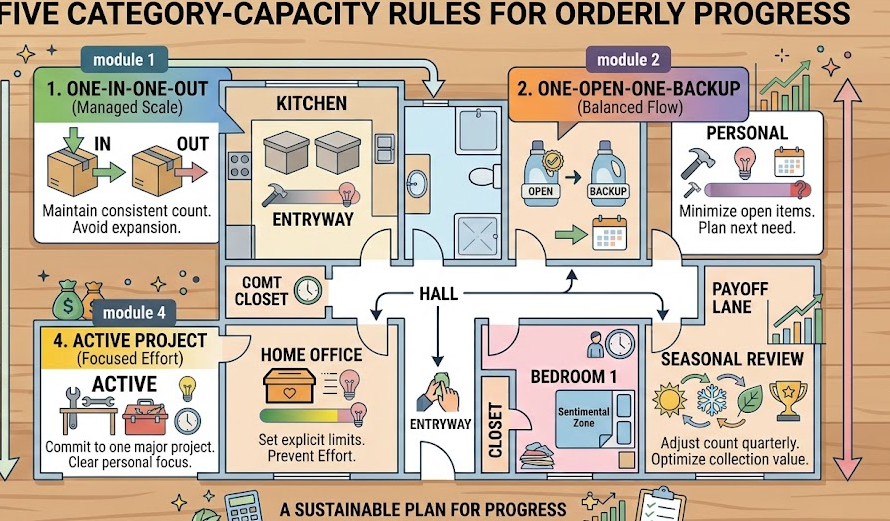
- One in, one out: useful for stable categories where the new item replaces a comparable one.
- One open, one backup: useful for some consumables with predictable use and supply access.
- Fixed container: new items enter only if the category still fits and remains findable.
- Project capacity: supplies stay within one active-project area; a new project waits or another closes.
- Seasonal review: capacity changes when winter, school, travel, or children’s sizes change.
Capacity is not a moral limit. Medical supplies, emergency reserves, adaptive equipment, work materials, cultural or religious items, and goods bought in response to access or price instability may require different rules. A small home may also need stricter physical boundaries without implying that its residents should own less than they need.
Use Replacement Rules That Address the Old Failure
“One in, one out” prevents category growth, but it does not guarantee a better replacement. Use the removal reason as a specification.
If the old item was:
- hard to clean, check maintenance requirements;
- uncomfortable, test fit or ergonomics where possible;
- incompatible, verify model numbers and dimensions;
- rarely used, consider borrowing, renting, or sharing;
- repeatedly repaired, compare repairability, warranty, parts, and expected use;
- too specialized, choose a more versatile alternative only if it performs the necessary task;
- forgotten in storage, assign the location before purchase.
EPA guidance encourages checking what is already available, reusing supplies, and sharing some infrequently used equipment. These are options, not commands. Borrowing is unsuitable when availability, hygiene, safety, fit, liability, or repeated use makes ownership more practical.
A replacement can also be an upgrade, not a failure of decluttering. If the household learned that the old version did not meet a genuine need, a carefully chosen new item may prevent several compromises or repeat purchases.
Add Friction Where the Category Repeats
The best purchasing check is easy to perform at the moment the pattern occurs.
Possible friction points include:
- keep measurements and model numbers with the shopping list;
- store category photos or counts in a shared note;
- remove saved carts after the need is met;
- unsubscribe from category-specific promotions after a project ends;
- disable automatic repeat delivery when consumption is uncertain;
- require a named storage location before ordering;
- use a shared approval rule for jointly funded or shared-space items;
- return unsuitable goods during the actual return window rather than storing them “for later.”
Friction should improve judgment, not create punishment or surveillance. A household spending agreement should not give one person hidden control over another adult’s lawful personal purchases. Shared-money and shared-space rules need mutual agreement; personal discretion can remain within those boundaries.
Treat Free Items as Items
No purchase price does not mean no cost. A promotional item, hand-me-down, giveaway, sample, curbside find, conference item, gift bag, or “included” accessory still needs storage, cleaning, maintenance, attention, and an eventual exit.
Use the same test:
- Is there a specific use?
- Would we choose it if the price were not the main feature?
- Is it safe, clean, complete, and lawful to take?
- Does it duplicate something we prefer?
- Where will it live?
- What happens to the item it displaces?
Declining a free item does not reject the giver. A brief “Thank you, but we do not have a use or place for it” protects both parties from a transfer that is unlikely to help.
For gifts, preferences can be shared before occasions: consumables the household actually uses, experiences, contributions toward a known need, or no gift. The giver still controls what they offer, and the recipient retains the right to decide what enters and remains in the home.
Audit Subscriptions and Automatic Deliveries
Physical clutter can arrive through a digital agreement made months earlier. Refill programs, product boxes, memberships with merchandise, samples, and free trials may continue after consumption or interest changes.
List:
- product and delivery frequency;
- current on-hand quantity;
- actual rate of use;
- next charge and shipment;
- skip, change, and cancellation process; and
- any minimum term or fee.
The US Federal Trade Commission advises consumers to understand trial and renewal terms, know how and when to cancel, and note the deadline before charges begin. Rules and remedies vary by jurisdiction, but the operational lesson is broad: an automatic inflow needs an active review point.
Do not solve overstock only by finding more storage. Pause, reduce, or cancel the inflow when the household already owns more than it can use safely within the relevant time.
Separate the Price From the Total Decision
A discount can answer “Is this cheaper than usual?” without answering “Do we need it?” Compare total cost, including mandatory fees, delivery, accessories, maintenance, storage, energy, disposal, and return difficulty.
The Competition Bureau Canada describes drip pricing as advertising a price that cannot be obtained because mandatory additional charges are added. Whatever the jurisdiction, use the final payable amount rather than the first displayed price when evaluating the purchase.
Bulk buying also requires a full calculation. Lower unit cost helps only if the household will use the quantity, can store it correctly, and is not tying up money or space needed elsewhere.
Create an Exception That Remains Intentional
Rigid rules fail when life changes. A previously removed category may need to return because:
- a child reaches a new size or stage;
- a disability, diagnosis, injury, or caregiving role changes requirements;
- work or school begins;
- weather or emergency preparation changes;
- a household member takes up a sustained activity;
- a replacement is safer, more accessible, or more efficient;
- the family moves to a home with different functions; or
- an earlier decluttering decision proved mistaken.
An exception is intentional when the household can name the changed need, choose a location, and decide what rule applies afterward. It does not require guilt or a defence of the earlier decision. New information can justify a new choice.
Build One Rule From Each Decluttering Session
At the end of a session, ask:
- Which category produced the most outgoing items?
- Why did those items enter or remain?
- What one check would have prevented the least useful inflow?
- Where should that check appear next time?
The answer might be “measure before buying storage,” “check the cable drawer,” “one active craft project,” “no automatic refill until one backup remains,” or “ask the intended recipient before accepting children’s items.”
Use one rule long enough to see whether it works. If it blocks legitimate needs, revise it. If it is constantly bypassed, move the check closer to the purchase moment or simplify it.
Jerome’s repeated truckloads do not mean the cleanouts failed. They reveal that exit work alone cannot control everything entering a changing household. A durable system keeps the useful freedom to buy, replace, receive, and grow while making repeated, low-value inflow easier to recognize before it needs another trip out.
FAQ
Is rebuying something always a decluttering failure?
No. Needs, bodies, work, seasons, homes, and interests change. Rebuying is reasonable when the need is real, the new item addresses the old failure, and it has a workable place and use.
How long should I wait before buying something?
Use enough time to reveal relevant information: inventory, measurements, compatibility, total cost, or whether interest continues. Urgent safety, health, work, school, caregiving, and replacement needs may require immediate action.
Does one-in, one-out work for every category?
No. It fits stable categories with comparable items. Consumables, children’s sizes, emergency supplies, medical equipment, work materials, and seasonal goods may need different capacity rules.
What if I decluttered too aggressively and need the item again?
Use that outcome as new information. Identify what need was underestimated, choose a suitable replacement, and adjust the category rule. The goal is better judgment, not defending every earlier decision.
How do I stop buying duplicates?
Give the category one visible home, keep a short list or photo where duplication is costly, and check the household before checkout. If items remain hard to find, improve location and labelling rather than relying only on memory.
Should I refuse all free items and hand-me-downs?
No. Apply the same need, condition, duplication, and storage test used for purchases. Accept useful items intentionally and make it easy to decline items that do not fit.
How often should I review automatic deliveries?
Review whenever on-hand quantity exceeds the planned reserve, usage changes, or renewal terms change. Record the next charge or shipment and any cancellation deadline when signing up.
Can storage containers prevent clutter from returning?
They can make a category visible and set capacity, but they cannot decide what should enter. Reduce and group the category first, measure it, then buy storage only if the remaining need is clear.
Sources
- What You Can Do — US Environmental Protection Agency
- Getting In and Out of Free Trials, Auto-Renewals, and Subscriptions — US Federal Trade Commission
- Drip Pricing — Competition Bureau Canada