A pantry can be full and still make dinner harder. Pasta sits behind baking supplies, three open bags of rice occupy different shelves, and a large package bought at a good unit price becomes invisible before the household finishes it. More space can delay the moment when this problem becomes obvious.
The useful question is not how many matching containers fit on a shelf. It is whether the pantry helps the household see what it has, reach what it uses, and notice what should be eaten before buying more.
From Jerome, EverydayWise Contributor
After moving from Korea to Canada, I began cooking much more and inviting people to our home more often. Restaurant meals were expensive, and home was more comfortable for long conversations. A larger house and a pantry made it seem reasonable to buy more ingredients, especially large packages from Costco. I assumed we would eventually eat or use them. Instead, the shelves became difficult to manage. I have found old food in the freezer, tools we never used, and potatoes and carrots that sprouted or softened before we finished them. Once, liquid from spoiled produce spread across the pantry floor. When seasonings, snacks, and extra packages had no defined areas, we could not stack efficiently or see what needed attention.
The passage above comes from an EverydayWise contributor’s household experience. It shows why pantry capacity and household consumption are different limits. A larger shelf can hold a bigger purchase, but it cannot create more meals, improve the storage environment, or remind someone to use an item.
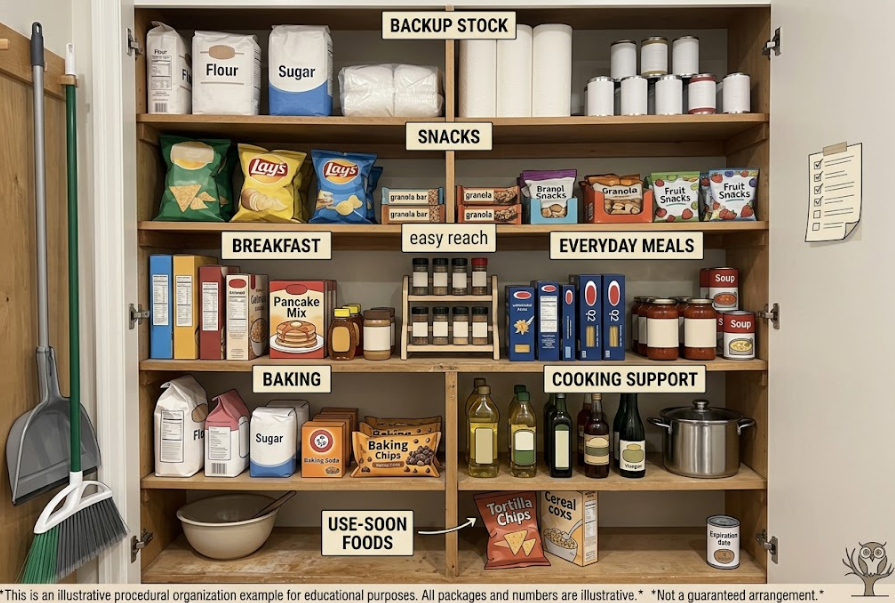
Quick decision: Divide the pantry by repeated household use: everyday meal building, breakfast, snacks, baking, cooking support, backup stock, and food needing earlier attention. Put frequent items between roughly knee and shoulder height, keep heavy and spill-prone items low, give each category a capacity boundary, and create one visible “use soon” area. Adjust the zones to real meals rather than copying a generic pantry picture.
Begin With Meals, Not Containers
Buying bins before understanding the pantry usually preserves the existing confusion in newer packaging. Start by observing how food leaves the space.
For several ordinary days, notice:
- which ingredients are used almost every day;
- which foods are usually taken together;
- which shelf requires repeated bending, reaching, or moving other items;
- which packages are opened twice because the first one could not be seen;
- which products are bought again while another remains at home;
- which items are intended for guests, holidays, or occasional projects; and
- which foods repeatedly expire, stale, sprout, leak, or attract pests.
This short observation distinguishes storage volume from service. Flour may deserve a large container because it is used weekly in one home. In another, the same container would preserve an aspirational baking category that blocks access to dinner ingredients.
Do not empty the entire pantry until there is a plan for the food and enough time to restore the space. Work one shelf or one use category at a time. Keep food away from the floor and from cleaning products while sorting.
Create Zones That Match Household Use
A practical pantry may use six or seven zones. The names should reflect the household’s real routines.
Everyday meal building
Place frequently used grains, pasta, canned vegetables, beans, sauces, and other dinner foundations where the main cook can see and reach them. Group foods that can substitute for one another close enough to compare. If several cuisines are cooked regularly, a small meal-family grouping may work better than separating every ingredient by package type.
Breakfast and packed meals
Keep cereal, oats, spreads, shelf-stable lunch items, and commonly packed foods together when this reduces morning searching. Items needing refrigeration still belong in the refrigerator; the zone organizes only their pantry partners.
Snacks
Use a bounded area rather than allowing snack packages to fill gaps across every shelf. Households with children can place approved self-serve foods within reach while keeping choking hazards, supplements, alcohol, caffeinated products, allergens, and adult-only items according to the household’s safety needs.Article”How to Create a Snack Station” will cover snack-station design in detail.
Baking and project cooking
Flour, sugar, leaveners, decorations, specialty pans, and infrequently used ingredients can share a zone if they are usually used together. Give the category less accessible space when it is occasional. The size of the zone should reflect current practice, not the number of projects someone hopes to begin.
Cooking support
Oils, vinegars, spices, broths, and frequently used condiments need convenient access, but not every product belongs beside heat. Follow the label and keep foods away from conditions that shorten quality or damage packaging. Use a tray for bottles likely to drip so one leak can be removed without emptying a shelf.
Backup stock
Reserve a defined area for duplicate staples that protect against a missed shopping trip or support known high use. Backup stock should refill the active zone rather than compete with it. If the backup area is full, the pantry has reached its purchase capacity even if another package would technically fit elsewhere.
Use soon
Create one visible location for opened packages, short-dated food, overripe shelf-stable produce, or an ingredient left from a specific recipe. This is not a shame bin. It is a meal-planning queue. Review it before writing the shopping list.
Give the Best Space to the Most Frequent Actions
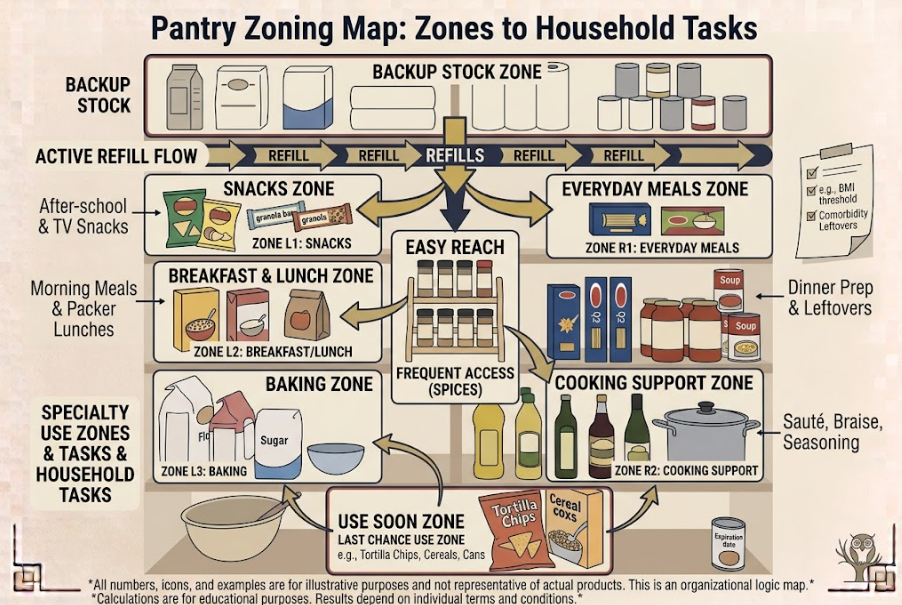
Frequency determines access. Place daily and weekly items in the easiest visual and physical range. Store occasional, lightweight supplies higher. Put heavy cans, large beverage containers, bulk packages, and appliances on lower, structurally suitable shelves.
Avoid storing food or breakable containers where reaching requires unstable furniture or where a falling item could injure someone. Shelf load limits and wall-mounting requirements come from the manufacturer; pantry organization cannot compensate for an overloaded or poorly secured unit.
Visibility matters as much as reach. A deep shelf can use a shallow tray that pulls forward, a riser that reveals the back row, or a turntable for appropriately sized bottles. These tools help only when the category remains bounded. A turntable packed two layers deep simply rotates hidden duplicates.
Use clearances based on the items that belong in the zone. Tall cereal boxes do not need to dictate every shelf height. Adjustable shelves can create shorter spaces for cans and jars, leaving a defined tall area for bottles and bulk packages. Article”Small-Kitchen Storage Ideas That Preserve Access” will address small-kitchen storage structures more fully.
Set a Capacity Before Buying More
Bulk value is real only when the household uses the food while it remains safe and acceptable. A lower unit price does not recover money spent on the portion discarded, nor the space and cleanup it required.
Give each category a physical limit:
- one tray for pasta;
- one shelf section for canned meal components;
- one bin for unopened snacks;
- one container plus one sealed refill for a frequently used grain; or
- one lower shelf for backup packages.
The examples are not universal quantities. The boundary should cover the household’s normal buying interval and consumption rate. A family of four that cooks rice daily needs a different capacity from a person who uses it twice a month.
Before buying a large package, ask:
- How much did we use during the last comparable period?
- Where will the unopened and opened portions live?
- Does the food need a cooler, darker, drier, or better-ventilated place than this pantry provides?
- Can we see and access the older supply first?
- What meal plan will use the quantity?
- Is the unit saving greater than the likely unused portion?
Article”Bulk Food Storage Without Waste” will provide the full bulk-storage and portioning framework. For this article, the pantry rule is simple: a sale does not expand the category’s capacity.
Treat Potatoes, Onions, and Other Produce as Living Inventory
Fresh produce does not become shelf-stable because it is placed in a pantry. Temperature, humidity, light, ventilation, variety, maturity, and damage affect how long it remains usable. Conditions that work for packaged pasta may be unsuitable for roots or bulbs.
University of Minnesota Extension notes that vegetables need different combinations of temperature and humidity and that storage life shortens when home conditions differ from the ideal. Ventilation also matters because harvested vegetables continue to respire. A warm pantry beside an appliance or heating duct may therefore be a poor place for a large bag intended to last weeks.
Use a produce routine:
- check the product-specific storage guidance rather than applying one rule to all vegetables;
- remove produce from packaging that traps damaging condensation when authoritative guidance calls for ventilation;
- keep it in an appropriate dark or low-light location when required;
- inspect it regularly and remove deteriorating items before liquid reaches shelving or other food;
- keep the amount small enough to inspect without lifting several layers; and
- clean and dry the shelf or tray after leakage before replacing food.
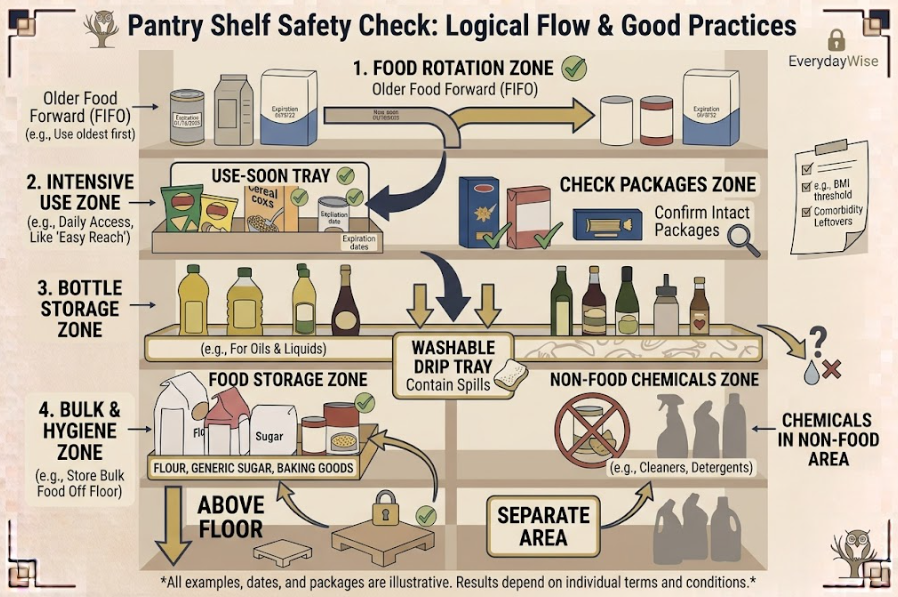
Do not store food directly on a pantry floor. A washable tray or low bin can contain soil and a small leak, but it does not make an unsuitable environment appropriate. If potatoes, carrots, or onions repeatedly deteriorate, buy less or use another recommended storage location rather than adding a larger basket.
Jerome’s discarded potatoes and carrots were not evidence that the foods were a poor value at purchase. The problem was that the package size exceeded both the household’s use rate and the pantry’s ability to preserve and display the produce.
Keep Labels, Dates, and Original Information Available
Decanting can improve access for frequently used dry goods, but it also can remove cooking instructions, ingredient and allergen information, lot codes, and best-quality dates. Do not transfer food merely to make shelves look uniform.
When a container genuinely improves use:
- choose a food-safe container suitable for the product;
- clean and dry it completely before refilling;
- label the contents clearly;
- preserve the relevant date, lot, preparation, and allergen information;
- avoid mixing a new package into old remnants when this hides age or contamination; and
- size the container so the normal purchase fits without leaving an unlabelled partial bag elsewhere.
FoodSafety.gov’s FoodKeeper provides product-specific storage guidance intended to help households maintain freshness and quality. USDA also distinguishes many quality dates from safety deadlines; wording and regulatory meaning vary by product and country. Use package instructions and product-specific authoritative guidance rather than treating every printed date as identical.
For a household managing allergies, separate placement alone is not a complete control. Packaging, labels, utensils, cross-contact, and household practices may all matter. Follow the medical and product guidance appropriate to the allergy.
Use Oldest First Without Turning the Pantry Into a Warehouse
When unpacking groceries, move the older matching product forward and place the new product behind it. Open packages should normally be visible before sealed duplicates. This basic rotation works only if the household can tell the items apart.
Do not create an elaborate inventory database unless someone will maintain it. A simple door list, whiteboard, or phone note can track only the categories most often forgotten or overbought. Record useful distinctions such as “one active, one backup” rather than every teaspoon of food.
Review the pantry before shopping:
- scan the use-soon zone;
- check active staples that are genuinely low;
- look for unopened backups;
- plan one or two meals around food needing attention; and
- add only the amount that fits the category boundary.
The goal is not perfect inventory accuracy. It is enough visibility to prevent routine duplicate buying and neglect.
Protect Food From Leaks, Pests, and Unsafe Neighbours
Clean crumbs and spills promptly. University of Minnesota Extension recommends inspecting packages for damage, using tightly closed glass, metal, or heavy plastic containers for insect-free dry foods, using older products before newer ones, and keeping storage areas clean. If insects appear, identify and address the affected food source rather than relying on unproven repellents.
Keep household cleaners, pesticides, automotive products, and other chemicals out of food zones and according to their labels. Do not place food below a product that could leak onto it. If a package is swollen, leaking, badly rusted, deeply dented at a seam, broken, pest-damaged, or contaminated by an unknown substance, do not taste the food to decide whether it is safe. Follow local food-safety or waste guidance.
Recall checks require the original identifying information. FoodSafety.gov notes that recalls are specific to details such as brand, product name, date, and establishment or lot information. This is another reason not to discard every original package immediately after decanting.
Build a Reset That Fits the Household
A pantry does not need a rigid weekly reorganization. Connect small actions to events that already occur:
- Before shopping: review use-soon food and backup stock.
- After shopping: rotate matching products and resolve packages that do not fit.
- After a spill: empty only the affected area, clean and dry it, and inspect adjacent packaging.
- Before guests or holidays: identify special ingredients already owned before buying more.
- At a seasonal change: review foods bought for the previous season and produce-storage conditions.
- When a category overflows: reduce the next purchase or enlarge the zone only after confirming sustained use.
Shared households need visible zone names. Labels can describe purpose—“Weeknight Meals” or “Lunch Packing”—rather than impose a taxonomy that only one person understands. Ask the people who unpack groceries or prepare food whether the location matches their actions.
A Practical First Reset
Choose one meal-related category that regularly creates friction, such as weeknight grains and pasta.
- Define the shelf boundary and a finish time.
- Remove only that category.
- Set aside damaged food and follow appropriate safety guidance.
- Group unopened duplicates, opened packages, and food needing earlier use.
- Choose an active location and a limited backup location.
- Preserve labels and dates when transferring food.
- Return older usable food to the front.
- Add one item to the next meal plan from the use-soon group.
- Clean the sorting surface and stop before opening another category.
The pantry is improved when the next meal and the next shopping decision become easier. Matching containers, colour-coded labels, and a perfectly filled shelf are optional. Visibility, access, suitable storage, and realistic quantities do the durable work.
FAQ
Should pantry zones be organized by food type or by meal?
Use whichever reduces searching and duplication. Frequently combined foods may work best in meal or task zones, while broad staples can remain in food-type groups. A hybrid system is often practical.
Should I put everything into clear containers?
No. Transfer food only when a container improves protection, access, or portioning. Preserve ingredient, allergen, date, lot, and preparation information, and use a suitable food-safe container.
Where should heavy pantry items go?
Place heavy and spill-prone items on lower shelves that are structurally suitable, without blocking safe access. Follow the shelf manufacturer’s load and anchoring instructions.
How much backup food should I keep?
Base it on normal use, shopping interval, storage conditions, budget, and credible disruption needs. Give backup stock a fixed area; when it is full, buy less rather than scattering overflow.
What should I do with food that has pantry insects?
Isolate and inspect affected dry foods and nearby packages. Discard infested products as local guidance directs, clean cracks and shelves, and protect unaffected food in tightly closed suitable containers. Do not rely on bay leaves or other unproven repellents.
Can potatoes and onions share one pantry bin?
Do not assume they should. Produce items have different storage needs, and home temperature, humidity, light, and ventilation matter. Check product-specific guidance and use quantities your conditions can support.
How often should I reorganize the pantry?
Use event-based maintenance: before and after shopping, after a spill, when a zone overflows, and at seasonal or holiday changes. A full reorganization is unnecessary when small resets keep the system functional.
Sources
- FoodKeeper App — FoodSafety.gov
- Shelf-Stable Food Safety — USDA Food Safety and Inspection Service
- Food Product Dating — USDA Food Safety and Inspection Service
- Harvesting and Storing Home Garden Vegetables — University of Minnesota Extension
- Pantry Pests: Insects Found in Stored Food — University of Minnesota Extension
- Recalls and Outbreaks — FoodSafety.gov