A cookware cabinet can look full even when it contains only a few useful pans. Handles cross, lids slide, and the pan needed for dinner sits under the heaviest pot. The problem is rarely the absence of one perfect organizer. It is the mismatch between the cookware, the storage structure, and the way each item must be retrieved.
Quick decision: Keep frequently used cookware where it can be removed without lifting an unrelated stack. Put heavier pieces in a stable lower location, give lids a restrained upright or shallow-drawer home, and use hanging storage only when the mounting, load rating, clearance, and household safety all work. Before buying another pan or organizer, identify the item’s job and its exact storage position.
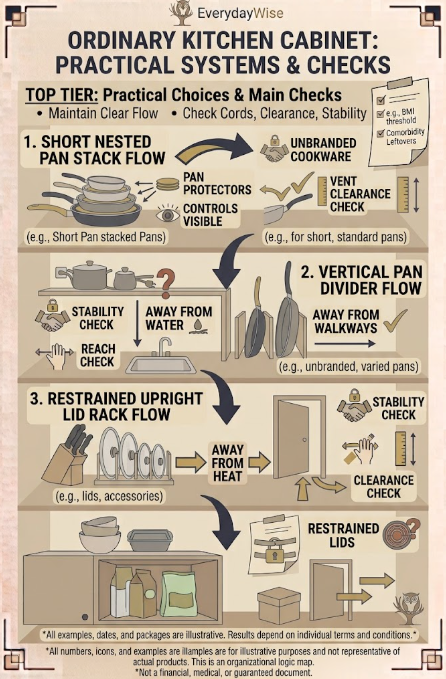
Start With the Retrieval Problem
Do not begin by emptying every kitchen cabinet or ordering a matching rack. Watch what happens during one ordinary week.
For each pot, pan, lid, and piece of bakeware, note:
- how often it is used;
- where it is used;
- whether it is heavy, awkward, sharp-edged, fragile, or easily scratched;
- whether another item must move before it can come out;
- whether it has a matching lid or removable part;
- whether the handle fits the cabinet with the door closed; and
- who needs to lift or reach it.
The repeated interruption is the design clue. If a daily frying pan requires the removal of three occasional stockpots, the stack is serving capacity rather than access. If lids fall whenever a door opens, they need restraint rather than a larger shelf. If a heavy Dutch oven lives above shoulder level because it fits there, the available space is not necessarily a suitable home.
Group cookware by access frequency:
- Daily or weekly: direct retrieval with no unrelated lifting.
- Occasional: one simple move may be acceptable.
- Specialty or seasonal: a clean, suitable secondary location may be more practical.
This first sort also reveals duplicates. Two pans of similar size may serve different purposes, but they should earn their places through actual use rather than the hope that they might be useful someday.
Let Weight and Grip Choose the Height
There is no single safe household weight for an upper cabinet. Risk changes with the object’s weight, shape, grip, starting height, reach distance, body position, repetition, and the person lifting it. NIOSH uses several of these factors when assessing workplace lifting; its equation is not a universal home-storage limit.
Use a household test instead. Can the intended user lift the empty item with two secure hands, keep it close to the body, see the route, and place it without twisting, overreaching, or standing on furniture? If not, move it lower or change the storage method.
Heavy cast-iron cookware, large stockpots, pressure cookers, and nested sets usually belong in a stable lower cabinet, deep drawer rated for the load, or another location that avoids overhead retrieval. Place the heaviest piece low and avoid making it the base of a stack that must be dismantled daily.
Check the complete load, not just one pan. Drawer slides, shelves, dividers, hooks, rails, and pull-outs have limits. Follow the cabinet, hardware, and organizer instructions; cookware weight can add up quickly. A drawer that opens smoothly when empty may sag, bind, or tip a freestanding unit when fully loaded.
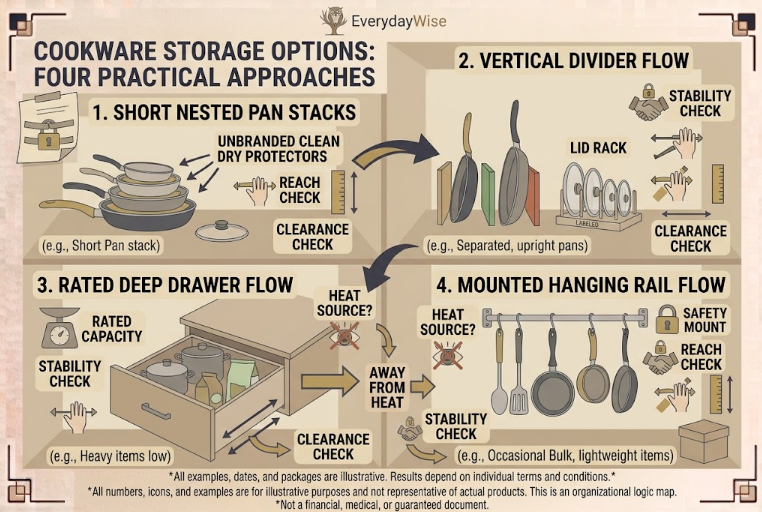
Choose Among Four Main Storage Patterns
Each pattern solves a different problem. The right one is the system that fits the cabinet and reduces the hardest retrieval step.
1. Short nested stacks
Nesting uses little horizontal space and works well when pans are compatible in shape and used at similar frequencies. Keep the stack short enough that the needed pan is not a lifting project. Put the most-used piece at or near the top.
Protect surfaces according to the cookware maker’s care guidance. A clean, dry pan protector or cloth may reduce contact between compatible pieces, but it should not trap moisture or introduce residue. Cookware should be clean and dry before storage. Material-specific care matters: cast iron, carbon steel, nonstick coatings, stainless steel, copper, and enamel do not all have identical needs.
Do not force a lid, handle, or rim into a nest that strains the pieces. A stack that rocks or leans is too tall, poorly matched, or in need of another method.
2. Vertical dividers
Vertical slots let a person pull one frying pan, skillet, baking sheet, or cutting board without lifting the others. They work best when the divider is stable, the slot fits the object’s thickness, and the cabinet has enough height for handles and rims.
Measure the cabinet opening as well as its interior. A pan may fit upright behind the face frame but fail to pass through the opening. Test rounded pans for rolling or leaning, and do not load a lightweight freestanding divider beyond its instructions. A fixed or properly installed system may be needed for heavier cookware.
Vertical storage often helps with baking sheets and cooling racks because these wide, thin items create unstable horizontal piles. Keep sharp-edged accessories restrained and away from a child’s access.
3. Deep drawers or rated pull-outs
A full-extension drawer can bring cookware into view and reduce deep-cabinet reaching. It can hold pans vertically with dividers or in short stacks. The benefit depends on rated hardware, complete extension, handle clearance, and a layout that does not jam when the drawer moves.
Place heavier pieces toward a stable part of the drawer according to its design, and keep handles within the drawer boundary. Test the drawer slowly after loading. If it bows, binds, strikes an adjacent handle, or makes a freestanding cabinet unstable, stop and reassess the load or installation.
4. Wall rails and ceiling racks
Hanging cookware can make individual pans visible and accessible, but it transfers the problem to mounting and clearance. Use only hardware designed for the wall or ceiling structure and the expected load. Follow the product instructions or use qualified installation help when the structure is uncertain.
Check head clearance, walking routes, doors, windows, cabinet operation, and the possibility that a pan could detach or swing. Do not place cookware where someone must reach across a hot burner. NFPA advises keeping combustible objects away from the stovetop; towels, packaging, wooden utensils, and similar items should not join a decorative rack near cooking heat.
Give Lids Their Own Decision
Lids are difficult because they are wide, thin, often breakable, and equipped with knobs that prevent flat stacking. Storing each lid on its pot may be convenient, but it consumes volume and can trap moisture if the pieces are not fully dry. Separate storage usually works better when pots need to nest.
Choose one of these patterns:
- Upright divided rack: useful when each lid is restrained and the rack cannot tip or slide.
- Shallow drawer: keeps lids visible if knobs and handles clear the drawer above.
- Cabinet-door organizer: saves shelf space only when hinges, door load, shelf clearance, and closing motion support it.
- Low bin with vertical files: can work for light lids when the bin pulls forward easily and does not become a loose pile.
- Paired storage: suitable for one or two frequently used pots when both pieces are completely clean and dry.
Arrange lids by diameter or by the pan family they serve. A small label can help when several look alike. If one lid fits several pans, store it with the most frequently used group rather than duplicating cookware to create perfect pairs.
Avoid precarious lid towers and loose glass lids at the edge of a high shelf. Do not use the oven as routine storage. Someone can preheat it without realizing that cookware, plastic parts, paper, or other stored objects remain inside.
Separate Cookware From Sharp Tools and Child Hazards
A lower cookware cabinet is often reachable by children. Pots and lightweight plastic bowls may be acceptable in some households, but heavy lids, glass pieces, blades, mandolines, skewers, and small detachable parts require separate judgment.
CPSC recommends safety latches or locks on cabinets and drawers to help keep children away from knives and other sharp objects. A lock is only one layer: keep sharp tools in a dedicated location, store heavy pieces so they cannot be pulled from an edge, and reassess the arrangement as a child grows or a visitor enters the home.
Do not hide knives between pans or leave a food-processor blade inside an unlabelled bowl. Anyone reaching into the cabinet should be able to see and grasp the cookware without contacting a concealed cutting edge.
Freestanding furniture used for cookware may also require anchoring. CPSC warns that furniture with doors, drawers, and shelves can tip; follow the product’s anchoring instructions and use hardware appropriate to the wall and unit.
Store Clean, Dry, and Complete Items
Organization cannot compensate for cookware put away wet, greasy, or partly assembled.
Before storage:
- Remove food residue and clean the item according to its instructions.
- Dry it completely, including rims, handles, seams, and lid edges.
- Confirm removable parts are present and safe to store together.
- Inspect handles, fasteners, glass, coatings, and electrical cords for damage.
- Leave pressure-cooker, appliance, and gasket storage configurations to the manufacturer’s guidance.
Do not generalize one material’s care routine to every pan. Seasoning, oiling, polishing, stacking, and lid position vary. If the instructions are missing, use the manufacturer’s current care page for the specific line rather than a viral universal “hack.”
Use Jerome’s Baking Equipment Test
From Jerome, EverydayWise Contributor
After moving to Canada, I cooked more and began buying more kitchen supplies. At one point I decided to try baking, something I had never done in Korea, and bought all kinds of equipment. I made dough and baked bread once. Later, the tools were pushed so far into storage that I could barely remember where I had put them.
The passage above comes from an EverydayWise contributor’s household experience. It illustrates a common planning gap: buying for a possible new routine before testing the routine and assigning the equipment a home.
Specialty tools do not need to be rejected simply because they are used occasionally. They do need an honest access level. Keep a small working kit for an activity still being tested. Borrow, rent, improvise safely with suitable tools, or buy one essential item before acquiring the full set. If the activity continues, expand deliberately.
Before bringing in a new pan, appliance, or baking tool, answer five questions:
- What exact task will it perform?
- Does an existing item already perform that task well enough?
- How often is the task likely to occur after the first month?
- Where will the item and all its parts live?
- Can it be retrieved without making daily cookware harder to use?
This is not a mandatory one-in-one-out rule. A growing household or new cooking routine may genuinely need more equipment. The purpose is to connect each purchase to space, use, and retrieval before the cabinet absorbs it.
Build the System With What You Own First
Test the layout before buying organizers:
- Remove one cookware category, not the whole kitchen.
- Clean and inspect the cabinet, shelf, or drawer.
- Separate daily, occasional, and specialty pieces.
- Place heavy items low and daily pieces within direct reach.
- Mock up vertical slots with sturdy temporary dividers that cannot collapse or damage cookware.
- Use a shallow box to test lid orientation.
- Open and close every door and drawer slowly.
- Cook two or three ordinary meals.
Notice every extra motion. Did someone lift a pot to reach a skillet? Did a handle catch? Did the lid rack move? Did a household member avoid the arrangement because bending, gripping, or reaching was difficult?
Only then measure for permanent organizers. Record interior width, depth, height, opening width, hinges, pipes, shelf thickness, and handle clearance. Confirm load ratings and mounting requirements. A product that fits the advertised cabinet width may still fail in the actual opening.
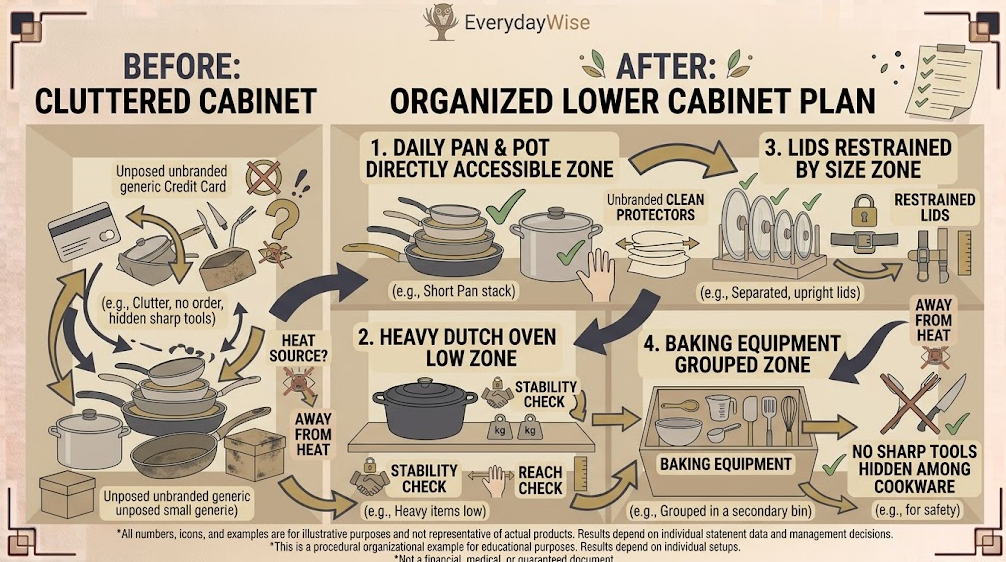
A 20-Minute Cookware Reset
Choose the cabinet or drawer causing the most repeated frustration.
- Remove only the cookware from that location.
- Set aside pieces with damage for manufacturer-guided evaluation.
- Identify the three most-used items.
- Return those items so each can be removed directly.
- Put the heaviest usable item in a stable low position.
- Restrain lids upright or in a shallow layer.
- Move one true specialty item to a labelled secondary location.
- Test the arrangement with the door or drawer fully operating.
The goal is not a showroom cabinet. A good system lets the intended user choose a pan, retrieve its lid, cook, clean, dry, and return both without dismantling the rest of the collection.
FAQ
Is it safe to stack nonstick pans?
Follow the cookware manufacturer’s care instructions. If stacking is permitted, keep the stack short and use a clean, dry protector when recommended so surfaces do not rub. Do not force incompatible shapes together.
Should heavy pots go in a bottom drawer?
Often a low location reduces overhead lifting, but confirm that the drawer, slides, cabinet, and installation are rated for the complete load. The intended user must also be able to bend, grip, and lift safely.
What is the best way to store glass lids?
Use a stable, restrained rack or shallow drawer where lids do not collide, tip, or fall from height. Check knob clearance and avoid loose stacks at shelf edges.
Can I hang pots above the stove?
Avoid any setup that requires reaching across hot cookware or places items in heat, flame, steam, or grease. Mounting must suit the structure and total load, and combustible items should stay away from the stovetop.
Should lids stay on their pots?
They can when the pieces are completely clean and dry and the added volume does not impair access. Separate lid storage is usually more space-efficient when pots nest.
How should I store cast-iron cookware?
Use the manufacturer’s cleaning, drying, seasoning, and stacking instructions for that cookware. Give heavy pieces stable low storage and prevent damaging contact with other surfaces.
How do I know whether to keep specialty bakeware?
Keep it when it supports a real or intentionally developing routine and has a suitable home. If it is unused, incomplete, duplicated, or blocking daily cookware, consider relocating, lending, donating, selling, or responsibly discarding it according to its condition.
Sources
- CDC/NIOSH — Revised NIOSH Lifting Equation
- CDC/NIOSH — About Ergonomics and Work-Related Musculoskeletal Disorders
- U.S. Consumer Product Safety Commission — Childproofing Your Home
- U.S. Consumer Product Safety Commission — Anchor It
- National Fire Protection Association — Cooking Safety