A larger package can have a lower price per kilogram and still cost more per meal. The difference appears after the purchase: food waits too long in the refrigerator, freezer packages disappear behind newer ones, pantry ingredients lose quality, and a family cooks around the bulk item instead of actually using it.
Bulk buying saves money only when the household can safely store, portion, find, and use the food. The storage plan is part of the price.
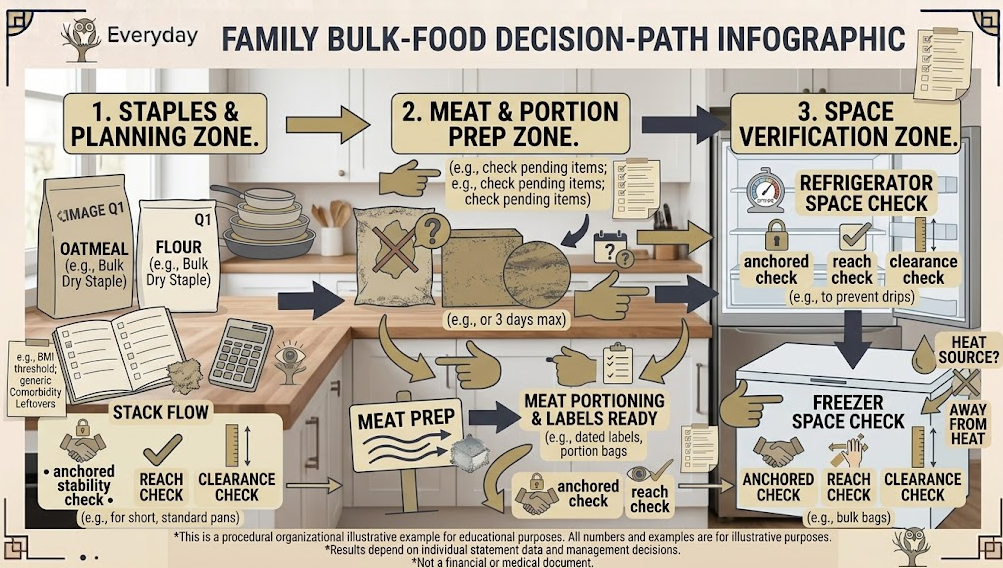
Quick decision: Before buying, divide the package size by the household’s realistic weekly use. Confirm safe storage time, available refrigerator or freezer space, portioning time, packaging, and a specific use plan. For perishables, complete the cold-storage work promptly after shopping. Label each portion with identity and date, keep product information for recalls and instructions, and review older stock before buying more.
Compare Cost per Amount Used, Not Cost per Unit Bought
The shelf label answers only one question: how much product is purchased for the price. It does not answer how much becomes a meal.
Use two calculations:
Purchase unit cost = package price ÷ package quantity
Consumed unit cost = total purchase and storage cost ÷ quantity actually used
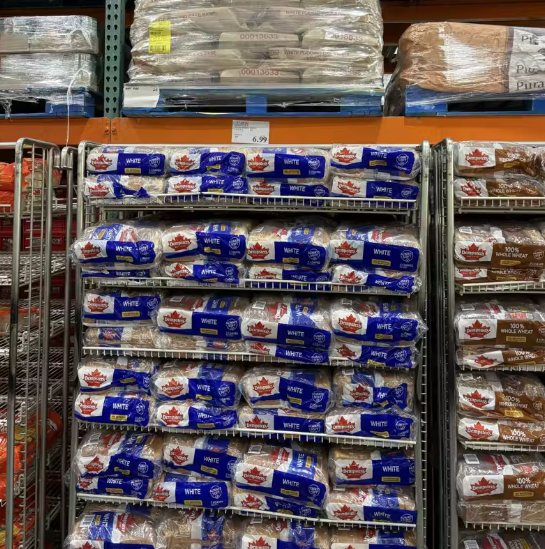
Suppose a small package costs $6 for one kilogram and a larger one costs $9 for three kilograms. The large package appears much cheaper per kilogram. If the household uses only 1.5 kilograms and discards the rest, it has paid $6 per consumed kilogram before counting bags, containers, freezer energy, or time. The apparent discount has disappeared.
This does not mean every gram must be used to justify a bulk purchase. Convenience, fewer shopping trips, emergency reserves, cultural cooking, large gatherings, and predictable family demand have real value. The calculation simply prevents the displayed unit price from being treated as the final result.
Before buying, record:
- package quantity;
- realistic use per week;
- number of weeks represented;
- official safe-storage or quality guidance;
- suitable storage capacity already available;
- preparation and packaging time required; and
- one or two planned uses for each portion.
If consumption rate is unknown, buy the smaller size once and measure actual use. A trial purchase gives better information than an optimistic estimate based on the amount of empty pantry space.
Use a Five-Gate Bulk Purchase Test
A bulk item should pass five gates before entering the cart.
1. Demand
Who will eat it, how often, and in what form? A family may eat chicken frequently but not the specific cut in the bulk pack. Children may be growing, but that does not guarantee a particular snack, grain, or vegetable will move quickly.
2. Time
How long can the food remain under the planned conditions? Use the product label and current official storage chart for the food and jurisdiction. Do not use one refrigerator rule for all meat, dairy, produce, or prepared foods.
3. Space
Is there measured room without blocking refrigerator or freezer airflow? “It will fit” is different from “it will remain visible and retrievable.” Do not buy against space expected to become available after an unspecified cleanout.
4. Processing
Can someone safely divide, wrap, label, and store the food promptly? Include the clean work surface, handwashing, tools, containers, and cleanup. If the household arrives home exhausted, the unprocessed package may spend its safest window waiting for tomorrow.
5. Recovery
What happens if plans change? Can suitable portions be frozen early, shared while still safely handled, or used in a flexible meal? A recovery plan should not depend on eating food after its safe period or giving uncertain food to someone else.
Failing one gate does not make the food or buyer irresponsible. It means the current package is larger than the current storage system.
Treat Perishable Bulk Food as a Same-Day Workflow
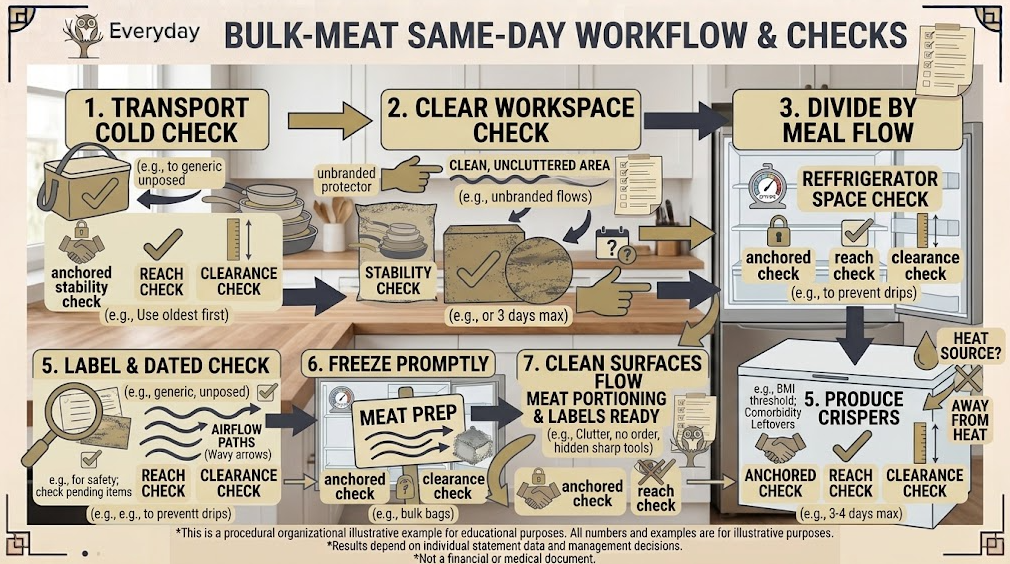
Health Canada advises refrigerating or freezing raw meat, poultry, fish, and seafood as soon as you get home. FDA guidance calls for refrigerating or freezing meat, poultry, eggs, seafood, and other perishables within two hours of purchase, or within one hour when the outside temperature is above 32°C (90°F).
The time includes transportation and unloading. Keep perishables cold on the way home, especially during long travel or hot weather. Separate raw animal-food packages from ready-to-eat foods and contain leaks.
Before shopping, prepare:
- enough suitable packaging or containers;
- labels and a marker;
- a clean, uncluttered work area;
- refrigerator and freezer space;
- a plan for each portion; and
- time to clean and sanitize affected surfaces appropriately.
Do not wash raw poultry. Prevent raw juices from contacting produce, cooked food, handles, containers, and other surfaces. Wash hands and use separate or appropriately cleaned tools and boards under current food-safety guidance.
If the package cannot be processed immediately, keep it safely cold and follow the product’s and official refrigerator time limits. The original purchase date, type of meat, and temperature history still matter.
Portion Around Future Use
The most efficient portion is not always one serving per person. It is the amount used in one future cooking event without repeatedly thawing a larger package.
Choose portions by asking:
- Is this for one dinner, two meals, or a gathering?
- Will it be cooked whole or separated later?
- Does the recipe use weight, count, or volume?
- Can the household safely use leftovers within the applicable time?
- Who will thaw and cook it?
Label each package with the food identity, portion amount, and freeze date. Add the intended dish when it meaningfully reduces decision time. “Chicken—900 g—stir-fry—Aug. 27” is more useful than an unlabelled opaque parcel.
Keep raw and cooked food identifiable. Do not combine new raw meat with an older frozen package or pour a new dry product over old stock without checking identity, dates, condition, and allergen information.
Flattening suitable packages may save space and speed thawing, but do not force sharp bones through wrapping or create packages likely to leak. Use food-storage materials for their intended conditions and follow their instructions. Remove excess air where the method permits, while avoiding unsupported claims that a package is vacuum sealed or safe for a particular cooking method.
Use Jerome’s Bulk-Meat Lesson
From Jerome, EverydayWise Contributor
As our children grew, our family of four began eating more, so I often bought meat in large packages. I learned that if I used part and left the rest in the refrigerator without dividing and freezing it, the smell could become unpleasant quickly. The lower price only helped when I dealt with the full package after bringing it home.
The passage above comes from an EverydayWise contributor’s household experience. It illustrates the difference between household demand and storage execution. A family can genuinely need a large quantity and still lose part of it when the processing step is deferred.
Smell may reveal spoilage, but a normal smell cannot prove that food is safe. Use time, verified temperature, package instructions, and official food-specific charts rather than waiting for sensory warning signs.
For example, FoodSafety.gov’s U.S. chart generally lists raw ground meats and ground poultry at one to two refrigerated days, while fresh beef, veal, lamb, and pork steaks, chops, and roasts are commonly listed at three to five days at 4°C (40°F) or below. Other meats, poultry, seafood, and processed products have different limits. Canadian guidance and product labels must be checked separately.
The practical lesson is to decide at purchase which portions will be cooked within the applicable refrigerator window and which will be frozen promptly. Do not wait for odor to make the decision.
Understand What Freezing Does—and Does Not Do
FDA explains that freezing at -18°C (0°F) stops bacterial growth but does not kill most bacteria. Properly handled food kept continuously frozen at that temperature can remain safe, while quality declines over time. Official freezer-storage durations commonly describe best quality rather than an automatic safety deadline.
Freezing cannot reverse earlier temperature abuse, contamination, or spoilage. Record the food’s history before it enters the freezer. An item that sat too long at room temperature does not become safe because it freezes solid.
USDA states that meat and poultry can be frozen in their original packaging, but that wrapping is permeable to air and quality may diminish over time. For longer storage, official guidance may recommend overwrapping with suitable airtight material or placing the package inside an appropriate freezer bag. Follow the current guidance and packaging instructions for the product.
Protect quality by:
- using packaging intended for freezer storage;
- keeping seals intact;
- limiting air exposure where the method permits;
- making portions reasonably thin and uniform;
- keeping the freezer at -18°C (0°F) or below;
- recording dates and identity; and
- rotating older suitable food forward.
Freezer burn is a quality problem, not by itself proof of a food-safety failure. However, damaged packaging, uncertain thawing, power loss, leaks, unusual condition, or unknown history requires a separate safety assessment.
Thaw by the Next Cooking Decision
Health Canada identifies safe defrosting methods that include the refrigerator, microwave, or cold water; U.S. guidance similarly recognizes refrigerator, cold-water, and microwave thawing with conditions. Never establish a routine of thawing perishable food on the counter.
Method affects the next step:
- Refrigerator: requires advance time and leak containment; follow official guidance on use or refreezing.
- Cold water: food must remain in suitable leak-proof packaging, water conditions must follow official instructions, and cooking may be required immediately.
- Microwave: can begin cooking parts of the food, so official guidance generally calls for immediate cooking.
- Cooking from frozen: possible for some foods and appliances when authoritative cooking instructions support it; allow the required time and verify safe internal temperature.
Do not create one thawing rule for every product. Large roasts, ground meat, seafood, prepared meals, and commercial frozen foods differ. Label placement should let the cook identify the food before opening it.
Store Dry Bulk Foods With Their Information
Dry foods avoid refrigerator deadlines but still face moisture, heat, pests, allergens, oxidation, and loss of identity.
Follow the product label for storage. Choose a clean, dry location away from unsuitable heat, water, cleaning chemicals, and pest access. Use food-safe containers intended for the product and household environment.
When decanting:
- preserve the product name, ingredients, allergen information, preparation instructions, date, and lot code;
- clean and fully dry the container before refilling;
- do not mix different products or lots merely because they look alike;
- avoid topping new stock over old stock; and
- keep a realistic maximum fill level.
Lot and product details matter during recalls. A handwritten word such as “flour” cannot identify the brand, variety, allergen statement, or recalled lot. Photographing the complete label may be a backup, but the record must remain findable and clearly linked to the correct container.
Transparent containers improve visibility but do not make every food suitable for light exposure or long storage. Follow product-specific guidance rather than assuming airtight, clear, or matching containers extend life indefinitely.
Make the Freezer Searchable
A full freezer can preserve food and conceal it at the same time. Organize by retrieval rather than by perfectly filled space.
Use broad sections such as:
- raw meat and poultry;
- seafood;
- cooked meals and leftovers;
- vegetables and fruit;
- bread and baking; and
- priority-use items.
Keep raw packages contained if leakage is possible during loading or thawing. Do not stack beyond stable limits or block required airflow. A chest freezer may need lift-out baskets or a simple map so food at the bottom remains visible in the inventory.
Maintain a short list on the freezer, phone, or household board:
| Item | Portions | Frozen | Planned use |
|---|---|---|---|
| Ground meat | 3 | Aug. 27 | tacos, pasta |
| Chicken thighs | 2 | Aug. 27 | sheet-pan dinner |
Update the count when removing a package, not later. Review the priority-use section before shopping. An inventory that requires weighing every bag will likely fail; a count of usable meal portions is usually enough.
Include Power-Outage Capacity in the Decision
Bulk frozen food concentrates value and dependence in one appliance. FoodSafety.gov states that during an outage, a full unopened freezer generally holds temperature for about 48 hours and a half-full freezer for about 24 hours. Actual conditions vary, and item-by-item decisions require official time-and-temperature guidance.
Keep an appliance thermometer inside and avoid opening the door unnecessarily. Know where current outage charts, emergency contacts, coolers, or backup options are located. Never taste food to determine safety.
The possibility of an outage does not make bulk freezing impractical. It means the freezer’s reliability, location, alarm options, household emergency plan, and potential financial loss belong in the bulk-buying decision.
A Bulk-Buying Trial
Before changing the household shopping pattern, test one product for one cycle.
- Record the regular and bulk prices and quantities.
- Measure actual weekly use.
- Confirm official storage guidance.
- Clear and measure the required space.
- Prepare packaging and labels before shopping.
- Process the purchase promptly.
- Count portions removed from storage.
- Record what was eaten, remained, lost, or required extra work.
At the end, calculate cost per amount consumed. Include packaging when meaningful and note whether the time and freezer space displaced another useful activity or food.
Repeat the bulk purchase when demand, storage, processing, and retrieval all worked. Buy smaller when one link repeatedly failed. The best package size is the one the household can turn into safe meals—not the largest package the cart or freezer can hold.
FAQ
Is bulk food always cheaper?
No. Compare the cost per amount actually consumed, including meaningful packaging and storage costs. A lower unit price can disappear when part of the food is discarded or displaces other useful storage.
How soon should I divide and freeze bulk meat?
Plan to process it promptly after shopping while keeping it safely cold. Use the product label and current official chart because refrigerator limits differ by meat type. U.S. guidance commonly gives ground meat one to two days and steaks, chops, and roasts three to five days at 4°C (40°F) or below.
Can I freeze meat in the store package?
USDA says meat and poultry may be frozen in original packaging, but the wrap can allow air through and quality may decline over time. For longer storage, follow official overwrapping guidance and the product instructions.
Does freezing kill bacteria?
Freezing stops bacterial growth but does not kill most bacteria. It cannot correct food that was already mishandled. Safe handling before freezing and safe thawing and cooking afterward still matter.
How should I label freezer portions?
Include food identity, amount or meal portion, and freeze date. Add a planned dish when useful, and retain the original product and lot information when needed for instructions or recalls.
Can I refill a dry-food container before it is empty?
Avoid topping new stock over old. Confirm identity, dates, allergens, condition, and lot information; clean and dry the container as appropriate before refilling.
How much freezer inventory should I keep?
Keep only what the household can identify, rotate, and protect within available space and its emergency plan. Use meal-portion counts and review older stock before buying more.
Sources
- Health Canada — Safe Food Storage
- Health Canada — Safely Defrosting Foods
- FDA — Safe Food Handling
- FDA — Are You Storing Food Safely?
- USDA FSIS — Freezing and Food Safety
- FoodSafety.gov — Cold Food Storage Charts
- FoodSafety.gov — Food Safety During Power Outage