From Jerome, EverydayWise Contributor
Everyone in our family likes carbohydrate-rich foods. Rice and noodles are easy to enjoy, and our growing children often want more food. But I gain weight more easily than my wife, so a carbohydrate-heavy meal does not always work the same way for me.
We try to put meat on the table for protein and serve Korean vegetable side dishes for variety and fibre. For snacks, we use foods such as Greek yogurt with fruit, nuts, boiled eggs, cheese, and bananas. I sometimes choose eggs or cheese when I feel like snacking because I hope something more substantial will help.
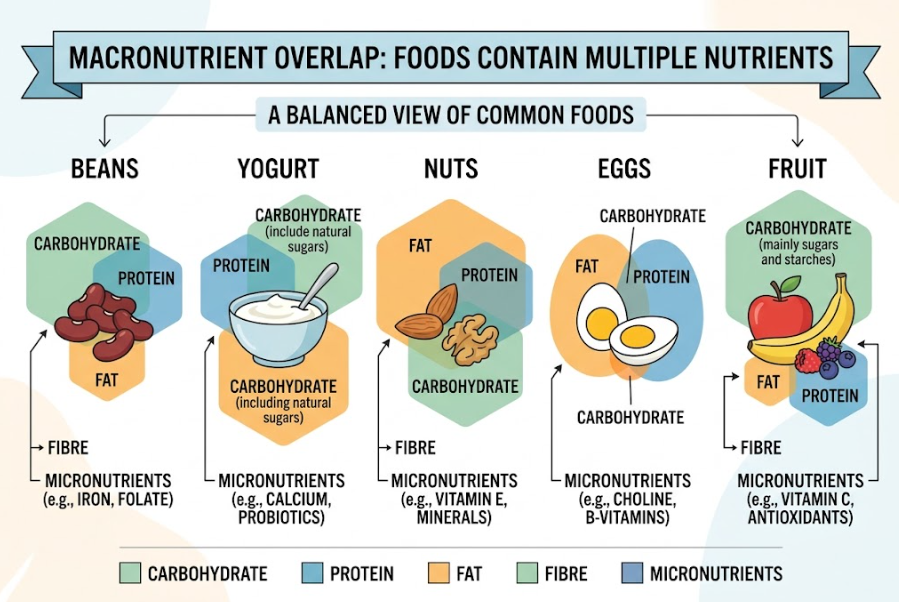
Still, foods do not fit into one clean box. Yogurt contains protein, carbohydrate, and sometimes fat. Nuts contain fat, protein, and carbohydrate. Even a simple banana is more than “just sugar.” Trying to balance all three nutrients can feel harder when every food seems to contain more than one.
The passage above comes from Jerome, an EverydayWise contributor. His family’s meals reveal an important point: protein, carbohydrate, and fat are not opposing teams. They are the three main macronutrients—nutrients the body uses in relatively large amounts. Most foods provide a mixture, and the value of a meal depends on food quality, total amount, variety, and the person eating it.
You do not need to track precise “macros” to benefit from understanding them. A practical goal is to know what each nutrient does, recognize useful food sources, and build meals that provide energy and satisfaction without turning food into a mathematical contest.

Macronutrients Are Categories, Not Food Identities
Carbohydrate, protein, and fat can all provide energy. Carbohydrate and protein provide about four calories per gram, while fat provides about nine. That difference helps explain why oils, nuts, cheese, and other high-fat foods are energy-dense, but it does not make them unhealthy. Energy density is one property, not a verdict.
Foods rarely belong exclusively to one category:
- rice is mostly carbohydrate but also contains some protein;
- beans provide carbohydrate, protein, and fibre;
- milk and yogurt can provide all three macronutrients;
- nuts provide mostly fat, plus protein, carbohydrate, and fibre;
- eggs provide protein and fat;
- fish may provide protein with varying amounts of fat;
- vegetables and fruit provide carbohydrate along with fibre, water, vitamins, and minerals.
When someone calls chicken a “protein” or rice a “carb,” they are naming the nutrient that is most useful for planning—not describing the food completely.
That shorthand becomes harmful only when it turns into moral labeling: protein as disciplined, carbohydrate as fattening, or fat as indulgent. The body needs all three. The more useful question is which foods supply them, in what amount, and within what overall pattern.
Carbohydrates: The Body’s Main Dietary Energy Source
Carbohydrate is the body’s primary dietary energy source. During digestion, many carbohydrates are broken down into glucose, which cells can use for energy. The body stores some glucose as glycogen in the liver and muscles for later use.
Carbohydrate is especially relevant to the brain, muscles during activity, and growing bodies. That does not mean every person needs the same amount or that every carbohydrate source has the same nutritional effect.
Three broad forms
Sugars include glucose, fructose, sucrose, and lactose. They occur naturally in foods such as fruit and milk and may also be added to foods and drinks.
Starches are longer chains of glucose found in foods such as grains, potatoes, corn, beans, and lentils.
Fibre is carbohydrate that the small intestine does not fully digest. Different fibres support bowel function, influence fullness, and interact with the gut microbiome. Fibre-rich foods also tend to supply vitamins, minerals, and other beneficial components.
This is why “carbohydrate” alone says too little. A soft drink, lentil soup, apple, oatmeal, and bowl of rice all contain carbohydrate, but they differ in fibre, water, protein, micronutrients, speed of consumption, and role in a meal.
Quality matters more than a simple carb count
WHO advises that carbohydrate for most people come primarily from whole grains, vegetables, fruits, and pulses such as beans, lentils, chickpeas, and peas. These sources provide more than energy.
Refined grains such as white rice and white bread can still be part of a healthy eating pattern. The practical choice is not always replacement. A family may mix barley or brown rice with white rice, add vegetables and protein to noodles, alternate refined and whole grain breads, or preserve a familiar staple while increasing fibre elsewhere.
Added and free sugars deserve separate attention. Sugar in whole fruit arrives with fibre and water. Juice loses much of the intact fibre, and WHO classifies its sugars as free sugars even when no sugar was added. Sweetened drinks can deliver sugar quickly without the same fullness as solid foods.
Does carbohydrate automatically cause weight gain?
No single macronutrient automatically determines weight. Over time, weight is influenced by total energy intake and expenditure, food form, appetite, sleep, activity, medications, health conditions, genetics, environment, and other factors.
For Jerome, large portions of rice or noodles may make it easier to exceed the amount that supports his weight goals. That personal observation can guide his portion without becoming a rule for his children. He might start with more vegetables and protein and add rice according to hunger, while a growing or highly active child may need more total food.
Very-low-carbohydrate diets are used in some medical and weight-management contexts, but they are not automatically appropriate for a family, a child, or a person taking glucose-lowering medication. Major restriction should be discussed with a qualified professional when health conditions are involved.
Protein: Structure, Repair, Enzymes, and More
Protein is built from amino acids. The body uses amino acids to build and maintain muscle and other tissues and to make enzymes, hormones, antibodies, transport proteins, and many other compounds.
Some amino acids are called essential because the body cannot make enough of them and must obtain them through food. This is why protein quality and dietary variety matter, although most people eating enough food from a varied pattern do not need to calculate individual amino acids.
Protein comes from many foods
Animal sources include:
- fish and shellfish;
- poultry and lean meat;
- eggs;
- milk, yogurt, and cheese.
Plant sources include:
- beans, peas, and lentils;
- tofu, tempeh, edamame, and other soy foods;
- nuts and seeds;
- some whole grains.
Health Canada recommends consuming plant-based protein foods more often. This does not require eliminating animal foods. It may mean using tofu in stew, adding lentils to meat sauce, serving beans alongside rice, rotating fish and meat, or choosing nuts and yogurt for different snacks.
More protein is not always better
Protein receives strong marketing attention because it is associated with muscle and fullness. But a “high protein” label does not guarantee a balanced food. A bar or shake may also be high in added sugar, sodium, saturated fat, or cost.
Many adults can meet protein needs through regular meals without powders. Growing children, older adults, athletes, pregnant people, people recovering from illness, and those eating restricted diets may need closer planning, but the appropriate amount varies.
Protein also does not cancel excess energy. Adding protein powder to an already adequate diet is not metabolically free, and eating more protein cannot replace resistance exercise when the goal is building muscle.
Some people with kidney disease or other medical conditions require individualized protein advice. General targets from an app should not override clinical guidance.
Why protein can change a snack
A banana mainly provides carbohydrate, while Greek yogurt or an egg contributes more protein. Cheese and nuts contribute protein plus fat. Combining fruit with yogurt or nuts may create a more substantial snack than fruit alone for some people.
That does not make the banana incomplete or the cheese automatically superior. The better choice depends on hunger, timing, allergies, total diet, and what comes next. A small snack before dinner has a different job from food intended to support several hours of activity.
Fat: Essential, Concentrated, and Highly Varied
Dietary fat provides energy, supplies essential fatty acids, forms part of cell structures, and helps the body absorb vitamins A, D, E, and K. It also contributes texture, flavour, and satisfaction.
Two fatty acids—linoleic acid, an omega-6 fat, and alpha-linolenic acid, an omega-3 fat—are essential because the body cannot make them. Other long-chain omega-3 fats, including EPA and DHA found mainly in seafood, have distinct roles and may be obtained through food or produced only to a limited degree from alpha-linolenic acid.
Unsaturated, saturated, and trans fat
Unsaturated fats are found in foods such as nuts, seeds, avocado, fish, and many plant oils. WHO recommends that most dietary fat for people age two and older come from unsaturated sources.
Saturated fat is found in varying amounts in fatty meat, butter, cheese, cream, coconut oil, palm oil, and many baked or fried products. Guidance generally recommends limiting saturated fat and replacing some of it with unsaturated fat rather than simply adding more fat overall.
Trans fat can occur naturally in small amounts in foods from ruminant animals, while industrially produced trans fat has historically come from partially hydrogenated oils. WHO recommends keeping trans fat very low and eliminating industrially produced sources.
The replacement matters. Replacing saturated fat with nuts, seeds, fish, or unsaturated plant oils is different from replacing it with refined starch and added sugar.
Why low-fat is not automatically healthier
Removing fat can reduce calories, but manufacturers or cooks may add sugar, starch, or sodium to maintain flavour and texture. Some foods naturally benefit from fat: nuts, seeds, fish, and avocado do not need to be made low-fat to be nutritious.
At the same time, because fat is energy-dense, portions can matter for someone managing total energy intake. A handful of nuts and repeated unmeasured handfuls are nutritionally similar in quality but different in energy.
Children have different needs from adults. WHO notes that higher total fat intakes may be acceptable for children because of growth and energy requirements. Restricting fat aggressively in a child’s diet without professional reason may displace needed energy and nutrients.
Why Percentage Ranges Are Not Personal Macro Prescriptions
Dietary Reference Intakes include Acceptable Macronutrient Distribution Ranges, or AMDRs. These express carbohydrate, protein, and fat as percentages of total energy associated with adequate nutrient intake and reduced chronic-disease risk at a population level.
WHO’s global healthy-diet guidance also gives broad energy ranges—for example, approximately 45–75 percent from carbohydrate for most people and, for adults, at least 15 percent from fat with a general upper level around 30 percent in its population guidance. Canadian DRI tables use age-specific ranges that are not identical across life stages.
These ranges are broad for a reason. Two healthy patterns can distribute macronutrients differently. A traditional grain-and-legume diet, a Mediterranean-style pattern, and a higher-fat pattern built around nuts, fish, vegetables, and unsaturated oils may all look different.
Do not convert a population range into a rigid target without considering:
- age and growth;
- total energy needs;
- activity and athletic training;
- pregnancy or breastfeeding;
- medical conditions and medications;
- food availability and culture;
- appetite and digestion;
- weight goals; and
- eating-disorder history.
Macro-tracking apps also depend on estimates. Food databases, recipe portions, restaurant meals, and labels contain normal variation. A displayed ratio such as 30/40/30 can look more precise than the underlying data or personal evidence justifies.
For a generally healthy household, food-based planning is often enough: include a protein source, choose fibre-rich carbohydrate foods regularly, include mostly unsaturated fat sources, and add vegetables and fruit. Exact percentages become more useful when a clinician or dietitian has a reason to set them.
How the Three Macronutrients Work Together in Meals
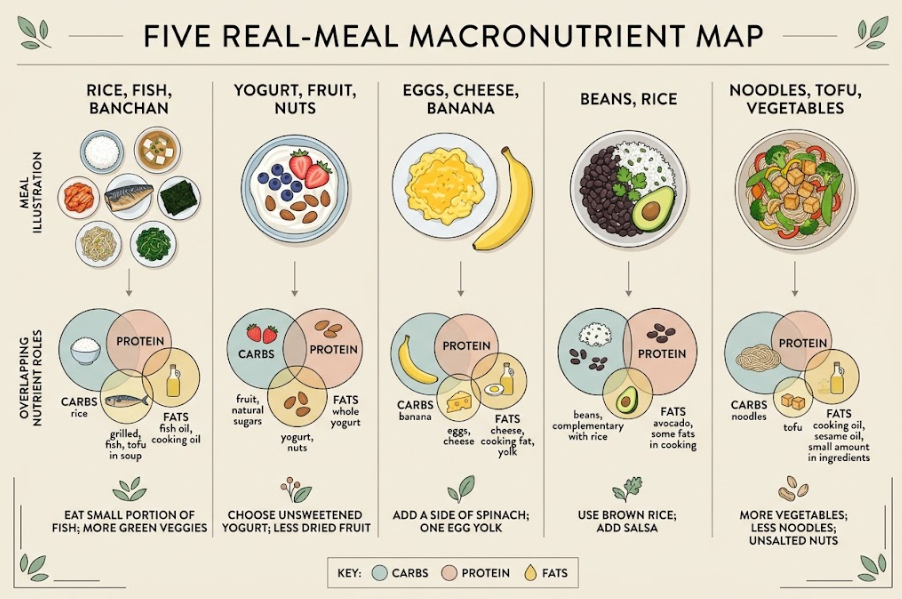
Meals are usually more satisfying and nutritionally useful when foods contribute different functions.
Rice, fish, and banchan
Rice provides mostly carbohydrate. Fish provides protein and may supply fat. Vegetable side dishes add fibre and micronutrients, while sesame seeds or oil add fat and flavour. The meal’s balance changes with portion sizes, preparation, and sodium across sauces, soup, and fermented dishes.
Greek yogurt, fruit, and nuts
Yogurt contributes protein, carbohydrate, and sometimes fat. Fruit adds carbohydrate, fibre, water, and micronutrients. Nuts add mostly unsaturated fat, plus protein and fibre. Sweetened yogurt or toppings may add sugar, which can be checked on the label.
Eggs, cheese, and banana
Eggs provide protein and fat. Cheese adds protein, fat, calcium, and often sodium. Banana provides carbohydrate, fibre, and potassium. This can be a substantial snack or small meal, but it is not automatically right for every hunger level or medical need.
Beans and rice
Both foods contain carbohydrate, and beans also contribute substantial protein and fibre. Together they create a practical, culturally adaptable base that can be completed with vegetables and an appropriate fat source.
Noodles with meat or tofu and vegetables
Noodles provide carbohydrate; meat or tofu contributes protein and fat; vegetables add fibre and volume; cooking oil and sauce influence fat and sodium. Rather than removing noodles, adjust the balance across the bowl.
Common Macronutrient Myths
“Carbs turn directly into body fat”
The body’s metabolism is more complex. Carbohydrate supplies energy and can support glycogen stores. Long-term weight gain reflects sustained energy imbalance and many interacting influences, not the mere presence of carbohydrate.
“Protein cannot be stored as fat”
Protein has important structural and metabolic roles, but excess energy from any macronutrient can contribute to energy surplus. Protein is not exempt from the broader diet.
“Eating fat makes you fat”
Dietary fat is essential. Because it is energy-dense, amount can matter, but type and total eating pattern matter too. Unsaturated-fat foods can support a healthy pattern.
“Plant proteins are incomplete and must be combined at every meal”
Plant proteins vary in amino-acid composition, but most people eating a varied diet with enough energy can meet needs across the day. Exact pairing at every meal is generally unnecessary. More careful planning may be useful in highly restricted diets.
“Children should eat the same macro ratio as adults”
Needs change with age and growth. Young children may need proportionally more fat than adults, and growing or active children may need more total energy. Adult weight-control rules should not be imposed automatically.
A Practical Way to Think Without Tracking
At a meal, ask four questions:
- Where is the carbohydrate energy? Choose a portion appropriate to the eater, emphasizing whole grains, legumes, vegetables, and fruit across the pattern.
- Where is the protein? Include beans, tofu, eggs, fish, meat, yogurt, nuts, seeds, or another suitable source.
- Where is the fat? Notice cooking oil, nuts, seeds, fish, dairy, meat, dressing, or sauce rather than assuming the meal contains none.
- Where are the fibre and micronutrients? Add vegetables, fruit, legumes, and whole grains.
Then consider satisfaction. A technically balanced meal that leaves someone hungry may need more total food, more protein or fat, more fibre, or simply a larger portion. A meal that feels heavy may need a smaller total amount or a different preparation—not the permanent removal of one macronutrient.
When Individual Guidance Matters
Macronutrient needs may require professional planning for diabetes treated with glucose-lowering medication, kidney or liver disease, pancreatic disorders, gastrointestinal disease, food allergy, metabolic conditions, pregnancy complications, intensive athletic training, underweight, significant unintentional weight change, or eating-disorder treatment.
Children need assessment if growth is not progressing as expected, the diet becomes extremely limited, food causes persistent distress, or a family is considering a restrictive diet. A physician or registered dietitian can evaluate the full pattern rather than applying a generic internet ratio.
Seek prompt medical care for symptoms such as severe weakness, fainting, persistent vomiting, dehydration, or signs of serious allergic reaction. Macronutrient adjustment is not a substitute for diagnosis.
The EverydayWise Perspective
Protein, carbohydrate, and fat do different jobs, but healthy eating does not require choosing a winner. Carbohydrate supplies a major source of energy. Protein provides amino acids for tissue and essential body processes. Fat supplies concentrated energy, essential fatty acids, and support for cell function and vitamin absorption.
The quality and context of the foods matter. Lentils are both carbohydrate and protein. Yogurt can contain all three macronutrients. Nuts are more than fat, and fruit is more than sugar. A family meal can serve different people without assigning the same ratio or amount to everyone.
Use macronutrients as a way to notice what a meal offers, not as a reason to fear food. For most households, a varied plate with protein, fibre-rich carbohydrate foods, mostly unsaturated fat sources, vegetables, and fruit will provide more useful direction than chasing a perfect percentage.
FAQ
Which macronutrient is most important?
There is no single winner. Protein, carbohydrate, and fat have different essential roles. The appropriate balance depends on the person, food sources, total intake, and health context.
Do I need protein at every meal?
Not as an absolute rule, but distributing protein foods across meals and snacks can make it easier to meet needs and may support satisfaction. Total intake and food variety across the day remain important.
Are all carbohydrates sugar?
No. Carbohydrates include sugars, starches, and fibre. Whole grains, beans, vegetables, fruit, milk, rice, bread, and sweetened drinks all contain carbohydrate in different forms and nutritional contexts.
Is white rice an unhealthy carbohydrate?
White rice is a refined grain and generally has less fibre than whole grain alternatives, but it can remain part of a healthy pattern. Pair it with vegetables and protein, adjust the portion, or mix it with whole grains when practical.
Is a low-fat food always a better choice?
No. It may contain more sugar, starch, or sodium, and some nutritious foods naturally contain fat. Compare similar products and consider the type of fat, serving size, and role in the meal.
Can children follow an adult high-protein or low-carbohydrate diet?
Not automatically. Children need adequate energy and nutrients for growth, and their appropriate macronutrient ranges differ by age. Restrictive diets for children should be discussed with a physician or registered dietitian.
Do I need to track macro percentages to eat well?
Most generally healthy people do not. Food-based planning can be sufficient. Tracking may be useful for a specific clinical or performance goal when the target is individualized and the burden does not harm the person’s relationship with food.
Reference Log
- Healthy Diet — World Health Organization, January 26, 2026. Used for: Carbohydrate and fat roles, food sources, broad energy ranges, child-fat distinction. Accessed 2026-08-27.
- WHO Updates Guidelines on Fats and Carbohydrates — World Health Organization, July 17, 2023. Used for: Fat quality, saturated and trans fat limits, carbohydrate quality. Accessed 2026-08-27.
- Dietary Reference Intakes: Macronutrients — Health Canada, November 19, 2025. Used for: Age-specific protein, carbohydrate, fat, fibre, and AMDR reference values. Accessed 2026-08-27.
- Dietary Reference Intakes Tables: Overview — Health Canada, November 19, 2025. Used for: AMDR definition and use. Accessed 2026-08-27.
- Eat Protein Foods — Health Canada, May 4, 2026. Used for: Plant and animal protein food choices. Accessed 2026-08-27.
- Eat Whole Grain Foods — Health Canada, May 4, 2026. Used for: Whole grain and fibre context. Accessed 2026-08-27.
- Omega-3 Fatty Acids: Health Professional Fact Sheet — U.S. National Institutes of Health, Office of Dietary Supplements. Used for: Essential fatty acids and omega-3 forms. Accessed 2026-08-27.
- Nutrient Recommendations and Databases — U.S. National Institutes of Health, Office of Dietary Supplements. Used for: Difference between personalized recommendations and label Daily Values. Accessed 2026-08-27.
- Nutrients — HealthLink BC, February 3, 2026. Used for: Public-facing nutrient function overview. Accessed 2026-08-27.
More in This Cluster: Healthy Eating Foundations
- How to Build a Balanced Plate for Real Family Meals
- How to Read Nutrition Labels Without Getting Misled
- Protein, Carbohydrates, and Fat: What Each One Does (you are here)
- How to Plan Healthy Meals on a Realistic Budget
- Whole Foods vs Processed Foods: What Actually Matters
- How to Make Gradual Dietary Changes That Can Last
- When Nutrition Advice Needs Professional Guidance