From Jerome, EverydayWise Contributor
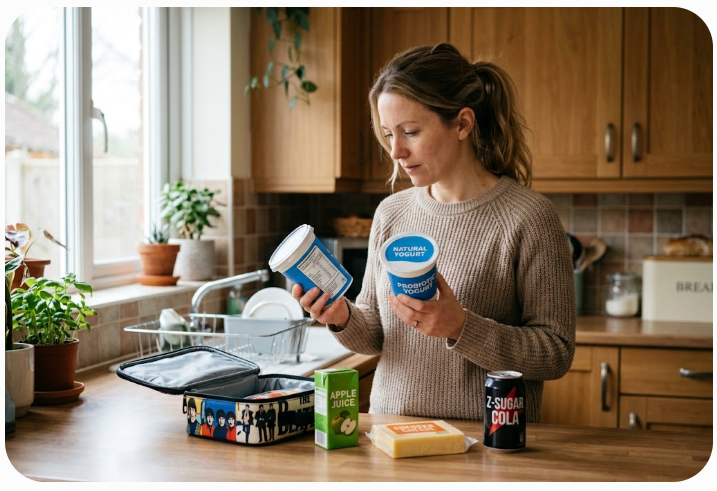
Drinks have become one of the harder choices in our house. We sometimes put juice in the children’s lunch boxes, and they may have a zero-sugar cola after coming home. My wife dislikes giving them drinks with a lot of sugar or carbonation, so even a simple beverage choice can turn into a family discussion.
We also try to choose snacks with more nutritional value. The children do not especially like very sweet snacks, which helps. We often serve Greek yogurt with fruit or offer nuts, and I have been eating boiled eggs, cheese, and bananas more often. But foods that sound similar can be very different. One yogurt may contain much more sugar than another. Cheese can provide protein and calcium while also containing substantial sodium or saturated fat. A “zero” drink may have no sugar but still raise other questions.
Looking at the package should make the choice easier. Sometimes it seems to create another layer of decisions.
The passage above comes from Jerome, an EverydayWise contributor. His family’s choices show what nutrition labels can and cannot do. A label can help compare two yogurts, identify how much sugar a juice contains, or reveal sodium in cheese. It cannot decide whether a particular child needs that food, whether the family enjoys it, or how often it belongs in the household routine.
Reading a label well is not about studying every number. It is about beginning with a purpose, checking the serving size, comparing the nutrients that matter for that purpose, and then using the ingredient list to understand what the numbers represent.
First Decide What You Want the Food to Do
The same product can look different depending on the question.
If you are choosing a snack, you might want protein and fibre that help make it satisfying. If you are comparing soup, sodium may be the main concern. If you need food before extended physical activity, carbohydrate may be useful rather than something to minimize. If you are managing an allergy, the ingredient and allergen information may matter more than calories.
Before reading, complete this sentence:
“I am comparing these products because I want more ___, less ___, or a better fit for ___.”
Possible answers include:
- more fibre;
- more protein;
- less sodium;
- less saturated fat;
- less added or free sugar;
- a suitable allergen profile;
- enough carbohydrate for the situation;
- a smaller or larger practical serving; or
- a product the household will actually eat.
Without a purpose, shoppers can move between numbers without knowing which difference matters. A label is a comparison tool, not a universal health score.
Step 1: Start With the Serving Size
Nearly every number in the Nutrition Facts panel refers to the stated serving. If the serving is one cup and you eat two cups, you consume approximately twice the listed calories and nutrients. If you eat half, you receive about half.
The serving size is not necessarily a recommendation for how much you should eat. It is the quantity used to calculate the panel. Your appropriate amount may differ because of age, appetite, activity, health, and the role the food plays in the meal.
This creates two common traps.
Trap 1: Comparing different serving sizes
Yogurt A may appear lower in sugar than Yogurt B simply because its label describes 100 grams while the other describes 175 grams. Crackers may list six pieces on one box and ten on another. Convert to the same quantity, or use labels with comparable serving sizes, before deciding.
Trap 2: Assuming the package is one serving
A bottle or bag that feels like a single item may contain more than one labeled serving. Some U.S. packages use dual-column labels showing information per serving and per package, but not every product does. Check “servings per container” as well as serving size.
For a quick comparison, use this sequence:
- Match the food category.
- Match or normalize the serving size.
- Compare the nutrients relevant to your goal.
Comparing cereal with cereal is usually meaningful. Comparing a spoonful of peanut butter with a cup of yogurt based on calories alone rarely answers a useful question because the foods serve different roles.
Step 2: Use Percent Daily Value as a Directional Tool
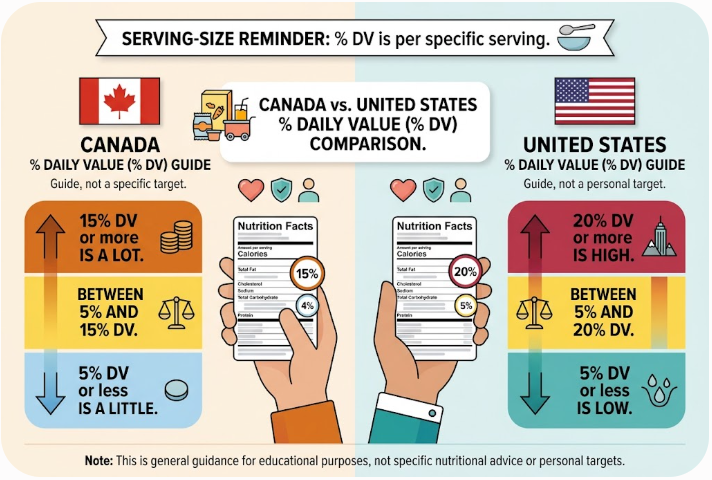
Percent Daily Value, or % DV, shows how much one labeled serving contributes to a reference daily amount for a nutrient. It helps translate unfamiliar gram and milligram numbers into a rough “little or a lot” scale.
The thresholds differ by country:
| Label system | A little | A lot |
|---|---|---|
| Canada | 5% DV or less | 15% DV or more |
| United States | 5% DV or less | 20% DV or more |
These are general interpretation tools, not personalized targets. The reference values are not tailored to your exact age, sex, body size, activity, medical condition, or energy needs. Children, in particular, may not share the adult reference amounts represented on many general labels.
Use % DV differently depending on the nutrient:
- For fibre, calcium, iron, potassium, and other nutrients you are trying to obtain, a higher % DV may help.
- For sodium, saturated fat, and added or total sugars you are trying to limit, a lower % DV may help.
The column does not need to add vertically to 100 percent. Each percentage refers to a different nutrient’s daily reference value. Ten percent DV for sodium plus 10 percent DV for fibre does not mean the food is “20 percent healthy.”
Also consider frequency. A food with 15 percent DV sodium may be manageable occasionally or as one component of a lower-sodium meal. Eating several similar products throughout the day can make the total more important.
Step 3: Read the Nutrients That Answer Your Question
You usually do not need to analyze every line. Focus on the two or three that affect the choice.
Calories
Calories describe energy, not overall nutritional quality. Foods such as nuts and seeds can be energy-dense and nutrient-rich, while a very low-calorie product may be insufficient as a meal. Use the number when energy is relevant, but do not let it replace the rest of the panel.
Protein
Protein can help a snack or meal feel more substantial and supports growth and tissue maintenance. Compare protein within similar products: plain Greek yogurt may contain more than conventional yogurt, for example, but formulas vary.
More is not always necessary. A food can contribute useful protein without being marketed as “high protein,” and some people with medical conditions need individualized guidance.
Carbohydrate and fibre
Total carbohydrate includes starches, sugars, and fibre. It is not the same as added sugar. Fibre is listed separately and can help distinguish a whole grain cereal, bean product, or higher-fibre snack from a refined alternative.
For packaged grain foods, check both fibre and the ingredient list. Brown colour, “multigrain,” or seed decoration does not prove that a product is primarily whole grain.
Sugars
Sugar labeling is one of the biggest Canada–U.S. differences.
The Canadian Nutrition Facts table lists Sugars and a % DV based on total sugars. The ingredient list groups sugar-based ingredients together under “Sugars,” helping readers see their combined presence. The panel generally does not provide the same separate Added Sugars line used in the United States.
The U.S. Nutrition Facts label lists Total Sugars and includes Added Sugars beneath it. Added sugars are those introduced during processing or preparation, while total sugars also include naturally occurring sugars such as lactose in milk and sugars in fruit.
This matters when comparing yogurt. Plain yogurt naturally contains lactose, so “total sugars” will not be zero even without sweetener. A flavoured product may contain natural milk sugar plus added sugar. In the United States, the added-sugars line helps separate them. In Canada, compare total sugars among similar yogurts and inspect the grouped sugar ingredients.
Juice presents another distinction. One hundred percent fruit juice may have no sugar added during manufacturing, yet WHO treats sugars naturally present in fruit juice as free sugars. “No added sugar” therefore does not mean unlimited or nutritionally equivalent to whole fruit. Health Canada recommends water as the drink of choice and whole or cut fruit more often than juice.
Fat, saturated fat, and trans fat
Total fat includes different types of fat. Fat is an essential nutrient, so the aim is not necessarily the lowest number. Saturated and trans fats are more useful comparison points when choosing products to eat regularly.
A cheese may offer protein and calcium while also contributing saturated fat and sodium. The label helps you see the trade-off. You might compare similar cheeses, use a smaller amount for flavour, or balance it with lower-saturated-fat foods elsewhere rather than declaring cheese forbidden.
Sodium
Sodium can accumulate through bread, cheese, sauces, processed meat, soup, snacks, and restaurant food—not only through salt added at the table. Compare similar products using the same serving size and % DV.
Low sodium is not the goal for every individual, especially when medical conditions, heavy sweating, or other circumstances require personalized advice. But for most shoppers, labels are useful for identifying products that contribute large amounts without tasting obviously salty.
Vitamins and minerals
Calcium, iron, potassium, vitamin D, and other declared nutrients may matter when filling a specific gap. Fortification can be useful, but it does not erase high sugar or sodium, and a short vitamin list does not make an otherwise nutritious food inadequate.
Step 4: Read the Ingredient List as a Recipe in Descending Order
Ingredients are generally listed by weight from most to least at the time of manufacture. The first few ingredients therefore tell you what largely makes up the product.
The list can help answer questions the panel cannot:
- Is the grain actually whole grain?
- Is the yogurt sweetened with sugar, syrup, or fruit preparation?
- Does the product contain an allergen?
- Which oils or fats are used?
- Are non-sugar sweeteners present?
- Is protein coming from the expected food or from added isolates?
Do not use ingredient length as a purity score. A vegetable soup may list many vegetables and spices, while a three-ingredient product can still be high in sodium, sugar, or saturated fat. Unfamiliar names are not proof of harm.
Instead, connect the list to your decision. If you want whole grain bread, look for a whole grain as a leading ingredient. If you avoid an allergen, use the allergen declaration and ingredient list every time, even for a familiar product whose formulation may change. If you want unsweetened yogurt, look for a product without sugar ingredients or sweetened fruit preparation.
In Canada, sugar-based ingredients are grouped in brackets after the word “Sugars.” This prevents multiple types of sugar from appearing separately lower in the list and making their combined importance harder to see.
Step 5: Treat Front-of-Package Claims as Invitations to Verify
The front of a package is advertising space as well as regulated labeling space. Words such as “natural,” “multigrain,” “made with real fruit,” “light,” “source of protein,” or “no added sugar” highlight selected characteristics. They do not summarize the entire food.
Use a claim to generate a question:
- “Multigrain”: Are the leading grains whole grains?
- “Made with fruit”: How much fruit, and in what form?
- “No added sugar”: How much total sugar is present, and is juice concentrate involved?
- “High protein”: How much per realistic serving, and what are sodium and saturated fat?
- “Light”: Lighter in what—calories, fat, sodium, colour, or flavour?
Canada now also requires a standardized black-and-white front-of-package symbol on many prepackaged foods that meet defined thresholds for being high in saturated fat, sugars, sodium, or a combination. The transition deadline ended on January 1, 2026.
The symbol is a fast warning, not a complete verdict. Exemptions exist, and it does not describe fibre, protein, affordability, cultural use, or actual intake. Use it to pause and inspect the full table.
A Practical Comparison: Yogurt, Juice, and Zero-Sugar Soda
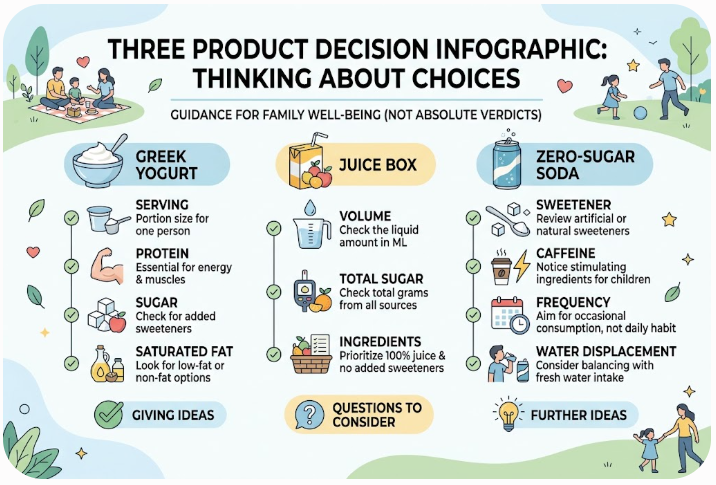
Jerome’s family choices show why a single rule does not work across categories.
Comparing two Greek yogurts
- Match the serving sizes.
- Compare protein.
- Compare total sugars.
- In the U.S., check added sugars; in Canada, inspect sugar ingredients.
- Compare saturated fat if the fat level matters to you.
- Consider calcium and whether the product is satisfying.
Plain yogurt with fruit added at home often gives the household more control over sweetness. A sweetened yogurt may still be a practical and nutritious choice if the family prefers it. The label shows the trade-off; it does not require one answer.
Evaluating a juice box
Check volume, total sugars, calories, ingredients, and whether it is 100 percent juice or a fruit drink. “100% juice” describes composition, not absence of free sugars. A small juice box is different from repeatedly refilling a large bottle, and water remains the default everyday drink in Canada’s food guide.
Evaluating zero-sugar cola
The label may show zero sugar and few or no calories. That answers one question: it is not supplying the sugar found in regular cola. It does not answer every question about the role of the beverage.
Check the ingredient list for non-sugar sweeteners and look for caffeine information where available. Consider age, frequency, dental exposure to acidic drinks, displacement of water or milk, and the household’s broader routine. Guidance for infants and young children is more restrictive; Health Canada advises that beverages containing caffeine or artificial sweeteners not be offered to young children.
For older children and adolescents, a label alone cannot create a universal family rule. Parents can use the information to decide whether the drink is occasional, whether a caffeine-free version is preferable, and whether water is reliably available.
Common Label-Reading Mistakes
Chasing the lowest number in every category
The lowest-calorie yogurt may also contain less protein. The lowest-fat dressing may contain more sodium or sugar. Trade-offs matter.
Ignoring the amount actually eaten
A favourable panel per tiny serving can become less favourable when the usual portion is several times larger.
Treating “zero” as complete information
Zero sugar does not mean zero caffeine, zero acidity, or nutritionally equivalent to water. Zero fat does not mean low sugar. Zero cholesterol does not necessarily mean low saturated fat.
Believing a front claim over the back panel
A positive claim can coexist with high sodium, saturated fat, or sugars. Turn the package around.
Trying to make one product perfect
A food need not optimize every nutrient simultaneously. Choose the qualities needed for its role and balance the broader pattern.
A 30-Second Label Routine
When time is limited, use this order:
- Purpose: What am I comparing for?
- Serving: Are these numbers based on the amount I will eat?
- Two priorities: Which two nutrients matter most here?
- % DV: Is that a little or a lot under this country’s system?
- Ingredients: What is the product mainly made from?
- Front claim: Does the detailed label support the marketing message?
- Context: How often and with what other foods will we use it?
This routine keeps grocery shopping from becoming a nutrition exam.
When General Label Reading Is Not Enough
Labels are designed for the general population. Individual needs can differ substantially. Ask a physician or registered dietitian for guidance when managing kidney disease, diabetes treated with medication, food allergy, celiac disease, metabolic disorders, swallowing problems, eating-disorder recovery, pregnancy complications, child growth concerns, or another condition requiring specific nutrient targets.
Allergy decisions deserve special caution. Precautionary statements, ingredient changes, cross-contact, and country-specific rules can make a familiar product unsafe. Do not rely only on the Nutrition Facts panel or a front claim such as “plant based.”
Supplements and supplemented foods may also use different labels, warning statements, or reference values from conventional foods. A product that resembles water or a snack may contain caffeine, vitamins, minerals, amino acids, or other supplemental ingredients. Read the entire package and follow age-related cautions.
The EverydayWise Perspective
A nutrition label is most helpful when it narrows a real choice. It can tell you which of two breads has more fibre, which soup has less sodium, whether yogurt contains added sweetener, or how a juice serving compares with the amount your child actually drinks.
It cannot tell you that one food is morally good, that another must never appear, or that a reference Daily Value is your personal prescription. It also cannot replace the meal around the product. Greek yogurt with fruit, cheese with vegetables and whole grain crackers, or an occasional juice box all belong to broader patterns.
Start with your reason for looking. Match the serving sizes. Read the two or three numbers that answer the question. Then inspect ingredients and front claims for context. The goal is not to memorize the panel. It is to make one clearer decision.
FAQ
Is 5% Daily Value always low and 20% always high?
It depends on the label system. Canada uses 5% DV or less as a little and 15% DV or more as a lot. U.S. FDA guidance uses 5% DV or less as low and 20% DV or more as high. These are general reference thresholds, not personal prescriptions.
Why does plain yogurt contain sugar?
Milk naturally contains lactose, a sugar. Plain yogurt can therefore show total sugars even when no sugar or syrup was added. U.S. labels list added sugars separately; Canadian shoppers should compare similar products and inspect the ingredient list.
Does “no added sugar” mean a drink is low in sugar?
No. Juice can contain substantial naturally occurring free sugars without added sugar. Check total sugars, serving size, and ingredients, and remember that whole fruit provides fibre that juice generally lacks.
Is a zero-sugar soft drink the same as water?
No. It may avoid the sugar and calories in regular soft drinks, but it may contain non-sugar sweeteners, caffeine, acids, or other ingredients. Age, frequency, dental health, and whether it displaces water or nutritious drinks matter.
Should I avoid every food with Canada’s “high in” symbol?
Not necessarily. The symbol flags that a product meets a threshold for saturated fat, sugars, sodium, or a combination. Use it to compare alternatives and consider frequency and serving size rather than treating it as a prohibition.
Are ingredients with long chemical names unsafe?
Not simply because of their names. Ingredient length or unfamiliar terminology is not a reliable safety test. Focus on regulated allergen information, the product’s composition, your health needs, and credible safety guidance.
Should children use the % Daily Value on an adult label?
With caution. Many general labels use reference values for adults and children four years and older, while needs vary with age and growth. % DV can support product comparison, but it does not prescribe a child’s exact daily intake.
Reference Log
- Nutrition Labelling: Nutrition Facts Table — Health Canada, September 5, 2024. Used for: Canadian serving size, Nutrition Facts table, ingredients, claims, comparison framework. Accessed 2026-08-27.
- How to Use Food Labels to Make Healthier Choices — Health Canada, March 31, 2026. Used for: Canadian 5%/15% DV guidance. Accessed 2026-08-27.
- Front-of-Package Nutrition Symbol — Health Canada. Used for: Symbol design and nutrients flagged. Accessed 2026-08-27.
- Front-of-Package Nutrition Symbol Compliance — Canadian Food Inspection Agency, November 17, 2025. Used for: January 1, 2026 compliance deadline. Accessed 2026-08-27.
- How to Understand and Use the Nutrition Facts Label — U.S. Food and Drug Administration, March 5, 2024. Used for: U.S. serving size and % DV framework. Accessed 2026-08-27.
- The Lows and Highs of Percent Daily Value — U.S. Food and Drug Administration, March 5, 2024. Used for: U.S. 5%/20% DV guidance. Accessed 2026-08-27.
- Added Sugars on the Nutrition Facts Label — U.S. Food and Drug Administration, March 4, 2026. Used for: Total versus added sugars and U.S. labeling. Accessed 2026-08-27.
- Healthy Diet — World Health Organization, January 26, 2026. Used for: Free sugars, juice, dietary-pattern context. Accessed 2026-08-27.
- Foods and Beverages That Undermine Healthy Eating — Health Canada, April 14, 2026. Used for: Free-sugar beverages and child dental-health context. Accessed 2026-08-27.
- Nutrition for Healthy Term Infants, 6–24 Months — Health Canada, October 30, 2025. Used for: Caffeine and artificial sweeteners for young children. Accessed 2026-08-27.
More in This Cluster: Healthy Eating Foundations
- How to Build a Balanced Plate for Real Family Meals
- How to Read Nutrition Labels Without Getting Misled (you are here)
- Protein, Carbohydrates, and Fat: What Each One Does
- How to Plan Healthy Meals on a Realistic Budget
- Whole Foods vs Processed Foods: What Actually Matters
- How to Make Gradual Dietary Changes That Can Last
- When Nutrition Advice Needs Professional Guidance