Quick Summary
A U.S. Department of Homeland Security final rule is scheduled to take effect on September 15, 2026. It replaces “duration of status,” often shown as D/S on an I-94, with fixed admission periods for F students, J exchange visitors, and I foreign-media representatives.
The change does not mean every current F, J, or I holder must file a new application on September 15. The rule includes transition provisions for people already in the United States and properly maintaining D/S status. What you should do now depends on your classification, whether you are already in the country, the documents in effect on September 15, and whether you will travel or need more time.
The most useful preparation is to collect your latest I-94, visa, I-20 or DS-2019, and any employment authorization document; compare their dates; and ask the appropriate school or program official about any mismatch. Do not use the visa expiration date as your U.S. stay deadline.
Important: This article explains the published rule as of August 6, 2026. It is general information, not legal advice. The effective date could change through congressional review, litigation, or a later federal notice.
Why This Matters
Under the current D/S system, many F, J, and I nonimmigrants are not admitted to one calendar end date. Their authorized stay is instead tied to maintaining the activities permitted by their status, such as a full course of study or an approved exchange program.
The final rule changes that structure. After it takes effect, new admissions in these classifications will generally carry an actual end date. A person who needs to remain beyond that admission period may need an extension of stay from U.S. Citizenship and Immigration Services or a new period of admission after travel.
This creates a practical risk: people may look at the wrong document. A visa in a passport permits a traveler to seek admission while it is valid; it does not determine how long that person may remain after entering. A program document describes the approved study or exchange activity, while the I-94 is the official admission record. After the new system begins, extending an I-20 or DS-2019 alone may not extend the period authorized by the I-94.
The rule also changes some departure periods, transfer rules, and extension procedures. Those changes can affect study plans, work authorization, family members, and international travel. The safest response is neither panic filing nor ignoring the rule. It is identifying which transition or new-admission rule applies to you.
What the Final Rule Actually Changes
F-1 students: a program-based period with a four-year ceiling
For new F-1 admissions under the rule, the fixed period is generally the time needed to complete the course of study listed on Form I-20, but no more than four years, plus specified additional periods. English-language training has a 24-month maximum admission period, while existing statutory limits continue to apply to public high school study.
The rule reduces the general F-1 period after program completion or authorized post-completion practical training from 60 days to 30 days for people governed by the new fixed-period rules. That time is for departure or another action to maintain lawful status; it is not an automatic extension of study or employment.
The rule also restricts some school transfers and changes in educational objectives. Students below the graduate level generally must complete the first academic year before transferring or changing an educational objective unless SEVP authorizes an exception for extenuating circumstances. At the graduate level or above, the restrictions are tighter. DHS retained authority to delay or suspend implementation of these particular restrictions, so students considering a transfer or program change should check current SEVP guidance before acting.
J-1 exchange visitors: the DS-2019 period, capped at four years
For new J-1 admissions, the authorized period is generally the program period shown on Form DS-2019, not to exceed four years, subject to the separate limits that already apply to particular exchange categories. J-2 dependents cannot receive a longer admission period than the J-1 principal.
The rule provides a 30-day period after the program end date or four-year maximum, whichever applies, for departure or another action to maintain lawful status. If a sponsor later extends a DS-2019, that document by itself will not extend the person’s immigration stay under the new framework. The J holder must also follow the USCIS extension-of-stay process.
I foreign-media representatives: much shorter admission periods
Most new I admissions will be limited to the time needed for the assignment, up to 240 days. A person presenting a passport issued by the People’s Republic of China, other than a Hong Kong or Macau SAR passport, is generally limited to 90 days. Extensions may be available in corresponding increments when the eligibility requirements are met.
This makes the I-94 especially important for correspondents and their employers. An assignment letter or ongoing employment does not replace the admission end date.
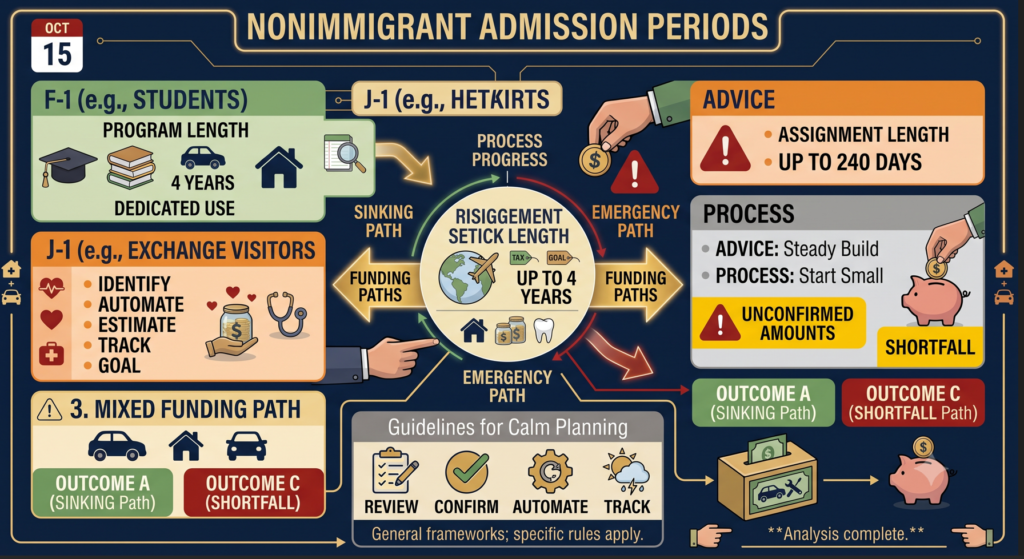
[IMAGE 2: Editorial infographic — three columns labelled F, J, and I, showing the general new admission framework: F program length up to four years, J program length up to four years, and I assignment length up to 240 days, with a clear note that exceptions apply.]
Current Holders Do Not All Switch the Same Way
The transition provisions are the most important protection against overreaction.
If you are in valid F or J D/S status on September 15
A person who is properly maintaining F or J status on September 15, 2026, and was admitted for D/S may generally remain until the later of the applicable EAD expiration date or the program end date on the I-20 or DS-2019 that applies under the transition rule. However, this protection cannot extend indefinitely: the rule sets a four-year transition ceiling measured from September 15, 2026, plus the departure period.
For this transition group, the rule retains a 60-day departure period for F holders and a 30-day period for J holders. That is why a current student should not assume the new 30-day F departure rule immediately replaces every existing 60-day period.
If the person needs more time, wants to begin a new program, or seeks covered post-completion training beyond the protected period, an extension-of-stay application may be required. A pending F-1 employment authorization application on September 15 also has specific protections; it should not automatically be refiled unless USCIS requests it.
If you are in valid I D/S status on September 15
The transition is shorter. Most properly maintaining I holders admitted for D/S may remain for the time needed to complete their activity, but no later than May 13, 2027. The corresponding limit is December 14, 2026, for the PRC-passport group subject to the rule’s 90-day treatment. Anyone needing additional time must use the extension procedure.
If you enter or re-enter after the effective date
Expect CBP to issue a fixed admission date under the new rule. After each arrival, retrieve the new I-94 and verify the classification and “admit until” date. Do not assume an earlier D/S admission, a still-valid visa, or a program document guarantees the same period after travel.
Travel during a pending extension can also change the case. The final rule contains circumstances in which an extension is not treated as abandoned, but the outcome depends on the remaining admission period and what documents are used for re-entry. A traveler with a pending case should obtain individualized advice before departure rather than relying on a general travel rule.
The Four Dates You Should Keep Separate
| Document or date | What it generally tells you | What it does not prove by itself |
|---|---|---|
| Visa expiration date | How long the visa may be used to seek admission, subject to its entries and other conditions | How long you may remain after admission |
| I-94 notation or admit-until date | Your official admission record and authorized admission period | That your school, exchange program, or employment remains valid |
| I-20 or DS-2019 program end date | The authorized school or exchange-program timeline | Under the new system, an automatic extension of the I-94 |
| EAD expiration date | The authorized employment period shown on that document | Permission to remain or work beyond the rules applicable to the underlying status |
If these dates do not line up, do not choose whichever is latest. Ask the official responsible for your program and, where the consequences are significant, a qualified U.S. immigration lawyer.
What to Check Now
1. Download your latest I-94
Use the official CBP I-94 system and save a copy. Confirm your name, classification, most recent entry, and whether the record says D/S or provides a date. A visa stamp is not a substitute.
2. Find the document that will be valid on September 15
F holders should locate the current I-20; J holders, the current DS-2019; and anyone with employment authorization, the applicable EAD. Do not rely on an old document kept for historical records.
3. Ask the right official
An F student should contact the designated school official. A J exchange visitor should contact the sponsor’s responsible officer. An I representative should coordinate with the employer and obtain legal advice when the assignment may exceed the transition or admission period. Dependents should be reviewed with the principal holder because their admission periods are linked.
4. Flag plans that cross an end date
Pay special attention if your expected graduation, academic training, OPT or STEM OPT, exchange extension, new program, transfer, or media assignment will continue beyond the relevant date. The need for a program-document update and the need for an immigration extension are related but not identical.
5. Plan extensions early, but do not file from a generic checklist
The final rule repeatedly directs applicants to the form and instructions designated by USCIS, with the required fee and any biometrics that may be required. The current Form I-539 page, filing edition, fee, supporting evidence, and availability of online filing must be checked when you are ready to file. Do not mail an application now solely because the rule has been published.
6. Recheck before travel
International travel can produce a new fixed admission period and can affect a pending extension. Before buying a non-refundable ticket, compare the visa, I-94, program document, pending receipts, and intended return date. Carrying a receipt notice may be relevant under the final rule, but it does not guarantee admission.
[IMAGE 3: Practical checklist image — a folder labelled “Before September 15” containing an I-94, current I-20 or DS-2019, EAD if applicable, and a written question list for a DSO, responsible officer, employer, or lawyer.]
What Remains Uncertain
September 15 is the published effective date, but the Federal Register notice explicitly says DHS will publish another document if congressional review changes that date or terminates the rule. Litigation could also affect implementation.
Operational details remain important. USCIS may update Form I-539 instructions, filing channels, fees, evidence lists, and biometrics procedures. SEVP may issue implementation guidance or delay certain transfer and educational-objective restrictions. Schools, sponsors, and employers may need time to update internal systems.
For that reason, a document check now is sensible, but a final filing or travel decision should use the instructions available immediately before action.
The Practical Decision
If you are already in the United States in valid D/S status, your first task is not to file automatically. Identify the transition rule, confirm the current program or employment documents, and determine whether your plan extends beyond the protected date.
If you will enter or re-enter after September 15, your first task is to check the new I-94 immediately after arrival and treat its fixed date as a deadline that must be coordinated with your program documents.
If you need additional time, will transfer or change programs, have a pending employment application, or plan international travel, move from a general document check to individualized guidance. In this system, the costliest mistake is likely to be assuming that one familiar date controls everything.
FAQ
Do all F, J, and I holders need to file Form I-539 on September 15, 2026?
No. The final rule provides transition treatment for people already in the United States, properly maintaining status, and admitted for D/S. Filing depends on the person’s classification, documents, plans, and applicable transition end date.
Is my visa expiration date my deadline to leave the United States?
Not necessarily. A visa is used to seek admission. The I-94 records the authorized admission period. The two dates serve different purposes.
Will current F-1 students immediately lose the 60-day departure period?
Not everyone. The transition provision retains a 60-day period for qualifying F holders already in D/S status on September 15. New fixed-period admissions generally use a 30-day post-completion period.
Does a new I-20 or DS-2019 automatically extend my stay?
Under the new fixed-period framework, no. A program document may support an extension request, but it does not by itself extend the I-94 admission period.
What happens to F-2, J-2, or I dependents?
Their authorized periods generally cannot exceed the principal holder’s period. Families should compare every person’s I-94 and include dependents correctly in any required extension process.
Can I travel while an extension of stay is pending?
The final rule protects some pending applications from abandonment in defined circumstances, but travel can still change the admission period or affect the case. Obtain case-specific advice before departure.
What should I monitor before September 15?
Watch the Federal Register, USCIS Form I-539 guidance, DHS Study in the States updates, your school or sponsor’s notices, and any court order or federal announcement affecting implementation.
Cluster Recommendation
Sources
- Federal Register / DHS – Establishing a Fixed Time Period of Admission and an Extension of Stay Procedure
- DHS Study in the States – Final Rule Establishing a Fixed Time Period of Admission: Quick Guide
- DHS – Announcement of Final Rule
- U.S. Department of State – What the Visa Expiration Date Means
- USCIS – Form I-539, Application to Extend/Change Nonimmigrant Status
- CBP – Official I-94 Website