Quick Summary
Iran said on August 5 that it and Oman had reached an understanding on the geographic coordinates of a shipping route through the Strait of Hormuz and were finalizing a joint announcement. That is diplomatic progress, but it is not yet the same as a signed operational agreement, safe passage for ordinary commercial traffic, restored oil exports, or lower prices at your local fuel station.
Oil markets are reacting to each new development. After falling sharply earlier in the week, Brent crude rose to $81.19 a barrel by 10:59 a.m. EDT on August 6, as renewed regional risks competed with optimism about the talks. That movement shows why a single headline is a weak basis for rushing to fill a tank, booking a flight solely because fares may fall, or rewriting a business fuel budget.
For most households, the practical response is to keep normal plans, compare the price available now with the cost of waiting, and avoid a large speculative purchase. For fuel-dependent businesses, the better response is to use scenarios rather than one oil-price forecast.
Status note: This article reflects information verified on August 6, 2026. The negotiations, shipping conditions, and energy prices can change quickly.
Why This Matters
The Strait of Hormuz is not just another shipping route. Before the conflict that began in late February, roughly one-fifth of daily global oil and liquefied natural gas supplies passed through it. Disruption has therefore affected crude oil, refined fuels, freight, aviation, business costs, and household budgets far beyond the Gulf.
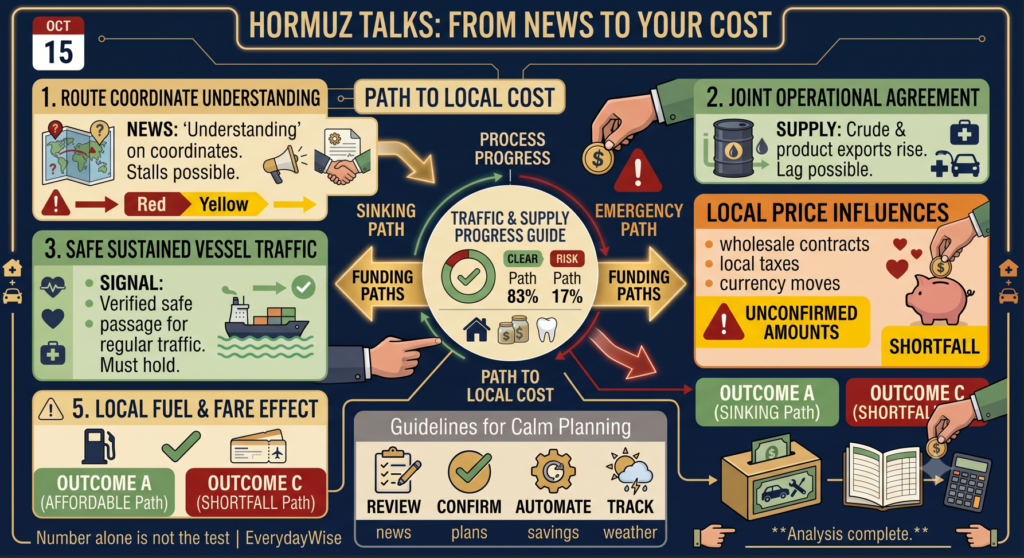
Yet the price at a fuel pump or on an airline checkout page does not move one-for-one with a Brent crude quote. The path from diplomacy to a consumer price contains several separate steps:
- Iran and Oman must convert their reported understanding into workable terms.
- Maritime authorities, shipowners, crews, and insurers must judge the route usable.
- Tanker traffic and export volumes must increase and remain stable.
- Producers and refineries must restore output and rebuild inventories.
- Wholesale product markets must adjust.
- Local taxes, currency movements, competition, inventories, and retailer pricing affect what consumers finally pay.
Skipping those steps creates two opposite mistakes. One is assuming that talks guarantee an immediate price decline. The other is assuming that any renewed attack guarantees that every local price will rise tomorrow. Both turn a complex supply chain into a prediction it cannot support.
What Has Actually Been Confirmed
There is an understanding on route coordinates
Iran’s Foreign Ministry spokesperson said Iran and Oman had reached an understanding on the geographic coordinates of a route through Hormuz and that a joint announcement was being finalized. He also said the arrangement would not by itself guarantee security in the waterway.
Oman and Iran had already established a working process. In a June 23 joint statement, they committed to continue discussions on navigation, services, costs, and future administration of the strait. Oman then worked with the International Maritime Organization to make a temporary corridor available for vessels seeking to leave the Gulf.
These facts show that the August announcement is part of an ongoing negotiation. They do not prove that normal two-way commercial traffic has resumed.
The shipping-safety signal remains cautious
The IMO’s Hormuz information page said on August 4 that its safe evacuation framework was currently paused. The organization reported that 136 vessels and an estimated 2,900 seafarers had been evacuated through the framework in late June, while about 20,000 seafarers, port workers, and offshore crews remained affected across the region.
That distinction matters. A proposed route can exist on a map while insurers, vessel operators, and crews still judge the physical and security risks too high for normal traffic. Verifiable, sustained vessel movements are a stronger operational signal than an announcement alone.
Oil prices have fallen, but they remain volatile
Brent dropped from levels above $100 during the earlier supply shock to around $80 as expectations of de-escalation improved. On August 6, however, it moved higher again as traders weighed the Iran–Oman talks against new security concerns elsewhere in the region.
Reuters reported that Gulf crude oil and condensate exports were largely steady in July but remained about 40% below pre-war levels. The U.S. Energy Information Administration also expects recovery to take time: its current outlook estimates global inventories fell by an average of 5.1 million barrels per day in the second quarter and will fall by another 2.2 million barrels per day in the third quarter.
This means the market can respond positively to diplomatic progress while still carrying a supply-risk premium.
What the Headline Does Not Tell You
A route agreement is not a security guarantee
Coordinates answer where ships might travel. They do not, by themselves, resolve mines, attacks, naval restrictions, vessel screening, insurance, crew safety, fees, liability, or the wider conflict. A final announcement could improve confidence without removing all of these obstacles.
More tanker traffic does not equal immediate new supply
Some vessels moving after a disruption may carry oil that was already produced and stranded. EIA notes that much of the increased traffic in its recovery scenario initially consists of previously stranded tankers. That can improve delivery conditions without proving that production has returned to normal.
Crude oil is not gasoline, diesel, or jet fuel
Crude must be transported and refined into products. Refinery capacity, maintenance, outages, product inventories, and regional fuel specifications can make diesel, gasoline, and jet fuel move differently. During the 2026 shock, the International Energy Agency highlighted especially high prices for diesel, jet fuel, and LPG—not merely crude.
A lower barrel price does not set your local price
Local fuel prices also reflect wholesale contracts, distribution costs, taxes, exchange rates, retail competition, and the timing of inventory replacement. A Canadian driver, a U.S. driver, and a European airline may therefore experience different timing and magnitude even when they watch the same Brent benchmark.
Decision Guide for Drivers
If you need fuel in the next few days
Buy what you reasonably need. Trying to time a geopolitical market to save a small amount per litre or gallon can cost more in an extra trip, a long detour, or the risk of running low.
A useful comparison is simple:
Possible saving from waiting = litres or gallons needed × plausible local price change
If a 40-litre fill might be three cents cheaper later, the possible saving is C$1.20. That does not mean the price will fall; it shows the scale of the decision. Compare that amount with the inconvenience and risk of waiting.
If your tank is already comfortable
There is no strong evidence-based reason to top it off solely because of one Hormuz headline. Keep monitoring the local posted price rather than treating a crude futures move as a direct forecast for tomorrow’s pump price.
If you can choose when and where to buy
Use ordinary cost controls: combine trips, compare nearby stations without making a long special drive, maintain correct tire pressure, and avoid unnecessary idling or aggressive acceleration. These reduce exposure whether the diplomatic outlook improves or deteriorates.
Decision Guide for Travelers
Do not book a flight solely because crude oil has moved down from its peak. Airlines do not normally reprice every seat immediately when oil moves, and jet-fuel costs are only one part of a fare. Demand, route competition, capacity, seasonality, currency, airport charges, and revenue-management systems also matter.
If you already have firm dates and find a fare that fits your budget, assess the actual ticket conditions: change fees, cancellation rights, baggage, connections, and whether the itinerary is exposed to a region with current airspace or operational disruption. A flexible ticket can be worth more than waiting for a hypothetical fuel-driven fare decline.
If your dates are flexible and the trip is discretionary, set a fare alert and a personal price ceiling. That creates a decision rule based on the offer you can buy—not on a forecast about diplomacy.
For travel to or through the Gulf, separate two questions:
- Price question: Is the fare acceptable?
- operational and safety question: Are the route, airspace, insurance, and official travel advice acceptable immediately before travel?
A cheaper fare does not answer the second question.
Decision Guide for Fuel-Dependent Businesses
Businesses should avoid rebuilding budgets around a single $80 crude assumption. Use at least three scenarios for the next review period:
| Scenario | Evidence to watch | Planning response |
|---|---|---|
| Gradual improvement | Joint terms published; sustained safe transits; export volumes rise; insurance conditions ease | Reduce emergency premium gradually; do not assume an instant return to pre-conflict costs |
| Uneven recovery | Limited route operates but delays, attacks, or refinery constraints continue | Keep a larger fuel and freight contingency; review supplier surcharges frequently |
| Renewed disruption | Talks fail, transits fall, attacks expand, or infrastructure is damaged | Activate conservation, routing, customer-notification, and cash-flow plans |
Separate what you can control from what you cannot. A small operator may not hedge commodity prices directly, but it can shorten quote-validity periods, identify which contracts allow a fuel surcharge, consolidate deliveries, track vehicle efficiency, and distinguish temporary surcharges from permanent price changes.
Do not change customer prices merely because Brent moved for one session. Document the cost actually affecting your business—fuel invoices, carrier surcharges, supplier quotes, and exchange-rate changes—and use the contract terms that apply.
What Could Change the Conclusion
The outlook would strengthen if Oman and Iran publish a joint operational statement, the IMO or relevant maritime authorities confirm workable passage, ordinary transits rise for more than a brief window, insurers reduce restrictions, and export volumes recover.
The opposite scenario remains possible. A joint statement could be delayed, limited, or overtaken by renewed military action. Safe passage could operate only for certain vessels. A shipping improvement might still leave refinery outages, depleted inventories, or Red Sea risks unresolved.
EIA’s forecast illustrates the conditional nature of the outlook. It expects Brent to average about $70 a barrel in the fourth quarter as production and trade recover, but it also expects inventory rebuilding and production normalization to take time. That is a forecast based on assumptions, not a guaranteed future price.
The Practical Decision
For most drivers, buy fuel when you need it and avoid panic filling. The likely dollar value of perfectly timing one ordinary tank is small compared with the uncertainty.
For travelers, judge the fare and ticket terms in front of you. Do not wait solely for a crude-price decline that may not reach airfares on your route.
For businesses, use triggers and scenarios rather than a single oil forecast. The key sequence is not “talks happened, therefore costs fall.” It is:
terms published → safe sustained traffic → restored supply → product-market adjustment → local cost change
Until more of that sequence is verified, the most rational response is preparation without speculation.
FAQ
Did Iran and Oman sign a final Hormuz agreement?
Not in the official material verified for this article. Iran said the countries had reached an understanding on route coordinates and were finalizing a joint announcement.
Has normal shipping through the Strait of Hormuz resumed?
Normal, safe, sustained commercial traffic has not been officially confirmed. The IMO’s August 4 page said its evacuation framework was paused.
Will gasoline prices fall immediately if a deal is announced?
Not necessarily. Safe traffic, export volumes, refining, product inventories, taxes, exchange rates, distribution, and local competition all affect the timing and size of a pump-price change.
Should I fill every vehicle and storage container now?
For most households, no. Buy what you normally need and follow local emergency guidance. Speculative buying can create unnecessary expense and local shortages.
Should I wait to book a flight because oil prices may fall?
Not solely for that reason. Airfares also depend on demand, capacity, competition, route conditions, and airline pricing. Use the actual fare, flexibility, and trip timing as your decision inputs.
What should a small business monitor?
Track its own fuel invoices and carrier surcharges, plus official shipping updates, sustained transit volumes, export recovery, refined-product markets, and relevant contract terms.
What would be the clearest sign of genuine improvement?
A joint operational announcement followed by sustained, verifiable safe transits and rising export volumes would be more meaningful than a diplomatic headline alone.
Cluster Recommendation
Sources
- International Maritime Organization – Middle East: Strait of Hormuz
- Foreign Ministry of Oman – Oman and the Islamic Republic of Iran Issue a Joint Statement
- U.S. EIA – Short-Term Energy Outlook: Global Oil Markets
- Reuters – Iran and Oman Reach Understanding on Coordinates of Route Through Hormuz
- Reuters – Oil Gains on Supply Concerns as Iran-Oman Talks Continue
- International Energy Agency – Sheltering From Oil Shocks