A shared closet can be neatly divided and still work badly. One person has room for shirts but nowhere for long clothing. Another has a shelf that is technically theirs but too high to use comfortably. Children’s clothes fit into the available space, yet the children cannot reach them without help. The boundaries look fair on paper while daily access remains uneven.
Shared closet organization involves more than fitting multiple wardrobes into one enclosure. It requires clear ownership, practical access, room for truly shared items, and a way to handle clothing whose destination has not been decided. The goal is not to make everyone store clothing in the same way. It is to give each person a usable system without turning every returned shirt or crowded shelf into a negotiation.
Quick decision
Before moving anything, identify:
- whose belongings are in the closet;
- which items are genuinely shared;
- what each person needs to reach most often;
- which garments require hanging length, shelves, or drawers;
- where undecided, outgrown, or hand-me-down items will wait; and
- which changes require another person’s agreement.
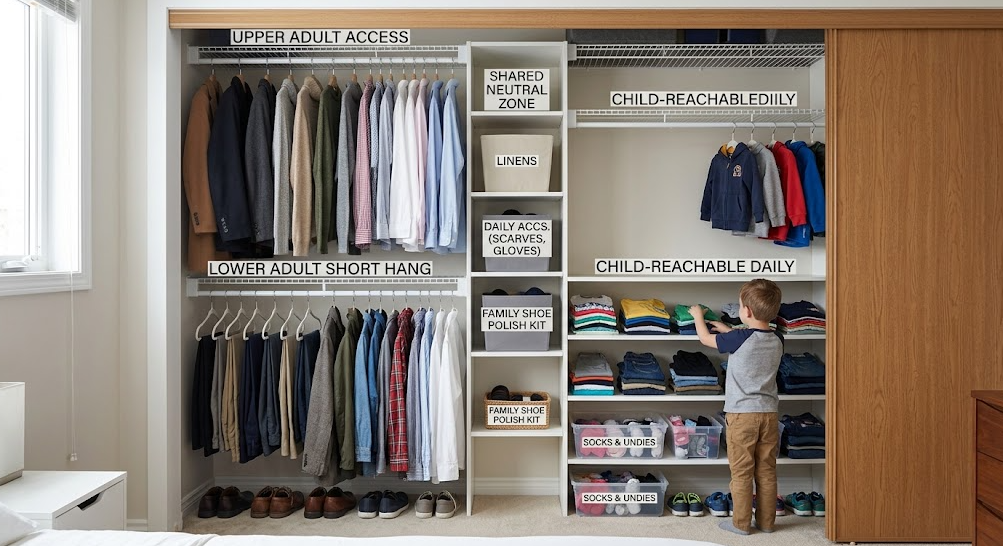
Start With People, Not Categories
Organizing all shirts together, all pants together, and all jackets together can look efficient. In a shared closet, however, it may scatter each person’s wardrobe across several heights and corners. Getting dressed then requires crossing through someone else’s zone or moving their belongings.
List the people who use the space and the activities the closet supports. A couple’s bedroom closet may hold work clothes, casual clothes, formal wear, and luggage. A children’s closet may also need school clothing, sports layers, uniforms, and a temporary place for outgrown garments. An entry closet may serve everyone but contain different quantities of coats, footwear, and weather accessories.
Give personal ownership priority over visual symmetry. When possible, each person should have a recognizable area where most daily clothing is stored. Categories can still exist inside that area. The difference is that the system begins with the user and then organizes the user’s belongings.
Equal Space and Usable Space Are Different
Dividing every rod and shelf exactly in half is simple, but equal measurements do not always produce equal usefulness. One person may own more long garments. Another may fold most clothing. A child’s small garments use less width but need lower placement. Work uniforms or adaptive clothing may need faster access than occasion wear.
A fair allocation considers:
- the actual volume of clothing that belongs in the closet;
- hanging length and garment structure;
- how frequently items are used;
- each person’s comfortable reach;
- mobility, strength, and other access needs;
- whether another storage location is available; and
- which household responsibilities the closet must support.
These considerations should not become a justification for one person to occupy every convenient area. Begin with a usable daily zone for each person, then allocate the remaining space according to documented needs. If one wardrobe exceeds the available capacity, address that mismatch openly rather than quietly expanding into another person’s section.
From Jerome, EverydayWise Contributor
My wife and I share a walk-in closet in our bedroom. Because I am taller, we separate some of the space by keeping my clothes higher and hers lower. With our children, reach matters even more. If their clothes are hung too high, they are less likely to choose or put away those clothes themselves. Our older child is a daughter and our younger child is a son, so only some of the daughter’s smaller unisex clothing has a clear hand-me-down path. As the children grow, they also want more say in clothing that reflects their own preferences.
The passage above comes from Jerome’s experience organizing clothing for four people with different heights, ages, and preferences. It shows why a family closet cannot be planned only by counting hangers. Access, ownership, and a credible next destination all influence where an item belongs.
Assign Space by Comfortable Reach
Frequently used clothing should be accessible without repeated stretching, climbing, deep bending, or moving another person’s possessions. The Canadian Centre for Occupational Health and Safety uses a similar frequency principle in workstation design: important and frequently used materials belong in the easiest reach zone, while occasional and rarely used materials can sit farther away. A closet is not a workplace, so this article adapts only that general placement principle and does not convert workplace dimensions into household requirements.
Ask each person to retrieve and return several ordinary items. Observe the movement rather than relying only on height measurements.
- Can the person see the item before reaching for it?
- Can they remove one hanger without pulling down several others?
- Can they open the drawer fully and see inside?
- Does returning the item require a stool or another person’s help?
- Does a mobility aid, closet door, or nearby furniture restrict the approach?
Use upper shelves for lighter, occasional items that the assigned user can access safely or can retrieve through an agreed method. Heavy objects should not be placed where they can fall during an overhead reach. A step stool should be stable, appropriate for the user, and stored where it can be used safely; improvised climbing on shelves, drawers, or unstable furniture is not a storage solution.
For children, independence changes with growth and ability. Daily clothing placed at a reachable height allows the child to participate in choosing and returning items. Higher storage can hold adult-managed supplies or future-size clothing. Reassess the arrangement as the child grows rather than expecting one height to work indefinitely.
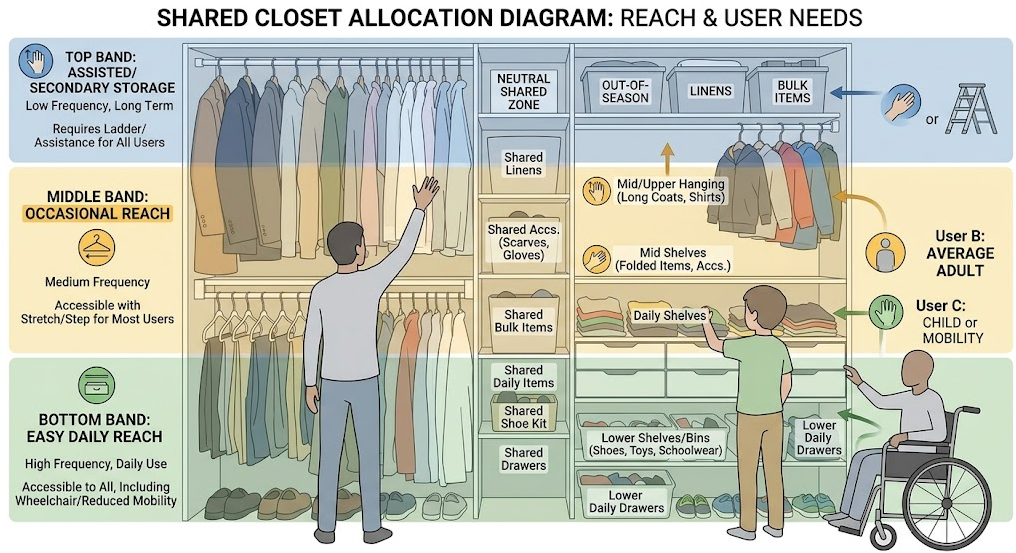
Create Four Types of Zones
A shared closet becomes easier to understand when every area has one of four roles.
Personal zones
These contain one person’s belongings and should be recognizable without checking every label. A section of rod, drawer group, shelf column, or set of bins can define the boundary. The shape matters less than clarity.
Avoid building personal zones from leftover fragments. If one person receives part of a high shelf, half a drawer, and a narrow rod behind the door, their clothing may technically fit but remain difficult to use. Consolidated space usually reduces crossing and accidental mixing.
Shared zones
Use these only for items the household actually treats as shared: perhaps luggage, a laundry basket, garment-care tools, or specific outerwear accessories. Do not label an item “shared” merely because ownership is unclear.
Define who can use the item and where it returns. A shared zone without a clear purpose can become the place where anything inconvenient is placed.
Transition zones
Some clothing is temporarily between destinations. It may be waiting for repair, laundering, a fitting decision, donation, or transfer to another child. Give these items a bounded holding place rather than mixing them with active wardrobes.
Set a physical capacity for the transition zone. This article does not prescribe a recurring review schedule; How to Keep a Closet Organized After the Reset will address ongoing maintenance. Here, the purpose is simply to prevent unresolved clothing from quietly becoming someone else’s storage problem.
Household-support zones
These hold items that support the closet’s function: an empty laundry basket, lint roller, spare hangers, or a limited set of clothing-care supplies. Keep them separate from personal clothing and place products according to their labels and household safety needs.
Protect Ownership Before Reorganizing
Moving a partner’s or child’s belongings may seem harmless when the goal is efficiency. Yet the person may rely on the existing location, recognize an item by context, or have a reason for keeping it. Ask before discarding, donating, reclassifying, or permanently relocating another person’s possessions.
A useful shared reset separates decisions into three levels:
- Independent decisions: changes entirely inside one person’s established zone.
- Notification decisions: small reversible changes that affect a shared surface or pathway.
- Agreement decisions: changing boundaries, removing another person’s item, purchasing a permanent system, or assigning responsibility.
If an item’s owner is unavailable, leave it in an identified holding area. Do not treat silence, absence, or lack of recent use as permission to remove it. Decluttering When You Share a Home covers consent and another person’s possessions in greater depth.
Give Hand-Me-Downs a Named Destination
Children’s clothing often remains in a shared closet because it may fit someone later. That possibility should be specific enough to guide storage.
Record the intended recipient, size or stage, and season. If only certain garments have a realistic hand-me-down path, separate those from items awaiting donation or another decision. A general “save for later” container can otherwise accumulate clothing that does not suit the next child’s needs, preferences, season, or expected size.
The future recipient should not be treated as obligated to wear every saved item. As children develop preferences, involve them at an age-appropriate level when active clothing is selected and when formerly shared or inherited pieces become theirs. Ownership becomes clearer when acceptance is explicit.
Keep future-size clothing outside the child’s easiest daily zone. A labeled secondary shelf or container prevents current and future sizes from being mixed during rushed mornings.
Choose Boundaries People Can See
Shared systems fail when the dividing line exists only in one person’s memory. Use a shelf edge, rod divider, drawer assignment, label, color-neutral tag, or container boundary to show where one zone ends.
Labels should describe the user or function rather than judge the contents. “Jordan — daily,” “shared travel,” and “awaiting repair” are more useful than “miscellaneous” or “clutter.” For young children, a simple word-and-picture label may make the destination easier to recognize.
Leave a small amount of working clearance between crowded sections. This is not empty space for its own sake. It allows hangers to move and makes the boundary visible. When clothing constantly crosses the divider, determine whether the cause is insufficient capacity, a difficult return motion, or an allocation that no longer matches actual use.

Discuss the Constraint Without Turning It Into a Contest
When space is tight, begin with observable constraints:
- available rod length and shelf dimensions;
- garments requiring full hanging length;
- drawers that are difficult for one person to operate;
- clothing used every week;
- items stored elsewhere; and
- zones that repeatedly overflow.
This keeps the discussion focused on the system. Statements such as “you have too many clothes” or “you never put anything away” convert a space problem into a character judgment and rarely reveal what allocation would work better.
Each person can state one access need and one flexibility. For example, someone may need work clothes at eye level but be willing to move formal wear higher. Another may need a full-length section but can fold casual shirts. These exchanges create options without requiring identical wardrobes or identical habits.
If the closet cannot provide a functional daily zone for everyone, reduce what the closet is expected to hold. Occasion clothing, luggage, or another low-use category may need a different location. How Many Clothes Do You Really Need? can help evaluate a wardrobe-capacity mismatch without assigning one universal clothing count.
Test the Allocation With Real Tasks
Before buying permanent dividers or installing new fixtures, test the proposed zones with temporary labels for one ordinary week. The test is about initial fit, not the long-term maintenance routine reserved for the next article.
Ask each person to complete the tasks they normally perform:
- choose an outfit;
- retrieve a less-frequent item;
- return clean clothing;
- place an undecided item in the transition zone; and
- use a shared item without disturbing personal sections.
Notice where assistance, crossing, or extra steps remain. A child’s low rod may support dressing but block a drawer. One partner’s full-length garments may extend into another person’s shelf. The shared basket may be convenient for one user and obstruct the other’s path.
Change the boundary that caused the friction. Do not redesign the entire closet after one misplaced item. A useful test distinguishes a structural mismatch from an ordinary exception.
Decision Summary
An effective shared closet gives every user recognizable ownership, comfortable access, and a clear place for items that are genuinely shared or temporarily undecided. Fairness comes from usable space, not identical measurements.
Begin with the people using the closet. Allocate daily reach before secondary storage, protect consent, name the hand-me-down destination, and make boundaries visible. Then test the arrangement through real dressing and return tasks. The result should let each person use the closet without navigating another person’s wardrobe or depending on rules only one household member remembers.
FAQ
Should couples divide a closet exactly in half?
Not necessarily. Equal measurements may not account for garment length, storage method, reach, or actual volume. Each person should first receive a functional daily zone; remaining space can then be allocated according to agreed needs.
What if one person owns many more clothes?
Measure the available capacity and identify what must remain in the shared closet. The larger wardrobe should not automatically absorb the other person’s usable space. Lower-use categories may need another location, and the quantity-capacity mismatch may need a separate review.
Can I reorganize my partner’s side as a surprise?
Avoid discarding, donating, or permanently relocating another person’s belongings without agreement. A surprise may remove location cues or cross an ownership boundary even when the intent is helpful.
How can children share a closet successfully?
Give each child a recognizable zone and place daily clothing within that child’s practical reach. Separate current sizes from future sizes, define ownership of inherited clothing, and involve children in choices appropriate to their age and ability.
Where should hand-me-down clothing go?
Use a labeled secondary location that identifies the intended recipient, size or stage, and season. Keep it outside the active wardrobe and separate it from donation or undecided items.
What belongs in the shared section?
Only items the users genuinely share or jointly manage, such as agreed luggage or clothing-care tools. Unclear ownership is a reason to identify an item, not to classify it automatically as shared.
How do we know whether the new division works?
Temporarily label the zones and test ordinary tasks for a week. Confirm that each person can find, remove, and return clothing without unsafe reaching, moving another person’s belongings, or crossing unclear boundaries.
Sources
- Canadian Centre for Occupational Health and Safety. “Working in a Sitting Position — Basic Requirements.” Government of Canada. https://www.ccohs.ca/oshanswers/ergonomics/sitting/sitting_basic.html