Shoes and accessories often become disorganized at the exact moment they are needed. The coat is on, the door is open, and one glove, the matching belt, or the second shoe is missing. Later, everything is returned quickly to the nearest hook, shelf, or drawer, where the same search begins again.
These items are difficult to organize because they do several different jobs. Shoes carry dirt and moisture. Bags need room to hold their shape. Belts and scarves are long but narrow. Jewelry is small enough to disappear and delicate enough to tangle or scratch. Treating all of them as “closet extras” usually creates a crowded collection of unrelated objects.
A useful system gives each category a home near the point where it is used, protects the item between uses, and keeps pairs or sets complete. The storage can be simple. The decisions behind it matter more than the organizer.
Quick decision
For each category, decide:
- Where do I put this on or take it off?
- How often do I use it now?
- Does it need to dry, stay upright, or keep a particular shape?
- What other piece must remain with it?
- Would an open shelf, divided drawer, hook, tray, or closed container make retrieval easier?
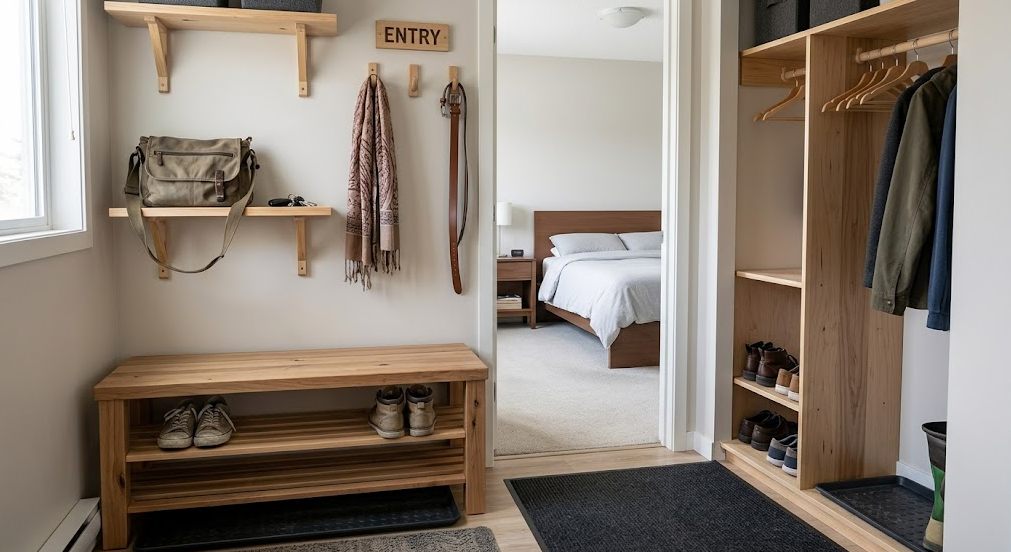
Begin With the Point of Use
The best storage location is often revealed by the last ordinary action involving the item.
- Shoes usually come off near an entrance, mudroom, garage door, or bedroom.
- A work bag may be packed near a desk but carried out through the entry.
- Belts may be selected beside clothing, while hats and gloves are chosen beside outerwear.
- Jewelry may be removed near a dresser, sink, or bedside table.
Notice where the object actually lands for several days. A tray placed where keys are removed may work better than a jewelry box across the room. A small shoe zone near the door may prevent daily footwear from migrating into a bedroom closet. If an item repeatedly ignores its assigned home, the location may be inconvenient rather than the household being careless.
One category can have more than one legitimate location. Daily shoes can remain near the entrance while occasion shoes stay in a bedroom closet. A frequently used tote can live near the door while travel bags occupy a higher shelf. The division should reflect use, not a rule that every similar object must share one container.
Give Every Item an Access Level
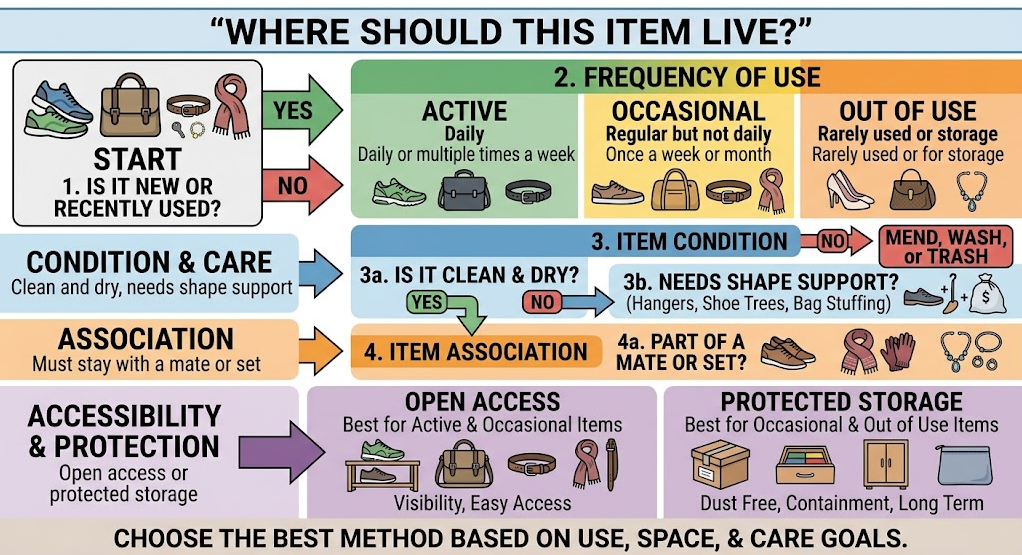
Before choosing shelves or hooks, divide each category into three access levels:
Active now
These are items used during the current week or season. They deserve the easiest reach and the clearest visibility. The active zone should have a capacity limit; when every pair of shoes or every bag becomes “active,” nothing remains easy to retrieve.
Occasional
These items serve a known purpose but are not needed weekly: formal shoes, an evening bag, a special belt, or travel accessories. They can occupy a less convenient but still identifiable place.
Out of current use
This group includes genuinely seasonal pieces and items awaiting a decision. Clean, dry items can move to protected storage. Anything damaged, outgrown, or no longer wanted should not consume long-term storage merely because it already has a container.
For a full seasonal transfer method, see Seasonal Clothing Rotation. The purpose here is only to decide which accessories need immediate access.
Store Shoes as Pairs, Not as a Pile
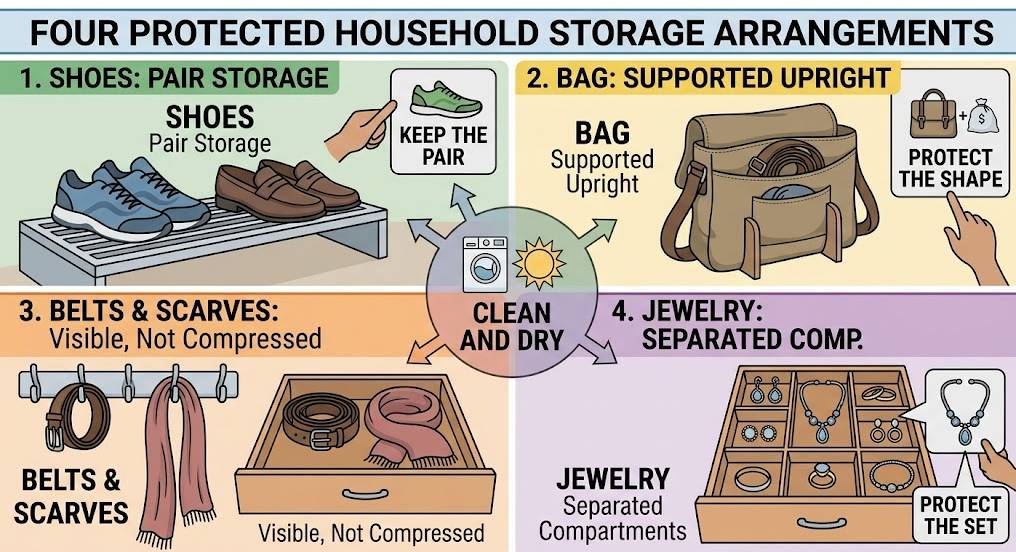
Shoes need enough structure to remain identifiable and enough separation to avoid being crushed. Start by pairing them. If one shoe is missing, put the single shoe in a short-term “mate missing” location rather than allowing it to travel through the closet.
From Jerome, EverydayWise Contributor
My daughter and son both play hockey, so skate care becomes a recurring problem every winter. Skates are footwear, but after practice they are soaked with sweat, and the odor becomes stronger over time even though the children are the ones wearing them. Hockey skates and ski boots also take up a great deal of room and are not easy to dry. Once snow boots are added, finding enough space to dry everything, control the smell, and store it properly becomes surprisingly difficult.
The passage above comes from Jerome’s experience managing a Canadian household in which several kinds of bulky winter footwear can return wet during the same week. It reveals a step that ordinary shoe-storage advice often skips: some footwear needs a transition zone before it is ready for its storage zone.
For skates, ski boots, snow boots, and other wet footwear, separate the return process into two locations when possible. The first is an open, suitable place where the pair can drain or dry without wetting other belongings. The second is its clean, dry storage location. Open fastenings and movable sections to improve access to the interior, and remove liners or insoles only when the manufacturer permits it. Follow the maker’s drying instructions; direct heat that is unsuitable for the materials can damage the footwear. Odor products should not replace drying and cleaning, and any product used inside specialized footwear should be compatible with the materials and the manufacturer’s care guidance.
Daily shoes can sit side by side on a low shelf, rack, or washable mat. Leave visibly wet or muddy footwear in an appropriate drying or cleaning area before moving it into enclosed storage. A closed box may hide clutter, but it can also hide the fact that a shoe was stored damp or dirty.
Avoid stacking shoes directly on one another when weight, dirt, hardware, or a rigid heel could mark or deform the pair below. The Canadian Conservation Institute gives museum collections much stricter instructions, including individual supports and archival materials, but its broad principles translate well to a household: support shape, keep shoes side by side, protect them from dust, and avoid crushing stacks. Its archival specifications and controlled storage conditions are not ordinary household requirements.
Shape support is most useful for footwear that collapses during storage. Use a clean insert or shoe tree appropriate for the material and manufacturer’s care instructions. Do not force an insert into a tight shoe. Tall boots may need gentle shaft support so they do not fold sharply, but the support should not stretch the material.
Transparent boxes, labels, or a simple photo on an opaque box can help with occasion shoes. The label should identify the pair clearly enough that the box does not need to be opened during every search.
Let Bags Rest Without Carrying a Load
A bag is storage while it is in use, but it becomes an object that needs storage when it is put away. Empty food, liquids, receipts, and loose items first. This prevents an old bag from becoming a second junk drawer and makes it ready for its next use.
Store bags in a way that supports the body rather than making the handles carry weight for months. A sturdy everyday bag may tolerate a suitable hook, but a delicate or heavy bag can distort when suspended. On a shelf, light, clean, colorfast filling can help a soft bag retain its form. Fill loosely; overpacking can stretch seams and closures.
Keep straps inside the bag or arranged so they do not snag neighboring items. Allow enough space that buckles, studs, and zippers do not press into another bag. Valuable, vintage, leather, or specialty materials may need manufacturer guidance or professional conservation advice; ordinary household methods should not be assumed safe for every finish.
Keep Long Accessories Visible Without Distorting Them
Belts, ties, and scarves are easy to lose because they occupy little volume but create visual overlap.
Belts can hang from a suitable belt hanger or lie in loose coils in a divided drawer. Avoid tight rolls that strain stiff material or hardware. If a buckle can scratch other pieces, give it separation.
Ties and scarves can hang, fold, or roll depending on the material and available space. The practical test is whether the method creates persistent creases, slipping piles, or a search through many layers. A shallow row often works better than a deep stack because the pattern remains visible.
Group these items by the way they are selected. Someone who chooses scarves by warmth may separate winter and light scarves. Someone who matches them by color may prefer a visible color sequence. The categories should shorten a real decision rather than create decorative order.
Protect Small Accessories From Tangling and Disappearing
Small items benefit from boundaries inside a drawer or on a tray. Earrings can remain as pairs; necklaces can be separated; watches and bracelets can have individual spaces. The goal is to prevent one movement from disturbing the entire collection.
Use shallow compartments when visibility matters. Deep containers encourage small objects to layer over one another. A lid can be useful for dust protection, travel, or household risks, but it adds a step. Reserve it for items that genuinely need protection rather than covering every daily object.
Keep valuable items in storage appropriate to their security and insurance needs. Store sharp pieces, small detachable parts, and long cords where children and pets cannot reach them. These decisions depend on the household; easy adult access should not override a foreseeable safety risk.
Preserve the Whole Set
Many searches begin because related pieces were stored according to different categories. A winter hat may be in the closet, its gloves in a drawer, and its matching scarf in a bin elsewhere.
Choose one of two approaches:
- Store the set together. This works when the pieces are almost always used as one unit.
- Store by category and create a location cue. A small label or written inventory can record where the companion piece lives.
The same choice applies to removable bag straps, shoe accessories, travel organizers, jewelry sets, and care supplies. Keep small replacement parts in a labeled packet attached to or stored immediately beside the main item when doing so is safe for the material.
Use Doors and Hooks Carefully
Vertical space can help, but it is not free space. Check the manufacturer’s installation method and load limit before hanging an organizer, rack, or hook. A door should still open fully, close correctly, and provide safe passage. Heavy bags should not make a lightweight door difficult to operate.
Keep heavy objects low enough that a fall is less hazardous. Avoid hooks that project into a walkway or catch loose clothing. Do not block vents, electrical equipment, emergency supplies, or an exit route. Renters should also confirm what mounting methods their lease permits.
If vertical storage becomes a dense wall of overlapping items, retrieval has failed even if everything technically fits. Reduce the active quantity or move occasional items elsewhere.
Choose an Organizer Only After the Location Works
Try the intended location with a temporary tray, open box, or marked shelf before buying a fitted organizer. One ordinary week will reveal whether the item returns there naturally, whether the space accommodates real quantities, and whether another person needs the same surface.
Once the location is proven, choose a storage method that matches the item. Hanger, Drawer, and Bin Storage Compared explains those tools in detail. Here, the important sequence is location first, item protection second, and product selection last.
Measure the available width, depth, height, door swing, and baseboard clearance. Count the pairs or pieces that truly belong in that zone. Product photographs often show fewer and smaller objects than a household owns.
Run a Departure-and-Return Test
Test the system with one normal outing:
- Can you find the shoes and every companion accessory without moving unrelated items?
- Can you remove one item without collapsing a stack?
- Is there a clear place for damp, dirty, or not-yet-ready items?
- Can everything be returned in a few simple motions?
- Does the storage protect shape and keep pairs complete?
If the departure is easy but the return is difficult, the system will gradually collect items outside their homes. Adjust the height, access, or capacity before adding another organizer. The longer-term routine belongs in How to Keep a Closet Organized After the Reset.
Decision Summary
Shoes and accessories stay organized when their storage reflects how they are used. Place active items near their point of use, protect vulnerable shapes, separate objects that can mark or tangle, and keep pairs or sets complete. Give occasional items a clearly identified secondary location.
A good result is not a closet in which every accessory is displayed. It is a system in which leaving and returning are both easy, the item is protected between uses, and the next search ends where it should begin.
FAQ
Should shoes be stored in boxes or on open shelves?
Either can work. Open shelves improve visibility and everyday access; boxes offer dust protection and stacking structure. Store shoes clean and dry, label opaque boxes, and avoid arrangements that crush footwear or require opening many boxes to find one pair.
Is it okay to stack shoes?
Direct stacking can transfer dirt and deform some shoes. Side-by-side storage or individual compartments are safer for pairs that can be marked, crushed, or bent.
Should handbags be hung by their handles?
It depends on the bag’s weight, construction, and manufacturer guidance. Long suspension can stress delicate handles. Supporting the bag on a shelf is often more suitable for heavy, structured, valuable, or rarely used bags.
How can I keep necklaces from tangling?
Separate them so one necklace can be removed without moving the others. Individual shallow compartments, suitable hooks, or separate pouches can work, depending on the material and household safety needs.
Where should hats, gloves, and scarves be stored?
Frequently used outerwear accessories usually work best near the exit used most often. Occasion or out-of-season pieces can move to protected secondary storage. Keep sets together when they are normally worn together.
Do I need special archival materials for ordinary shoes and bags?
Usually not. Museum guidance is designed for long-term preservation of collection objects. For ordinary belongings, begin with clean, dry storage, gentle shape support, separation from damaging hardware or dirt, and the maker’s care instructions. Seek specialist advice for valuable or fragile objects.
What should I do if the organizer is already full?
Do not compress more items into it automatically. Confirm which pieces need active access, move occasional items to a labeled secondary location, and review damaged or unused items before buying more storage.
Sources
- Canadian Conservation Institute. “Storage for Costume Accessories – CCI Notes 13/12.” Government of Canada. https://www.canada.ca/en/conservation-institute/services/conservation-preservation-publications/canadian-conservation-institute-notes/storage-costume-accessories.html