When should winter coats go into storage? The calendar offers a date, but it cannot tell a household whether next week will bring one cold morning, three wet school days, or a trip into a different climate.
A more useful question is which clothes still need immediate access during the transition. Seasonal rotation works better as a gradual change in access than as one day when an entire wardrobe changes places.
From Jerome, EverydayWise Contributor
Seasonal clothing felt clearer when I lived in Korea. Summer was hot enough that winter clothing could be put away, with only an occasional light outer layer needed. In winter, shorts had no practical role. After moving to Canada, I found that thick outerwear could remain useful much longer. In spring, I would hesitate over whether to move it to basement storage, push it into the deepest part of the closet, or keep it near the entrance. With children growing at the same time, every exchange also revealed clothes that no longer fit and clothes that might or might not work for the next child.
The passage above comes from an EverydayWise contributor’s household experience. It shows why a rotation system needs room for overlap. Weather, travel, work, school, growth, and storage conditions may change on different schedules.
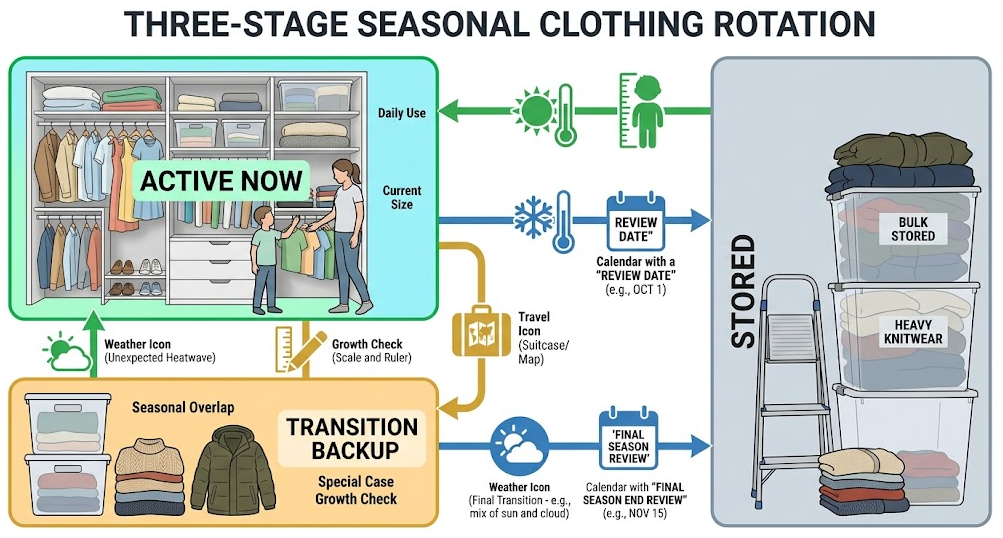
Quick decision: Divide clothing into three groups: active now, transition backup, and stored. Keep the next two to four weeks of likely clothing accessible, including a small weather-overlap set. Clean and dry everything before longer storage, inspect garments and the storage location, label by person, season, size, and review point, and complete the exchange in bounded sections rather than emptying every closet at once.
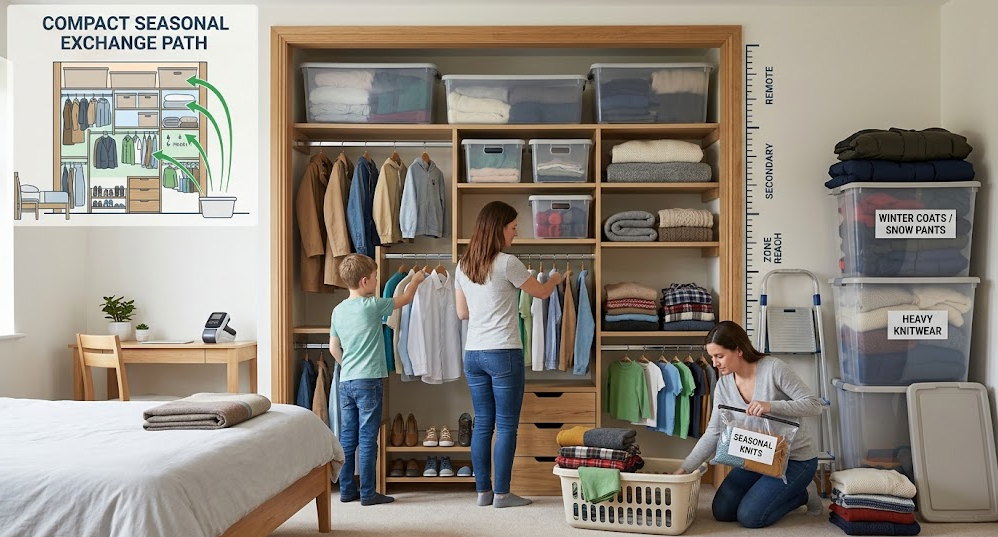
Use Three Access Levels Instead of Two Seasons
A simple “in season” and “out of season” split works only when the boundary is dependable. Many households need a third level between the everyday closet and remote storage.
Active now
These are the clothes likely to be used during ordinary life in the next two to four weeks. They receive the easiest rail, shelf, drawer, and entryway positions.
Transition backup
This is a limited bridge for plausible weather changes and near-term events. It might contain one warm coat after most winter clothing has moved, a light rain layer before summer, or a few warmer items during an early autumn cold spell. The group should be small enough to remain identifiable.
Stored
These garments have no credible near-term use and can move to a less accessible location. They still need a safe environment, a clear label, and a future review point.
The three levels prevent one uncertain forecast from keeping an entire previous-season wardrobe in prime space. They also reduce the chance that a household must reopen several containers to find one coat.
The two-to-four-week window is an EverydayWise planning tool, not a meteorological rule. Shorten or extend it according to local forecast reliability, travel, work requirements, health needs, children’s routines, and the cost of being without a particular garment.
Choose the Rotation Trigger From Real Conditions
Rotation does not need a universal date. It can begin when several signals appear together:
- daily weather has changed enough that another clothing group is being used repeatedly;
- the current closet is crowded by clothes no longer being chosen;
- school, work, sport, or travel routines are changing;
- children need a size check before the next weather period;
- the storage area will soon become difficult to access; or
- the household has time to wash, dry, inspect, label, and finish the exchange.
A single warm afternoon is weak evidence that every cold-weather item can leave. Several weeks of changed use, supported by the local forecast and upcoming plans, provide a stronger reason to rotate.
Use a calendar reminder as a review prompt rather than an automatic moving day. A spring reminder might ask: “Which heavy items have not been used for three weeks, and what cold-weather backup still has a credible role?” An autumn reminder can prompt a fit and condition check before the first urgent morning.
This approach preserves household judgment. The system supplies a review point; the household decides what current conditions require.
Rotate One Bounded Section at a Time
Seasonal exchanges can spread quickly. Coats leave the entry closet, storage bins come upstairs, children’s clothes cover a bed, and laundry waits beside garments that still need repair or a decision.
Use the controlled-session method from Article”How to Declutter Without Making a Bigger Mess”. Choose one boundary:
- one person’s outerwear;
- one child’s everyday clothing;
- one rail section;
- one drawer category;
- one labelled storage container; or
- one activity, such as school or outdoor work.
Prepare destinations before removing anything:
- active now;
- transition backup;
- store after cleaning;
- wrong size or fit review;
- repair or condition decision;
- another person’s item; and
- donate, recycle, or discard through the appropriate later decision.
Finish that section before opening another container. Return active clothing, place the transition group, complete the storage preparation, and move decision items into clearly bounded next steps.
The purpose of this sequence is continuity. The household should still be able to dress, leave home, and use the room while the larger rotation progresses.
Build the Transition Group Around Consequences
An overlap garment earns accessible space when being without it would create a credible near-term problem. Useful questions include:
- Could local weather make this necessary before the next review?
- Is there a planned trip, ceremony, activity, or work requirement?
- Would another accessible garment serve the same purpose?
- Can this item be retrieved from storage without reopening the whole system?
- Does keeping it here block clothing used more often?
Jerome’s Canadian experience suggests a practical compromise: a household can move most bulky winter volume away while retaining a small, deliberate outerwear bridge. The choice is narrower than deciding whether “winter is over.”
Give the transition group a defined location. A short rail section, one shelf, or one labelled container keeps overlap from expanding back into the entire closet. Set a second review date. When the backup period passes, move the remaining garments together rather than allowing them to become forgotten permanent residents of the primary zone.
Check Fit Before Clothing Disappears Into Storage
Children’s clothing can change size between the end of one season and the return of the next. Adult clothing may also stop fitting because bodies, health needs, work, or preferences change.
Before storing a garment for months, ask:
- Does it fit now?
- Is it likely to fit the intended person when it returns?
- Is it comfortable and appropriate for that person’s current life?
- Does it need repair before storage?
- Is there a specific hand-me-down recipient, or only a vague possibility?
- Would a future label make the size and intended person clear?
Jerome has an older daughter and a younger son. Some unisex clothes can move between them, but not every outgrown item has a realistic hand-me-down path. Separating “next child—specific size” from “maybe useful” keeps the storage label honest.
Do not require children to decide every item in one long session. A limited group of current favourites, disliked items, and uncertain pieces may produce better information. Decisions about another person’s belongings still require consent, as discussed in Article”Decluttering When You Share a Home“.
The detailed question of how many garments to keep, including body-size change and rarely worn clothing, belongs to Article”How Many Clothes Do You Really Need?”. During rotation, the immediate task is to prevent obviously wrong-size or ownerless clothing from being stored as if its future use were settled.
Clean, Dry, and Inspect Before Longer Storage
Storage pauses ordinary handling, so small problems may remain hidden for months. Examine each garment for dampness, soil, food residue, stains, damaged seams, missing fasteners, and signs of insects or mould.
Follow the care label and use an appropriate cleaning method for the garment. Allow items to dry completely before closing them into a container. Recently worn outerwear, footwear, and weather-exposed clothing may need additional drying time even when the surface feels dry.
Canadian Conservation Institute guidance is designed for museum and collection textiles, so its preservation methods exceed what an ordinary wardrobe usually requires. Its underlying cautions are still useful: textiles can be damaged by excess moisture, mould, insects, dust, unsuitable supports, and poor storage conditions. The Institute advises storing textiles clean and dry in a cool, dark, dry location with ventilation.
If active mould or insect activity is suspected, isolate the affected garment from the rest of the wardrobe and address the underlying environment before returning it. Do not use improvised chemical treatments that may harm people, pets, or fabrics. Significant contamination or recurring building moisture may require appropriate local professional help.
Cleaning is not a reason to delay every rotation indefinitely. If a garment cannot be prepared during the session, give it a visible “clean before storage” destination and deadline rather than mixing it into the completed container.
Evaluate the Storage Location, Not Just the Container
A strong container cannot correct every environmental problem. Before moving clothing to a basement, attic, garage, under-bed space, spare room, or deep closet shelf, inspect the location.
Look for:
- current or past water entry;
- condensation or persistent dampness;
- large temperature swings or nearby heat;
- signs of insects or rodents;
- direct light;
- dust and dirt;
- sharp edges or unfinished surfaces;
- weight and stacking stability;
- safe access without climbing on furniture; and
- whether a leak, odour, or damaged container would be noticed.
The Canadian Conservation Institute explains that dark, undisturbed textile storage can provide favourable conditions for clothes moths and carpet beetles, especially where vulnerable fibres or soils are present. Household clothing is not a museum collection, but long, undisturbed storage still benefits from cleanliness and periodic inspection.
Do not place heavy containers where retrieving them requires uncontrolled lifting. Follow shelving and container weight limits, keep routes clear, and avoid blocking building equipment, vents, electrical panels, or emergency access.
Detailed comparisons of bins, drawers, garment bags, and hangers belong to Article”Hanger, Drawer, and Bin Storage Compared”. The rotation decision at this stage is whether the location is clean, dry, stable, inspectable, and realistically accessible.
Label for the Next Retrieval
“Winter clothes” may be clear on storage day and unhelpful six months later. A useful label answers the questions the future household will ask.
Include:
- person or owner;
- clothing category;
- size when relevant;
- season or conditions served;
- date stored;
- next review point; and
- any unresolved action, such as “repair zipper before use.”
Examples:
- “Mina—winter school layers—current size—stored May 2026—review September.”
- “Adult formal clothing—clean—review before December event.”
- “Younger child—next-size unisex tops—verify fit before autumn.”
Maintain a simple location note if clothing is distributed across several places. The record can be a phone note, a paper list inside the main closet, or a photograph of labels. Its job is to prevent rebuying or opening every container during the first weather change.
Avoid inventory detail that no one will update. A container-level record is usually enough unless individual garments are valuable, rare, borrowed, or otherwise require closer tracking.
Bring the New Season In Deliberately
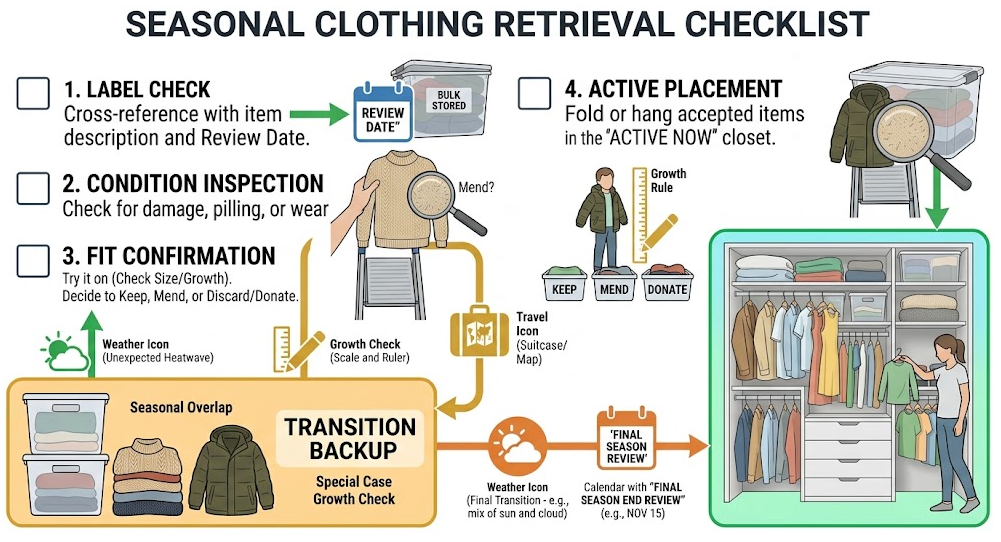
Retrieval is a review, not an automatic return of every stored item.
As each garment comes out:
- Check the label and intended person.
- Inspect for odour, moisture, mould, insects, staining, or damage.
- Confirm fit, comfort, and present use.
- Follow the care label if refreshing or cleaning is needed.
- Place active clothing into the accessible zone established in Article”How to Organize a Small Closet”.
- Keep a limited transition group from the previous season.
- Route unresolved items without mixing them into current clothing.
If a stored container shows moisture, insects, or mould, pause the exchange and keep its contents separated until the source and safe response are understood. Moving affected garments directly into the closet can spread the problem.
Complete the Rotation With a Handoff Note
A rotation is complete when the current closet works, the transition group has a limit and review date, stored garments are clean and labelled, and decision items have named next steps.
Record three pieces of information:
- what remains in transition and when it will be reviewed;
- where stored clothing is located; and
- which fit, repair, donation, or replacement decisions remain open.
Jerome’s family usually performs a larger clothing review around summer or winter. The durable part of that practice is not the size of the event. It is the opportunity to bring weather, children’s growth, actual use, and storage capacity into the same decision.
A well-run rotation leaves the household prepared for the next likely conditions without requiring every possible garment to occupy immediate space.
FAQ
How often should seasonal clothing be rotated?
Review it when weather, routines, travel, children’s growth, or closet crowding materially changes. A calendar reminder can start the review, but the actual movement should reflect local conditions and near-term use.
What clothes should stay out between seasons?
Keep a limited transition group for credible weather changes, travel, work, school, and planned events. Choose items that cover the likely gap without returning the previous season’s full volume to prime space.
Should seasonal clothes be washed before storage?
Follow each care label and store clothing clean and completely dry. Soil, food residue, moisture, and existing damage may worsen or attract pests during long, undisturbed storage.
Can I store clothes in a basement, attic, or garage?
Only after evaluating the actual location. Check for water entry, dampness, temperature extremes, pests, dust, light, unstable stacking, and safe access. A sealed container does not make a persistently unsuitable location safe for every garment.
How should I store clothes children may grow into?
Label them by intended child, category, size, date stored, and review point. Keep only items with a credible hand-me-down path, and verify fit and preference when the season returns rather than assuming every stored item will be used.
What should I do if I find moths or mould during rotation?
Separate affected garments from other clothing and investigate the storage environment before returning anything. Avoid guessing at chemical treatments. Recurring moisture, extensive mould, or a significant infestation may require appropriate local professional assistance.
Sources
- Basic Care — Textiles — Canadian Conservation Institute
- Textiles and the Environment — Canadian Conservation Institute