QQQ, QLD, and TQQQ all track the same underlying index — the Nasdaq-100 — but they are structurally very different products. Understanding that difference matters more than the headline return numbers, because two of these three funds can lose the vast majority of their value in a downturn that QQQ would survive relatively intact.
This article is educational, not investment advice. It explains how these funds are built and what the historical numbers show — it isn’t a recommendation to buy any of them. Leveraged ETFs in particular carry risks that make them unsuitable for many investors, and past performance never guarantees future results.
What Each Fund Actually Is
- QQQ (Invesco QQQ Trust): Tracks the Nasdaq-100 directly, with no leverage. If the index goes up 1% in a day, QQQ goes up roughly 1%.
- QLD (ProShares Ultra QQQ): A 2x daily leveraged fund. If the Nasdaq-100 goes up 1% in a day, QLD aims to go up roughly 2%. The reverse is also true on down days.
- TQQQ (ProShares UltraPro QQQ): A 3x daily leveraged fund. A 1% daily move in the index aims to become roughly a 3% move in TQQQ, in either direction.
The word “daily” is doing a lot of work in those descriptions, and it’s the single most important thing to understand before looking at any return numbers.
Why “Daily” Leverage Doesn’t Mean “3x Over Time”
This is the part that trips up a lot of people, including in content that promotes these funds without fully explaining it. QLD and TQQQ reset their leverage ratio every single day, not once at purchase. Over a single day, that math works cleanly. Over months or years in a choppy, sideways, or highly volatile market, the daily resets can cause the fund’s long-term return to diverge significantly from “2x” or “3x” of the index’s actual return over that same period — a phenomenon often called volatility decay or “leverage decay.” In a strong, consistent uptrend, this effect works in the leveraged fund’s favor. In a choppy or declining market, it works against it, sometimes severely.
10-Year Performance (as of mid-2026)
Based on data compiled from ETF analytics providers as of mid-2026:
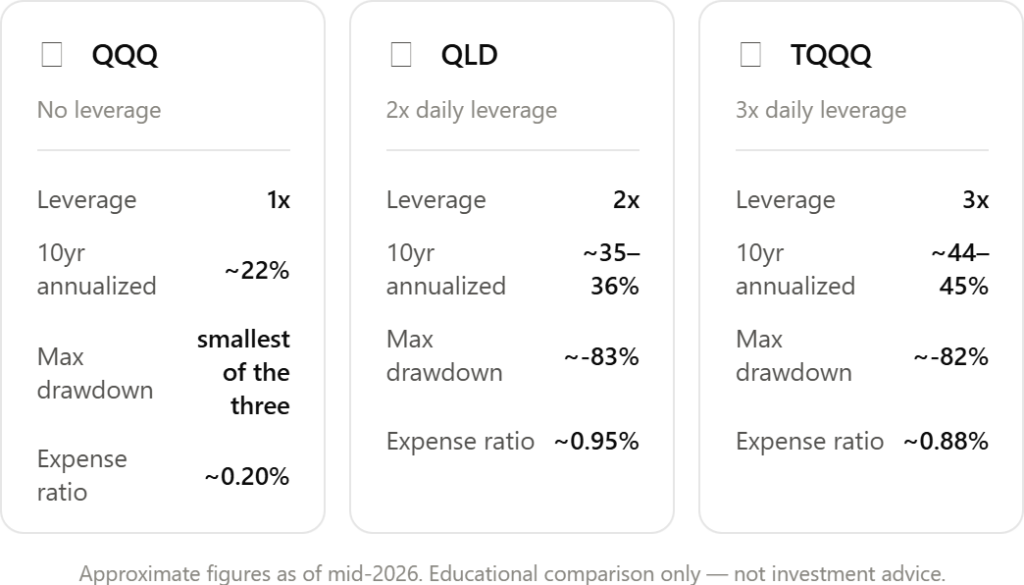
A few things to notice here:
- The leveraged funds’ long-term annualized returns are not simply 2x or 3x QQQ’s return — QLD’s ~35% isn’t exactly double QQQ’s ~22%, and TQQQ’s ~44% isn’t exactly triple it. This is a direct, visible result of the volatility decay effect described above.
- The drawdowns are severe. A roughly -82% to -83% maximum decline means an investor who bought at the peak would have needed a gain of well over 400% just to get back to even — a very different risk profile than QQQ.
- These 10-year windows happen to cover a period with a strong, sustained bull market in tech stocks. That’s precisely the environment where leverage decay works in the leveraged funds’ favor. A different 10-year window — one with more sideways or declining periods — would likely tell a very different story.
The 2022 Downturn: A Real Stress Test
2022 offers a useful real-world example of how these funds behave in a bad year. During that downturn, QLD and TQQQ both experienced dramatically larger declines than QQQ — consistent with their leverage multiples, and then some, due to daily compounding effects during a volatile, declining period. Recovering from a decline of that size requires a proportionally much larger subsequent gain, which is a mathematical reality that applies regardless of which fund eventually “wins” over a longer stretch.
Volatility and Fees
- Volatility: TQQQ has meaningfully higher volatility than QLD, which in turn has meaningfully higher volatility than QQQ. Higher volatility means larger day-to-day swings in both directions.
- Expense ratios: All three carry higher costs than a typical broad-market index fund, with the leveraged funds (QLD, TQQQ) generally charging close to 1% annually — significantly more than QQQ’s expense ratio.
What This Means in Practice
These structural differences matter most in two scenarios:
- Lump-sum investing near a market peak: A large investment in a leveraged fund right before a downturn can produce losses far more severe, and recoveries far slower, than the same investment in QQQ.
- Long holding periods through volatile or sideways markets: Because of daily leverage resets, leveraged funds are generally built and marketed as short-to-medium-term tactical tools, not standard long-term buy-and-hold core holdings — a distinction that’s easy to miss in content that only highlights strong bull-market returns.
Dollar-cost averaging (investing a fixed amount on a regular schedule) is sometimes discussed as a way to manage this volatility, since it spreads purchases across both up and down periods rather than risking a single lump-sum entry at a market peak. It doesn’t eliminate the underlying leverage decay risk, though, and a severe, prolonged downturn can still meaningfully erode returns even with a consistent purchase schedule.
FAQ Section
Is QLD just “half as risky” as TQQQ since it’s 2x instead of 3x? It’s meaningfully less risky by several measures (lower volatility, historically smaller — though still severe — drawdowns), but “half as risky” oversimplifies it. Both carry substantially more risk than an unleveraged fund like QQQ, and both are subject to the same daily-reset leverage decay mechanics.
Why did QLD’s 10-year return come out to roughly 35–36% instead of exactly double QQQ’s ~22%? This is the leverage decay effect in action. Daily leverage resets mean long-term leveraged fund returns don’t scale as a clean multiple of the underlying index’s return, especially over periods that include both up and down volatility, not just a smooth uptrend.
Are leveraged ETFs meant to be held for years, like a typical index fund? Many financial professionals and the funds’ own documentation generally describe leveraged ETFs as tools designed for short-term tactical use, precisely because of how leverage decay behaves over longer holding periods in non-trending markets. Whether a longer holding period is appropriate depends heavily on an individual’s risk tolerance, time horizon, and overall financial situation.
Should I buy QQQ, QLD, or TQQQ? This article can’t answer that for your specific situation, and we’re not a licensed financial advisor. The right choice depends on your risk tolerance, investment timeline, financial goals, and overall portfolio — a licensed financial advisor can help you evaluate that in the context of your full financial picture.
This article is for general educational purposes only and does not constitute financial or investment advice. Historical returns and drawdown figures are approximate, sourced from third-party ETF analytics providers as of mid-2026, and are subject to change. Past performance does not guarantee future results. Leveraged ETFs carry substantial risk and may not be suitable for all investors — consult a licensed financial advisor before making investment decisions.