A kitchen sink can smell bad for several completely different reasons. Food may be trapped in a strainer. Grease may be coating the drain opening. Residue may be hidden beneath a garbage-disposal splash guard. A rarely used drain may have lost the water seal in its trap. Or the smell may signal a blockage, leak, venting problem, or sewage backup that cleaning cannot correct.
EverydayWise founder Jerome remembers a period when frequent home cooking and packed lunches helped his two-income immigrant household reduce food costs, but cleanup gradually became difficult to manage. Skipping the dishes once or twice allowed dirty cookware and utensils to accumulate. At times, the kitchen smelled when the family returned home, and the larger the task became, the easier it was to postpone again. He and his wife later divided cooking and dishwashing responsibilities more clearly, which made the kitchen more manageable.
That experience does not establish where the smell originated, whether the home had a disposal, or whether there was a plumbing fault. It does show why an odour problem should be divided into two decisions: What is producing the smell, and what is the smallest routine that will keep the same source from rebuilding?
Practical rule: Remove visible organic material first, identify the source before adding a product, and stop treating the problem as cleaning when drainage, plumbing, gas, or electrical warning signs appear.
First, Decide Whether the Smell Is the Sink
Do not begin by pouring a deodorizer down the drain. Start with a simple location test.
Fill a clean glass with cold water, move into another room, and smell the water there. The United Kingdom’s Drinking Water Inspectorate advises that if a stagnant or sewage-like smell disappears away from the sink, the sink or drain is the more likely source. If the odour remains in the glass, the water or household plumbing may need investigation.[1]
Then narrow the location:
- Dishes, cloths, sponges, or food waste: The smell is strongest above the basin or beside accumulated items.
- Sink surface or strainer: The odour remains after the dishes are removed but is strongest around visible residue.
- Drain opening: The smell is strongest directly above the drain, often with a greasy ring or trapped food.
- Garbage disposal: The smell is concentrated at the disposal opening or rubber splash guard.
- Overflow opening: On sinks equipped with one, odour is strongest near the overflow channel.
- Under the sink: The cabinet smells stronger than the basin, or there is moisture, staining, swelling, corrosion, or pest evidence.
- Plumbing system: The sink drains slowly, gurgles, backs up, smells like sewage repeatedly, or changes when another fixture operates.
Also note the pattern. An odour that appears only after dirty dishes sit overnight points toward accessible organic material. One that follows disposal use may point toward retained debris or operating practice. A smell from a seldom-used sink after a long absence may involve a dry trap. A persistent sewage odour from a frequently used sink deserves a plumbing assessment rather than endless deodorizing.
If the smell resembles natural gas, fuel, overheated wiring, or burning plastic, do not continue this cleaning sequence. Leave the area as appropriate and contact the local emergency service, gas utility, fire service, electrician, landlord, or building manager. Do not use an odour article to distinguish a potentially dangerous gas by smell alone.
Remove What Is Sitting Above the Drain
The nearest source is usually the safest place to begin.
Move dishes to a stable sorting area. Discard food into the appropriate waste or compost stream rather than washing large solids down the drain. Wash the dishes or load them into the dishwasher according to their material and appliance instructions. Remove and launder or replace sour cloths and sponges.
If a large backlog has become discouraging, use a short sequence:
- discard food and empty containers;
- group sharp items where they can be seen;
- wash cups and utensils needed for the next meal;
- clear one basin or work zone;
- wash the remaining items by type; and
- clean the sink only after the dishes are out.
This is not a lower hygiene standard. It is a way to restore a functional washing area without pretending the whole kitchen must be corrected in one burst. Wear gloves if spoiled food, broken glass, sharp utensils, or irritating residue may be present. Never reach blindly into cloudy water.
Jerome’s experience reached a point where only a few utensils were sometimes washed for the next meal while the rest remained. The useful lesson is not that a particular person failed. It is that the available routine no longer matched the cooking volume and household workload. Clearing the sink solves today’s smell; changing the handoff between cooking and cleanup is what can stop the same backlog from returning.
Clean the Basin According to Its Material
Once the sink is empty, remove the strainer, stopper, rack, and removable accessories. Scrape or wipe food into the waste bin. Wash accessible pieces with warm water, mild dishwashing liquid, and a soft cloth or non-scratch sponge unless their manufacturer directs otherwise.
Do not assume every sink tolerates the same pad or chemical. Stainless steel, enameled cast iron, fireclay, quartz composite, solid surface, copper, and natural stone can react differently to acids, chlorine, abrasives, metal tools, and prolonged soaking. Elkay, for example, recommends mild liquid dish detergent, thorough rinsing, and drying with a soft cloth for its stainless-steel sinks, while warning against abrasive cleaners and cloths.[2] That is a useful mild starting point, but the reader’s own sink instructions control.
Use this general sequence:
- rinse away loose soil;
- apply the approved mild cleaner to a cloth or sponge;
- clean the basin, rim, faucet base, drain flange, and strainer contact area;
- use a soft detail brush around approved seams and removable parts;
- rinse all cleaner away; and
- dry the surface and accessories before reassembly.
Do not treat staining, scratched finish, failed sealant, corrosion, chipped enamel, or a loose drain flange as odour alone. Cleaning may reveal damage without being able to repair it.
Clean the Drain Entrance Without Creating a Chemical Experiment
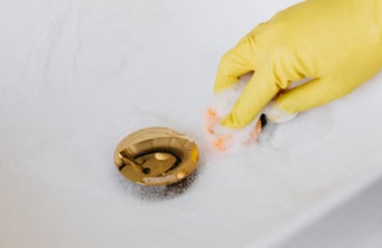
Food residue and biofilm can collect on the strainer basket, stopper, drain flange, and the accessible wall just below the opening. Remove only parts designed for routine owner removal. Wash them separately, then clean the accessible entrance with mild dish soap and a narrow non-metal brush that cannot fall into the drain.
Flush with the water temperature and flow appropriate for the plumbing and any attached appliance. A flush can carry away loosened residue; it does not prove a deeper clog has cleared.
Be cautious with popular combinations. Baking soda followed by vinegar produces visible fizzing, but the reaction is not evidence that a blockage has been removed or the drain disinfected. More importantly, a drain may already contain another product. Health Canada warns never to mix bleach with household cleaners, including acids such as vinegar or products containing ammonia, because toxic gases can form.[3]
Use only one drain product at a time, exactly as its label permits, and only when it is compatible with the plumbing, septic system, disposal, and known material already in the drain. Do not add bleach after vinegar, ammonia, a drain opener, or an unknown cleaner. Ventilate as directed, keep children and pets away, and preserve the product label if a plumber may need to know what was used.
If a chemical drain opener has already been added, do not plunge, dismantle the trap, or add another product without following its label and obtaining appropriate guidance. Splashing corrosive liquid can turn an ordinary clog into an injury risk.
If There Is a Garbage Disposal, Treat It as an Appliance
A disposal adds hidden surfaces and moving components. Find its brand, model, manual, and power arrangement before cleaning it.
Turn the unit off and disconnect power as the manufacturer directs before touching a removable baffle or putting a tool near the opening. Never put a hand into the grinding chamber, even when the switch is off. InSinkErator and Moen both give this warning; Moen directs users to use tongs or pliers for visible objects when its instructions permit removal.[4][5]
For an odour on a compatible model:
- Confirm that the sink and disposal drain normally.
- Disconnect power.
- Remove the splash guard only if the manual says it is removable.
- Clean the underside of the guard or baffle and the accessible upper lip using the manufacturer-approved method.
- Rinse and reinstall the part securely.
- Restore power only after tools and hands are clear.
- Operate the unit with the prescribed water flow.
Moen identifies the underside of the splash guard as a place where odour-causing residue can collect and requires power to be cut before removal.[4] InSinkErator similarly directs owners to disconnect power before cleaning its baffle and says never to put a hand into the disposal.[5] Model instructions still decide whether the guard comes out, which pad or cleaner is compatible, and how the chamber is flushed.
Do not pour fat, oil, or grease into a disposal. InSinkErator instructs users to run cold water, start the unit before gradually adding appropriate food waste, and avoid feeding a large volume at once.[6] Do not assume citrus peels, ice, bleach, drain cleaner, or a commercial disposal product is safe for every unit. Follow the manual and product label.
Stop if the disposal hums without turning, trips repeatedly, leaks, smells electrical, has a damaged guard, or fails to drain. A jammed or leaking appliance needs model-specific troubleshooting or qualified service, not a stronger deodorizer.
Check an Overflow Channel Only If the Sink Has One
Some sinks contain an overflow opening and concealed channel; many kitchen sinks do not. If one is present, residue can accumulate where ordinary wiping does not reach.
Consult the sink manual before inserting a brush or product. Clean only the accessible opening and removable cover with a compatible method. Do not force a rigid object into the channel, flood the cabinet, or assume an overflow from another sink design is assembled the same way.
If water appears under the sink during testing, the channel leaks, or the smell persists inside an inaccessible passage, stop and arrange appropriate repair.
Understand What the P-Trap Can and Cannot Explain
The curved pipe beneath a sink normally retains water. That water seal helps keep sewer gases from entering the room. The City of Calgary notes that traps in sinks and other fixtures can dry out, breaking the water seal and allowing sewer gas to escape.[7]
For a genuinely seldom-used sink, running water may refill a dry trap. Observe from a safe position for leaks, and confirm that the smell diminishes. This explanation is less convincing for a kitchen sink used repeatedly every day. A persistent sewage smell in a frequently used fixture can involve a leak, failed connection, blockage, siphoned trap, venting fault, or another plumbing defect.
Do not dismantle the P-trap simply because it is visible. It may contain hot water, sharp debris, grease, sewage, or a chemical drain product, and an incorrect reassembly can leak. In a rental or multi-unit building, report the problem according to the lease and building process rather than altering shared plumbing without authorization.
Call a qualified plumber or the responsible building contact when there is:
- recurring sewage odour after accessible cleaning;
- slow drainage or repeated blockage;
- gurgling, especially when another fixture operates;
- water or sewage backing up into the sink;
- moisture, staining, swelling, corrosion, or mold under the sink;
- a trap or connection that appears loose, cracked, missing, or incorrectly configured;
- an odour spreading beyond one fixture; or
- uncertainty about chemicals already present in the line.
The City of Calgary describes sewage or dirty water rising through a sink or drain as a sewer backup and advises treating it as a wastewater problem, not ordinary cleaning.[8]
Build a Small Odour-Prevention Routine
Once the source is removed or repaired, prevention should match the actual cause.
After cooking
- scrape food into the appropriate waste stream;
- wash or load high-residue cookware before it dries in place;
- empty and rinse the strainer;
- operate a disposal only as its manual directs; and
- wipe standing residue from the basin and rim.
At the end of the day
- leave at least one basin usable;
- remove wet food scraps, cloths, and sponges;
- check that the sink drains normally; and
- assign any remaining dishes to a specific next step rather than an undefined “later.”
When the smell returns
- locate it again instead of automatically repeating the last remedy;
- record whether it follows certain foods, disposal use, absence, rain, or another fixture;
- check for slow drainage, gurgling, leaks, or backup; and
- escalate when the pattern points below the accessible cleaning zone.
Jerome’s household improved after cooking and dishwashing responsibilities were divided more clearly. Another household may alternate days, clean while cooking, run a dishwasher after dinner, or use a ten-minute reset. The correct system is the one that gives the cooking load a realistic cleanup path without placing technical plumbing work on an ordinary household routine.
Decision Summary
- Test whether the smell follows a glass of water away from the sink.
- Locate the odour among dishes, cloths, basin, drain entrance, disposal, overflow, cabinet, or plumbing.
- Remove visible food and restore one usable washing zone before deep-cleaning.
- Clean the sink according to its material and manufacturer instructions.
- Wash removable strainers and accessible drain parts without pushing debris deeper.
- Never mix cleaning products or add a chemical when the drain’s contents are unknown.
- Disconnect power and never put a hand into a garbage disposal.
- Refill a dry trap only when low use makes that explanation plausible.
- Treat persistent sewage smell, gurgling, slow drainage, leakage, or backup as a plumbing problem.
- Prevent recurrence with a small, clearly owned cleanup routine rather than waiting for a perfect reset.
FAQ
Why does my kitchen sink smell even after I cleaned the basin?
The source may be the strainer, stopper, drain entrance, garbage-disposal splash guard, overflow channel, cabinet leak, trap, or deeper plumbing. Localize the smell and note slow drainage, gurgling, leaks, or backup before repeating a cleaner.
Can I pour baking soda and vinegar down a smelly drain?
Do not use fizzing as proof that a clog is cleared or a drain is disinfected. First identify what is in the drain and check material, disposal, septic, and product compatibility. Never combine vinegar or another acid with bleach, and never add a second cleaner to an unknown product.
How do I clean a smelly garbage disposal safely?
Follow the specific disposal manual. Disconnect power before cleaning a removable splash guard or baffle, and never place a hand in the unit. Use only the model-approved cleaning method and obtain service for jams, leaks, electrical odour, repeated trips, or drainage failure.
Does a sewage smell mean the P-trap is dry?
It can when a drain has not been used for a long period and the water seal has evaporated. It is less persuasive for a frequently used kitchen sink. Persistent sewage smell, gurgling, slow drainage, leaks, or interaction with other fixtures requires plumbing investigation.
How can I tell whether the smell is in the water or the drain?
Fill a clean glass with cold water and take it into another room. If the smell disappears, the sink or drain is more likely. If it remains in the glass, contact the water provider, building contact, or a qualified plumber for appropriate investigation.
When should I call a plumber for a smelly kitchen sink?
Call when odour persists after accessible cleaning, the sink drains slowly or gurgles, water or sewage backs up, there is leakage or cabinet damage, the smell affects several fixtures, the trap or connections appear defective, or drain chemicals make safe work uncertain.
References
[1] Drinking Water Inspectorate. “Taste and Odour in Drinking Water.” https://www.dwi.gov.uk/consumers/learn-more-about-your-water/taste-and-odour-in-drinking-water/
[2] Elkay. “Stainless Steel Sink Cleaning and Care Tips.” https://helpcenter.elkay.com/s/article/Stainless-Steel-Sinks-Clean-Care
[3] Health Canada. “Reduce Your Risk from Toxic Gases: Never Mix Bleach with Other Cleaning Products.” https://recalls-rappels.canada.ca/en/alert-recall/reduce-your-risk-toxic-gases-never-mix-bleach-other-cleaning-products
[4] Moen. “How Do I Eliminate Odors in a Garbage Disposal?” https://solutions.moen.com/Article_Library/How_do_I_Eliminate_Odors_in_a_Garbage_Disposal
[5] InSinkErator. “There’s an Odor Coming From Garbage Disposal.” https://support.insinkerator.com/app/answers/detail/a_id/521/~/theres-an-odor-coming-from-garbage-disposal
[6] InSinkErator Canada. “Garburators.” https://www.insinkerator.com/en-ca/insinkerator-products/garbage-disposals
[7] City of Calgary. “Home Maintenance – Electrical, Plumbing and Gas Systems.” https://www.calgary.ca/property-owners/home-maintenance.html
[8] City of Calgary. “Sewage Backups.” https://www.calgary.ca/water/wastewater/sewage-backup.html
This article provides general household-cleaning, appliance-safety, and plumbing-triage information. Sink materials, disposals, drainage systems, septic systems, product labels, and local responsibilities vary. Follow the sink and appliance manuals and every chemical label. For suspected gas, chemical exposure, electrical danger, sewage backup, persistent sewer gas, leakage, or inaccessible plumbing defects, leave the area when appropriate and contact the relevant emergency service, poison centre, utility, landlord, manufacturer, plumber, electrician, or qualified technician.
More in This Cluster: Kitchen Cleaning
- How to Degrease Kitchen Cabinets Without Damaging Them
- How to Clean an Oven Safely Without Damaging It
- How to Clean and Maintain a Dishwasher Properly
- How to Clean a Refrigerator Properly and Reset What You Store
- How to Remove Kitchen Sink Odours by Finding the Source (you are here)
- How to Clean Kitchen Countertops Safely by Surface
- Kitchen Cleaning Mistakes That Spread Germs—and How to Stop Them