You wake up with a cough, congestion, and a heavy feeling that makes the morning routine harder than usual. There is no dramatic emergency. You may not even have a fever. But you still have to decide: go to work, send a child to school, work from home if possible, or stay home completely?
The decision is rarely solved by one symptom. A cough can linger after the most contagious part of an illness. Fever matters, but respiratory infections do not always cause fever. A negative test may provide useful information without proving that you cannot spread another virus.
For most people in ordinary community settings, the better framework is to look at the direction of recovery, the presence of fever, the ability to function, and the rules of the setting you are returning to.
Quick decision: Stay home when respiratory symptoms are new or worsening and are not better explained by another cause. Consider returning when symptoms have been improving overall for at least 24 hours, any fever has been gone for at least 24 hours without fever-reducing medicine, and you can participate safely. Then use added precautions for the next five days.
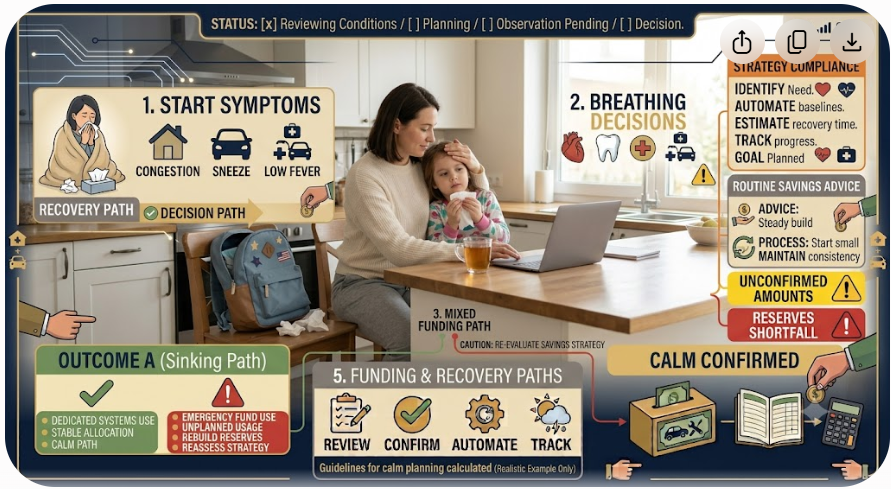
Start With the General Rule—Then Check the Exceptions
CDC’s general respiratory-virus guidance says to stay home and away from others when you have symptoms such as cough, fatigue, fever, headache, or a runny nose that are not better explained by another cause. You can return to normal activities when, for at least 24 hours, both of the following are true:
- your symptoms are getting better overall; and
- you have not had a fever and are not using fever-reducing medicine.
This is a symptom-based recovery rule, not a requirement to identify the exact virus first. As EW-H-0022 explains, cold, flu, COVID-19, RSV, and other respiratory illnesses can overlap. The stay-home decision should not depend on successfully guessing which one you have.
The general rule is a starting point, not permission to disregard other requirements. A school, employer, local health department, sports program, or care facility may have a more specific policy. Certain diagnosed illnesses and active outbreaks can also trigger different instructions. Healthcare settings use separate infection-control guidance because patients may be especially vulnerable.
If the applicable rule is stricter than the general community guidance, follow the stricter rule or ask the organization to clarify it.
A Four-Stage Return Framework
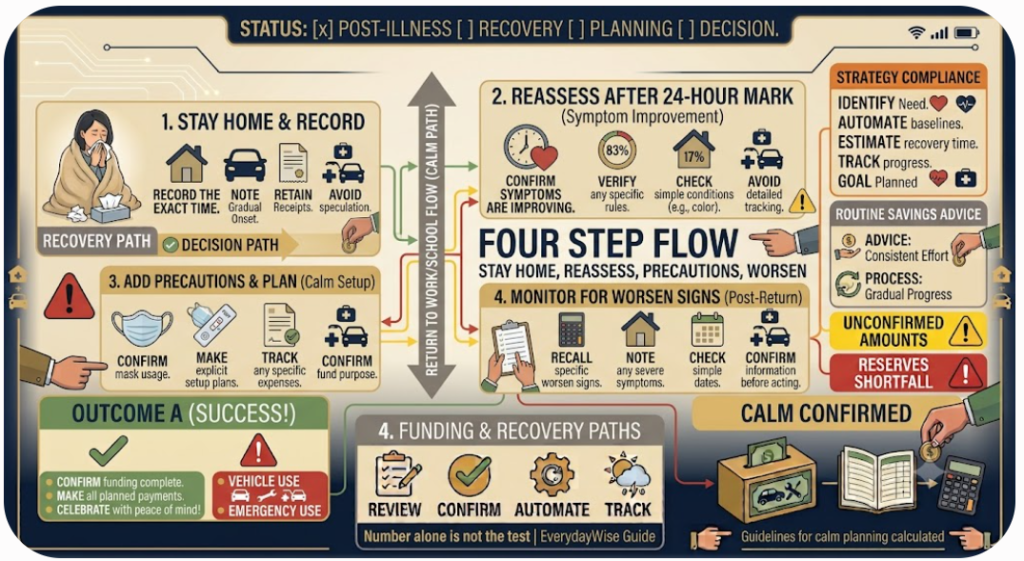
Stage 1: Stay home while the illness is new, worsening, or disruptive
Stay home when new respiratory symptoms are not improving, particularly when you feel feverish, have measured fever, are unusually exhausted, are coughing frequently, or cannot manage normal responsibilities safely.
Do not let the absence of fever decide the question by itself. Flu and other respiratory infections can occur without fever. Someone who is too weak to complete ordinary tasks, cannot concentrate adequately, or needs care that a school or workplace cannot reasonably provide is not ready simply because the thermometer is normal.
The same principle applies to children. CDC school guidance says a returning child should be well enough to participate, manage an improving cough and congestion with appropriate independence, and avoid requiring so much care that staff cannot teach or care for other students.
Staying home is not always easy. Missing pay, arranging childcare, finding a substitute, or keeping up with schoolwork can create real pressure. Those constraints are reasons for employers and schools to offer flexible, non-punitive policies; they do not change what the symptoms indicate. If remote work, make-up work, or another temporary accommodation exists, use it to reduce the conflict between recovery and obligations.
Stage 2: Reassess the whole illness—not the best hour of the day
Before returning, look back over at least 24 hours. Ask:
- Are symptoms improving overall? A single good morning does not establish a recovery trend. Compare cough, congestion, fatigue, aches, appetite, and ability to function with the previous day.
- Has fever been absent for at least 24 hours without fever-reducing medicine? Medicine that lowers temperature can hide the information you are trying to assess.
- Can the person handle the actual day? Consider the commute, stairs, sustained attention, physical work, meals, bathroom needs, and the ability to manage coughs and secretions.
- Could returning expose someone at higher risk? A classroom, shared vehicle, open office, or close-contact job may include older adults, infants, pregnant people, immunocompromised people, or people with chronic conditions.
- Is there a specific policy or clinical instruction? Check messages from the school or employer, outbreak notices, and any advice given after a test or medical visit.
“Improving overall” does not mean that every symptom has disappeared. A mild cough or tiredness may persist. It means the illness has moved in a better direction as a whole and the person can resume activity without pretending to be recovered.
Stage 3: Return with added precautions for five days
Meeting the return criteria does not mean the chance of transmission is zero. CDC recommends added precautions for the next five days because a recovering person may still be able to spread the virus.
Depending on the setting and the person’s ability, precautions may include:
- wearing a well-fitting mask;
- improving indoor air or choosing better-ventilated spaces;
- keeping more distance from others where practical;
- practicing careful hand and respiratory hygiene; and
- testing before close contact when the result would affect a decision.
These are options to layer according to risk; not every tool will fit every person or setting. Children younger than age two should not wear masks. Some people with disabilities cannot wear or remove a mask safely. When one precaution is not workable, emphasize the others that are.
The five-day period is not automatically five additional days at home. It is a period of greater care after normal activities resume. Conversely, returning to normal activities does not mean abandoning precautions on day one.
If you tested positive but never developed symptoms, CDC advises using added precautions for five days when around others indoors because you may still be contagious. Follow any disease-specific, local, school, or workplace instructions that also apply.
Stage 4: Step back again if fever returns or symptoms worsen
Recovery is not always linear. If fever develops after you return, or you begin to feel worse again, stay home and away from others again. Restart the return assessment: wait until symptoms have been improving overall and fever has been absent without fever-reducing medicine for at least 24 hours. Then begin another five-day period of added precautions.
A return of fever or a significant reversal can also be a reason to seek medical advice, especially for someone at higher risk or when the illness has become severe or progressive. Trouble breathing, persistent chest pain or pressure, confusion, or another emergency warning sign needs urgent medical attention rather than a workplace or attendance calculation. EW-H-0027 will provide the full breathing-symptom escalation framework.
Work and School Use the Same Health Logic—but Not the Same Practical Test
The core recovery criteria are similar, but “able to participate” means different things in different settings.
| Setting | Questions before returning | What may justify more time at home |
|---|---|---|
| Desk or remote-capable work | Can you think clearly, complete essential tasks, and manage symptoms without repeated close contact? | Marked fatigue, frequent coughing, inability to concentrate, or no meaningful improvement |
| Physical or safety-sensitive work | Can you safely manage exertion, equipment, driving, heat, or protective gear? | Weakness, dizziness, breathlessness, poor concentration, or medication effects that impair safe work |
| School | Can the student participate, manage improving cough and congestion, and get through the day without disproportionate staff support? | Excessive fatigue, inability to manage secretions, poor intake, or need for more care than the school can provide |
| Close-contact or high-risk environment | Can exposure be reduced, and are there setting-specific rules? | Ongoing symptoms combined with unavoidable close contact or vulnerable people; stricter organizational guidance |
This table does not create medical clearance or override policy. It translates “return to normal activities” into the demands of the real setting.
For a child, also check the school’s written illness policy rather than relying on what another family was allowed to do. CDC notes that state and local health departments may add guidance and that schools may change exclusion procedures during outbreaks or periods of high absence.
For an employee, ask a precise operational question: “What is the current respiratory-illness return policy, and is remote work or another temporary adjustment available?” You do not need to disclose more health information than the organization legitimately requires, but the exact documentation and leave rules depend on location and workplace policy.
Where Testing Fits—and Where It Does Not
Testing can help identify COVID-19, flu, or another infection and may affect treatment, precautions, or institutional rules. It is especially time-sensitive when a person has risk factors for severe illness. CDC says flu antivirals work best when started within one to two days after symptoms begin, while COVID-19 treatment must also begin within a limited early window.
Testing does not replace the recovery check.
- A positive test can affect treatment and the precautions you take.
- A negative rapid test may not rule out the infection being tested for.
- A negative COVID-19 test says nothing about whether you have flu, RSV, or another contagious illness.
- A test result does not prove that someone who feels worse and cannot function is ready to return.
If you are at higher risk, very sick, or worsening, contact a clinician promptly rather than waiting for a return-to-work or return-to-school deadline. This article does not attempt to recreate the testing and early-treatment framework owned by EW-H-0022.
Common Return-to-Work and Return-to-School Mistakes
“No fever means I should go.”
Fever is only one part of the rule. Symptoms should also be improving overall, and the person should be capable of participating safely.
“I took medicine and the fever is gone.”
The 24-hour fever-free period is counted without fever-reducing medicine. A temporarily lowered temperature does not show that fever has resolved.
“I still cough, so I must stay home until the cough disappears.”
Not necessarily. Some symptoms can linger. Look at the overall trend, functional ability, setting-specific policy, and whether added precautions can reduce residual risk.
“The extra five days mean I cannot return for five more days.”
The CDC framework uses those five days for added precautions after return. They are not automatically five additional stay-home days.
“A negative test clears me.”
A negative result is one piece of information. It does not establish that all contagious respiratory illness is absent or that you are physically ready for the day.
“I returned once, so I should push through a setback.”
If fever appears or symptoms worsen again, step back. Stay home, reassess, and seek medical advice when the reversal is concerning.
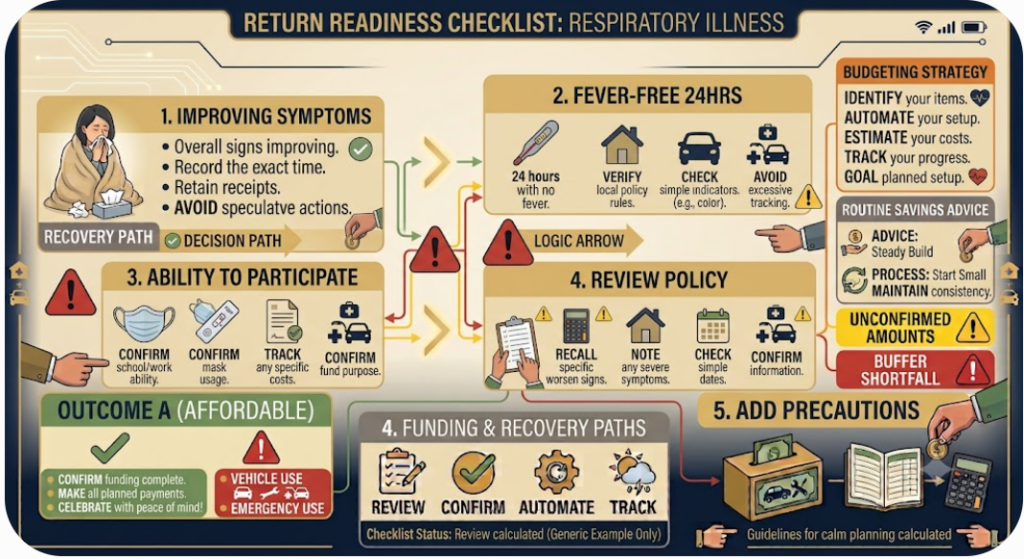
Decision Summary
The safest practical question is not “Do I still have any symptoms?” It is: Has the illness improved enough, for long enough, that I can return without ignoring my own limits or avoidable risk to others?
For most people in community settings:
- stay home while new respiratory symptoms are not improving;
- return when symptoms have improved overall for at least 24 hours and fever has been absent for at least 24 hours without fever-reducing medicine;
- make sure the person can actually participate in work or school;
- follow the applicable local and organizational rules;
- use added precautions for the next five days; and
- stay home again if fever returns or symptoms worsen.
The timeline is more useful than a single snapshot. A normal temperature, one negative test, or one energetic hour should not carry the whole decision.
This article provides general health information, not a diagnosis, medical clearance, or legal advice about leave or accommodations. Follow local public-health guidance and the applicable school or workplace policy. Healthcare personnel and people in care facilities should follow setting-specific infection-control guidance. Seek prompt professional care for severe, worsening, or concerning symptoms.
FAQ
Do I have to stay home until every symptom is gone?
Not usually under the general CDC community guidance. Symptoms should be improving overall for at least 24 hours, any fever should be gone for at least 24 hours without fever-reducing medicine, and you should be able to participate safely. Setting-specific rules may be stricter.
Can I return if I still have a cough?
Possibly. A lingering but improving cough does not automatically prevent return. Consider its frequency, whether you can manage it, your overall recovery, the people around you, and the precautions available.
Does the five-day precaution period start when symptoms begin?
In this framework, it begins when you return to normal activities after meeting the improvement and fever criteria. If you worsen and stay home again, reassess before returning and begin a new five-day precaution period.
Can a child go back to school if fever is gone but the child is exhausted?
Not necessarily. A returning child should be well enough to participate and should not need more care than school staff can reasonably provide. Check the school’s policy.
Does a negative COVID-19 test mean I can go to work or school?
No. It may not rule out COVID-19, it does not rule out other respiratory infections, and it does not establish that symptoms are improving or that you can function safely.
What if my employer or school requires a longer absence?
Follow the applicable policy and ask for clarification if it conflicts with current public-health guidance or your clinician’s instructions. Local outbreak rules or setting-specific risks may justify different requirements.
Should healthcare workers use this return framework?
Not as their only guidance. CDC maintains separate infection-control recommendations for healthcare settings, and the facility’s occupational-health policy may impose additional work restrictions.
Sources
- CDC – Preventing Spread of Respiratory Viruses When You’re Sick
- CDC – When Students or Staff Are Sick
- CDC – Preventing Spread of Infections in K-12 Schools
- CDC – People at Increased Risk for Severe Respiratory Illnesses
- CDC – How to Protect Yourself and Others from COVID-19
- CDC – Treating Flu with Antiviral Drugs
More in This Cluster: Cold, Flu, and Respiratory Illness
- Cold, Flu, COVID-19, or RSV? What Your Symptoms Can—and Cannot—Tell You
- When Should You Stay Home from Work or School With a Respiratory Illness? (you are here)
- Fever Basics for Adults and Children: What the Number Really Means
- Hydration During Illness: What to Drink and When to Get Help
- How to Reduce the Spread of Respiratory Illness at Home
- When Breathing Symptoms Need Urgent Care
- Building a Practical Sick-Day Supply Kit