A dishwasher can keep completing cycles while gradually cleaning less well. A film appears on glasses, food returns to supposedly clean plates, the machine develops an odor, or water remains around the filter. These symptoms are often treated as a reason to pour in a stronger cleaner. But the better first question is whether water can still move through the machine as designed.
EverydayWise founder Jerome has described a period when frequent cooking for a family of four made dishwashing increasingly difficult to keep ahead of. Kitchen management improved after he and his wife divided cooking and dishwashing responsibilities more clearly. That experience shows how assigning maintenance can make a repeated task more manageable. It does not mean that Jerome used a dishwasher or followed any particular appliance-care method. The correct method still comes from the machine’s manual.
Practical rule: Before adding a cleaning product, check the filter, spray-arm movement, drain area, seals, detergent, and loading. A cleaning cycle cannot correct a blocked spray arm, incorrectly installed filter, leak, or failed component.
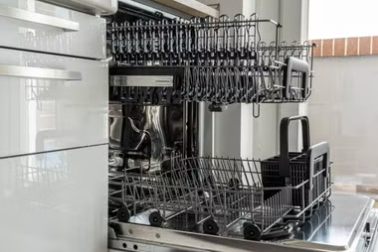
Start With the Model and the Symptom
Find the model number and owner’s manual before removing a part. Dishwashers differ in filter design, spray-arm removal, self-cleaning cycles, approved cleaners, water-softening systems, and maintenance intervals. Some filters twist out by hand; others are not intended for routine owner removal.
Then identify what prompted the cleaning:
- Visible food debris suggests checking the filter, spray arms, and loading.
- A greasy film may involve detergent amount, water temperature, cycle choice, loading, or accumulated soil.
- White scale or cloudiness may involve hard water, detergent, rinse aid, or mineral buildup rather than food.
- Odor may come from trapped debris, standing water, a dirty seal, or a drainage problem.
- Water left in the tub may indicate a filter or drain-path obstruction, but it can also signal an installation or mechanical problem.
- Leaking, electrical odor, grinding, repeated error codes, or failure to drain requires troubleshooting, not a stronger cleaning recipe.
This separation matters because “dirty dishwasher” is not one diagnosis.
Make the Machine Safe to Inspect
Run maintenance only when the machine is empty and cool. Cancel the cycle and follow the manual’s instructions for shutting off power when your hands or tools would enter an area containing moving or electrical components. Never reach into the sump or drain area while the appliance may start.
Remove the racks only as directed. Wear cut-resistant gloves if broken glass may be present, and lift fragments with care rather than feeling around blindly. Keep children and pets away from detergent, pods, sharp debris, and the open machine. Health Canada warns that household chemical products can cause poisoning, burns, fires, or explosions when handled incorrectly, and advises users to read labels, use recommended protection, keep products in their original containers, and never mix them.[1]
Stop before routine cleaning if you find:
- water leaking onto the floor or into cabinetry;
- a scorched smell, melted wiring, sparking, or a tripping breaker;
- a damaged power cord or supply hose;
- cracked racks, exposed sharp metal, broken glass in an inaccessible area, or a damaged tub;
- a loose spray arm or component you cannot reinstall securely;
- sewage-like backup or water returning from the sink; or
- an error code that persists after the manual’s approved reset.
Contain active water if safe, disconnect the appliance as the manufacturer directs, and contact the appropriate installer, plumber, electrician, manufacturer, or appliance technician.
Clean the Filter Without Damaging It
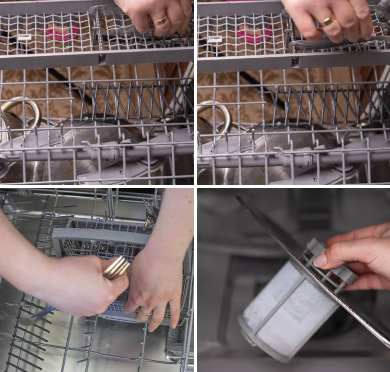
The filter is the first component to inspect when food particles remain on dishes or odor develops. Whirlpool explains that removable filters capture food and debris and may require routine rinsing; Bosch likewise directs owners of applicable models to wash the filter under running water with mild soap and a soft brush.[2][3]
Use this controlled sequence:
- Consult the manual. Confirm that the filter is removable and note how it unlocks and returns.
- Remove the lower rack. Set it where it will not roll or create a trip hazard.
- Look for sharp debris. Remove visible glass or bones carefully before gripping the filter.
- Unlock without force. Turn, lift, or release the assembly exactly as shown for the model.
- Rinse gently. Use running water and, if permitted, mild soap with a soft brush or sponge. GE cautions that abrasive pads or brushes can damage certain filters.[4]
- Inspect the seating area. Wipe accessible loose debris without pushing it into the pump or drain opening.
- Reinstall completely. Align, lock, and test the filter as the manual directs. An incorrectly seated filter can allow debris to recirculate or interfere with operation.
Do not substitute a knife, metal pick, or aggressive scouring pad for patience. If the filter is cracked, warped, or will not lock, replacement is safer than running the machine with an unreliable barrier.
How often should the filter be cleaned?
There is no universal calendar. The interval depends on the machine, whether dishes are scraped, the type of soil, and how often it runs. Use the manual’s schedule or filter indicator. Between scheduled checks, treat declining performance, visible debris, or a new odor as reasons to inspect sooner.
The most useful maintenance schedule is one the household can actually remember. Assigning filter inspection to a person or recurring household task is more reliable than assuming someone will notice it eventually.
Check the Spray Arms and Loading Path
Spray arms must rotate freely and their openings must remain clear. Before removing one, spin it gently by hand with the racks correctly positioned. Look for a tall pan, utensil, cutting board, or rack item blocking its path. Whirlpool identifies free spray-arm movement, correct loading, and a clear filter as basic checks when dishes are not cleaning properly.[5]
If the arm is removable according to the manual:
- note its orientation and fastening method;
- remove it without forcing clips or plastic fittings;
- rinse it under running water;
- clear approved openings with the tool the manufacturer recommends; and
- reinstall it securely, then verify free rotation.
Bosch recommends checking and cleaning spray arms every few months on relevant models and describes using water and a toothpick to release debris from blocked holes.[6] That is a manufacturer example, not permission to use a toothpick on every spray system. Avoid widening nozzles with metal wire or drilling out deposits; altered jets can change water distribution.
Loading is part of maintenance because recurring obstruction can mimic a dirty machine. Face soiled surfaces toward the spray, keep the detergent dispenser clear, prevent lightweight items from falling, and leave the arms room to rotate. Do not overload the racks simply to avoid a second cycle if the result is repeated rewashing.
Wipe Seals, Edges, and Accessible Interior Surfaces
The door gasket and the narrow edge outside the main spray path can collect residue. With the machine off and cool, wipe only accessible areas with the method allowed in the manual. Use a soft cloth, limit moisture around controls and the latch, and dry the area afterward.
Inspect rather than scrub a torn, hardened, displaced, or mold-stained gasket. Cleaning will not restore a seal that has lost its shape. A persistent leak around the door may also come from level, loading, excess suds, latch alignment, or another fault; do not assume the gasket is the only cause.
Remove debris from the visible tub floor, but do not dismantle pump covers, hoses, floats, or electrical assemblies unless the manufacturer identifies them as owner-maintenance parts. Protect stainless-steel and coated interiors from steel wool, harsh abrasives, and unapproved chlorine products.
Choose an Interior-Cleaning Method the Dishwasher Approves
After the filter and spray path are clear, an approved empty cleaning cycle may help remove compatible grease, residue, or mineral film. Options vary by model:
- a built-in machine-care or cleaning cycle;
- a manufacturer-approved dishwasher-cleaning product;
- a specific citric-acid procedure;
- a measured vinegar method explicitly permitted by the manufacturer; or
- ordinary detergent in a prescribed empty cycle.
Do not turn these examples into a universal recipe. Acids can affect some metals, seals, stone residues, or other materials, and a manufacturer may specify placement, amount, cycle, and frequency. GE, for example, describes approved dishwasher cleaner, citric acid, and a model-appropriate vinegar procedure for certain interiors.[7] Another brand or model may provide different instructions.
Never mix vinegar, bleach, ammonia, drain cleaner, dishwasher cleaner, or detergent. Do not run two products together because each is safe separately. Health Canada specifically warns that mixing bleach with other cleaners can create toxic gases.[8]
Use only detergent formulated for automatic dishwashers. Hand dish soap can create excessive suds and leakage. Follow both the detergent label and appliance instructions rather than automatically filling every dispenser. More detergent is not always more cleaning; water hardness, soil level, cycle, and product concentration affect the correct amount.
Treat Mineral Buildup as a Water-and-Settings Question
White deposits in the tub can indicate hard water, but not every cloudy glass is removable scale. Before repeatedly acid-cleaning the machine, check:
- the local water hardness;
- the dishwasher’s water-softener setting, if equipped;
- dishwasher salt requirements for the model and region;
- detergent type and dose;
- rinse-aid setting; and
- whether the marks wipe off or are permanent etching.
An approved descaling method may remove mineral deposits inside the dishwasher. It cannot reverse etched glassware. If deposits return quickly, correcting the water, product, or setting mismatch is more useful than repeatedly cleaning the symptom.
A Practical Maintenance Routine
Use condition and manufacturer guidance rather than an elaborate universal calendar.
After ordinary loads
- Remove fallen labels, bones, glass, or food pieces when the machine is cool.
- Check that no item blocked an arm or dispenser.
- Leave the machine as the manual recommends after unloading; ventilation instructions vary.
At a recurring household check
- Inspect and, if required, clean the filter.
- Spin and inspect the spray arms.
- Wipe accessible door edges and seals.
- Check detergent and rinse-aid use against water conditions.
- Look beneath and around the machine for moisture.
When performance changes
- Diagnose before deep-cleaning.
- Separate food blockage, mineral scale, loading, detergent, drainage, and mechanical symptoms.
- Run only the approved cleaning cycle for the identified condition.
- Record a recurring error or leak instead of repeatedly resetting it.
This is where Jerome’s experience offers a useful household insight. The improvement came after cooking and dishwashing responsibilities became clearer, not after pursuing a perfect kitchen. Dishwasher maintenance can be handled the same way: give the filter check, detergent restock, or unloading routine an owner. The personal story supports the organization of work, while the appliance manual still controls the technical method.
When Cleaning Is Not Enough
Arrange qualified help when the dishwasher:
- continues to leave standing water after accessible, approved checks;
- leaks repeatedly or shows moisture in cabinetry;
- makes new grinding, buzzing, or impact sounds;
- repeatedly trips a breaker or shows electrical damage;
- has a damaged tub, latch, rack coating, hose, wiring, heater, or pump area;
- produces sewage backup or cross-connection concerns;
- cannot hold a filter or spray arm securely;
- returns the same error code; or
- still cleans poorly after correct loading, product use, filter care, and approved troubleshooting.
Cleaning removes accessible soil and mineral film. It cannot repair a pump, valve, heater, sensor, seal, drain installation, or electrical fault.
Decision Summary
- Find the model manual and identify the symptom before removing parts or adding cleaner.
- Make the machine empty, cool, and safe to inspect.
- Clean a removable filter gently and reinstall it completely.
- Check spray-arm openings and free rotation, then correct loading that blocks the wash path.
- Wipe accessible seals and edges without flooding controls or dismantling protected components.
- Use only an interior cleaner and cycle approved for the model and condition.
- Never use hand dish soap or mix household cleaning products.
- Treat recurring mineral scale as a water, detergent, and settings issue—not only a cleaning issue.
- Assign recurring maintenance clearly so it does not disappear between cooking and cleanup tasks.
- Stop when the symptom is a leak, electrical issue, persistent drainage fault, broken component, or installation problem.
FAQ
How often should I clean my dishwasher filter?
Follow the model manual or filter indicator. The interval depends on filter design, use, food soil, and whether dishes are scraped. Inspect sooner if food returns to dishes, odor appears, or performance declines.
Can I put vinegar in any dishwasher?
No. Use vinegar only if the dishwasher manufacturer permits it and follow the specified amount, placement, and cycle. A model-approved dishwasher cleaner or another procedure may be required instead.
Why is my dishwasher still dirty after a cleaning cycle?
A cleaning cycle cannot correct a clogged or incorrectly installed filter, blocked spray arm, overloaded rack, unsuitable detergent, drainage problem, failed heater, or mechanical fault. Diagnose the symptom before repeating the cycle.
Can I use regular dish soap in a dishwasher?
No. Hand dish soap can create excessive suds and leakage. Use only detergent formulated for automatic dishwashers and follow the appliance and detergent directions.
How do I clean dishwasher spray arms?
Check the manual first. If removal is owner-approved, remove the arm as directed, rinse it, clear openings only with an approved tool, reinstall it securely, and confirm free rotation. Do not widen nozzles with metal tools.
When should a dishwasher be serviced instead of cleaned?
Seek help for recurring leaks or standing water, electrical odor, breaker trips, sewage backup, damaged parts, insecure filters or spray arms, persistent error codes, or poor performance after approved maintenance and correct use.
References
[1] Health Canada. Use Household Chemicals Safely — label compliance, protective equipment, original containers, safe storage, and mixing prohibition. https://www.canada.ca/en/health-canada/services/home-safety/household-chemical-safety.html
[2] Whirlpool. How to Clean a Dishwasher Filter in 3 Steps — removable-filter purpose, location, gentle rinsing, brushing, and reinstallation. https://www.whirlpool.com/blog/kitchen/fixing-removing-and-replacing-dishwasher-filters.html
[3] Bosch. How to Properly Clean Your Dishwasher Filter — model-specific removal, running water, mild soap, soft brush, and replacement. https://www.bosch-home.com/us/owner-support/get-support/support-selfhelp-dishwashers-cleaning-dishwasher-filter
[4] GE Appliances. Dishwasher – How to Clean Fine and Ultra Fine Filters — filter-specific removal, warm soapy water, gentle tools, and abrasion warning. https://products.geappliances.com/appliance/gea-support-search-content?contentId=35611
[5] Whirlpool. Why Is My Dishwasher Not Cleaning Dishes Properly? — loading, spray-arm movement, and filter checks. https://www.whirlpool.com/blog/kitchen/dishwasher-not-cleaning.html
[6] Bosch. Dishwasher Cleaning & Maintenance — spray-arm inspection, model-specific removal, rinsing, and clearing blocked openings. https://www.bosch-home.com/us/owner-support/dishwashers/cleaning-maintenance
[7] GE Appliances. Dishwasher – Cleaning the Interior — manufacturer-approved dishwasher cleaner, citric-acid, and vinegar procedures for applicable models. https://products.geappliances.com/appliance/gea-support-search-content?contentId=21552
[8] Health Canada. Reduce Your Risk from Toxic Gases: Never Mix Bleach with Other Cleaning Products — toxic-gas risk from combining bleach and household cleaners. https://recalls-rappels.canada.ca/en/alert-recall/reduce-your-risk-toxic-gases-never-mix-bleach-other-cleaning-products
This article provides general household-cleaning and appliance-safety information. Dishwasher designs, filtration systems, cleaners, detergents, water conditions, and maintenance procedures vary. Follow the appliance manual and every product label. For leaks, electrical concerns, chemical exposure, sewage backup, damaged components, or persistent drainage and performance problems, stop and contact the appropriate emergency service, poison centre, manufacturer, plumber, electrician, or qualified appliance technician.
More in This Cluster: Kitchen Cleaning
- How to Degrease Kitchen Cabinets Without Damaging Them
- How to Clean an Oven Safely Without Damaging It
- How to Clean and Maintain a Dishwasher Properly (you are here)
- How to Clean a Refrigerator Properly and Reset What You Store
- How to Remove Kitchen Sink Odours by Finding the Source
- How to Clean Kitchen Countertops Safely by Surface
- Kitchen Cleaning Mistakes That Spread Germs—and How to Stop Them