A countertop can look clean and still be poorly prepared for food. It can also be hygienically treated and unnecessarily damaged. Those two failures often come from the same shortcut: choosing a cleaner before identifying the surface and deciding what the cleaning is meant to accomplish.
EverydayWise founder Jerome remembers years when frequent home cooking and packed lunches helped his two-income immigrant household control food costs. Repeated meal preparation also meant repeated grease, crumbs, containers, and cleanup. His account does not identify the family’s countertop material or any sanitizer they used. It does illustrate the practical problem: a work surface must be safe enough for the next meal without turning every evening into a restoration project.
The useful goal is not to make a countertop smell “sterile.” It is to remove soil with the mildest compatible method, add a food-contact sanitizing step when the situation calls for one, and recognize damage that cleaning cannot correct.
Practical rule: Identify the countertop, clean first, and use a sanitizer or disinfectant only when its label permits that exact surface and food-contact use. Follow the stated wet contact time and rinse instruction.

Start With the Countertop, Not the Cleaner
“Stone,” “wood,” and “white counter” are not precise enough. A stone-looking surface may be natural granite, marble, engineered quartz, porcelain, sintered stone, or laminate. A wood surface may be oil-finished butcher block, film-finished wood, or a decorative laminate. Solid-surface material can resemble stone but follow different renewal and chemical-compatibility rules.
Look for an invoice, installation record, manufacturer label, leftover sample, warranty document, or the fabricator’s information. If the home is rented, ask the landlord or building manager before using a strong product or attempting restoration. When the identity remains uncertain, use the least aggressive plausible method on a hidden spot and avoid acids, alkalis, bleach, solvents, abrasive powders, scouring pads, and prolonged soaking until compatibility is established.
Also inspect the condition:
- Are seams tight and dry?
- Is the surface sealed, oiled, coated, or unfinished?
- Are there cracks, chips, swollen edges, loose tiles, failed grout, or peeling finish?
- Does water darken natural stone or wood quickly?
- Is staining below the surface rather than removable soil on top?
A cleaner cannot reseal porous stone, restore a failed wood finish, flatten swollen laminate, repair cracked grout, or make a deep crevice reliably cleanable. Separate those conditions from ordinary residue before scrubbing harder.
Decide Whether You Need Cleaning, Sanitizing, or Disinfecting
These words are not interchangeable.
- Cleaning removes food, grease, dirt, and some microorganisms with water, detergent, and physical action.
- Sanitizing reduces microorganisms on a cleaned surface to a level considered safe under the product’s approved use.
- Disinfecting uses a registered product to kill specified microorganisms under label conditions. Household disinfection is generally more relevant after illness or a higher-risk contamination event than after every sandwich.
The CDC says cleaning with soap and water is sufficient in most household situations, while cleaning must come before sanitizing or disinfecting because soil can interfere with the chemical action.[1] Health Canada advises sanitizing countertops, cutting boards, and utensils before and after food preparation and provides a Canadian kitchen-sanitizer or diluted-bleach pathway, followed by careful rinsing.[2] These statements are not a reason to apply bleach automatically to every countertop. The surface instructions and sanitizer label must also allow it.
For an ordinary counter used for coffee, packaged groceries, or a cooked meal, prompt cleaning with a compatible detergent may be the appropriate task. Add a food-contact sanitizing step when required by local public-health guidance or after a higher-risk exposure such as raw meat or poultry juices, raw pet food, vomit or diarrhea, a household illness, pests, or another identified contamination. Floodwater, sewage, a chemical spill, or a recall requires incident-specific guidance; an everyday wipe-down is not enough.
Read the Product Label as a Set of Operating Instructions
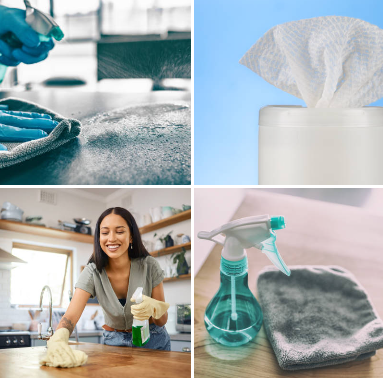
“Kitchen,” “natural,” and “antibacterial” on the front of a bottle do not establish that a product is suitable for a food-contact countertop.
Before use, confirm:
- Registration or authorization: In Canada, look for the applicable Health Canada authorization, such as a Drug Identification Number on an authorized surface disinfectant. In the United States, use an EPA-registered product for the claimed sanitizing or disinfecting task.[3][4]
- Surface compatibility: The label must permit the material or the manufacturer must approve the product.
- Food-contact direction: Determine whether food must be removed, whether the product is approved on food-contact surfaces, and whether a potable-water rinse is required.
- Dilution: Measure concentrate exactly. More is not automatically more effective or safer.
- Contact time: Keep the surface visibly wet for the full time stated for the intended claim. EPA guidance explains that effectiveness depends on maintaining that wet contact time.[4]
- Finish: Rinse or air-dry exactly as directed before food touches the surface again.
- Safety controls: Follow ventilation, glove, eye-protection, storage, and child- or pet-separation instructions.
Never mix bleach with vinegar, ammonia, or another cleaner. Do not layer products because the first one “did not smell strong enough.” If a different product is needed, remove the first one as its label directs, rinse where required, ventilate, and allow the surface to return to the specified condition.
Spraying a product onto a visibly greasy counter and wiping it off immediately may accomplish neither cleaning nor the label’s sanitizing claim. Conversely, leaving an incompatible disinfectant on a delicate surface longer than directed can damage the finish without adding useful protection.
Use One Basic Cleaning Sequence
The compatible product changes by material, but the operating sequence is stable:
- Move food, small appliances, knives, and hot cookware to safe locations.
- Remove crumbs and loose debris without dragging grit across the finish.
- Wash a manageable section with the approved mild cleaner and a clean, nonabrasive cloth or sponge.
- Give dried residue time to soften rather than immediately reaching for a blade or abrasive.
- Rinse away detergent when the material instructions call for it.
- Dry the surface, especially at seams, edges, faucet cutouts, joints, and backsplashes.
- If sanitizing is needed, apply a compatible food-contact product to the already-clean surface and complete every label step.
- Return food and equipment only after the required rinse and drying are complete.
Work from the cleaner area toward the dirtier area and change the cleaning side or cloth when it becomes loaded with residue. The last cluster article addresses the wider system of hands, cloths, sponges, raw-food pathways, and cross-contamination; the essential point here is narrower: a dirty tool cannot deliver the clean surface the method assumes.
Laminate: Protect Seams and Edges From Water
For laminate, begin with a clean damp nonabrasive cloth and a mild liquid detergent or an approved household cleaner. Formica instructs users to rinse with clean water and dry with a soft cloth, while avoiding flooding—especially near seams—because water can penetrate and swell the substrate.[5]
Do not use steel wool, abrasive pads, abrasive powder, or an unapproved solvent. Pay attention to the sink cutout, backsplash joint, front edge, and any lifted seam. If the edge is swollen, the laminate is separating, or liquid can enter the substrate, repeated wet cleaning will not repair it. Keep the area dry and arrange an appropriate repair or replacement assessment.
Before sanitizing, verify that both the laminate maker and the product label permit the chemical and procedure. A food-contact claim does not override a surface incompatibility.
Engineered Quartz: Protect the Resin as Well as the Mineral
Engineered quartz contains mineral aggregate bound with resin; it should not be treated as if it were an uncoated piece of natural stone. For routine care, Caesarstone recommends warm soapy water or mild detergent, a clean damp cloth, and thorough drying.[6]
Avoid assuming that vinegar, bleach, oven cleaner, drain cleaner, paint remover, or an abrasive pad is safe across brands. Strong alkalis, acids, oxidizers, solvents, heat, and aggressive scrubbing can affect resin, colour, gloss, or warranty coverage. Remove dried food with a manufacturer-approved method and non-scratch tool rather than a metal blade unless the exact care guide permits one.
For sanitizing, use the specific quartz manufacturer’s compatible-product guidance plus the sanitizer label. If those instructions conflict, do not improvise; ask the manufacturer or fabricator for a suitable food-contact option.
Natural Stone: Identify the Stone and Its Sealer
Granite, marble, limestone, soapstone, slate, and other natural stones do not share one chemical tolerance. Acid can etch calcite-based stones such as marble and limestone even when it is marketed as a household cleaning ingredient. Sealers also vary and may respond differently from the stone beneath.
The Natural Stone Institute recommends a neutral cleaner, stone soap, or mild liquid dishwashing detergent with warm water, followed by thorough rinsing and soft-cloth drying.[7] Use only the amount required; excess soap can leave a film.
Do not interpret a darkened area automatically as dirt. It may be absorbed oil or water, etching, sealer failure, or another stain requiring stone-specific diagnosis. Likewise, do not reseal simply because a calendar says so. Confirm the stone, current finish, sealer product, cure time, and whether the counter must remain out of food service. Deep stains, widespread etching, cracks, loose seams, or an unknown coating belong with a qualified stone professional or the fabricator.
Solid Surface: Follow the Finish-Specific Care Guide
Solid-surface countertops are nonporous, but their matte, satin, semi-gloss, and high-gloss finishes may require different care. Corian says warm soapy water, an ammonia-based household cleaner, or a dedicated countertop cleaner can handle most residue, while window cleaner may leave a waxy buildup.[8] That is Corian guidance, not permission to use ammonia on every material or mix it with bleach.
Avoid heat, deep cuts, and prolonged exposure to unapproved strong chemicals. Some solid-surface damage can be professionally renewed, but casually sanding one glossy or patterned area can create a conspicuous patch. Use the brand’s finish-specific instructions or a certified repair provider.
Butcher Block and Wood: The Finish Determines the Method

First determine whether the wood is intended as a direct cutting surface and whether it is finished with food-grade oil, an oil-and-wax system, varnish, polyurethane, or another film coating. Those are different surfaces.
Wipe up wet food and raw-meat liquid promptly. Use the maker-approved cleaning method with limited moisture, and dry the wood rather than leaving pooled water. John Boos warns against allowing wet meat and liquids to stand on its butcher-block surfaces and ties care to the particular finish and maintenance system.[9]
Do not apply an arbitrary cooking oil; some oils can become rancid, and a finish must be suitable for the intended food-contact use. Do not assume a homemade vinegar, peroxide, or bleach routine is compatible with every wood top. If the maker permits direct food preparation, follow its cleaning, sanitizing, drying, and re-oiling directions. Otherwise, use a separate clean cutting board for raw-food work.
Deep knife grooves, open joints, blackened areas, persistent odour, flaking coating, or wood that remains damp can prevent reliable cleaning. Sanding and refinishing may change the food-contact status and should follow the fabricator’s system or qualified advice.
Tile and Grout: Treat the Assembly, Not Just the Tile
Ceramic or porcelain tile may tolerate a product that cementitious grout, natural-stone tile, sealant, caulk, or a decorative finish does not. Identify each component.
Use a compatible neutral cleaner, rinse residue, and dry joints. Avoid aggressive wire brushes or repeated acid cleaning that can erode grout or damage adjacent stone and metal. Missing grout, cracked tile, loose sections, and failed caulk create places where moisture and food soil can enter. Cleaning the visible face does not correct the gap beneath it.
For a food-contact sanitizing step, confirm that the label permits the tile and grout assembly and can reach the surface for the required contact time. A deteriorated porous joint may need repair before it can be managed reliably.
Stainless-Steel Worktops: Clean With the Grain and Rinse Residue
For stainless steel, remove grit, use a compatible mild detergent and soft cloth, rinse, and dry. When a visible grain is present, wipe with it rather than across it. Avoid carbon-steel wool and tools that can scratch the finish or leave particles that rust.
“Stainless” does not mean unaffected by every chloride, acid, alkali, or prolonged chemical exposure. Check the grade and manufacturer’s care instructions, particularly around welds, seams, and appliance junctions. Use only a food-contact sanitizer whose label permits stainless steel, and complete any required potable-water rinse.
Know When the Countertop Is No Longer a Cleaning Job
Stop escalating household chemistry when you find:
- swelling, delamination, soft substrate, or a lifted laminate seam;
- a cracked slab, moving seam, loose tile, or missing grout;
- flaking paint, varnish, epoxy, or another coating;
- deep wood checking, persistent dampness, or an unknown finish;
- widespread stone etching, embedded staining, or suspected sealer failure;
- recurring moisture from a sink, faucet, backsplash, wall, or appliance;
- contamination by sewage, floodwater, pests, hazardous chemicals, or broken glass in inaccessible joints; or
- a surface whose identity and food-contact suitability cannot be established.
At that point, isolate the area from food preparation and contact the installer, manufacturer, landlord, fabricator, restoration professional, public-health authority, insurer, or other qualified service as the situation requires.
Build a Countertop Routine That Matches the Cooking Load
Jerome’s experience is useful because the volume of cooking did not disappear when the kitchen became difficult to manage. The household improved by making responsibilities clearer. Countertop care can use the same realism without assigning every family the same schedule.
A workable routine may be:
- clear and clean the active preparation zone after each meal;
- wipe spills before they dry or penetrate seams;
- complete a compatible sanitizing step after higher-risk food preparation;
- leave the surface dry and ready for the next user;
- inspect vulnerable seams and joints during a weekly reset; and
- keep the exact countertop care guide and sanitizer label accessible.
The routine should not depend on remembering a viral cleaning recipe. It should depend on knowing the surface, the contamination level, and the next safe state.
Decision Summary
- Identify the countertop material, finish, manufacturer, and condition before choosing a product.
- Clean visible soil first with the mildest compatible method.
- Do not disinfect every counter by default; match sanitizing or disinfecting to the actual risk and public-health guidance.
- Confirm food-contact approval, dilution, wet contact time, rinse requirement, ventilation, and protective equipment on the label.
- Never mix cleaners or assume a food-safe ingredient makes a material-safe formula.
- Protect laminate seams, quartz resin, natural-stone chemistry and sealers, solid-surface finish, wood coating, grout joints, and stainless-steel finish.
- Use a separate cutting board when the counter’s direct-food-preparation status is uncertain.
- Treat cracks, swelling, failed coatings, open joints, persistent moisture, and major contamination as repair or incident-response problems.
- Build a small cleaning routine around the household’s real cooking volume.
FAQ
Do I need to disinfect my kitchen countertops every day?
Usually not. Cleaning with a compatible detergent is sufficient in many ordinary household situations. Use a food-contact sanitizer or disinfectant when the actual contamination risk or public-health guidance calls for it, and only when the product label and countertop instructions permit the method.
What makes a countertop cleaner food-safe?
“Food-safe” is not enough by itself. Confirm that the product is authorized for the intended claim, permitted on the exact countertop, approved for food-contact surfaces, used at the correct dilution and wet contact time, and rinsed or air-dried as the label directs.
Can I use vinegar on quartz, granite, or marble countertops?
Do not treat vinegar as universal. Acid can etch marble and limestone, may affect some stone sealers, and may conflict with engineered-quartz instructions. Follow the exact manufacturer or fabricator guidance; use a neutral mild cleaner when the surface is uncertain.
Can I use bleach to sanitize every countertop material?
No. A public-health bleach pathway does not establish compatibility with every resin, sealer, wood finish, grout, metal, or warranty. Both the surface instructions and the bleach-product directions must allow the concentration, contact time, rinse, and use.
How should I clean a butcher-block countertop safely?
Identify whether it is oil-finished, waxed, film-coated, or intended for direct cutting. Use the maker-approved method with limited moisture, dry promptly, and maintain the specified food-contact finish. Use a separate cutting board when the counter’s direct-food-preparation status is uncertain.
When should a countertop be repaired instead of cleaned again?
Seek repair or replacement guidance for swelling, delamination, open seams, deep cracks, loose tile, missing grout, flaking coating, persistent moisture, deep wood damage, widespread stone etching, or contamination that entered inaccessible porous joints.
References
[1] Centers for Disease Control and Prevention. “Cleaning and Disinfecting.” https://www.cdc.gov/hygiene/cleaning-disinfecting/index.html
[2] Health Canada. “Food Safety and You.” https://www.canada.ca/en/health-canada/services/general-food-safety-tips/food-safety-you.html
[3] Health Canada. “Biocides.” https://www.canada.ca/en/health-canada/services/drugs-health-products/biocides.html
[4] United States Environmental Protection Agency. “Selected EPA-Registered Disinfectants.” https://www.epa.gov/pesticide-registration/selected-epa-registered-disinfectants
[5] Formica Corporation. “Laminate Cleaning and Maintenance.” https://www.formica.com/en-us/campaigns/care-and-maintenance
[6] Caesarstone Canada. “Caring for Your Caesarstone Quartz, Porcelain & ICON Surfaces.” https://www.caesarstone.ca/wp-content/uploads/sites/5/2025/06/digital_CA-EN_care_maintenance_manual.pdf
[7] Natural Stone Institute. “Learn About Cleaning Products for Natural Stone.” https://www.naturalstoneinstitute.org/consumers/care/
[8] Corian Design. “Use & Care.” https://www.corian.com/-use-care-
[9] John Boos & Co. “Boos Block Care and Maintenance.” https://www.johnboos.com/care-and-maintenance/blocks
This article provides general household-cleaning and food-safety information. Countertop materials, finishes, sealers, warranties, product registrations, labels, and public-health instructions vary. Follow the countertop manufacturer or fabricator and every cleaning-product label. For illness outbreaks, chemical exposure, sewage, floodwater, pests, major structural damage, persistent moisture, or an uncertain food-contact surface, isolate the area as appropriate and contact the relevant public-health authority, poison centre, manufacturer, landlord, installer, insurer, or qualified professional.
More in This Cluster: Kitchen Cleaning
- How to Degrease Kitchen Cabinets Without Damaging Them
- How to Clean an Oven Safely Without Damaging It
- How to Clean and Maintain a Dishwasher Properly
- How to Clean a Refrigerator Properly and Reset What You Store
- How to Remove Kitchen Sink Odours by Finding the Source
- How to Clean Kitchen Countertops Safely by Surface (you are here)
- Kitchen Cleaning Mistakes That Spread Germs—and How to Stop Them