Quick Answer
To fund holidays without creating credit card debt, decide what the whole celebration can cost before deciding what to buy. Protect regular bills and essential expenses first, list every holiday category—not only gifts—and compare the total with cash already saved plus the amount you can realistically set aside before spending begins.
If the first plan costs more than the available cash, change the plan rather than treating a credit limit as additional income. Reduce the number or price of gifts, simplify meals and events, change travel plans, use rewards only at their real redemption value, or move optional traditions to another year. Keep the holiday money separate in your records, automate contributions when practical, and stop new spending when the category limits are reached.
A credit card can still be a payment tool if the purchase is already funded and you can pay the statement balance in full by the due date. It is not a debt-free funding method when repayment depends on future income that has not been reserved.
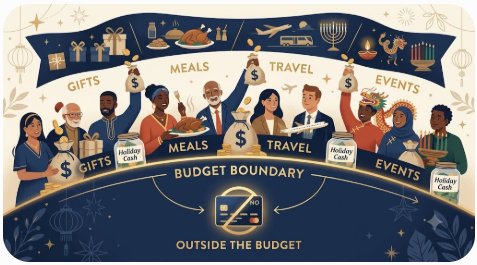
Start With the Amount the Household Can Afford
Holiday planning often begins with a list of people. A safer starting point is the amount of money available after normal obligations are protected.
The Consumer Financial Protection Bureau’s holiday guidance recommends accounting for usual monthly expenses before deciding what is available for gifts, travel, meals, or hosting. Consumer.gov similarly describes a budget as a comparison of income and expenses. Those principles matter because a holiday purchase does not replace rent, utilities, groceries, insurance, debt payments, or the next month’s ordinary needs.
Use this boundary:
Holiday spending limit = holiday cash already saved + additional cash that can be set aside before the holiday
Do not include an expected bonus, tax refund, reimbursement, or resale proceeds until the money is sufficiently certain and available. If it arrives later, you can revise the plan. Building today’s commitments around uncertain income transfers the risk to tomorrow’s bills.
EverydayWise uses holiday sinking fund as a practical label for money assigned to predictable holiday costs. CFPB does not define a regulated product by that name. The underlying ideas—setting a goal, estimating expenses, tracking spending, and saving over time—come from general consumer-finance planning.
Count the Whole Holiday, Not Only Gifts
Gift lists are visible, but the smaller surrounding costs often create the overrun. Build categories that reflect how your household actually celebrates.
Possible categories include:
- gifts and gift exchanges;
- groceries, baking, restaurant meals, and hosting;
- travel, fuel, parking, lodging, and baggage fees;
- decorations, cards, wrapping, and shipping;
- clothing, school events, photos, and performances;
- charitable giving, tips, and community events;
- childcare or pet care related to travel or gatherings; and
- a small buffer for price changes or an intentionally unplanned item.
Not every household needs every category. The purpose is not to create a complicated tracker. It is to reveal costs that otherwise appear one at a time and seem harmless.
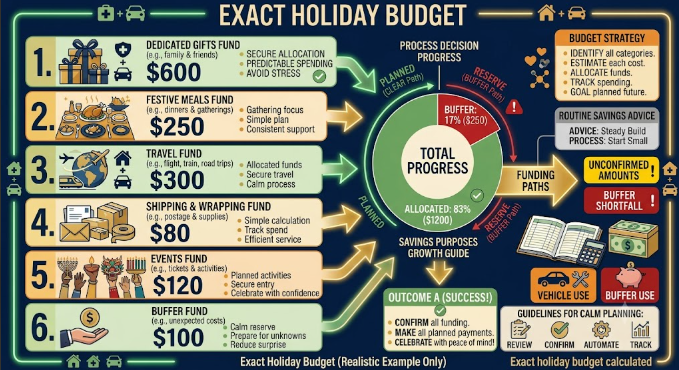
Suppose a household plans $600 for gifts, $250 for meals, $300 for travel, $80 for shipping and wrapping, $120 for events, and a $100 buffer. The complete plan is:
$600 + $250 + $300 + $80 + $120 + $100 = $1,450
All amounts in this example are assumptions, not recommended spending levels. The useful result is the total. A $600 “gift budget” would not describe a $1,450 holiday.
Turn the Total Into a Funding Schedule
Once you know the target and date, subtract what is already saved and divide the remainder by the number of contributions left.
Contribution per pay period = (target − amount already saved) ÷ remaining contributions
If the $1,450 plan is eight pay periods away and $250 is already saved:
($1,450 − $250) ÷ 8 = $150 per pay period
Check that $150 against real cash flow. A correct equation can still produce an unaffordable contribution. If only $90 per pay period is available, eight contributions would add $720; combined with the existing $250, the realistic funding amount would be $970.
That creates a $480 planning gap:
$1,450 − $970 = $480
The gap is information, not failure. It tells you how much the plan must change, how much additional confirmed income would be needed, or how much more time the goal would require. Do not hide the gap by leaving categories out or assuming a card will solve it.
For a full-year cycle, you might save a consistent monthly amount. For a shorter first cycle, calculate using the actual contributions remaining. After the holiday, use the final total as evidence for next year rather than automatically repeating the original estimate.
Close the Gap Before Shopping
When the first plan exceeds available cash, revise it in an order that protects the parts of the holiday that matter most.
1. Identify the priorities
Ask which activities carry the most meaning and which are mainly habits, expectations, or convenience. A visit may matter more than elaborate decorations. A shared meal may matter more than several individual gifts. The answer is personal; the purpose of the question is to direct limited money toward the highest-value choices.
2. Set category limits
Give each category a maximum that adds up to the revised total. A single overall number is easy to lose track of during several weeks of purchases. Category limits make the trade-off visible: an extra $40 for travel must come from another category unless the total funding changes.
3. Adjust the structure, not only the unit price
Finding a cheaper version of every planned item may not be enough. Consider reducing the number of exchanges, drawing names, agreeing on gifts only for children, setting a shared price range, hosting a potluck, combining trips, sending digital greetings, or choosing one paid event.
These are options, not universal rules. Discuss changes early when other people are affected. A clear conversation before purchases is easier than explaining financial strain afterward.
4. Treat the buffer as protection, not a shopping target
A buffer can absorb a fare change, forgotten ingredient, or shipping difference. If it remains unused, it can stay in savings or become the opening balance for the next cycle. Its presence does not require spending it.
Separate Funding From Payment Method
Cash, debit cards, credit cards, gift cards, and digital wallets are ways to pay. They do not determine whether a purchase is funded.
A purchase is funded when money has already been assigned to it and paying the bill will not compete with other obligations. This distinction allows a household to use a credit card for convenience, purchase protection, or rewards without confusing the available credit line with the holiday budget.
Before charging a holiday purchase, ask:
- Is the full amount already inside the relevant category?
- Will the reserved cash remain untouched until the card payment clears?
- Can the statement balance be paid in full by the due date?
- Are returns, refunds, rewards, and shared reimbursements being recorded accurately?
CFPB explains that a card with a grace period may allow a consumer who is not carrying a balance to avoid interest on purchases by paying the balance in full by the due date. Grace periods are not required on every card, and carrying a balance can change how interest applies. Check the actual agreement and statement rather than assuming all purchases are interest-free for a month.
If the purchase can only be paid after future paychecks arrive, the card is financing the holiday. That may be an intentional borrowing decision, but it should not be described as spending saved cash.
Be Careful With BNPL and Promotional Offers
Buy now, pay later can make a large checkout total look like a small installment. CFPB describes BNPL as credit that divides a purchase into payments over time. Multiple plans can overlap, automatic payments can compete with bills, and refunds or disputes may require careful tracking.
Before accepting any installment or deferred-interest offer, write down:
- the full purchase price;
- every payment amount and date;
- fees, interest, and late-payment consequences;
- the account that will fund automatic payments;
- the effect of a return or partial refund; and
- all other installments due in the same period.
“No interest if paid in full” may be a deferred-interest arrangement rather than a simple zero-interest purchase. CFPB warns that failing to pay the entire promotional balance by the deadline can result in interest being charged back to the original purchase date, depending on the terms. Minimum payments may not be enough to clear the balance on time.
The simplest debt-avoidance test is still the funding test: if the full purchase is not supported by the holiday plan, smaller installments do not make it affordable. They change the payment schedule.
Track Spending While the Season Is Happening
The plan only works if purchases reduce the category balances. Choose one authoritative record—the same principle used for tracking multiple savings goals in the previous cluster article.
A simple table can contain:
| Category | Limit | Spent | Remaining |
|---|---|---|---|
| Gifts | $420 | $275 | $145 |
| Meals | $220 | $90 | $130 |
| Travel | $230 | $230 | $0 |
| Events | $50 | $35 | $15 |
| Buffer | $50 | $0 | $50 |
| Total | $970 | $630 | $340 |
These amounts continue the hypothetical revised plan above. Verify the arithmetic after returns, reimbursements, or category transfers. A pending refund is not available cash until it is credited. A shared purchase is not cheaper merely because someone intends to repay part of it.
Review the tracker before shopping, not only afterward. When a category reaches zero, the choices are to stop, move money deliberately from another category, or increase the total only if genuinely unassigned cash is available. Do not silently spend next month’s bill money.
Use Sales and Rewards Without Letting Them Rewrite the Plan
A discount reduces cost only when the purchase was already useful and the final price fits the category. Buying an unplanned $80 item for $50 increases spending by $50; it does not save $30 against a plan that contained no purchase.
Compare final costs, including shipping, taxes, memberships, financing terms, and return conditions. Avoid allowing countdown timers, free-shipping thresholds, or points promotions to decide the quantity.
Treat rewards conservatively. Confirm the redemption value and any restrictions before including rewards in the plan. If points cover a $60 purchase, record the actual cash cost and the points used. Do not count the same rewards toward two categories or assume future points will arrive before redemption.
What to Do If Spending Has Already Exceeded the Plan
Stop adding purchases long enough to establish the real position. List posted and pending transactions, outstanding cash purchases, installment obligations, expected refunds, and the cash still reserved. Then calculate the gap.
Possible responses include:
- returning eligible items you no longer want;
- cancelling optional orders or events within their terms;
- reducing the remaining categories;
- using genuinely unassigned cash; or
- creating a specific repayment plan for debt already incurred.
Do not use an emergency fund automatically. Holiday spending is generally predictable, while an emergency fund is intended for unplanned financial shocks. A genuine emergency that occurs during the holiday season remains an emergency; ordinary seasonal overspending does not change category because it is uncomfortable.
If minimum debt payments or essential bills are at risk, the priority has shifted from holiday optimization to short-term cash-flow protection. Stop discretionary spending and contact creditors or qualified local support early when payment problems cannot be resolved within the household budget.
Reset the Fund After the Holiday
Within a few weeks, record the final cost by category. Include forgotten expenses that appeared after the main event, such as return shipping, delayed travel charges, or a January card transaction.
Then ask:
- Which estimate was accurate?
- Which category produced surprises?
- Which purchases added little value?
- Did the contribution schedule fit normal cash flow?
- Should the next cycle start earlier, use a different total, or simplify the celebration?
If the final cost was $1,080 and the next comparable holiday is 12 months away, a starting estimate would be $90 per month:
$1,080 ÷ 12 = $90
That is a planning baseline, not a promise that prices or circumstances will remain unchanged. Review the target when travel plans, household size, traditions, or income changes.
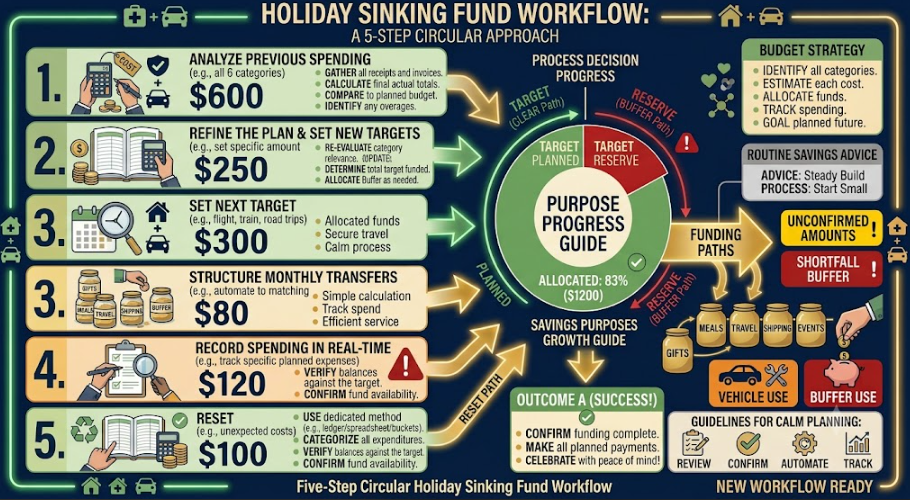
Decision Summary
Fund the holiday from a defined amount of cash, not from a list of desired purchases. Protect normal obligations, count the complete cost, calculate what can be saved before the deadline, and revise the plan when the numbers do not fit. Use a credit card only as a payment method when the purchase is already funded and the statement can be paid according to its terms.
The goal is not to remove generosity or enjoyment. It is to decide what this celebration can include without assigning its cost to future months.
FAQ
How early should I start a holiday sinking fund?
Start when you can identify the next likely holiday cost. A full year makes contributions smaller, but a shorter cycle can still work if you divide the remaining target by the actual pay periods or months left and confirm the result fits your cash flow.
What should a holiday budget include besides gifts?
Consider meals, hosting, travel, fuel, lodging, shipping, wrapping, cards, decorations, clothing, events, giving, childcare, pet care, and a modest buffer. Include only categories relevant to your household.
Is it okay to use a credit card for holiday shopping?
It can be a payment tool if the purchase is already funded, you preserve the reserved cash, and you can pay the balance in full by the due date. Check the card’s grace-period and interest terms. Charging an unfunded purchase creates borrowing even if repayment is planned.
Is buy now, pay later a way to avoid credit card debt?
It avoids a credit card balance only by using another form of credit. Evaluate the full price, payment dates, overlapping plans, fees, refunds, and whether the full purchase fits your budget.
What if I cannot afford gifts for everyone?
Change the structure before borrowing. Options include drawing names, setting a shared limit, giving only to children, offering a service or shared activity, or having an honest conversation about expectations. Choose what fits your relationships and circumstances.
Should I use my emergency fund for holiday expenses?
Usually not for ordinary seasonal spending, because holidays are predictable. Keep emergency savings for unplanned financial shocks. A true emergency that happens during the season should be judged by its nature, not its date.
How much should I save for the holidays each month?
There is no universal amount. Estimate your total, subtract what is already saved, and divide the remainder by the contributions left. If that contribution does not fit your cash flow, reduce the target or adjust the timeline rather than treating the formula as a requirement.
This article provides general financial information, not individualized financial, tax, legal, credit, or investment advice. Credit terms, consumer protections, payment systems, and support resources vary by country and provider.
Sources
- CFPB – Three Ways to Enjoy the Holidays Without Going Into Debt
- CFPB – A Five-Step Spending Plan to Avoid Holiday Debt
- CFPB – What Is a Grace Period for a Credit Card?
- CFPB – Buy Now, Pay Later: Market Trends and Consumer Impacts
- CFPB – How Deferred-Interest Promotions Work
- CFPB – Your Money, Your Goals Toolkit
More in This Cluster: Sinking Funds and Planned Expenses
- What Is a Sinking Fund and Who Needs One?
- How to Create Sinking Funds for Annual Bills
- Emergency Fund vs. Sinking Fund: Key Differences
- How Many Sinking Funds Are Too Many?
- Best Ways to Track Multiple Savings Goals
- How to Fund Holidays Without Credit Card Debt (you are here)
- How to Plan for Car Repairs, School Costs, and Home Maintenance