When one person in a household develops a cough, fever, sore throat, or congestion, preventing every exposure may be impossible. People share air, bathrooms, kitchens, and caregiving duties. A young child cannot isolate independently, and an older or disabled family member may need close help.
That does not make precautions pointless. Household protection works by reducing opportunities for a respiratory virus to move from one person to another. The most useful plan combines several manageable layers: less close contact, cleaner air, a well-fitting mask when appropriate, hand and surface hygiene, and a clear caregiving routine.
Quick decision: First identify who is sick and who is most vulnerable. Then reduce close shared time, improve the air, add masks when people must be together, and focus cleaning on hands and frequently touched items. Reassess the plan each day as symptoms and household needs change.
Think in Layers, Not in a Perfect Seal
Respiratory viruses can spread through particles released when people breathe, talk, cough, or sneeze. Risk generally rises with closer, longer indoor contact, especially when air circulation is poor. Hands and contaminated surfaces can also contribute to spread for some viruses.
No single household action creates a guaranteed barrier. A closed bedroom door does not clean shared air. A disinfected countertop does not offset hours of close face-to-face contact. A mask worn below the nose does not perform as intended. The practical goal is to combine protections that fit the home.
Use three planning questions:
- Where is the closest contact happening? Think about sleeping, eating, caregiving, rides, and shared leisure time.
- Which protection can reduce that contact or exposure? Space, airflow, masking, shorter visits, and hygiene each address a different part of the problem.
- Who needs extra protection? Older adults, very young children, pregnant people, people with weakened immune systems, and people with certain chronic conditions may face greater risk from respiratory illness.
This is risk reduction, not a test of whether a family followed every rule perfectly.
Start With Space and Household Roles
The ill person should stay home and away from others, including household members who are not sick, while symptoms are active. Inside the home, “away” can mean using a separate room when available, sleeping separately, avoiding shared meals for a time, and keeping close interactions brief.
There is no single distance that makes an interaction safe. More space generally lowers exposure, but time, airflow, coughing, masking, and the room all matter. In a studio apartment or during hands-on care, complete separation may be unrealistic. Use the layers that remain available.
A simple household role plan reduces repeated exposure:
- Choose one primary caregiver when practical instead of rotating everyone through close contact.
- If possible, choose a caregiver who is not at increased risk for severe illness.
- Leave drinks, meals, tissues, and needed items at the doorway or edge of the resting area.
- Use messages or phone calls for routine check-ins when the person can safely manage alone.
- Postpone visitors and nonessential indoor gatherings.
- Avoid sharing cups, eating utensils, towels, phones, and other items that move directly between faces or hands until they have been cleaned.
Children, people with disabilities, and frail adults may need touch, supervision, feeding, or medication help. Do not withhold necessary care to preserve distance. Instead, shorten unnecessary face-to-face time, improve airflow, use a suitable mask when feasible, and clean hands before and after care.
Improve the Air You Share
Cleaner air helps reduce the concentration of virus-containing particles indoors. It is especially useful when household members cannot remain in separate rooms.
Practical options include:
- open windows or exterior doors when weather, outdoor air quality, security, and mobility make it safe;
- use kitchen and bathroom exhaust fans that vent outdoors;
- run the home’s heating or cooling fan when appropriate for the system;
- use the most efficient HVAC filter the system can safely accommodate, following manufacturer guidance;
- operate a correctly sized portable air cleaner with a high-efficiency particle filter in the room where people spend time; and
- move necessary conversations or visits outdoors when feasible.
Do not aim a fan so that it blows directly from the sick person toward someone else. A portable air cleaner also needs clear airflow around its intake and outlet; hiding it behind furniture can reduce its usefulness.
Ventilation has limits. Opening a window may be unsafe during wildfire smoke, extreme heat or cold, severe pollen conditions, or when a child could fall. In those situations, filtration or shorter shared-room time may be a better layer. Avoid ozone-generating devices and unproven air-treatment claims. Cleaner air supports a broader plan; it does not replace distance, staying away from others, or other precautions.
Use Masks Where They Add the Most Value
A mask can reduce the amount of infectious material an ill person releases and can help protect the wearer from inhaling particles. Masks are most useful during unavoidable shared indoor time: caregiving, passing through common areas, riding in a car, or using a shared room.
Choose the most protective mask the person can wear consistently and comfortably. It should fit closely and cover both the nose and mouth. Better-fitting respirators, such as N95 or KN95 types, generally offer more wearer protection than looser masks, but a mask that is constantly removed or cannot be used safely is not a workable layer.
Masking requires judgment:
- Do not put a mask on a child younger than 2 years.
- Do not use one on someone who cannot remove it independently or whose condition makes masking unsafe without clinical guidance.
- Replace a disposable mask when it becomes wet, dirty, damaged, or difficult to breathe through.
- Handle it by the straps when possible and clean hands after removal.
- Never treat a mask as permission for prolonged close contact when that contact can be avoided.
If the ill person cannot wear a mask, the caregiver may still benefit from a well-fitting one, combined with cleaner air and shorter contact.
Keep Hygiene Focused and Proportionate
Good hygiene matters, but a respiratory illness does not require turning the home into a continuously disinfected facility.
Ask the ill person to cough or sneeze into a tissue or elbow rather than their hands. Discard used tissues, then wash hands. Household members should wash with soap and water regularly, especially after contact with respiratory secretions, used tissues, or care items. If soap and water are unavailable, an alcohol-based hand sanitizer containing at least 60% alcohol is a practical alternative for most situations.
Prioritize surfaces and objects that receive frequent hand contact:
- doorknobs and light switches;
- faucets and toilet handles;
- counters and table edges;
- refrigerator and microwave handles;
- phones, remote controls, keyboards, and tablets; and
- mobility aids or caregiving equipment used by more than one person.
Clean with a household product containing soap or detergent. When someone is sick, disinfection may be appropriate after cleaning, especially for frequently touched shared surfaces. Follow the product label, including surface compatibility, ventilation, protective equipment, dilution, and required wet contact time. Never mix bleach with ammonia or other cleaners.
Dishes can be washed with dish soap and hot water or in a dishwasher. Dirty laundry from the sick person can generally be washed with other household laundry using detergent and the recommended water temperature, then dried completely. Wash hands after handling it and clean the hamper as appropriate. Specially separating every towel or running an empty sanitizing cycle is not routinely necessary for an ordinary respiratory illness.
Different infections can require different cleaning rules. Vomiting or diarrhea may point to a gastrointestinal illness with its own disinfection guidance. A confirmed infection or public-health instruction should override this general respiratory plan.
Build a Routine the Household Can Maintain
A short written plan is more useful than a long list no one follows. Assign actions to moments in the day.
| Moment | Practical action | What to avoid |
|---|---|---|
| Morning check-in | Review symptoms, fever status, drinking, function, and who needs extra protection | Assuming yesterday’s plan still fits |
| Shared-room contact | Shorten the interaction; improve air; use well-fitting masks when feasible | Crowding around the sick person |
| Meals and drinks | Deliver separate clean items; wash after use | Sharing cups or tasting from the same utensil |
| Caregiving | Use one lower-risk caregiver when practical; clean hands before and after | Rotating multiple visitors through close care |
| Evening reset | Clean high-touch shared surfaces; replace wet masks; refresh airflow safely | Disinfecting every wall, floor, and object |
Testing can sometimes change treatment, precautions, or decisions around a high-risk person, but EW-H-0022 owns the full testing and diagnostic-uncertainty framework. If a household member is at increased risk for severe flu or COVID-19, contact a clinician promptly because treatment may need to start early.
Know When to Ease Precautions—and When to Add Them Back
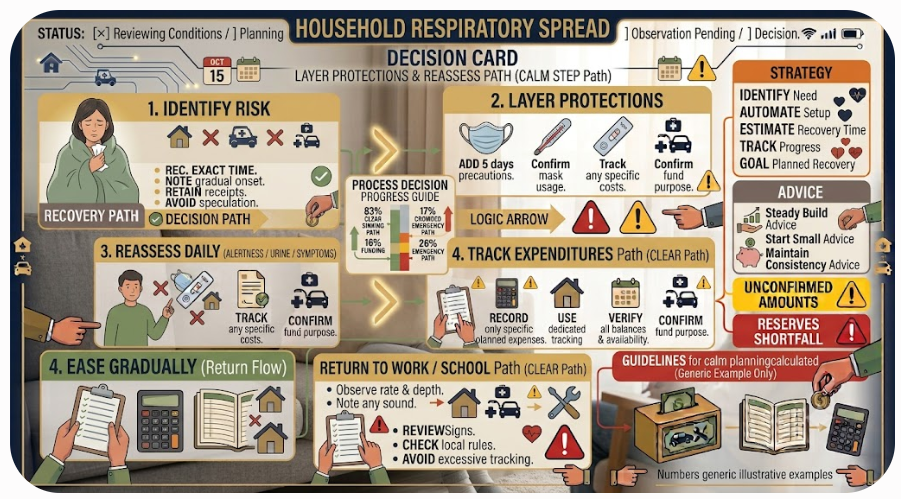
Follow the return framework from EW-H-0023: a person can generally resume normal activities when symptoms have been improving overall for at least 24 hours and any fever has been gone for 24 hours without fever-reducing medicine. For the next five days, add precautions such as cleaner air, hygiene, masking, distance, or testing when around others indoors.
Those five days are not a guarantee that transmission is impossible afterward, and they are not automatically five more days of complete household isolation. They are a period for extra care, especially around someone at higher risk.
Step protections back up if fever returns or symptoms worsen. Stay away from others again until the improvement and fever-free criteria are met. Local public-health guidance, a specific test result, a clinician’s instructions, or rules for healthcare and long-term-care settings may require a different plan.
Decision Summary
Reducing household spread is not mainly about finding the strongest disinfectant. It is about reducing close exposure and making several practical protections work together.
- Give the ill person space and shorten unnecessary close contact.
- Protect higher-risk household members first.
- Improve ventilation and filtration without creating weather, smoke, or airflow hazards.
- Use a well-fitting mask during unavoidable shared indoor time when it can be worn safely.
- Focus hygiene on hands, respiratory secretions, shared items, and high-touch surfaces.
- Wash dishes and laundry normally with detergent; avoid unnecessary contamination rituals.
- Assign caregiving roles so the plan is consistent and fewer people are repeatedly exposed.
- Reassess daily, continue added precautions for five days after returning to normal activities, and step back if symptoms worsen.
The useful question is not, “Did we eliminate every germ?” It is: “Where is exposure most likely today, and which layers can this household realistically strengthen?”
This article provides general health information, not diagnosis or individualized infection-control advice. Follow local public-health guidance and instructions from a clinician. Seek emergency care for trouble breathing, chest pain, blue or gray lips or face, severe confusion, or another serious or rapidly worsening symptom.
FAQ
Does the sick person need a separate bedroom and bathroom?
A separate room can reduce contact, but not every home has one. Use available distance, cleaner air, well-fitting masks during shared time, shorter interactions, and focused hygiene. If a separate bathroom is unavailable, clean frequently touched surfaces regularly.
Should everyone in the home wear a mask all day?
Not necessarily. Masks add the most value during unavoidable shared indoor contact, especially around a high-risk person. Fit, comfort, safety, and the ability to wear the mask consistently matter.
Do I need to disinfect the entire house every day?
No. Focus on frequently touched shared surfaces and items. Ordinary cleaning removes germs in most situations; when someone is sick, disinfecting selected surfaces after cleaning may be appropriate. Follow the product label.
Can I wash the sick person’s laundry with everyone else’s?
Yes, for ordinary respiratory illness. Use detergent and the recommended water temperature, dry items completely, wash hands after handling dirty laundry, and clean the hamper as appropriate.
Should family members share meals if they sit far apart?
More distance helps, but shared indoor time without masks still creates exposure. Separate mealtimes or outdoor eating may be more protective while someone is actively sick, particularly when a high-risk person lives in the home.
Is opening a window always the best choice?
No. Consider outdoor smoke, pollen, temperature, security, and fall risk. When opening windows is unsafe or uncomfortable, use suitable HVAC filtration, an appropriately sized portable air cleaner, or less shared-room time.
What if the only available caregiver is high risk?
Necessary care should continue, but add layers: reduce face-to-face time, improve air, use a well-fitting mask when safe, clean hands before and after care, and contact the person’s clinician early for a tailored plan.
Sources
- CDC – Preventing Spread of Respiratory Viruses When You’re Sick
- CDC – Masks and Respiratory Viruses Prevention
- CDC – Taking Steps for Cleaner Air for Respiratory Virus Prevention
- CDC – Hygiene and Respiratory Viruses Prevention
- CDC – When and How to Clean and Disinfect Your Home
- CDC – People at Increased Risk for Severe Respiratory Illnesses
More in This Cluster: Cold, Flu, and Respiratory Illness
- Cold, Flu, COVID-19, or RSV? What Your Symptoms Can—and Cannot—Tell You
- When Should You Stay Home from Work or School With a Respiratory Illness?
- Fever Basics for Adults and Children: What the Number Really Means
- Hydration During Illness: What to Drink and When to Get Help
- How to Reduce the Spread of Respiratory Illness at Home (you are here)
- When Breathing Symptoms Need Urgent Care
- Building a Practical Sick-Day Supply Kit