The worst time to discover that the thermometer battery is dead, the only pain reliever is expired, or every cold medicine in the cabinet contains the same active ingredient is when someone is already sick.
A useful sick-day kit is not a miniature pharmacy. It is a small, organized set of supplies that helps a household observe symptoms, stay reasonably comfortable, reduce avoidable spread, and know whom to contact. The right kit depends on who lives in the home. A healthy adult living alone, a family with an infant, and a household managing asthma or kidney disease should not stock the same things.
The goal is readiness without overbuying: stock by function, check every label, and customize for the people who may actually use the kit.
Quick decision: Start with a working thermometer, a simple symptom log, fluids the household will drink, tissues, soap, well-fitting masks, and any person-specific medicines or action plans already recommended by a clinician. Add symptom medicines only after checking age limits, active ingredients, warnings, interactions, and expiration dates. Treat pulse oximeters, humidifiers, home tests, and electrolyte products as optional tools with specific uses—not universal requirements.
Build Around Jobs, Not Products
Store shelves encourage people to shop by symptom: one box for cough, another for congestion, another for “daytime,” and another for “nighttime.” That approach can create duplication before it creates preparedness.
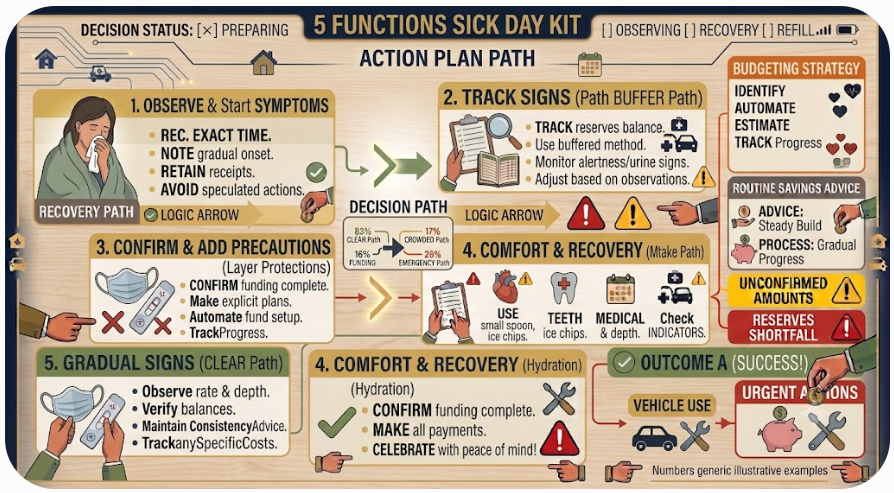
Instead, give the kit five jobs:
- Observe and record: measure temperature when useful and track symptoms, function, medicines, and changes.
- Support comfort and hydration: make drinking, resting, and managing ordinary discomfort easier.
- Reduce spread: keep practical hygiene and masking supplies within reach.
- Follow individual plans: make prescribed medicines, devices, and written instructions easy to find.
- Escalate or replenish: keep contact information and a short restocking list ready.
This structure prevents a common mistake: buying several products that do the same job while missing something basic, such as a dosing syringe or the number for an after-hours clinic.
Start With the People in the Household
Before buying anything, write down who might use the kit and what changes the decision for them.
- Are there infants or children? Record current weights when medication instructions depend on weight, and update them as children grow.
- Is anyone pregnant, breastfeeding, older, immunocompromised, or managing heart, kidney, liver, lung, blood-pressure, or bleeding problems?
- Does anyone have a medication allergy or take prescriptions that can interact with nonprescription products?
- Does anyone have an asthma, COPD, allergy, diabetes, seizure, or other action plan?
- Has a clinician restricted someone’s fluid intake or advised them to avoid a particular medicine?
Put a current medication list, allergies, clinician and pharmacy numbers, local urgent-care details, and the local poison-information number with the kit. Do not put private health details on an outside label where visitors can see them.
If a household member has a written action plan, the plan should determine which prescribed device or medicine belongs nearby. A generic checklist should never override individualized instructions.
The Core Kit Most Households Can Use
A working digital thermometer
Choose a thermometer appropriate for the ages in the household and keep its instructions. Know which measurement method it uses; oral, rectal, ear, forehead, and underarm readings are not interchangeable. Do not create your own conversion rule between sites.
Check that the display works and keep a compatible spare battery if the design allows replacement. Clean the device according to its instructions. If one thermometer may be used rectally, label it clearly and do not use it orally.
A simple care log
A paper notebook can be more dependable than memory when several people are providing care. Record:
- date and time;
- temperature and measurement site;
- major symptoms and ability to drink, eat, sleep, speak, walk, or play;
- medicine name, active ingredient, amount, and time given;
- home-test result, when relevant; and
- whether the person is improving, stable, or worsening.
The log reduces accidental repeat dosing and makes a call with a clinician more useful. It is an observation record, not a diagnostic tool.
Fluids and easy comfort options
Keep ordinary drinks the household will accept—water, tea, broth, or another familiar option. Ice pops or ice chips may be easier for some people. Oral rehydration solution can be useful when vomiting or diarrhea causes substantial fluid and salt losses, but it is not required for every cold. Sports drinks are not automatically equivalent to oral rehydration solution.
Households with medically prescribed fluid limits should not create a generic “drink as much as possible” rule. Follow the person’s care plan.
Saline nasal drops or spray can be a non-drug comfort option. For an infant, a clean bulb syringe or other age-appropriate suction device may help with nasal mucus when used as directed. Honey can soothe cough for people aged one year and older, but it must not be given to an infant under one because of botulism risk. Lozenges and hard candies are choking hazards for young children.
Supplies that reduce mess and spread
Include tissues, a lined waste container or small trash bags, soap, and well-fitting masks in sizes that household members can use. Hand sanitizer containing at least 60% alcohol is a practical backup when soap and water are not available, but it must be stored out of children’s reach and used under supervision.
Masks should not be placed on children younger than two or on anyone who cannot remove one safely. Replace masks that are wet, soiled, damaged, or difficult to breathe through. Routine household cleaning supplies can remain with the normal cleaning products; a respiratory sick-day kit does not need an arsenal of special disinfectants.
Add Medicines Deliberately
Nonprescription medicine is optional. It may reduce symptoms, but it does not turn a viral illness into a harmless one, and more products do not necessarily provide more relief.
Choose a medicine only for a symptom the household reasonably expects to treat and only if it is appropriate for the intended user. Keep it in the original child-resistant container with the Drug Facts label and its dosing device.
Before use, read:
- Active ingredient: what is actually in the product;
- Purpose and uses: which symptom it is intended to address;
- Warnings: who should not use it and when to ask a clinician or pharmacist;
- Directions: age, amount, timing, and maximum use; and
- Other information: storage conditions and expiration details.
Single-ingredient products can make it easier to match one medicine to one symptom and avoid unintended duplication. Multi-symptom products may contain pain relievers, cough suppressants, antihistamines, or decongestants that also appear in another product. Brand names and “day” or “night” labels are not enough—compare active ingredients.
Acetaminophen, for example, appears in many combination products. Taking more than one acetaminophen-containing medicine can lead to an overdose and liver injury. Other ingredients may cause drowsiness, raise blood pressure, interact with prescriptions, or be inappropriate for certain conditions. When uncertain, ask a pharmacist to review the exact products and the household medication list.
Children need their own safety check
Children are not smaller adults. FDA does not recommend over-the-counter cough and cold medicines for children younger than two, and manufacturers label these products “Do not use in children under 4 years of age.” For children ages four to six, the American Academy of Pediatrics advises using cough medicine only when a doctor recommends it. Always follow the current product label and pediatric guidance.
For a child’s liquid medicine, keep the supplied oral syringe, dropper, dosing spoon, or cup with that bottle. Do not use a kitchen spoon, and do not swap dosing devices between products with different concentrations or markings. Use the child’s current weight and the product-specific instructions or clinician guidance; do not invent a dose.
Do not give aspirin to a child or teenager with a suspected viral illness unless a clinician has specifically directed it. Do not give honey to an infant under one.
Decide Whether Optional Devices Earn Their Place
Pulse oximeter
A pulse oximeter may be useful when a clinician has recommended one and explained what readings mean for a specific person. It is not a required item for every household. Readings can be affected by circulation, cold skin, movement, nail products, device quality, placement, and skin pigmentation. A reassuring number must never override severe breathing difficulty, blue or gray color, confusion, chest pain, inability to speak normally, or rapid deterioration.
Cool-mist humidifier
A cool-mist humidifier may ease dryness or congestion for some people, but it creates work. It must be placed safely, cleaned as directed, and emptied or maintained so it does not disperse mold, bacteria, or mineral deposits. Warm-mist or steam devices can burn children. If the household will not clean a humidifier correctly, saline and ordinary room comfort measures are safer supplies to prioritize.
Home respiratory tests
An authorized home test can be useful only if the result may change an action—such as contacting a clinician about time-sensitive treatment, protecting a high-risk person, or following local work or school rules. Buy the correct test for the intended user, keep the instructions, follow its storage limits, and check the current expiration information. Some FDA-authorized COVID-19 tests have extended expiration dates that may differ from the date printed on the box.
A negative antigen result may not rule out infection early in illness; follow the test’s current instructions for repeat testing. Do not stock so many tests that most expire unused.
Store the Kit Safely and Make It Easy to Use
“Easy to find” does not mean “easy for a child to reach.” Store medicines and alcohol-based sanitizer up, away, and out of sight, with safety caps secured. Keep products in original containers. A bathroom cabinet may be too warm or humid for some medicines; use the storage directions on each label.
Use one clearly marked bin for non-medicine supplies and a secure medicine location nearby. Separate adult and child products. If two caregivers might confuse similar bottles, add a plain organizational label without covering the Drug Facts label, concentration, lot number, or expiration date.
Keep prescribed medicines under their normal storage conditions. Do not move refrigerated, temperature-sensitive, controlled, or emergency medicines into a general bin unless their instructions allow it.
Use a Two-Minute Maintenance Routine
Review the kit at least once a year and before the household’s usual respiratory-illness season. Also check it after an illness.
Use five actions:
- Test: Turn on the thermometer and any recommended device.
- Read: Check medicine, test, mask, and battery condition and expiration information.
- Remove: Take out expired, damaged, recalled, or no-longer-appropriate products.
- Replace: Restock only what was used or what the household plan still requires.
- Update: Refresh child weights, medication lists, action plans, and contact details.
Do not use expired medicine. The preferred disposal route for most expired or unwanted medicines is an authorized take-back program; follow FDA or local instructions for products with special disposal requirements. Do not pour medicines down a sink or flush them unless the specific instructions say to do so.
A Practical Shopping Decision
Before an item enters the kit, ask:
| Question | Keep or buy when… | Skip or reconsider when… |
|---|---|---|
| What job does it do? | It fills a clear observation, comfort, prevention, plan, or contact need | Another item already fills the same job |
| Who will use it? | The label and personal health context make it appropriate | Age, pregnancy, condition, allergy, or interaction is unclear |
| Can we use it correctly? | Instructions and measuring or cleaning tools are available | The device or medicine invites guessing |
| Will it be maintained? | Storage and review are realistic | It is likely to expire, become contaminated, or be forgotten |
| Will it change an action? | The result or relief helps guide a known next step | It offers a number or result without a plan |
Decision Summary
A strong sick-day kit is small enough to understand and complete enough to support the next decision.
- Build by function, not by the number of products on a shelf.
- Start with a working thermometer, care log, fluids, tissues, soap, masks, and household contact information.
- Keep individual prescriptions, action plans, and medication lists current.
- Read active ingredients and warnings before adding or combining nonprescription medicines.
- Use product-specific measuring devices for children; never guess a dose.
- Treat a pulse oximeter, humidifier, home test, and oral rehydration solution as situation-dependent tools.
- Store medicines securely in original containers and review the kit at least yearly and after use.
- Let symptoms, function, and trend—not the size of the kit—determine when medical help is needed.
Preparedness is not having something for every possible symptom. It is being able to find the right basic tool, use it safely, and recognize when the next step belongs to a pharmacist, clinician, poison centre, urgent-care service, or emergency team.
This article provides general health information. It does not recommend a specific medicine, dose, device, or treatment for an individual. Follow product labels and personal clinical advice, and seek urgent help for serious or rapidly worsening symptoms.
FAQ
How many days of supplies should a sick-day kit contain?
There is no universal quantity. Keep enough ordinary consumables to avoid an immediate shopping trip, but base amounts on household size, storage space, expiration dates, and how quickly items can be replaced. Prescriptions and emergency-preparedness supplies follow separate refill and care-plan rules.
Should every home have a pulse oximeter?
No. It is most useful when a clinician recommends it and provides an individualized interpretation plan. It cannot replace observation of breathing effort, speech, movement, color, alertness, or worsening symptoms.
Are combination cold medicines convenient or risky?
They can be convenient when every active ingredient is appropriate and needed, but they make accidental duplication easier. Compare the active-ingredient section of every product and ask a pharmacist when medicines, conditions, pregnancy, or age create uncertainty.
Can I keep medicines in a weekly organizer inside the kit?
Keep sick-day medicines in their original labeled containers. Original packaging preserves the active ingredient, concentration, warnings, lot number, expiration date, and directions. A personal prescription organizer should follow the person’s established medication-management plan.
Do I need electrolyte drinks for a cold?
Usually not. Ordinary fluids are often sufficient when a person can drink and is not losing substantial fluid and salts. Oral rehydration solution may be more appropriate for significant vomiting or diarrhea. Follow fluid restrictions and seek advice for dehydration concerns.
How often should I replace a thermometer?
There is no routine replacement interval that applies to every model. Replace it if it is damaged, unreliable, cannot be cleaned as directed, or no longer works after battery replacement. Check operation during the kit review rather than waiting for illness.
What should I do if a child may have swallowed medicine or hand sanitizer?
Do not wait for symptoms or try to make the child vomit. Contact the local poison-information service immediately and call emergency services for collapse, seizure, breathing difficulty, or inability to wake. Keep the container available so the product and strength can be identified.
Sources
- FDA – The Over-the-Counter Drug Facts Label
- FDA – Acetaminophen
- FDA – Should You Give Kids Medicine for Coughs and Colds?
- AAP / HealthyChildren.org – How to Use Liquid Medicines for Children
- CDC – Hygiene and Respiratory Viruses Prevention
- FDA – Where and How to Dispose of Unused Medicines
More in This Cluster: Cold, Flu, and Respiratory Illness
- Cold, Flu, COVID-19, or RSV? What Your Symptoms Can—and Cannot—Tell You
- When Should You Stay Home from Work or School With a Respiratory Illness?
- Fever Basics for Adults and Children: What the Number Really Means
- Hydration During Illness: What to Drink and When to Get Help
- How to Reduce the Spread of Respiratory Illness at Home
- When Breathing Symptoms Need Urgent Care
- Building a Practical Sick-Day Supply Kit (you are here)