An affordable bill can still arrive on an unaffordable day. The amount has not changed, but its position between paychecks can push an account below zero, force a late payment, or make money reserved for food and transportation look temporarily available. Matching bills to pay is the work of correcting that sequence without pretending that a calendar can repair a budget whose totals do not work.
Reader decision: Build a paycheck-to-bill map that protects essential spending, assigns each recurring bill to money already received, and identifies which due-date changes would genuinely reduce risk.
First confirm that timing is the problem
This process begins after a basic cash-flow diagnosis. Add up realistic income and outflows over a representative period and follow the running balance between deposits. If total recurring expenses and ordinary living costs exceed dependable income, moving a due date may prevent one late fee, but the deficit will reappear.
Matching is most useful when the period is sustainable overall but one part of it is overloaded. Typical signs include:
- the account repeatedly reaches its lowest point just before a known payday;
- several large obligations fall inside the same pay period;
- the month ends positive after an earlier shortage;
- bills are paid with the next paycheck even though they were due before it; or
- money for groceries, transportation, medication, or childcare is repeatedly used to cover an early bill.
If the totals and the timing are both unstable, make a cautious map anyway, but label the result provisional. A clean calendar cannot make uncertain income predictable.
Use money when it is usable, not when it is earned
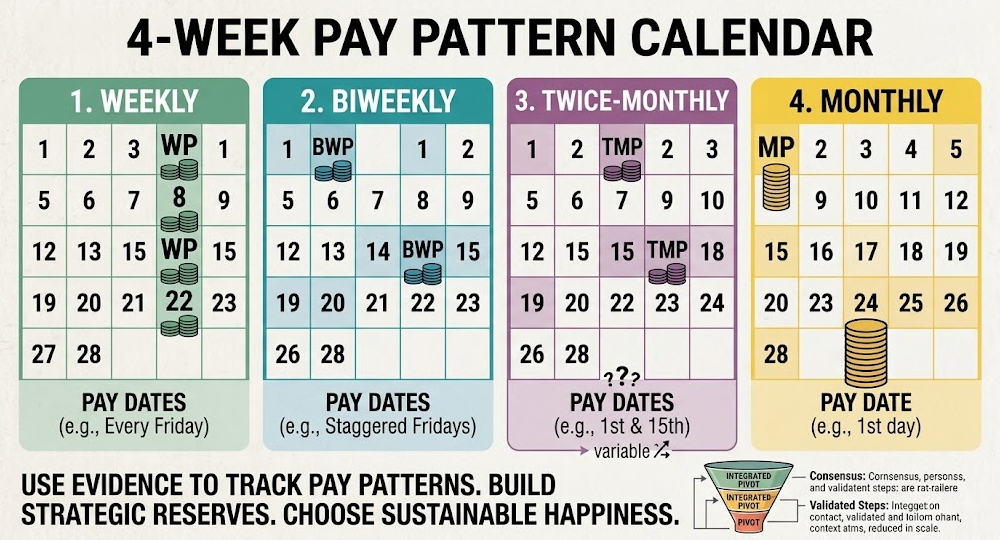
Your pay schedule is not simply “twice a month” or “every two weeks.” Record the date on which each deposit is normally available to spend. A payday shown on a pay stub may differ from the moment a cheque clears or a benefit becomes accessible.
Common patterns create different calendars:
- Weekly: usually four paydays, occasionally five, with a short interval between them.
- Every two weeks: 26 pay periods in a typical year, so two months usually contain a third paycheck. Do not build regular monthly obligations around that extra check unless the plan deliberately accounts for it.
- Twice monthly: commonly 24 deposits on two recurring dates. The number of days between deposits is uneven.
- Monthly: one deposit must carry the full cycle.
- Variable or irregular: dates, amounts, or both may change; fixed obligations should be tested against conservative dependable income rather than the best recent period.
Also record other dependable income on its actual availability date. Do not count unused credit, an overdraft limit, a hoped-for bonus, or unconfirmed overtime as income.
Build a Paycheck-to-Bill Map
The purpose of the map is not to make every paycheck carry the same dollar amount. It is to ensure that each bill is supported by money that will be available before the payment must arrive, while leaving enough for necessities between paydays.
Use one representative cycle. If pay or bills vary significantly, test a low-income or high-expense cycle as well.
Step 1: List usable pay dates and conservative amounts
For each deposit, record:
- the expected availability date;
- the take-home amount you can reasonably rely on;
- whether the date or amount can change; and
- which period it must support until the next dependable deposit.
For variable income, separate a dependable base from a variable layer. Assign required bills to the base where possible. Variable earnings can support flexible spending, catch-up work, or future reserves after they arrive; treating them as guaranteed before receipt increases the chance of a shortfall.
Step 2: Inventory recurring bills by payment deadline
For every recurring obligation, record:
- the normal amount or a cautious estimate;
- the due date;
- the date payment must be initiated;
- the likely clearing date;
- the consequence of a late or failed payment;
- whether the provider says the date can be changed; and
- whether the amount varies.
The due date is not always the action date. A mailed payment may need to be sent well in advance. An online transfer can also require processing time. Confirm the provider’s instructions rather than assuming that clicking “pay” on the due date makes the payment timely.
Include rent or mortgage, utilities, insurance, minimum debt payments, childcare, subscriptions, support obligations, and any automatic transfers that function like commitments. Avoid counting a card purchase and the later card payment twice in the same cash view.
Step 3: Protect the spending that does not arrive as a bill
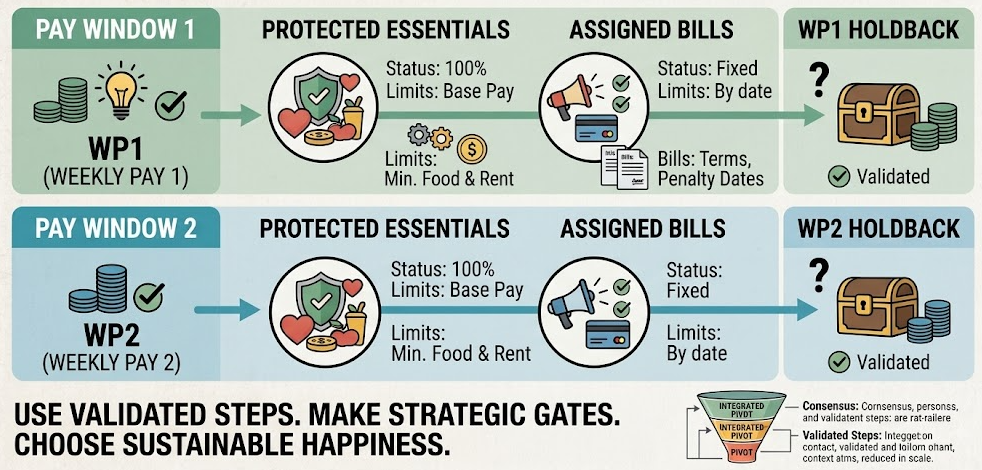
A map made only from statements can overassign a paycheck. Before attaching bills, reserve a realistic amount for needs between this payday and the next:
- groceries and household basics;
- transportation to work, school, or appointments;
- medication and essential health costs;
- childcare or caregiving;
- necessary cash spending; and
- a small operational margin for variable amounts or processing differences.
Call this the protected essentials amount. It is not spare money, and it should not disappear merely because no company sends an invoice for it.
Step 4: Assign each bill to the paycheck before it
Start with the first paycheck in the cycle. Subtract protected essentials, then assign bills that must be paid before the next dependable deposit. Continue paycheck by paycheck.
For each pay window, calculate:
Usable paycheck − protected essentials − assigned bills = projected remainder
The remainder is not automatically available for discretionary spending. It may need to remain in the account as a holdback for a bill due early in the next window. The question is whether the running balance stays above the household’s required floor after payments clear.
A bill due on the second day of the month may logically belong to the final paycheck of the previous month. This is the most important mental shift in matching: the calendar month containing the due date does not decide which paycheck funds it. The last safe deposit before the due date does.
Step 5: Mark the holdback amount
When one paycheck must fund a later bill, record the amount as held for that bill. You can track it in a notebook, budgeting app, spreadsheet, separate bills account, or account category. The method matters less than making the commitment visible.
Do not subtract the same holdback twice. If you move money to another account, the transfer is not a new expense; the bill payment is the outflow. Your system should show both where the money is and what it is reserved for.
Step 6: Find the overloaded window
Highlight any pay window where:
- the projected remainder falls below zero or below a necessary operating floor;
- essential living money is being used for bills;
- a large variable bill could erase the margin;
- several high-consequence payments compete for the same deposit; or
- the plan depends on income that is not dependable.
That is the window to redesign. Moving every bill creates administrative work without necessarily improving cash flow.
Choose due-date changes by impact, not convenience
Some providers may allow a due-date change, but policies differ. Before requesting one, ask:
- Is a different due date available for this account?
- When would the change take effect?
- Would the first statement after the change cover a longer period or require a different amount?
- Would any fee, interest, grace-period, promotional, or autopay term change?
- Must the account be current first?
- Will the new date remain fixed, or can it move on weekends and holidays?
The Consumer Financial Protection Bureau warns that not every company permits a change and that the first bill after a change may be higher. Some changes do not take effect until a later billing cycle. Keep the original deadline until the provider confirms the new one in writing or in the account.
Prioritize a change that moves a large or high-consequence bill out of an overloaded window and into a window with a verified remainder. A small subscription may be easy to move but have little effect. Changing a major payment by several days may help more—if the provider permits it and the transition does not create a larger immediate bill.
Do not move a due date later merely to spend the supporting paycheck first. The new date works only if the money remains reserved.
Test the transition month separately
A steady-state calendar can look safe while the changeover month fails. Suppose a utility due date moves from the 8th to the 20th. The provider may extend the first billing period, delay the effective date, or generate an amount different from the usual estimate. If you release the money held for the old date too soon, another obligation may consume it.
For each approved change:
- retain the amount planned under the old schedule until the new date is confirmed;
- enter the actual first changed bill rather than a normal-month estimate;
- verify any automatic-payment setting after the change;
- check the account after the first payment clears; and
- update the map only when the new pattern is operating as expected.
Change one or a small number of dates at a time when possible. This makes errors easier to identify and prevents several transition effects from landing together.
Use automation only after the funding rule works
Autopay can reduce forgotten payments, but it does not solve insufficient funds. A poorly timed automatic debit can convert a late-payment problem into an overdraft, returned-payment fee, or missed essential purchase.
Before enabling it, confirm:
- which account will be charged;
- whether the debit is for a fixed amount, minimum amount, statement balance, or another option;
- when the provider initiates and clears it;
- how to change or cancel it;
- what alerts are available; and
- whether the mapped paycheck reliably funds it.
For variable bills, an alert plus manual review may be safer than unattended payment when the margin is narrow. If you use a separate bills account, transfer amounts early enough to clear and reconcile the account regularly. Separation improves visibility; it does not create more money.
An illustrative two-paycheck example
Assume a household receives $2,000 on the 1st and $2,000 on the 15th. Its recurring bills total $2,600, and it needs $1,100 for groceries, transportation, medication, and other ordinary spending during the month. The overall plan has a $300 margin.
Under the current schedule, $1,750 of bills falls before the 15th. If the household protects $550 for essentials in that first window, the first paycheck has only $1,450 available for bills. The window is $300 short even though the month is $300 positive.
The map identifies the question precisely: can at least $300 of obligations move into the second window without causing that window to fail? If a $400 insurance payment can move, the first window gains $400. The second paycheck then supports $1,250 of bills plus $550 of essentials, leaving $200. Across the full month, the original $300 margin remains; the distribution has changed, not the total.
This is illustrative, not a universal allocation. If the provider makes the first changed insurance bill larger by $150, the transition must include that amount. If total monthly costs were $4,200 against $4,000 of income, the same move would not eliminate the $200 deficit.
Common matching mistakes
Dividing every monthly bill exactly in half
Equal division can be useful for saving toward a bill, but it does not reflect actual deadlines, uneven pay intervals, variable amounts, or the first-of-month bill funded by the prior month’s income.
Treating a third biweekly paycheck as routine monthly income
Those paychecks occur in particular months, not every month. Give them an intentional role only after regular windows are viable.
Ignoring essentials because they have no due date
Food and transportation compete for the same cash as invoices. Protect them before assigning the full paycheck to bills.
Assuming a requested date is already effective
Continue following the existing statement until the provider confirms the change.
Moving bills without checking the next cycle
A change that relieves one window can overload another. Recalculate the entire cycle and the transition month.
Using credit to bridge a repeated gap
A credit card may postpone cash leaving the account, but it creates a later obligation and may add interest. It changes timing only if the balance can be paid under a workable plan.
Optimizing a calendar when the totals are negative
If the representative period remains in deficit, name that problem directly. Timing work can support a broader response, but it should not hide the need to change income, costs, commitments, or obtain qualified help.
Decide whether the new schedule is better
Run the proposed map through at least one complete cycle and compare it with the old schedule. A better match should improve evidence that matters:
- the lowest projected balance is safer;
- fewer essential dollars are temporarily diverted;
- fewer bills depend on the next paycheck arriving early;
- the transition does not introduce fees or an unusually large bill;
- the system remains understandable to everyone responsible for household payments; and
- the monthly totals still work.
If a provider will not change a date, keep the bill assigned to the last safe paycheck and make the holdback more visible. If several bills remain crowded despite date changes, the next article addresses what to do when bills arrive at once. Building a full one-month cash buffer is a later and more demanding step; it is not a prerequisite for making today’s map more accurate.
The aim is not a beautiful calendar. It is a schedule in which money is present before it is promised, essentials remain protected, and each paycheck has a job that survives the days until the next one.
FAQ
Should I match bills to the paycheck before or after the due date?
Use the last dependable paycheck that becomes available early enough for the payment to arrive on time. Never plan on a paycheck that normally arrives after the deadline.
Can I ask a company to change my bill due date?
Sometimes. Provider policies differ, and not every bill can be changed. Ask when the change takes effect, whether the first bill will be different, and whether any terms or automatic-payment settings will change.
Which bill should I move first?
Start with a movable bill whose amount or consequence materially overloads one pay window. Recalculate the destination window before requesting the change.
How should I handle a bill due on the first of the month?
It often needs to be funded from the final paycheck of the previous month. Mark that money as held for the bill rather than treating it as available month-end cash.
Is autopay the best way to match bills to paydays?
Only after the underlying map works. Autopay can prevent forgetting, but it can also trigger a failed payment or overdraft when the account is not funded.
What if my paycheck amount changes every period?
Build required commitments around a conservative dependable base where possible, mark variable income separately, and test the map against a lower-income period. Do not promise variable earnings before they arrive.
What if I cannot cover essential bills even after changing dates?
Treat that as more than a scheduling problem. Prioritize immediate necessities and contact providers, local assistance services, or a qualified nonprofit financial counselor in your jurisdiction before missed payments compound.
Sources
- CFPB – Request a Change in Your Bill Due Date
- CFPB – Adjusting Your Bill Due Dates Can Help You Stay on Top of Your Bills and Manage Your Cash Flow
- CFPB – Creating a Cash Flow Budget
- CFPB – Improving Cash Flow
- Consumer.gov / FTC – Making a Budget