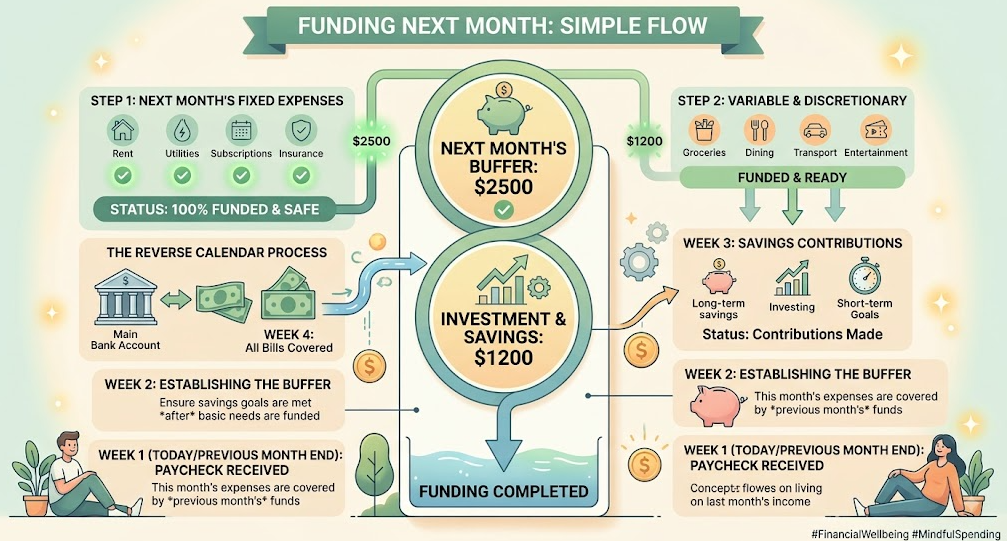
Picture the first day of next month. Before that month’s first paycheck arrives, the money for its recurring essentials is already assigned: housing, utilities, groceries, transportation, insurance, minimum required payments, medication, and necessary care. The balance is not a windfall. It is next month’s operating money, waiting before the bills begin.
Now work backward to today. The useful question is not, “How do I somehow save a whole month at once?” It is, “What is the next layer of future spending I can fund without making the current month less safe?”
Reader decision: Define a one-month operating target, build it in protective stages, keep it available without mixing it into ordinary spending, and establish clear rules for completion, use, and refill.
Know what this buffer is meant to do
A one-month cash buffer is money set aside to fund a chosen month of normal, recurring household outflows before that month begins. Its main purpose is cash-flow stability. It reduces dependence on the exact order of paydays and due dates and gives the household more room to absorb ordinary timing changes.
This is not the same as an emergency fund. The Consumer Financial Protection Bureau describes emergency savings as a cash reserve for unplanned expenses or financial emergencies—such as a repair, medical bill, or income loss—that are not part of routine monthly spending. A cash buffer, by contrast, is assigned to expenses you expect.
The same dollars should not be counted twice. If $1,500 is labeled as next month’s rent, food, and transportation, it is not also $1,500 available for an unexpected repair. A household may eventually maintain both an operating buffer and emergency savings, but this article addresses only the operating buffer.
A buffer also does not fix a recurring deficit. If dependable income remains below realistic recurring outflows, moving money into a buffer account can make the current shortage worse. Return to the cash-flow diagnosis from the first article in this cluster and address the total imbalance before treating a full-month target as immediately achievable.
Define the month you are trying to pre-fund
“One month of expenses” sounds precise, but it can produce very different numbers. Gross income is not an expense. A high-spending holiday month may not represent ordinary operations. An average can hide a winter utility bill or a five-week grocery cycle.
Choose a representative upcoming month and use actual recent records to estimate what must be paid or purchased during it. The CFPB’s cash-flow guidance recommends tracking income and expenses for at least one month before building a cash-flow budget. If your costs vary significantly, review several months and test the target against a higher ordinary month rather than relying only on the lowest.
Start with outflows that keep the household operating:
- housing;
- utilities and essential communication;
- groceries and household basics;
- transportation needed for work, school, health care, or caregiving;
- insurance premiums needed to maintain chosen or required coverage;
- medication and routine essential health costs;
- necessary childcare or caregiving;
- minimum required debt payments and legal obligations; and
- a modest allowance for ordinary variation in these categories.
Whether to include discretionary spending is a choice, not a moral test. A core buffer may cover only recurring essentials and required payments. A full operating buffer may also include the household’s realistic routine personal spending. Label the target accurately. Calling an essentials-only amount a complete month of all spending creates false confidence; requiring every optional expense before recognizing progress can make the target unnecessarily discouraging.
Do not include known but nonmonthly costs as though they occur every month unless their monthly share is actually transferred into this operating account. Annual insurance, school fees, holiday spending, major maintenance, and similar expenses belong in the irregular-expense system reserved for a later article in this cluster.
Build a One-Month Buffer Ladder
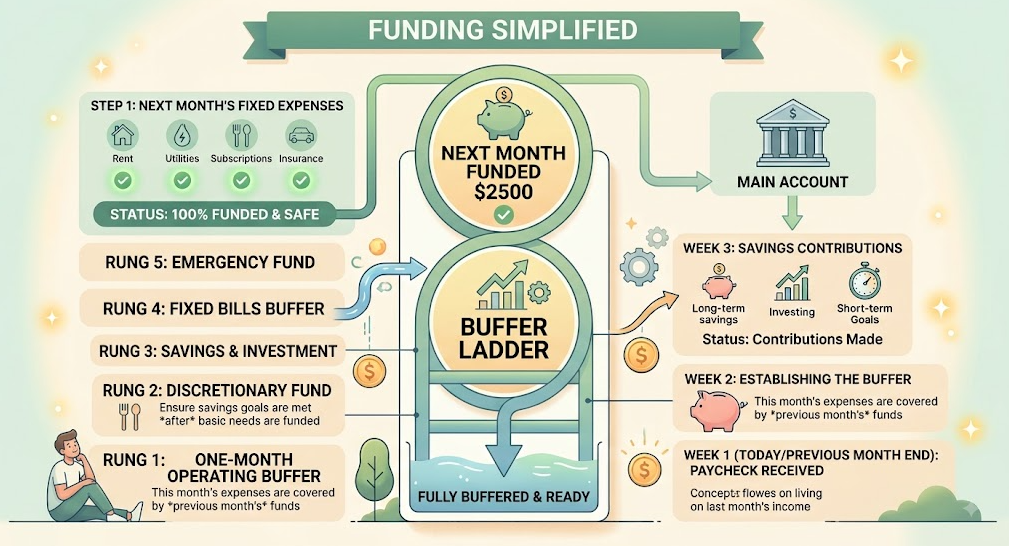
The full target is the destination, but it should not be the only meaningful milestone. Use a ladder so that every completed stage protects something specific.
1. Calculate the target
List the covered outflows for the chosen month and add them once. Use take-home cash needs, not gross income. Avoid double-counting credit-card purchases and the later card payment. If groceries bought on a card are included in the spending categories, include only the portion of the card payment needed to pay for those purchases—not both as separate costs.
Write a short scope statement beside the total:
“This target covers one representative month of recurring essentials and required payments. It excludes emergencies and separately planned irregular costs.”
That sentence prevents the balance from silently acquiring more jobs than it can perform.
2. Identify what is already assigned
Check cash that is genuinely available for this purpose. Do not count an overdraft limit, unused credit, a deposit that has not arrived, money reserved for current bills, or savings assigned to another goal.
If some existing savings can be redesignated without weakening a higher-priority protection, document the change. Otherwise, begin at zero. The relevant calculation is:
Buffer target − cash already assigned to the buffer = build gap
3. Choose protective rungs
Divide the gap into stages based on what each amount can protect. For example:
- a small operating floor that prevents routine balance errors from reaching zero;
- the largest essential bill due before the next paycheck;
- one pay window of essential spending;
- half of the defined monthly target; and
- the full one-month target.
These are planning stages, not universal amounts. A monthly-paid worker, a biweekly-paid household, and someone with variable income face different pay windows. Choose rungs that correspond to the actual cash-flow calendar.
The first rung matters. A household that has accumulated $300 toward a $3,000 target does not yet have a full buffer, but it has created $300 of distance from an overdraft, late fee, or badly timed transfer. Track both the current rung and the final target.
4. Set a contribution the current month can support
Use the cash-flow map, not optimism, to choose the contribution. Look at the lowest projected balance before each dependable deposit. A transfer is safe only if current bills, ordinary essential spending, pending transactions, and a reasonable operating margin remain funded afterward.
Possible contribution sources include:
- a fixed amount after each dependable deposit;
- part of the remainder from a lower-expense pay window;
- a chosen share of variable income after it arrives;
- a fee refund, rebate, gift, or other one-time inflow; or
- money released when a temporary expense ends.
Automatic transfers can support consistency. The Federal Deposit Insurance Corporation notes that scheduled transfers can help people save before spending. Automation is useful only when the sending account can support it. If pay or expenses vary, a manual transfer after checking the balance may be safer than an automatic transfer that triggers an overdraft or forces the money straight back.
Do not fund the buffer by missing required payments, underestimating food or medication, or adding high-cost debt. If no safe recurring contribution exists, the correct result is not failure. It is evidence that the household needs a smaller first rung, a longer timeline, a change in recurring totals, additional income, or qualified assistance.
Keep the buffer separate in purpose
Separation can be physical, digital, or simply well recorded. The important point is that the balance cannot be mistaken for spending money.
Options include:
- a separate savings or transaction account with no avoidable monthly fee;
- a bank or credit-union subaccount labeled “Next Month”;
- a clearly tracked portion of an existing account; or
- another secure, accessible cash-equivalent arrangement appropriate to the reader’s country and circumstances.
Compare account fees, minimum-balance requirements, transfer times, withdrawal limits, deposit protection, and access during weekends or holidays. A buffer that takes several days to reach the bill-paying account may require earlier transfers. A separate account that charges more than the buffer prevents is a poor fit.
Readers who receive means-tested public benefits should verify whether liquid savings affect eligibility or reporting obligations before choosing a target or account. Rules vary by program and jurisdiction; do not assume that every benefit treats savings the same way.
Security matters as well. Avoid recording full account numbers in a worksheet. Use protected access, monitor statements, and know how to respond if an account is compromised.
An illustrative build plan
Suppose a household defines its core one-month buffer as $3,100:
- $1,450 housing;
- $300 utilities and essential communication;
- $600 groceries and household basics;
- $300 transportation;
- $200 insurance;
- $150 minimum required debt payments; and
- $100 medication and ordinary variation.
The household already has $400 assigned only to next month, leaving a $2,700 build gap.
Its ladder is:
- Rung 1 — $600: a modest operating floor;
- Rung 2 — $1,450: the largest essential bill;
- Rung 3 — $1,900: one protected pay window based on its actual calendar;
- Rung 4 — $2,325: three-quarters of the core target; and
- Rung 5 — $3,100: the complete core month.
After reviewing the running balance, the household chooses a $225 transfer after each dependable biweekly paycheck. A $450 one-time refund is also assigned after it arrives. The arithmetic is:
$400 starting buffer + $450 one-time deposit + ($225 × 10 deposits) = $3,100
That is an illustrative path, not a promise that every household can or should use the same amount or pace. A variable-income household might contribute a smaller base amount plus a percentage of income above a conservative threshold. Someone recovering from the shortage described in the previous article might first complete only Rung 1 while stabilizing current obligations.
The household should recalculate after every deposit and expense change. If the transfer repeatedly has to be reversed, the amount or timing is too aggressive for the current cash flow.

Decide when the buffer is complete
The number alone is not enough. Use a completion test:
- The balance equals the defined target.
- Every dollar has one documented job in the selected month.
- The money is accessible before each covered payment must be made.
- Current-month obligations remain funded without borrowing from the buffer.
- The same balance is not counted as emergency savings or another goal.
Once the test passes, change how the household operates. Instead of spending each paycheck immediately against the next bill, income received during the current month can replenish or fund the following month according to the chosen system. This transition may take more than one cycle; verify the running balance before changing payment dates or automatic transfers.
Create use and refill rules before you need them
A buffer is meant to move. Using it for the month it was assigned to is not “breaking into savings.” The important distinction is whether the household is following the planned cycle or consuming future money without a refill plan.
Write three rules:
- Normal use: which next-month outflows the buffer pays and when money moves to the operating account;
- Unplanned use: who decides when the buffer may cover something outside its stated purpose; and
- Refill: how future income restores the target after use or a cost increase.
Review the target when housing, childcare, insurance, transportation, debt minimums, household size, or income timing changes. A target based on last year’s costs can remain fully funded on paper while no longer covering the intended month.
If the buffer is repeatedly used early for ordinary expenses, investigate rather than judging the household. The cause may be an understated target, a recurring deficit, variable income, untracked spending, or an account system that makes the money too easy to misread. The later weekly-versus-monthly budgeting article can help choose a monitoring rhythm, but it does not change the target’s purpose.
Build time, not a badge
The practical value of a one-month cash buffer is not the ability to say that one exists. It is the time between income and obligation: time to handle a delayed deposit, time to avoid assigning the same paycheck twice, and time to make a decision before a due date becomes a crisis.
Start with the correct target, then build the next protective rung at a pace the current month can support. A buffer created by destabilizing today is not protection. A buffer built deliberately becomes a quieter operating system—one in which next month does not have to wait for its first paycheck to begin.
FAQ
Is a one-month cash buffer the same as an emergency fund?
No. A cash buffer pre-funds expected routine outflows. Emergency savings are reserved for unplanned expenses or financial shocks. Keep the purposes separate and do not count the same balance toward both targets.
Should the target equal one month of income or one month of expenses?
Use the covered outflows for a representative month. Income may be higher or lower than those costs and does not show what the buffer must actually fund.
Do I need the full month before the buffer helps?
No. Smaller rungs can protect an operating floor, a major bill, or one pay window. Label partial progress accurately so it is useful without being mistaken for a complete month.
Should I automate my buffer contributions?
Only if the amount and transfer date are safe across your cash-flow cycle. With variable income or a low balance, reviewing the account and transferring manually may reduce overdraft or reversal risk.
Where should I keep the buffer?
Use a secure, low-cost place that is distinct in purpose and accessible before covered payments are due. Compare fees, minimums, transfer time, withdrawal conditions, and applicable deposit protection.
What if I cannot find money to contribute?
Choose a smaller first rung and confirm that your recurring totals work. Do not skip essentials or required payments to create the appearance of savings. A persistent deficit may require changes to income, costs, debt arrangements, or qualified assistance.
When should I change the target?
Review it after meaningful changes to recurring essentials, required payments, household needs, or income timing, and at least during a regular annual cash-flow review.
Sources
- CFPB – Creating a Cash Flow Budget
- CFPB – An Essential Guide to Building an Emergency Fund
- FDIC – Saving for the Unexpected and Your Future
- CFPB – Evidence-Based Strategies to Build Emergency Savings
- CFPB – A Financial Empowerment Toolkit for Workers