The utility bill was not forgotten. One person thought it had already been paid; the other had planned to cover it from the next paycheck. Meanwhile, an automatic transfer moved money to savings exactly as instructed.
Each action made sense on its own. Together, they left the operating account short. The failure was not arithmetic—it was a missed handoff between people, dates, and rules.
A useful household cash-flow system prevents that kind of ambiguity. It gives everyone who needs to know one current view of the money, assigns the next action, and makes exceptions visible before they become fees or missed essentials.
Reader decision: Choose the smallest shared cash-flow system your household can maintain, then define its balance floor, roles, review rhythm, exception rules, and reset process.
A system is more than a budget or an app
A budget answers whether expected income can cover expected spending over a period. A cash-flow system also answers operational questions:
- What money is actually usable today?
- What must remain protected before the next income date?
- Which payments and transfers will occur first?
- Who checks that they happened?
- What changes when reality differs from the plan?
The Consumer Financial Protection Bureau’s cash-flow budget carries each week’s ending balance into the next week’s beginning balance. That continuity matters: a household cannot evaluate Friday’s payment as though Monday’s remaining balance did not exist. A simple system preserves the same chain even if it uses a paper calendar rather than a spreadsheet or app.
The system should not recreate every financial decision from the beginning. It should hold the decisions already made: the household’s bill dates, protected essentials, spending limits, buffer contribution, and irregular-expense assignments. Its job is to keep those decisions visible and executable.
Start with the smallest reliable version
More detail does not automatically produce more control. A system with twelve accounts, dozens of categories, and daily reconciliation may be precise but unusable for a household that will not maintain it. A single bank balance, however, may be too vague because some of that money is already committed.
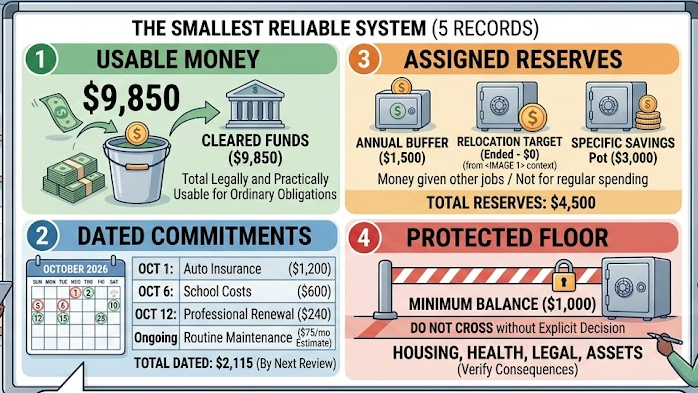
The smallest reliable system usually needs five records:
- Usable money: cleared funds that can legally and practically be used for the household’s ordinary obligations.
- Dated commitments: bills, transfers, and essential spending expected before the next review.
- Assigned reserves: money already given another job, such as a one-month operating buffer or a known annual bill.
- A protected floor: the balance the operating account should not cross without an explicit decision.
- An exception list: anything late, disputed, unusually high, missing, duplicated, or uncertain.
These can fit on one page. The records may live in a notebook, calendar, spreadsheet, budgeting tool, or combination. Choose the format that the responsible people can access and update—not the one with the longest feature list.
Build a Household Cash-Flow Loop
The loop has seven parts. Each part should produce a visible answer or action.
1. Create one shared view
List the operating accounts and payment methods that affect near-term household cash. Include pending card payments, automatic withdrawals, cash needed for essentials, and restricted benefits where relevant. Do not add credit limits to available cash, and do not count an incoming payment until its amount and usable date are reasonably known.
“Shared” does not require every adult to have access to every account. Privacy, financial safety, legal ownership, cultural expectations, or a history of coercive control may require separate accounts and limited permissions. It does require the people making connected decisions to have the information they need. A shared summary can show commitments and available household funds without exposing unrelated personal transactions.
Choose one source of truth. If a paper calendar, banking app, and spreadsheet disagree, specify which one controls and how the others are updated.
2. Define the protected floor
The protected floor is not merely the bank’s minimum balance. It is the amount that must remain available for obligations due before the next reliable inflow, plus any small margin the household deliberately preserves for timing uncertainty.
For example, suppose the operating account has $2,400. Before the next paycheck, the household expects $1,050 in scheduled bills, $420 for groceries and transport, and a $130 margin for payment timing. The usable amount above the floor is:
$2,400 − ($1,050 + $420 + $130) = $800
That $800 is not automatically discretionary. Planned reserves, debt decisions, and other goals may still claim it. The calculation simply prevents the full displayed balance from being mistaken for unassigned money.
Recalculate the floor when a due date, income date, essential need, or pending transaction changes. A floor that never responds to reality becomes decorative.
3. Assign roles by action, not personality
Avoid vague assignments such as “Alex handles money.” Divide the work into observable actions:
- Record: enter new bills, income dates, and changes.
- Execute: approve or make payments and transfers.
- Verify: confirm that transactions cleared for the expected amount.
- Reconcile: compare records with actual balances and resolve exceptions.
- Escalate: alert the household when the protected floor may be crossed.
One person may perform several roles, but every critical action needs an owner and a backup. If only one person knows the system, illness, travel, overload, or loss of account access can stop it. Keep a secure inventory of institutions, billers, and recovery procedures; never place passwords or full account credentials in an ordinary shared sheet.
4. Attach actions to the pay cycle
A busy household benefits from event-based routines. Instead of relying on “check the budget often,” define what happens when money arrives and shortly before bills leave.
On each usable pay date:
- confirm the deposit cleared and compare it with the expected amount;
- protect essentials due before the next pay date;
- make or schedule required payments;
- fund approved reserves only after the operating floor remains safe; and
- record the next checkpoint.
Before a high-withdrawal day, check the available—not merely displayed—balance and pending transactions. Once a week, scan the bill calendar and exception list. At month-end, reconcile the full cycle and prepare the next month. These rhythms can coexist: pay-cycle actions move the money, weekly scans catch changes, and monthly reconciliation tests the design.
5. Write exception rules before you need them
Automation handles expected events. A system proves its value when the expected event changes.
Define what happens if:
- income is late or smaller than expected;
- a bill is higher, earlier, or duplicated;
- a required payment fails;
- an automatic transfer would cross the floor;
- an assigned reserve must be used for another purpose; or
- two household members make conflicting commitments.
A useful exception rule contains a threshold, an owner, and a next action. For example: “If projected cash falls within $100 of the protected floor, pause nonessential scheduled transfers, notify both operators, and review the dated commitments before new spending.” The $100 is illustrative, not a universal standard.
Do not assume a partial payment, paused transfer, or canceled automatic debit changes a contract or prevents fees and service consequences. Confirm current terms with the provider. When all obligations cannot be paid, return to consequence-based bill triage rather than letting the loudest notification decide.

6. Reconcile facts, not intentions
Reconciliation asks whether the system’s record matches reality. Compare:
- expected deposits with cleared deposits;
- scheduled payments with actual amounts and dates;
- operating and reserve records with account balances;
- card purchases with the amount reserved for the card payment; and
- household commitments with transactions not yet posted.
Investigate differences instead of silently adjusting the record. A $60 variance could be a forgotten purchase, a price change, a duplicate charge, a pending authorization, or a recording error. Those causes require different responses.
The Federal Deposit Insurance Corporation’s Money Smart guidance treats a spending and saving plan as something that changes to reflect reality. Adjustment is not evidence that the plan failed. Repeated unexplained adjustments, however, are evidence that the system is missing information or assigning unrealistic amounts.
7. Reset only what the evidence supports
At the end of a full cycle, keep what worked and change the smallest failing part. Ask:
- Did the balance cross the protected floor?
- Were bills recorded before they became urgent?
- Did each assigned action have an owner and backup?
- Which variances repeated?
- Did automation execute correctly?
- Was the review rhythm sustainable?
If the weekly scan repeatedly catches problems, keep it. If daily entry is abandoned after three days, replace it with transaction import plus a weekly review. If two accounts consistently cause transfer errors, simplify the flow. If a separate reserve prevents accidental spending, preserve it.
Do not respond to every mistake by adding another category, account, notification, or meeting. Complexity has a maintenance cost.
Choose tools after defining the loop
Paper is visible and easy to discuss but must be updated manually. A spreadsheet can show dates, balances, and assignments flexibly but may require careful version control. A budgeting app may import transactions and automate categories, yet imports can lag, rules can misclassify spending, and access or subscription terms can change. Bank alerts are useful for thresholds and cleared transactions, but they rarely show the household’s complete plan.
Evaluate any tool against six questions:
- Can the necessary people access the right information safely?
- Does it show payment timing, not only monthly totals?
- Can it distinguish available money from assigned money?
- Are corrections and exceptions easy to see?
- Can the household export or recover its records?
- Will the household still maintain it during a busy or difficult month?
Use the least complicated combination that passes those tests. A calendar, two alerts, and a weekly ten-minute review may outperform an elaborate app that no one opens.
Separate automation from oversight
Automatic payments can reduce missed due dates, and automatic transfers can make approved saving consistent. They can also execute when income is delayed or the account is short. Set them only after checking the withdrawal date, amount variability, overdraft or insufficient-funds consequences, cancellation timing, and the institution’s current terms.
Pair each automation with oversight:
- an alert before or after large transactions;
- a named person who verifies completion;
- a rule for variable bills;
- a safe way to pause or revise transfers; and
- a record of the next review.
Automation performs an instruction. It does not decide whether the instruction still fits.
Know when the system is revealing a larger problem
A system can improve timing and coordination, but it cannot manufacture income. If total essential outflows persistently exceed reliable income, changing apps, moving money among accounts, or checking more often will not resolve the structural gap.
Return to the earlier diagnosis when:
- the projected ending balance remains negative across a complete cycle;
- the household repeatedly borrows for ordinary essentials;
- the protected floor can be maintained only by skipping required payments;
- assigned reserves are continually emptied for current bills; or
- one person’s spending or account control prevents informed participation.
The appropriate next step may involve reducing commitments, increasing reliable income, contacting billers, obtaining qualified financial or legal help, or addressing financial abuse. A joint system is not suitable when participation could put someone at risk; confidential support and separate access may be more important than shared visibility.
A worked household loop
Consider a household paid on the 5th and 20th. It uses one operating account, one reserve account, a shared bill calendar, and bank alerts.
On the 5th, the operator confirms a $2,600 deposit. The next-pay commitments are $1,450 in bills, $500 in essential variable spending, and a $150 timing margin. With a $350 starting balance, the projected amount above the floor is:
$350 + $2,600 − ($1,450 + $500 + $150) = $850
The household has already approved $300 for irregular expenses and $250 for its operating buffer, leaving $300 unassigned. The record owner enters those assignments; the executor schedules them; the verifier checks the transactions two days later.
During the weekly scan, a utility estimate rises by $90. The exception rule pauses the $250 buffer transfer until the actual bill and revised floor are confirmed. After reconciliation, the household reduces that transfer to $160. It does not call the missing $90 a budgeting failure or hide it by counting credit as cash.

Make the system easy to resume
Real households miss reviews. Design a restart procedure that does not require reconstructing months of perfect data:
- confirm current cleared balances;
- list obligations before the next reliable inflow;
- identify pending transactions and assigned reserves;
- calculate the temporary protected floor;
- resolve urgent exceptions; and
- resume the normal loop at the next checkpoint.
The purpose is continuity, not a flawless historical record. A simple system succeeds when it can be used in an ordinary month, questioned in an unusual month, and restarted after disruption.
One view, clear ownership, regular correction
A household cash-flow system does not need to watch every dollar in real time. It needs to preserve the decisions that matter until the next review.
Create one shared view. Protect a realistic floor. Assign record, execution, verification, and escalation roles. Attach actions to pay dates and review points. Write exception rules, reconcile against cleared facts, and reset only what the evidence shows is failing.
The system is complete when the next important action is visible, owned, and recoverable—not when the household has adopted the most sophisticated tool.
FAQ
Do we need a joint bank account to run a household cash-flow system?
No. The system needs sufficient shared information about connected obligations and available household funds, not universal account access. Separate accounts may be appropriate for privacy, autonomy, safety, or legal reasons. Agree on what must be reported and who can act.
How many accounts should a simple system use?
There is no universal number. Use enough separation to prevent assigned money from being spent accidentally, but not so many accounts that fees, transfers, minimum balances, or maintenance create new errors.
How often should we review cash flow?
Use event-based checks: when income arrives, before major withdrawals, when an exception appears, and at month-end. A brief weekly scan can catch changes between those events. Households with irregular income or very low balances may need more frequent checks.
Should one person manage all household finances?
One person can execute routine tasks, but critical information and backup access should not depend entirely on that person. Assign specific actions, provide appropriate visibility, and keep secure recovery instructions.
Is automatic bill payment safer than manual payment?
It reduces some missed-payment risk but can create overdraft or timing problems if amounts vary or deposits are late. Check dates, alerts, cancellation rules, and account capacity before automating, then verify that payments cleared.
What if our records never match the bank balance?
Reconcile cleared transactions, pending authorizations, transfers, card purchases, fees, and timing differences. If discrepancies persist, simplify the records and contact the financial institution about transactions you do not recognize.
What should we do if we stop maintaining the system?
Restart from today’s cleared balances and obligations before the next reliable income date. Rebuild the protected floor, resolve urgent exceptions, and resume at the next checkpoint. You do not need a perfect historical reconstruction to regain control.
Sources
- CFPB – Creating a Cash Flow Budget
- CFPB – Your Money, Your Goals Toolkit
- CFPB – Bill Calendar: Know What You Owe and When It Is Due
- FDIC – Money Smart for Adults, Module 4: Your Spending and Saving Plan
More in This Cluster: Cash Flow Management
- Cash Flow vs Budget: Why the Difference Matters
- How to Match Bills to Your Pay Schedule
- What to Do When All Your Bills Arrive at Once
- How to Build a One-Month Cash Buffer
- Weekly vs Monthly Budgeting
- How to Manage Irregular Large Expenses
- Simple Cash Flow Systems for Busy Households (you are here)