Sleep advice often arrives as a perfect-life checklist: wake at the same time, exercise, get daylight, avoid caffeine, stop using screens, eat early, relax, keep the bedroom silent, and never let the weekend differ from Monday.
Most of those ideas have a reasonable purpose. The problem is the delivery. A parent with a waking child, a night-shift worker, a caregiver listening for movement, or an adult sharing a small home cannot implement an ideal bedroom and schedule all at once. Trying to follow every rule can turn bedtime into another performance test.
Practical sleep hygiene is smaller. It means identifying the condition that most often blocks sleep, choosing one change you can repeat, and judging whether it improves the pattern.
Quick decision: Protect enough time for sleep first. Then choose one primary lever—schedule, transition into sleep, bedroom conditions, daytime activity, or evening intake—and one low-effort support. Keep them stable for 10 to 14 days. If you still cannot sleep, wake repeatedly, or remain sleepy despite adequate opportunity, do not keep adding rules indefinitely. Record the pattern and discuss persistent problems with a clinician.

Sleep Hygiene Is Support, Not a Test of Discipline
CDC and NHLBI recommend a regular sleep schedule, a quiet and cool bedroom, reduced bright light before bed, regular physical activity, and attention to caffeine, alcohol, and large evening meals. These habits can make sleep easier, but they do not guarantee it.
A sleep routine cannot create hours that a work roster removes. Blackout curtains cannot stop untreated pain. A relaxing shower cannot diagnose breathing pauses. Telling a caregiver to make the room silent may be incompatible with the person’s responsibility to hear someone who needs help.
Use sleep hygiene for two jobs:
- Create a more predictable opportunity for sleep.
- Reduce avoidable signals that compete with sleep.
Do not use it to blame yourself for insomnia, excessive daytime sleepiness, repeated awakenings, or a possible sleep disorder. NHLBI describes cognitive behavioral therapy for insomnia (CBT-I)—not a generic checklist—as the usual first treatment option for long-term insomnia. Persistent symptoms may need proper assessment and structured treatment.
Start With the Bottleneck, Not the Full List
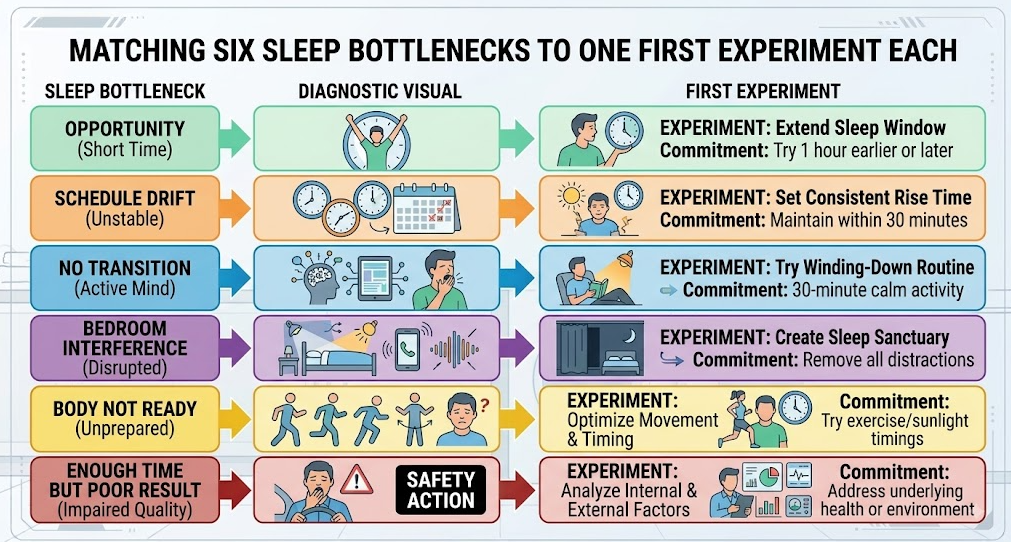
Review the last seven nights. Which statement best describes what went wrong most often?
| Main bottleneck | What it looks like | First lever to test |
|---|---|---|
| Not enough opportunity | The alarm arrives fewer hours after bedtime than your sleep target requires | Protect the sleep window before optimizing the room |
| Schedule drift | Bedtime and wake time move widely across workdays and days off | Stabilize a wake anchor or overlapping sleep block |
| No transition | Work, chores, gaming, conflict, or scrolling continues until lights-out | Add a short, repeatable closing sequence |
| Bedroom interference | Light, noise, heat, pets, alerts, or another person’s schedule wakes you | Solve the largest repeated disturbance |
| Body not ready | Late caffeine, nicotine, alcohol, a large meal, or vigorous activity appears connected | Change one timing variable, not everything consumed |
| Enough time but poor result | You allow adequate opportunity but remain unrefreshed or very sleepy | Keep a diary and move toward quality or clinical evaluation |
This table is not diagnostic. It prevents a common mismatch: buying a sleep mask when the real problem is a six-hour window, or banning a phone when pain is causing every awakening.
Lever 1: Build Around a Wake Anchor
For many people, wake time is more constrained than bedtime. Work, school drop-off, medication schedules, transit, or caregiving sets the morning. Use that fixed point to protect the sleep opportunity identified in the previous article.
NHLBI recommends going to bed and waking at the same time each day and keeping the difference between weeknights and weekends to about an hour when possible. Treat “when possible” seriously. The goal is not to make every day identical; it is to reduce unnecessary swings that repeatedly force the body between schedules.
Choose one of three anchors:
- Fixed wake anchor: appropriate when the morning start is stable most days.
- Wake range: a 30- to 60-minute window when family or work needs vary modestly.
- Overlapping sleep block: useful for night or rotating shifts, where the entire schedule cannot remain fixed but some sleep hours can recur across work and rest days.
If your bedtime target is much earlier than your current pattern, move it gradually. Going to bed before you are ready to sleep can create long periods of wakefulness and frustration. Keep the wake anchor reasonably stable while shifting the evening routine in manageable steps.
Do not sacrifice the total sleep opportunity just to achieve a beautiful schedule. Consistency is valuable, but a consistent six-hour window remains too short for most adults.
Lever 2: Create a Closing Sequence
A wind-down routine does not need candles, special tea, or an hour of meditation. Its job is to mark that decisions and stimulation are ending.
Choose three ordinary actions that already belong near bedtime:
- close the kitchen or finish the final household check;
- prepare tomorrow’s essential item or write down unfinished tasks; and
- complete washing, medication, reading, stretching, prayer, music, or another quiet cue.
Keep the order similar. A routine is easier to repeat when it is attached to an existing event—after the dishwasher starts, after the last dog walk, or when a reminder sounds—rather than dependent on suddenly feeling motivated.
NHLBI recommends using the hour before bed for quiet time and avoiding bright artificial light and intense exercise during that period. That does not require every reader to perform a silent 60-minute ritual. If you realistically have 15 minutes, use a dependable 15 minutes.
Protect the transition from tasks that expand without a natural end. “One more email,” an autoplaying episode, short-form video, or an unresolved household debate can consume the entire sleep window. Set an external stopping cue before you are tired enough to make poor decisions.
The detailed effect of screen light, content, alerts, and time displacement belongs to the later screen article. For now, ask only: Does this activity keep extending bedtime or keep my mind engaged after I intended to stop?
Lever 3: Fix the Largest Bedroom Disturbance
CDC describes quality sleep as uninterrupted and refreshing and recommends a quiet, relaxing, cool bedroom. “Cool” is relative to climate, bedding, health needs, housing, and personal comfort. The practical test is whether temperature repeatedly wakes you or makes it hard to settle.
Walk through the room at the time you actually sleep. Look for one repeated disturbance:
- exterior light, an illuminated clock, or morning sun;
- traffic, neighbours, household activity, or a partner’s schedule;
- notifications, vibration, or charging lights;
- overheating, cold, or bedding that traps too much heat;
- pets moving, scratching, or occupying the sleep space;
- a mattress, pillow, reflux position, pain, or mobility issue; or
- a safety need that makes darkness or earplugs inappropriate.
Choose the least complicated safe response. That may be an eye mask, curtains, a fan, moving the phone out of reach, changing notification settings, a door sweep, different bedding, or a household agreement about the final person entering the room.
Do not block sounds you must hear for a baby, a person receiving care, an alarm, a smoke or carbon-monoxide detector, or another safety system. Keep the route to the bathroom clear and use appropriate low-level lighting if darkness creates a fall risk.
Renters, people in shared housing, and those without temperature control may not be able to create an ideal room. Improvement still counts. Reduce the disturbance you control and record the constraint you cannot.
Lever 4: Use the Day to Support the Night
NHLBI recommends daily outdoor time when possible and regular physical activity. Daytime light and activity can support a stable sleep-wake pattern, but the useful amount and timing depend on the person, climate, disability, work schedule, and medical advice.
Attach daylight or movement to an existing part of the day:
- step outside after waking or during a break;
- take a brief walk after a meal;
- use active transport for part of a routine trip;
- perform chair-based or clinician-approved movement when walking is not suitable; or
- schedule exercise at a time you can repeat without cutting into sleep.
If vigorous late exercise leaves you alert, move it earlier or reduce intensity near bedtime. If evening exercise is the only kind you can maintain and it does not delay sleep, do not discard it solely because a generic checklist says “never exercise at night.” Track your own pattern while respecting clinical restrictions.
The same logic applies to morning light for conventional schedules. A night-shift worker trying to sleep after sunrise has a different light goal. Bright light can support alertness during part of a night shift, while reducing light and keeping the daytime bedroom dark may support sleep afterward. The timing should follow the work pattern, not a daytime worker’s morning routine.
Lever 5: Change One Evening Intake Variable
Do not respond to poor sleep by simultaneously eliminating coffee, tea, chocolate, alcohol, dinner, and every enjoyable evening habit. You will not know which change mattered, and the plan is unlikely to last.
Choose the factor most plausibly connected to the pattern:
- Caffeine or nicotine: both are stimulants and can interfere with sleep. Caffeine timing, amount, source, and individual sensitivity deserve their own article; for this test, move the last serving earlier without making an abrupt withdrawal plan.
- Alcohol: it may make a person feel sleepy, but NHLBI notes that it can produce lighter sleep and more waking during the night. Do not use alcohol as a sleep treatment.
- Large or heavy meals: if fullness, reflux, or discomfort appears near bedtime, move the meal earlier or change size while preserving adequate nutrition.
- Fluids: if bathroom trips repeatedly interrupt sleep, consider shifting more fluid earlier. Do not restrict fluids in a way that conflicts with heat, exercise, pregnancy, illness, or medical guidance.
- Medicines and supplements: record timing and symptoms, then ask a pharmacist or prescriber. Do not stop, move, split, or replace a prescribed medicine on your own.
The experiment should change one variable while the rest of the routine stays reasonably steady. That makes the result interpretable.
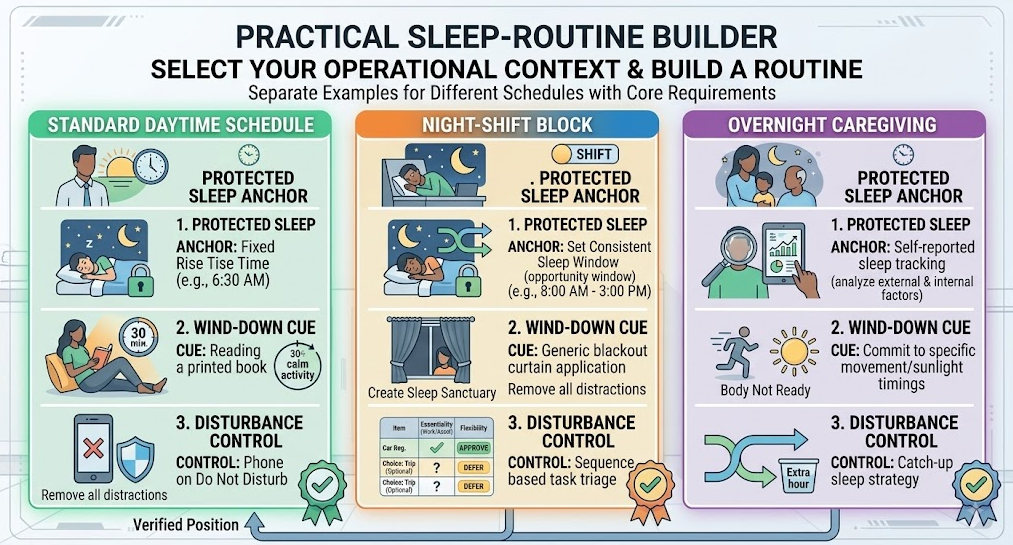
Adapt the System for Shift Work and Caregiving
A rotating roster or overnight responsibility changes what “consistent” can mean. It does not erase the need for sleep; it changes the design problem.
NIOSH warns that repeatedly switching between night work and a daytime schedule can create a continuing jet-lag-like pattern. Its training materials suggest a compromise schedule with some sleep hours overlapping across workdays and days off, while also warning against staying awake all day before or after a night shift because extended wakefulness increases short-term accident and injury risk.
For a night-shift block, practical priorities may be:
- go to the protected sleep space soon after essential post-shift tasks;
- keep some recurring core sleep hours across the block and days off when feasible;
- reduce light and noise during daytime sleep;
- coordinate household interruptions before the shift block begins; and
- avoid driving if too sleepy to do so safely.
Caregivers and parents may need a shared coverage plan rather than a prettier bedtime routine. Identify which awakenings truly require you, which tasks another person can cover, and whether a protected first or second sleep block is possible. If no adequate window exists, the problem is structural. Treating it as weak willpower hides the need for help, schedule changes, respite, or workplace accommodation.
Run a 10- to 14-Day Experiment
Write down:
- the primary lever you selected;
- the one supporting action;
- sleep opportunity and estimated sleep;
- number or rough duration of major awakenings;
- morning refreshment;
- daytime sleepiness;
- whether you followed the experiment; and
- unusual disruptions.
Review after 10 to 14 days:
- Clear improvement: keep the useful change and stop adding rules.
- Partial improvement: keep the primary lever and adjust one support.
- No improvement because the plan was not feasible: redesign the environment or responsibility, not your character.
- No improvement despite consistent opportunity and execution: investigate sleep quality, timing, health, medicines, or a sleep disorder.
- Worsening sleepiness or a safety concern: stop waiting for the experiment to finish and seek appropriate advice.
Do not optimize the diary itself. A one-minute record completed consistently is more useful than a complex tracker abandoned after three nights.
Know When Sleep Hygiene Has Reached Its Limit
Talk with a healthcare professional when sleep problems are regular, when you remain tired or sleepy after enough sleep opportunity, or when signs suggest a sleep disorder. CDC specifically identifies repeated waking and feeling tired after enough sleep as poor-quality signs.
Seek advice sooner for loud snoring with gasping or witnessed breathing pauses, unintended sleep, worsening mood symptoms, falls, or sleepiness affecting driving or hazardous work. Bring the diary and a list of medicines, supplements, work shifts, naps, alcohol, and caffeine.
Do not start an over-the-counter sleep aid or supplement simply because routine changes failed. NHLBI notes that some antihistamine sleep aids can be unsafe for some people and that melatonin has not been proven as an effective treatment for insomnia; supplements can also have risks and interactions.
Decision Summary
Practical sleep hygiene is not a contest to create a flawless evening. It is a controlled attempt to make sleep more likely.
- Protect enough sleep opportunity before polishing the routine.
- Match the first change to the actual bottleneck.
- Use a wake anchor, wake range, or overlapping core sleep block.
- Build a short closing sequence from actions you already perform.
- Fix the largest repeated bedroom disturbance without blocking safety signals.
- Change one intake or timing variable at a time.
- Adapt the system for shifts, caregiving, disability, housing, and climate.
- Keep what helps after 10 to 14 days; do not keep adding rules when adequate opportunity remains unrefreshing.
The best sleep routine is not the one that looks most disciplined. It is the smallest set of conditions that reliably protects your opportunity to sleep—and makes it obvious when the problem needs a different kind of help.
This article provides general health information, not individualized treatment. Do not change prescribed medicines or use alcohol, over-the-counter products, or supplements as sleep treatments without appropriate professional guidance. Persistent insomnia, excessive sleepiness, breathing-related symptoms, or safety concerns deserve clinical assessment.
FAQ
What is the most important sleep-hygiene habit?
First protect enough time for sleep. After that, the most useful habit is the one that corrects your largest repeated bottleneck—often schedule drift, no transition, bedroom interruption, or an evening substance or activity.
Do I need the same bedtime every night?
Not necessarily to the minute. A reasonably stable wake time or range is often more practical. Shift workers may need overlapping core sleep hours rather than one identical bedtime across every workday and day off.
How long should a wind-down routine be?
Long enough to create a repeatable transition, not so long that it removes sleep time. A dependable 10- to 20-minute sequence can be more useful than an elaborate hour-long routine that rarely happens.
Must the bedroom be completely dark and silent?
No. Reduce light, noise, and temperature disturbances that actually affect your sleep. Do not block alarms, smoke or carbon-monoxide detectors, a child, a person receiving care, or lighting needed to prevent falls.
Should I stop exercising at night?
Track your response. If vigorous late exercise delays sleep, move it earlier or reduce intensity. If evening activity is your only sustainable option and does not interfere, a universal ban may be unnecessary.
How long should I test a sleep-routine change?
Ten to 14 ordinary days is a practical window for seeing a pattern. Change one primary factor and one simple support, and record sleep opportunity, awakenings, refreshment, and daytime sleepiness.
What if good sleep hygiene does not work?
That does not prove you failed. Adequate opportunity with persistent insomnia, repeated awakenings, unrefreshing sleep, or excessive sleepiness may require assessment for timing, health, medication, or sleep-disorder factors and possibly structured treatment such as CBT-I.
Sources
- CDC – About Sleep
- NHLBI – Healthy Sleep Habits
- NHLBI – Insomnia Treatment
- CDC/NIOSH – Coping with Night and Evening Shifts: Sleep
- NHLBI – Sleep Diary
More in This Cluster: Sleep Foundations
- How Much Sleep Do Adults Need?
- Sleep Hygiene That Is Actually Practical (you are here)
- Why You May Wake Up Tired
- Caffeine Timing and Sleep
- Naps: When They Help and When They Disrupt Sleep
- How Phone Use Affects Bedtime
- When to Discuss Sleep Problems with a Clinician