It is 2:30 p.m., you are struggling to stay alert, and tonight’s sleep matters. Would a nap restore enough alertness to help—or make bedtime harder?
The answer is not that naps are always helpful or always disruptive. A nap is a tool with a job. Its effect depends on why you are sleepy, when you lie down, how long you sleep, how strongly you are sleep-deprived, and what you need to do immediately after waking.
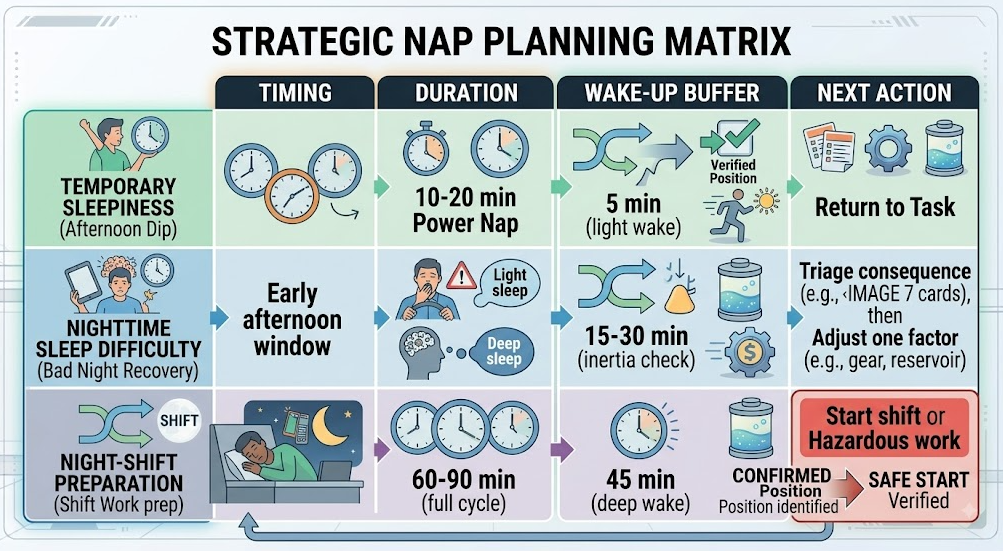
Quick decision: If you need a temporary alertness boost and normally sleep at night, choose an early-afternoon nap and set aside about 20 minutes for sleep, plus time to wake fully. If you already have trouble falling asleep or staying asleep, move the nap earlier, shorten it, or skip it while you test the effect. Use a different, planned strategy for night-shift work. A nap may reduce sleepiness temporarily, but it does not replace adequate sleep or explain repeated unintended dozing.

Give the Nap One Clear Job
Before setting an alarm, finish this sentence: “I am taking this nap so that…”
A useful answer is specific and temporary:
- I had one unusually short night and need to be more alert this afternoon.
- I am preparing for a scheduled night shift.
- I have a safe break and need a brief recovery before non-urgent work.
- I am ill or recovering and my body needs additional rest, within my care plan.
A less useful answer hides an unresolved pattern:
- I sleep too little every night and plan to make it up in fragments.
- I cannot stay awake during routine activities and do not know why.
- I nap late because I am exhausted, then cannot sleep at night.
- I need a nap before I can drive despite already fighting sleep.
NHLBI notes that daytime naps can improve alertness and performance in the short term, but they do not provide all the benefits of nighttime sleep and cannot truly make up for repeated sleep loss. That distinction sets the boundary: use a nap for a defined alertness need, not as proof that the underlying sleep problem is solved.
When a Nap Is More Likely to Help
For an adult on a conventional daytime schedule, a nap is more likely to be useful when it is:
- planned, rather than an accidental doze;
- early enough that it does not compete strongly with the main sleep period;
- brief enough to reduce the chance of waking from deeper sleep;
- followed by a buffer before driving, clinical work, machinery, or another safety-critical task; and
- occasional or purpose-specific, rather than the only way to function every day.
NHLBI advises adults to nap for no more than 20 minutes and, when nighttime sleep is difficult, to limit naps or take them earlier in the afternoon. Treat 20 minutes as a practical starting point, not a guarantee. Time spent lying down is not always time asleep, and a person with substantial sleep loss may enter deeper sleep more quickly.
An alarm helps define the experiment. Choose a quiet, dim place when possible. If you do not fall asleep, a brief period of rest may still feel restorative, but do not keep extending the session until it consumes the afternoon.
When a Nap Is More Likely to Disrupt Sleep
Sleepiness builds across waking time. A late or long nap can reduce some of that pressure shortly before the main sleep period. The result may be a later sleep onset, more time awake in bed, or a shifted schedule.
A nap deserves closer scrutiny when:
- it ends near your intended sleep time;
- it regularly lasts much longer than planned;
- you already struggle to fall asleep or stay asleep;
- it pushes dinner, movement, medication, or the wind-down routine later;
- you wake from it groggy and use more caffeine, which then reaches bedtime; or
- you sleep late after a poor night, nap late, and repeat the cycle.
People with insomnia are often advised to avoid naps, especially in the afternoon, as part of protecting nighttime sleep. That does not mean every person who naps has insomnia. It means that if difficulty sleeping at night is already the problem, a daytime nap is a variable worth testing deliberately rather than defending automatically.
Do not use an arbitrary clock rule without considering your schedule. “After 3 p.m.” has a different meaning for someone aiming to sleep at 9 p.m. than for someone beginning a night shift at 11 p.m. Anchor the decision to the intended main sleep period.
Duration Changes the Waking Experience
A nap is not only the sleep itself. The first minutes after waking matter.
NIOSH describes sleep inertia as the temporary grogginess and reduced performance that can follow sleep. Longer naps can reach deeper sleep, increasing the chance of difficult waking. Its training materials note that waking at about 20 minutes may reduce sleep inertia compared with waking after roughly an hour, while severe sleep deprivation can bring deeper sleep sooner and make even a short nap harder to wake from.
You may see advice to sleep for about 90 minutes to complete a “full cycle.” Treat that as context-specific, not a universal formula. Sleep cycles vary, actual sleep onset is uncertain, and an alarm cannot guarantee the stage from which you wake. A long nap also uses more daytime and may interfere more with nighttime sleep.
For most adults seeking a simple daytime alertness boost, start shorter. Longer planned sleep may have a role before or during night work, during illness or recovery, or under professional guidance, but it is a different decision from a routine afternoon nap.
Protect a Wake-Up Buffer
Do not schedule the alarm for the exact moment you must perform at full capacity. NIOSH notes that sleep inertia often dissipates within 15 to 30 minutes after a short nap, but timing and severity vary. The practical lesson is to reserve a transition period.
After waking:
- Sit up and orient yourself before standing.
- Use light and ordinary movement to help re-establish alertness.
- Reassess whether you are actually ready for the next task.
- Delay driving or hazardous work if you remain foggy, slow, or unable to focus.
A nap does not create a safety certificate. If you are already struggling to stay awake while driving, pull over or stop in a safe place. Do not continue to a preferred nap location. If sleepiness remains after resting, do not resume the hazardous activity merely because the alarm has sounded.
Night-Shift Naps Need a Separate Plan
For night workers, a daytime nap may not be an optional extra; it can be part of a fatigue-management plan. NIOSH cites evidence that planned naps before a night shift can improve alertness during the shift and that brief naps during scheduled breaks may also help. These findings come from shift-work settings and should not be converted into a general recommendation for long afternoon naps.
Build a shift-specific plan around four questions:
- When is the main sleep period? A pre-shift nap supplements it; it should not quietly replace it.
- Is napping permitted and protected? Follow workplace policy and use an appropriate safe space.
- What happens immediately after waking? Allow time for sleep inertia before safety-critical duties.
- How will the trip home be handled? A workplace nap does not guarantee safe driving after the shift.
NIOSH describes studies using pre-shift naps of 1.5 to 3 hours and brief workplace naps, but the durations and conditions varied. Those are research examples, not a single prescription. Shift timing, commute, workplace rules, health conditions, caregiving duties, and the ability to obtain a main sleep period all change the plan.
If rotating shifts repeatedly prevent adequate sleep, the schedule itself is part of the problem. A carefully timed nap may reduce fatigue for one shift; it cannot make chronic circadian disruption or insufficient sleep harmless.
Do Not Let a Rescue Nap Become the Routine
An occasional rescue nap after an unusually short night is different from needing one every day despite allowing enough time for sleep.
Watch for this loop:
- insufficient or disrupted nighttime sleep;
- strong afternoon sleepiness;
- a long or late nap;
- reduced sleep pressure at bedtime;
- later or more fragmented sleep; and
- another need to nap the next day.
The way out is not necessarily to ban naps immediately. First identify which part of the loop you can test safely. A shorter and earlier nap may preserve function while you rebuild the main sleep opportunity. If the nap is not necessary for safety, skipping it for several days may show whether bedtime improves. If daytime sleepiness becomes unsafe, stop the activity and address the sleep deficit rather than forcing wakefulness.
Repeated need for naps can also reflect fragmented sleep, a timing mismatch, medicine or substance effects, a sleep disorder, or another health issue. The nap may be revealing the problem rather than causing it.
Run a Seven-Day Nap Test
Do not compare one unusually good day with one unusually bad night. Use a short record to see the direction of the pattern.
For seven days, note:
- main sleep start and end times;
- estimated time asleep and major awakenings;
- why you considered a nap;
- when the nap began and ended;
- estimated time actually asleep;
- alertness before the nap, 30 minutes after, and later in the day;
- grogginess after waking;
- intended bedtime and estimated time to fall asleep;
- caffeine after the nap; and
- any unintended dozing or safety concern.
Change only one main variable. For example, keep the nap brief and move it earlier, or keep the timing stable and shorten it. Do not simultaneously change caffeine, bedtime, exercise, meal timing, and the nap unless safety requires it.
At the end, ask:
- Did the nap improve the period for which it was intended?
- Did I recover before the next important task?
- Did nighttime sleep begin later or feel more fragmented?
- Did I need the nap because of a temporary event or an ongoing pattern?
- Was I choosing the nap, or was sleep happening unintentionally?
Know When Sleepiness Is the Main Issue
Planned napping is a self-management choice. Falling asleep unintentionally is different.
Arrange a clinical discussion when you repeatedly doze without intending to, need frequent naps despite adequate sleep opportunity, remain unrefreshed, or have loud snoring, gasping, breathing pauses, unusual nighttime movements, or a medicine-related change in alertness. Bring the seven-day record, your usual schedule, medicines and supplements, and observations from a bed partner when available.
Seek prompt help when sleepiness creates immediate danger. Stop driving, operating equipment, working at height, supervising a hazardous process, or doing another task in which a lapse could cause harm. A short nap can be one part of an immediate fatigue response, but it must not delay safe stopping or evaluation of repeated dangerous sleepiness.
Decision Summary
A useful nap has a purpose, a boundary, and a recovery period.
- For a conventional schedule, start with an early-afternoon nap of about 20 minutes.
- Allow time after waking before demanding or safety-critical work.
- If nighttime sleep is difficult, test an earlier, shorter, or omitted nap.
- Do not assume a 90-minute cycle is exact or appropriate for everyone.
- Use a separate, planned approach for night-shift naps.
- Treat naps as temporary alertness support, not repayment for chronic sleep debt.
- Track the effect on both daytime function and the next main sleep period.
- Discuss repeated unintended sleep or persistent need for naps with a clinician.
The right question is not “Are naps healthy?” It is “What job is this nap doing, and what does it cost the next sleep period?”
This article provides general health information, not an individualized sleep plan or diagnosis. Nap timing and duration may need adjustment for shift work, insomnia, pregnancy, illness, medicines, disability, caregiving, or other circumstances. Stop safety-critical activity when sleepy and seek professional advice for persistent or unintended sleep.
FAQ
How long should an adult nap?
For a simple daytime alertness boost, NHLBI advises adults to nap for no more than 20 minutes. Allow additional time after waking because sleep inertia can temporarily reduce alertness.
What is the best time to nap?
For most daytime schedules, early afternoon is a practical starting point. If the nap makes it harder to sleep at night, move it earlier, shorten it, or test going without it. Shift workers need a schedule-specific plan.
Will a 20-minute nap ruin nighttime sleep?
Not necessarily. A short, early nap is less likely to compete with nighttime sleep than a long, late one, but individual response varies. Track sleep onset and nighttime awakenings rather than assuming.
Why do I feel worse after a nap?
You may be experiencing sleep inertia, especially if you woke from deeper sleep or were very sleep-deprived. Leave a recovery buffer and avoid driving or hazardous work until alertness has returned.
Is a 90-minute nap better than a short nap?
Not universally. Sleep cycles and sleep-onset time vary, so 90 minutes does not guarantee an easy awakening. A longer nap may also interfere more with the next sleep period.
Can naps make up for lost sleep?
They can provide a short-term alertness boost, but NHLBI says they do not supply all the benefits of nighttime sleep. Repeated sleep loss requires protection of the main sleep opportunity and, when needed, professional review.
When should daytime napping concern me?
Discuss it with a clinician if naps are frequent and necessary despite adequate sleep opportunity, if you fall asleep unintentionally, or if sleepiness affects driving, work, or daily function. Stop any unsafe activity immediately when you cannot stay alert.
Sources
- NHLBI – How Much Sleep Is Enough?
- NHLBI – Healthy Sleep Habits
- NHLBI – Insomnia Treatment
- CDC/NIOSH – Nap Duration; Sleep Inertia
- CDC/NIOSH – Napping Before Night Shift; Naps at Work
More in This Cluster: Sleep Foundations
- How Much Sleep Do Adults Need?
- Sleep Hygiene That Is Actually Practical
- Why You May Wake Up Tired
- Caffeine Timing and Sleep
- Naps: When They Help and When They Disrupt Sleep (you are here)
- How Phone Use Affects Bedtime
- When to Discuss Sleep Problems with a Clinician